ROI Case File No.329 | 'ChronoAnalytics' Disappearing Time'
📅 2025-11-20 23:00
🕒 Reading time: 8 min
🏷️ RCD

- Chapter 1: Meeting as Erosion—15 Hours of 40 Weekly Hours Disappear
- Chapter 2: Invisible Time—Can't Improve Without Records
- Chapter 3: Record as Mirror—Visualizing All Time in 4 Weeks
- Chapter 4: Time as Asset—Productivity Improvement After 6 Months
- Chapter 5: The Detective's Diagnosis—Records Liberate Time
- Related Files
Chapter 1: Meeting as Erosion—15 Hours of 40 Weekly Hours Disappear
The week after the Mandala Tech MANDALA Chart case was solved, a consultation arrived from Tokyo regarding time management at a business consulting company. Episode 329 of Volume 27, "The Pursuit of Reproducibility," tells the story of visualizing disappearing time and transforming it into meaningful time.
"Detective, our employees work 40 hours weekly. However, 15 of those hours disappear into meetings. That's 37.5% of the week. And the same agenda items repeat, decided matters don't execute. Time is consumed, yet no results emerge."
Seiichi Tokita, Operations Improvement Director at ChronoAnalytics, a Chiyoda native, visited 221B Baker Street with an utterly exhausted expression. In his hands were employee weekly schedules and, in stark contrast, an analysis report marked "meeting time overlap."
"We conduct business efficiency consulting for companies in Tokyo. Founded 10 years ago. We analyze client company business processes and propose improvements—that's our business. However, embarrassingly, our own business efficiency is the worst."
ChronoAnalytics' Time Waste Problem: - Established: 2015 (business efficiency consulting) - Annual revenue: ¥920M - Staff: 52 (Consultants 38, Sales 8, Management 6) - Weekly work hours: Average 40 hours/person - Weekly meeting hours: Average 15 hours/person (37.5%) - Meeting types: 8 regular meetings, irregular project meetings - Problem: Same agenda repeats, priorities not shared, decided matters not executed
Deep anguish over self-contradiction filled Tokita's voice.
"The problem is meetings have become 'reporting venues.' Each department reports 'this is what we did this week.' But hearing that, nothing gets decided. It ends with 'please continue next week.' And next week, the same agenda emerges."
Typical Meeting Repetition:
Week 1 All-Hands Meeting (Monday 9 AM, 2 hours):
Tokita: "Let's confirm this week's key issues. Sales department, what's the progress?"
Sales Director: "Contract negotiation with Company A is progressing. Meeting with their decision-maker scheduled."
Tokita: "Understood. Then please continue next week."
Consulting Director: "Trouble occurred in Company B project. Deadline may be delayed."
Tokita: "What's the cause?"
Consulting Director: "Requirements definition was ambiguous."
Tokita: "Then please reconfirm requirements. Report next week."
2 hours later, meeting ends. No decisions made
Week 2 All-Hands Meeting (Monday 9 AM, 2 hours):
Tokita: "Continuing from last week. Sales department, what happened with Company A negotiation?"
Sales Director: "Their decision-maker was absent, couldn't meet. This week, will reschedule."
Tokita: "Understood. Then report again next week."
Consulting Director: "Company B project still confirming requirements."
Tokita: "Progress is slow. Please finish confirmation by next week."
Same agenda repeats
Week 3 All-Hands Meeting (Monday 9 AM, 2 hours):
Tokita: "Company A negotiation?"
Sales Director: "This week for sure can meet."
Tokita: "...Understood."
After 3 weeks, nothing has progressed
Tokita sighed deeply.
"At meetings I just say 'please report' and 'please continue next week.' Nothing gets decided. And employees are exhausted thinking 'same discussion again?' Can't see meaning in using time."
Chapter 2: Invisible Time—Can't Improve Without Records
"Mr. Tokita, how are meeting minutes currently managed?"
To my question, Tokita answered.
"We take minutes for each meeting. However, formats vary. Agenda, participants, decisions... content differs by writer. And we never review minutes. Write and done."
Current Approach (Record Neglect Type): - Record: Create minutes but format inconsistent - Check: Never review minutes - Do: Decisions ambiguous, not executed
I explained the importance of time redesign.
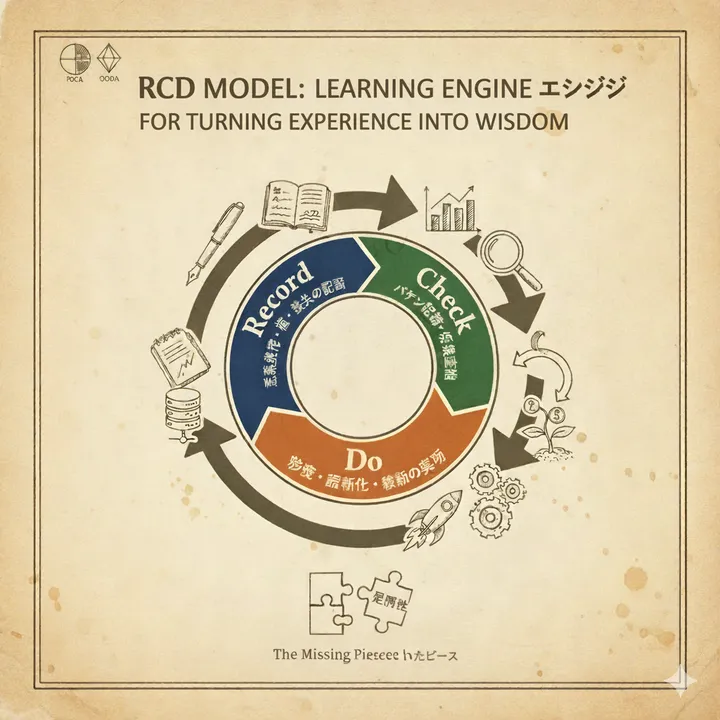
"To change how time is used, first record, then check, finally do. RCD Model—Record, Check, Do. This sequence transforms meetings into value."
⬜️ ChatGPT | Concept Catalyst
"Don't increase meetings. Design time. Create meaningful time with RCD."
🟧 Claude | Story Alchemist
"Increase not used time, but meaningful time. Records visualize time."
🟦 Gemini | Compass of Reason
"RCD is time reconstruction technology. Maximize meeting value with Record-Check-Do sequence."
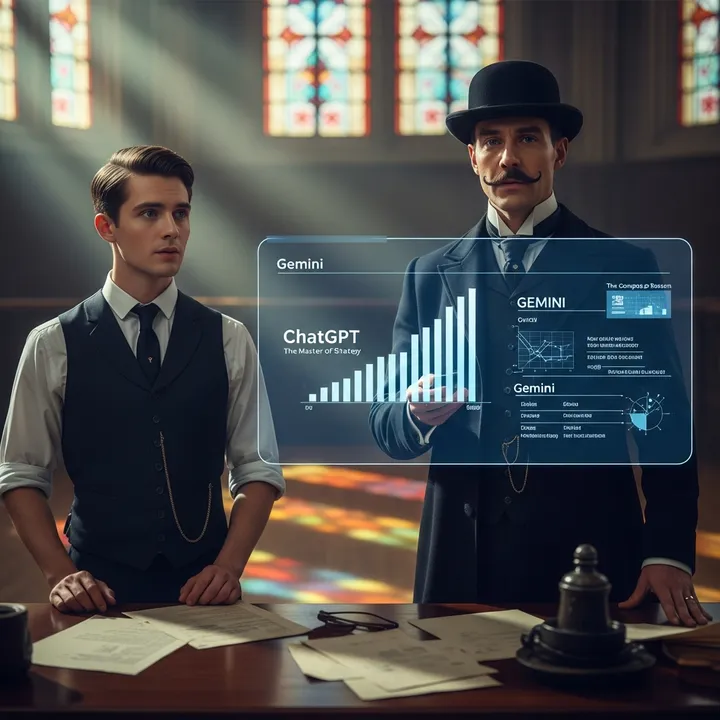
The three members began analysis. Gemini deployed the "RCD Model Framework" on the whiteboard.
RCD Model's 3 Steps: 1. Record: Visualize all meetings, log agenda/results/time 2. Check: Analyze records, discover overlaps/waste 3. Do: Reduce unnecessary meetings, document decisions
"Mr. Tokita, let's redesign ChronoAnalytics' time with RCD Model."
Chapter 3: Record as Mirror—Visualizing All Time in 4 Weeks
Phase 1: Record (4 weeks)
For 4 weeks, recorded all meetings.
Recording Format:
【Meeting Name】All-Hands Meeting
【Date/Time】2025-11-04 Monday 9:00-11:00 (2 hours)
【Participants】12 people
【Agenda】
1. Sales department progress report
2. Consulting department issue report
【Decisions】None
【Next Actions】Continue next week
4 Weeks Total Records: - Total meetings: 148 times - Total time: 312 hours - Average per person: 15 hours/week
Phase 2: Check (1 week)
Analyzed 4 weeks of data.
Discovery 1: Agenda Overlap Rate 42% - Same agenda appeared 3+ times: 28 agendas - Example: "Company A contract negotiation" appeared 4 times - Reason: No progress, only reporting
Discovery 2: Decision Execution Rate 40% - Total decisions in 4 weeks: 87 - Actually executed: 35 (40%) - Not executed: 52 (60%) - Reason: Decisions ambiguous, responsibility unclear
Discovery 3: Unnecessary Participants 32% - Average meeting participants: 8.5 people - People actually needing attendance: 5.8 people - Unnecessary participants: 2.7 people (32%) - Time waste: 84 hours/week company-wide
Phase 3: Do (2 months)
Based on Check analysis, implemented improvements.
Improvement 1: Meeting Consolidation and Frequency Reduction
Before: - All-Hands Meeting: Weekly 2 hours - Department meeting: Weekly 1.5 hours - Project meeting: 3 times weekly 1 hour each
After: - All-Hands Meeting: Monthly 1.5 hours (for decisions only) - Department meeting: Biweekly 1 hour - Project meeting: Weekly 30 minutes (stand-up format) - Weekly report: Written report via email (no meeting)
Effect: - Weekly meeting time per person: 15 hours → 6 hours (60% reduction)
Improvement 2: "No Meeting Wednesday" Introduction
Concept: - Every Wednesday, no meetings scheduled - Time for focused work
Effect: - Deep work time: Average 2 hours/week → 8 hours/week (+300%) - Project completion count: Monthly average 18 → monthly average 28 (+56%)
Improvement 3: Participant Optimization
Before: - "Everyone attend" meetings - Many unrelated participants
After: - Core members only (decision-makers) - Others receive meeting minutes afterward - Join only when their input needed
Effect: - Average participants: 8.5 people → 4.2 people (51% reduction)
Improvement 4: Decision Documentation
Before: - Decisions conveyed only verbally - "What was decided" ambiguous
After:
- All decisions recorded in "Decision Log"
- Format:
【Decision】Complete Company A contract negotiation within this month
  【Reason】To achieve Q4 revenue target
  【Owner】Sales Director
  【Deadline】2025-11-30
  【Next Check】Check progress in weekly report 2025-11-25
Effect: - Decision execution rate: 40% → 85% (+113%)
Chapter 4: Time as Asset—Productivity Improvement After 6 Months
Results After 6 Months:
Dramatic Meeting Time Reduction: - Weekly average meeting time per person: 15 hours → 6 hours (60% reduction) - Reduction: 9 hours/week/person × 52 people = 468 hours/week - Monthly reduction: 1,872 hours (equivalent to 78 days of work)
Meeting Quality Improvement: - Agenda duplication rate: 42% → 8% (81% reduction) - Decision execution rate: 40% → 85% (+113%) - Meeting productivity (decisions per hour): 0.25 → 2 (+700%)
Productivity Improvement: - Projects completed: Monthly average 18 → monthly average 28 (+56%) - Overtime hours: Monthly average 32 hours → monthly average 18 hours (44% reduction) - Employee satisfaction: 3.1/5 → 4.4/5
Financial Results: - Annual revenue: ¥920M → ¥1.18B (+28%) - Investment: Meeting management system ¥1.8M - Investment recovery period: 1.2 months
Tokita's Summary:
"Before introducing RCD Model, we recognized 'too many meetings,' but didn't know how much waste existed.
Record (recording) visualizing all 4 weeks of meetings revealed shocking facts. 42% agenda duplication, 60% decisions unexecuted...
Check (checking) data analysis clarified which meetings to reduce, which to improve.
Do (doing) reducing unnecessary meetings and documenting decisions cut meeting time 60% and more than doubled decision execution rate.
Time redesign isn't simply reducing meetings. Record, check, do. This cycle transforms time into assets."
Employee Voices:
Consultant A: "Previously, nearly half my week was filled with meetings. Couldn't get time for document creation or customer response, always working overtime. Now, with 'No Meeting Wednesday' I can work focused. Overtime also decreased."
Sales Director B: "Previous all-hands meetings just had each department report in turn. Even sitting 2 hours, most discussion unrelated to me. Now, share information via weekly reports, discuss only matters truly requiring decisions monthly. How time is used changed dramatically."
Client Deployment:
ChronoAnalytics began proposing RCD Model proven in-house to client companies.
A Manufacturing Client: "We want to implement your RCD Model. We also have too many meetings."
Tokita: "First, record all meetings for 4 weeks. We'll analyze that data and provide improvement proposals."
After 3 months, that client: - Meeting time: Weekly average 20 hours → weekly average 8 hours (60% reduction) - Productivity: +42% - Employee satisfaction: 2.9/5 → 4.1/5
ChronoAnalytics' revenue further expanded through such client results.
Chapter 5: The Detective's Diagnosis—Records Liberate Time
That night, I reflected on the essence of RCD Model.
ChronoAnalytics noticed too many meetings. However, how much waste existed wasn't visible.
Recording, checking, and doing with RCD Model visualized time. Agenda duplication, unexecuted decisions, unnecessary participants... all became clear in numbers.
"Time redesign is productivity reconstruction. Record-Check-Do transforms meetings into value."
The next case will also depict the moment when time transforms into assets.
"Don't increase meetings, design time. Visualize with Record, analyze with Check, reduce with Do. RCD transforms disappearing time into meaningful time."—From the detective's notes
Related Files
🎖️ Top 3 Weekly Ranking of Case Files
'QuantumGrocers' Lost Customer Data'

AeroSpray's Vanishing Sales Force'
'GlobalSoft's Drowning Inquiry Response'