ROI Case File No.338 | 'The Invisible Constraints of GlobalTech'
📅 2025-11-29 23:00
🕒 Reading time: 10 min
🏷️ PEST

- Chapter 1: The 3-Year Futility — System Not Found
- Chapter 2: The Maze of Requirements — What's Truly Necessary?
- Chapter 3: The Discovery of Regulations — Overlooked Constraints
- Chapter 4: The Discovery of Reselection — Food-Specialized System
- Chapter 5: The Value of Regulatory Compliance — Results After 12 Months
- Chapter 6: Detective's Diagnosis — Look Not at Internal but External
- Related Files
Chapter 1: The 3-Year Futility — System Not Found
The week after the Quantum Dynamics hybrid CAD operation case was solved, a consultation about production management system selection arrived. Volume 27, "The Pursuit of Reproducibility," Episode 338 tells the story of visualizing invisible constraints.
"Detective, we've been searching for a production management system for three years. We consulted over 15 vendors. However, we can't find a system that fits us. Why?"
Makoto Yamamoto, Production Management Director of GlobalTech, originally from Shizuoka, visited 221B Baker Street with an exhausted expression. In his hands, he held 15 vendors' system proposals alongside contrasting evaluation sheets marked "Compatibility: Impossible."
"We operate food manufacturing. We do both in-house product manufacturing and OEM contract manufacturing. Annual revenue is 1.8 billion yen. Eighty-five employees. In 2020, we implemented the sales management system 'Sales Cost Pro.' However, this system has no production management functions."
GlobalTech's Production Structure: - Established: 1995 (food manufacturing) - Annual revenue: 1.8 billion yen - Employees: 85 - Manufacturing items: In-house products (45%), OEM contracts (55%) - Current system: "Sales Cost Pro" (sales management only) - Problem: Production planning, lot management, expiration date management done in Excel
Yamamoto's voice carried deep frustration.
"We're satisfied with the sales management system. Orders, shipments, billing, inventory management. These function without problems. However, we can't manage production planning. So we manage separately in Excel. This takes 5 hours weekly."
Typical Operational Problems:
Problem 1: Production Planning Management (Excel) - Create production plans weekly - Consider both in-house products and OEM - Check raw material inventory, plan orders - Work time: 5 hours/week (responsible: Yamamoto)
Problem 2: Lot Management (Paper-based) - Record manufacturing date, raw material lot, expiration date for each manufacturing lot - Handwrite in paper ledger - If quality problems occur, track applicable lots - Work time: 2 hours/day
Problem 3: Expiration Date Management (Excel) - Manage inventory expiration dates in Excel - Prioritize shipment of products near expiration - However, not linked to sales management system, so double entry - Work time: 1 hour/day
Problem 4: Inventory Work (Paper → Manual Entry) - Conduct monthly inventory - Record inventory numbers on paper - Later, manually input to sales management system - Double work occurs - Work time: 8 hours/month
Yamamoto sighed deeply.
"We've been searching for systems with production management functions since three years ago. Consulted over 15 vendors. However, every system is told 'partially fits but doesn't fit completely.'
One system can manage production planning but not lot management. Another can do lot management but doesn't support both in-house products and OEM. Yet another has all features but costs 30 million yen, over budget.
What are we overlooking?"
Chapter 2: The Maze of Requirements — What's Truly Necessary?
"Yamamoto-san, what criteria do you use when selecting systems?"
To my question, Yamamoto spread out materials.
"Our requirements list. Thirty items. Production planning, lot management, expiration date management, inventory, raw material management... We're searching for systems that meet all of these."
Current Understanding (Requirements Coverage Model): - Recognition: Search for systems meeting all 30 requirements - Problem: Not considering external environment (regulations, market, technology)
I explained the importance of analyzing external environment and discovering overlooked constraints.
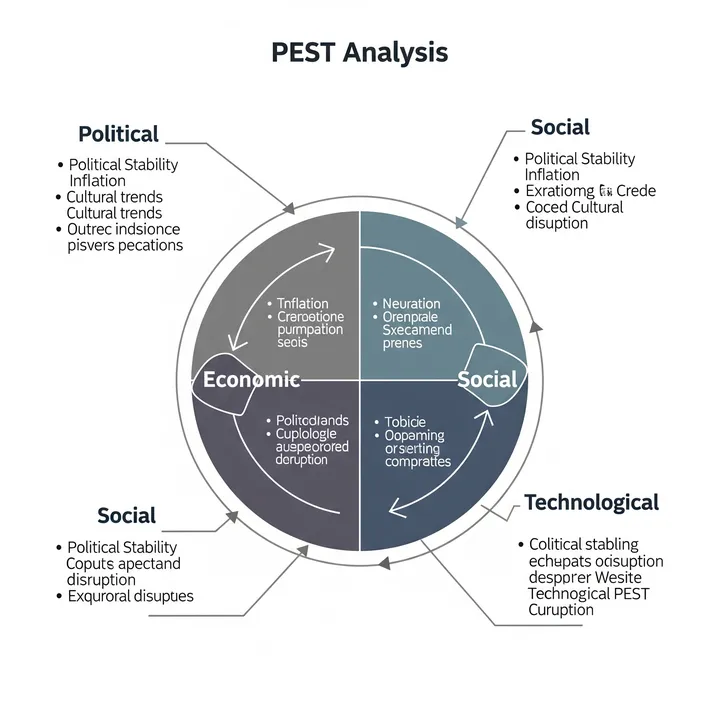
"The problem isn't the requirements list. It's the external environment. PEST analysis — Political, Economic, Social, Technological. Politics (regulations), economy, society, technology. Analyzing external environment from these four perspectives reveals overlooked constraints."
⬜️ ChatGPT | Catalyst of Concepts
"Don't look at requirements. Look at environment. Visualize external constraints with PEST."
🟧 Claude | Story Alchemist
"Invisible constraints always exist in 'regulations.' Check that wall first."
🟦 Gemini | Compass of Reason
"PEST is environmental analysis technology. See through external constraints with four aspects: political, economic, social, technological."
The three members began analysis. Gemini displayed the "PEST Framework" on the whiteboard.
PEST's 4 Elements: 1. Political: Regulations, government policies 2. Economic: Economic conditions, costs 3. Social: Social trends, employee acceptance 4. Technological: Technological evolution, compatibility
"Yamamoto-san, let's analyze from 'Political' first. What regulations exist in food manufacturing?"
Chapter 3: The Discovery of Regulations — Overlooked Constraints
Phase 1: PEST Analysis — 2 weeks
Political: Regulations
Identified regulations related to food manufacturing.
Regulation 1: Food Sanitation Act - Obligation to retain manufacturing records - Record manufacturing date, raw material lot, manufacturing lot, workers - Retention period: Expiration date + 1 year
Regulation 2: Food Labeling Act - Obligation to display expiration date, raw materials, manufacturing facility code - Misrepresentation subject to penalties
Regulation 3: Traceability (voluntary but recommended) - Make traceable from raw material suppliers to product shipment destinations - For rapid response when quality problems occur
Discovery: - Yamamoto: "Of course I know these regulations. We currently handle them with paper and Excel" - Me: "Then, did you communicate these regulatory requirements to system vendors?" - Yamamoto: "...No, we didn't. We assumed systems naturally handled them"
Important Discovery: - Many system vendors don't understand food manufacturing-specific regulations - General manufacturing systems don't support Food Sanitation Act or traceability
Economic: Costs
Organized budget allocatable for system implementation.
Budget Limit: - Initial implementation cost: 8 million yen - Annual maintenance: Within 1 million yen
Currently Reducible Costs: - Labor costs for Excel/paper-based work: - Production planning: 5 hours/week × 52 weeks = 260 hours/year - Lot management: 2 hours/day × 240 days = 480 hours/year - Expiration date management: 1 hour/day × 240 days = 240 hours/year - Inventory: 8 hours/month × 12 months = 96 hours/year - Total: 1,076 hours/year × 3,000 yen (hourly rate) = 3.23 million yen/year
ROI Target: - Implementation cost 8 million yen ÷ annual reduction 3.23 million yen = 2.5-year investment recovery - Acceptable range: Within 3 years
Social: Employee Acceptance
Surveyed employee attitudes toward system implementation.
Manufacturing Site Voices (interviewed 10 people):
Site Leader A: "We've used paper ledgers for over 30 years. We're used to them. Honestly, learning new systems is troublesome."
Worker B: "Can't even use Excel. Not good with computers. Paper and pen are best."
Quality Control Staff C: "Traceability is important. But we can handle it with current paper-based system. Don't feel need to systematize."
Discovery: - Site is reluctant to change - System implementation needs sufficient education and support - Intuitive UI (user interface) essential
Technological: Technological Evolution and Compatibility
Investigated integration possibility with current system "Sales Cost Pro."
Sales Cost Pro Specifications: - API integration: Supported (some functions) - Can acquire inventory data, order data via API - Integration with production management system eliminates double entry
Cloud vs On-Premise: - Site has unstable internet connection - Cloud systems halt work when connection drops - On-premise (in-house server) preferable
Tablet Support: - Tablet input ideal at manufacturing site - For smooth transition from paper
PEST Analysis Integration:
Overlooked Constraints:
- Political: Food Sanitation Act/traceability support essential
- Economic: Budget limit 8 million yen, investment recovery within 3 years
- Social: Low site acceptance. Intuitive UI essential
- Technological: API integration with Sales Cost Pro, on-premise, tablet support
Chapter 4: The Discovery of Reselection — Food-Specialized System
Phase 2: Reselection Based on PEST Analysis — 4 weeks
Consulted system vendors again based on PEST analysis results.
New Requirements List (PEST Integrated Version):
Political: - Food Sanitation Act compliance (manufacturing record retention) - Traceability function (raw materials → product tracking)
Economic: - Initial implementation: Within 8 million yen - Annual maintenance: Within 1 million yen
Social: - Intuitive UI (tablet support) - Site education support available
Technological: - API integration with Sales Cost Pro - On-premise support
Reselection Results:
Vendor G: Food Manufacturing Specialized Production Management System
Product: - Food Sanitation Act compliant (automatic manufacturing record retention, expiration date management) - Traceability function (tracking from raw material lots to product lots) - Supports both in-house products and OEM - Tablet support (manufacturing site input)
Price: - Initial implementation: 7.5 million yen - Annual maintenance: 900,000 yen
Place: - On-premise support - API integration with Sales Cost Pro possible
Promotion: - Site education support (3 days) - 3-month follow-up after implementation
Evaluation: - Meets all PEST analysis requirements - Specialized for food manufacturing, incorporates industry know-how
Phase 3: Implementation — 6 months
Implementation Flow:
Months 1-2: System Setup - API integration with Sales Cost Pro - Register product master, raw material master - Configuration according to manufacturing lines
Month 3: Site Education - Train manufacturing site leaders and workers on tablet operation (3 days) - Emphasize "can use with same feeling as paper"
Months 4-6: Parallel Operation - Parallel operation of paper-based and system - Keep paper until site becomes familiar - Gradually transition to system
Chapter 5: The Value of Regulatory Compliance — Results After 12 Months
Results After 12 Months:
Work Time Reduction:
Production Planning: - Before: Excel manual work, 5 hours/week - After: System automatic creation, 30 minutes/week - Reduction: 4.5 hours/week × 52 weeks = 234 hours/year
Lot Management: - Before: Paper ledger, 2 hours/day - After: System automatic recording, 10 minutes/day - Reduction: 1.83 hours/day × 240 days = 439 hours/year
Expiration Date Management: - Before: Excel manual work, 1 hour/day - After: System automatic management, 5 minutes/day - Reduction: 0.92 hours/day × 240 days = 221 hours/year
Inventory: - Before: Paper → manual entry, 8 hours/month - After: Tablet input, 2 hours/month - Reduction: 6 hours/month × 12 months = 72 hours/year
Total Reduction: 966 hours/year
Monetary Effect: - 966 hours × 3,000 yen (hourly rate) = 2.9 million yen/year
Investment Recovery: - Implementation cost: 7.5 million yen - Annual reduction effect: 2.9 million yen - Investment recovery period: 2.6 years
Strengthened Regulatory Compliance:
Food Sanitation Act: - Manufacturing records automatically retained, audit response easy - Before: Manually search paper ledgers (half day during audits) - After: Instant system search (5 minutes)
Traceability: - When quality problems occur, instantly identify applicable lots - Before: Check paper ledgers one by one (half day to 1 day) - After: Identify in 5 minutes with system
Actual Case: - 8 months after implementation, raw material defect discovered - System identified product lots using applicable raw materials in 5 minutes - Rapid recall response, minimized damage - Before: Would take 1 day with paper ledgers, response could be delayed
Site Changes:
Manufacturing Site Leader A: "Initially thought 'paper is sufficient.' But tablet input was easier than expected. Just follow screen, input manufacturing date, lot number, raw materials. Same feeling as writing on paper. And searching later became easier. With paper, forget where wrote, but with system can search."
Quality Control Staff C: "Strengthened traceability made emergency response faster. In 8-month raw material defect case, identified applicable product lots in 5 minutes. This was impossible with paper-based system."
Yamamoto's Feedback:
"Until conducting PEST analysis, we only focused on '30-item requirements list.' Only asked system vendors 'do you have this feature?' 'do you have that feature?'
However, by analyzing external environment, we saw overlooked constraints. Political (regulations) made us realize Food Sanitation Act and traceability support essential. Social revealed low site acceptance, need for intuitive UI. Technological made us understand on-premise and tablet support important.
And we found a food manufacturing specialized system. System we couldn't find searching for 3 years was found 2 weeks after PEST analysis. Achieved 2.9 million yen annual reduction and strengthened regulatory compliance.
Invisible constraints existed in external environment."
Chapter 6: Detective's Diagnosis — Look Not at Internal but External
That evening, I contemplated the importance of external environment analysis.
GlobalTech only focused on internal perspective called "30-item requirements list." However, true constraints existed in external environment — regulations, economy, society, technology.
By visualizing external environment with PEST analysis, constraints like Food Sanitation Act, traceability, site acceptance, on-premise support became visible. And optimal solution of food manufacturing specialized system was found.
"Don't look at internal. Look at external. Analyze political, economic, social, technological with PEST. Invisible constraints exist in external environment."
The next case will also depict the moment of analyzing external environment.
"Political, Economic, Social, Technological. Analyze external environment with these four. Invisible constraints exist in regulations and society. Look not at internal requirements list but at external environment." — From the Detective's Notes
Related Files
🎖️ Top 3 Weekly Ranking of Classified Case Files
What is MVP
What is Agile Development
What is STP Analysis