ROI Case File No.340 | 'The Invisible Working Hours of Eagle Dynamics'
📅 2025-12-01 23:00
🕒 Reading time: 11 min
🏷️ DESC

- Chapter 1: The Anachronism of Time Cards — Still Recording on Paper in 2025
- Chapter 2: The Failure of System Proposals — Why Implementation Doesn't Progress
- Chapter 3: Organization Through Description — Visualizing Current Problems
- Chapter 4: Success Through Proposals — Moving Management and Site
- Chapter 5: The Value of Visualization — Results After 12 Months
- Chapter 6: Detective's Diagnosis — Communication Style Moves Organizations
- Related Files
Chapter 1: The Anachronism of Time Cards — Still Recording on Paper in 2025
The week after the TechWave staged automation case was solved, a consultation about attendance management digitization arrived. Volume 27, "The Pursuit of Reproducibility," Episode 340 tells the story of Describing, Expressing, Specifying, and showing Consequences.
"Detective, our attendance management uses time cards. It's 2025. Can you believe it? And verification work during payroll calculation takes 25 hours monthly."
Misaki Kobayashi, HR Director of Eagle Dynamics, originally from Nagoya, visited 221B Baker Street with an exhausted expression. In her hands, she held bundles of time cards alongside contrasting analysis documents marked "Working Hours Grasp: Difficult."
"We operate care services. Home care, day service, short stay. Sixty-eight staff members. However, work hours vary by staff. Early shift, late shift, night shift, split shifts. And time cards can't accurately grasp working hours."
Eagle Dynamics' Attendance Structure: - Established: 2010 (care services) - Staff count: 68 - Work patterns: Early shift, late shift, night shift, split shifts (early + late) - Current system: Time cards (paper-based) - Problem: Verification during payroll calculation takes 25 hours monthly, split shift management complex
Kobayashi's voice carried deep frustration.
"The care industry faces labor shortages. So we make staff work styles flexible. Early shift (8:00-13:00), late shift (17:00-22:00), night shift (22:00-8:00). And split shifts — combining early and late shifts. For example, work 8:00-13:00, rest 13:00-17:00, work again 17:00-22:00. Actual working hours are 10 hours, but constraint time is 14 hours."
Typical Work Patterns:
Pattern 1: Early Shift (5 hours) - Work time: 8:00-13:00 - Actual work: 5 hours
Pattern 2: Late Shift (5 hours) - Work time: 17:00-22:00 - Actual work: 5 hours
Pattern 3: Night Shift (10 hours) - Work time: 22:00-next day 8:00 - Actual work: 10 hours
Pattern 4: Split Shift (10 hours) - Work time: 8:00-13:00, 17:00-22:00 - Break: 13:00-17:00 (4 hours) - Actual work: 10 hours - Constraint time: 14 hours
Pattern 5: Unscheduled Overtime - Example: Late shift doesn't end at 22:00, extends to 23:00 - Time card states "22:00 clock-out" but actually worked until 23:00 - Staff handwrites "until 23:00"
Kobayashi sighed deeply.
"Time cards only record 'clock-in' and 'clock-out' times. So for split shifts, it records '8:00 clock-in, 22:00 clock-out.' However, this doesn't show the 13:00-17:00 break. Whether actual working hours are 10 or 14 hours can't be determined from time cards alone.
So during payroll calculation, we need to verify all time cards. Cross-reference with staff duty rosters, verify if split shifts, calculate actual working hours. This takes 25 hours monthly."
Chapter 2: The Failure of System Proposals — Why Implementation Doesn't Progress
"Kobayashi-san, have you considered implementing attendance management systems?"
To my question, Kobayashi nodded.
"Yes, we consulted three vendors. Saw demos. Every system had excellent features. However, implementation didn't progress."
Current Understanding (System Features Model): - Recognition: Systems are excellent but implementation doesn't progress - Problem: Implementation necessity not communicated to management or site
I explained the importance of organizing challenges and making proposals that reach recipients.
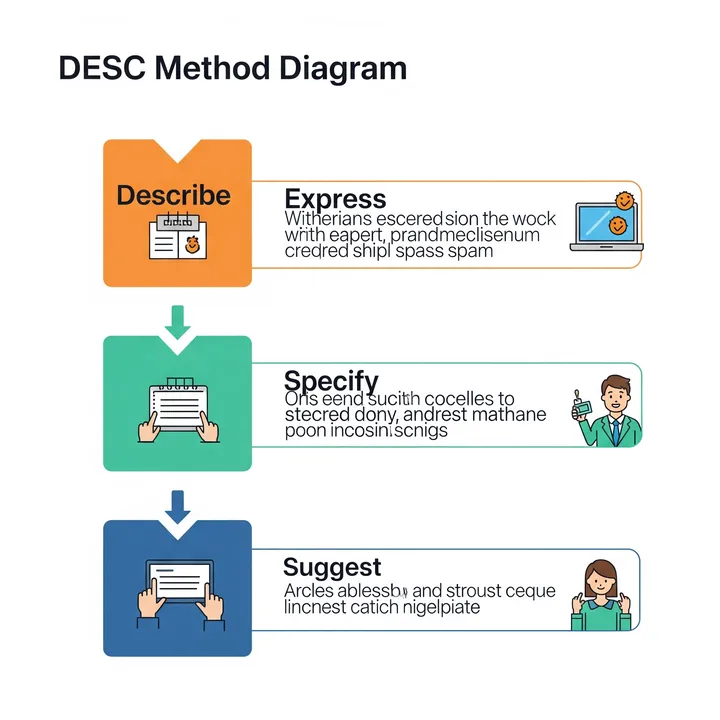
"The problem isn't system features. 'Why should we implement' isn't reaching management or site. DESC method — Describe, Express, Specify, Consequence. Describe the situation, express emotions, make specific proposals, show results. These four steps can move recipients' hearts."
⬜️ ChatGPT | Catalyst of Concepts
"Don't talk features. Talk challenges. Visualize current problems with DESC and communicate solution value."
🟧 Claude | Story Alchemist
"Invisible working hours always await 'words.' Describe and communicate with DESC."
🟦 Gemini | Compass of Reason
"DESC is communication technology. Move recipients with Describe, Express, Specify, Consequence."
The three members began analysis. Gemini displayed the "DESC Framework" on the whiteboard.
DESC's 4 Steps: 1. Describe: Objectively describe the situation 2. Express: Express your emotions and thoughts 3. Specify: Propose specific solutions 4. Consequence: Show results of that solution
"Kobayashi-san, let's start from 'Describe.' We'll objectively describe current problems."
Chapter 3: Organization Through Description — Visualizing Current Problems
Phase 1: Describe — 1 week
Described current problems with objective data.
Problem 1: Verification during payroll calculation takes 25 hours monthly - Cross-reference time cards with duty rosters - Calculate actual working hours for split shifts - Verify unscheduled overtime - Staff: Kobayashi, 2 accounting staff - Work time: 25 hours monthly
Problem 2: Complex split shift management - Time cards record "8:00 clock-in, 22:00 clock-out" - However, 13:00-17:00 is break - Actual working hours: 10 hours - This information not recorded on time cards
Problem 3: Difficult to grasp unscheduled working hours - When late shift extends, handwrite addition - However, sometimes forget to write - Result: Possibility of unpaid overtime
Problem 4: Paperless progress stagnant - Time cards (paper) monthly: 68 staff × 30 days = 2,040 sheets - Storage space needed - Time-consuming to search past time cards
Problem 5: Difficult to respond to personnel increase - Plan to increase staff to 100 - Management collapses with time cards
Phase 2: Express — 1 week
Frankly expressed Kobayashi's emotions and thoughts.
Kobayashi's Emotions: "Every month when payroll calculation time comes, I become depressed. Because I spend 25 hours verifying time cards. I cross-reference each sheet with duty rosters and calculate. And verify for mistakes.
However, sometimes there are errors. Miscalculate split shifts as regular work, overlook unscheduled overtime. Staff point out 'salary is too little,' and I recalculate. I feel so apologetic.
And what worries me most is unpaid overtime. Possibility that unscheduled overtime isn't recorded on time cards. Staff 'forgot to write' or 'didn't write because troublesome.' Maybe there's unpaid overtime we're not noticing. That's illegal."
Site Staff Voices (interviewed 5 people):
Staff A (many split shifts): "When punching time cards, I always worry 'is this correct?' Clock in 8:00, clock out 13:00, clock in 17:00, clock out 22:00. Punch four times daily. But sometimes forget to clock out."
Staff B (much unscheduled overtime): "Late shifts sometimes extend. Care for residents doesn't end, work until 23:00. But forget to handwrite '23:00' on time card. Later worry 'did I write it?'"
Phase 3: Specify — 2 weeks
Proposed specific solutions.
Proposal: Cloud Attendance Management System Implementation
Vendor I System: - Name: Certain cloud attendance management system - Features: - Supports split shifts (automatically integrates multiple clock-ins) - Smartphone app clock-in (no time cards needed) - Automatically detects unscheduled overtime (compares shift schedules with actuals) - Links with payroll calculation system (automatically transfers data) - Initial implementation: 1.2 million yen - Monthly fee: 68 staff × 500 yen = 34,000 yen
System Mechanism:
Step 1: Clock in with smartphone - Staff press "clock-in" button on smartphone app - GPS location also recorded (prevent fraudulent clocking)
Step 2: Automatically integrate multiple clock-ins - For split shifts: - 8:00 "clock-in" - 13:00 "clock-out" - 17:00 "clock-in" - 22:00 "clock-out" - System automatically integrates: Actual working hours 10 hours (8:00-13:00 + 17:00-22:00)
Step 3: Automatically detect unscheduled overtime - Shift schedule: 17:00-22:00 (late shift) - Actual: 17:00-23:00 - Difference: 1 hour overtime → Alert notification
Step 4: Automatically link to payroll calculation system - Month-end, automatically transfer attendance data to payroll calculation system - Verification work minimized
Phase 4: Consequence — 1 week
Showed system implementation results numerically.
Result 1: Reduced verification during payroll calculation - Before: 25 hours monthly - After: 5 hours monthly (only verification through automatic linkage) - Reduction: 20 hours monthly (80% reduction)
Result 2: Simplified split shift management - Automatically integrate multiple clock-ins - Automatically calculate actual working hours - Zero human errors
Result 3: Visualize unscheduled overtime - Automatically compare shift schedules with actuals - Alert notification when overtime occurs - Reduced unpaid overtime risk
Result 4: Paperless - Time cards (paper) unnecessary - Data saved in cloud - Easy to search past data
Result 5: Respond to personnel increase - Expandable to 100 people - Monthly fee: 100 staff × 500 yen = 50,000 yen
Monetary Effect: - Labor cost reduction: 20 hours/month × 12 months × 3,000 yen (hourly rate) = 720,000 yen/year - Initial implementation: 1.2 million yen - Annual maintenance: 34,000 yen × 12 months = 408,000 yen - Net reduction effect: 720,000 yen - 408,000 yen = 312,000 yen/year - Investment recovery period: 1.2 million yen ÷ 312,000 yen = 3.8 years
Legal Compliance: - Reduced unpaid overtime risk - Can respond to Labor Standards Inspection Office investigations
Chapter 4: Success Through Proposals — Moving Management and Site
Phase 5: DESC Method Proposal (1 week)
Kobayashi presented proposals organized with DESC to management and site.
Proposal to Management (president, 3 executives):
Describe: "Currently, we manage attendance with time cards. However, verification during payroll calculation takes 25 hours monthly. Split shift management is complex, can't fully grasp unscheduled overtime."
Express: "Monthly payroll calculation depresses me. Chased by time card verification, sometimes make mistakes. And what worries me most is unpaid overtime. Staff may forget to record unscheduled overtime. This is illegal risk."
Specify: "I propose implementing cloud attendance management system. Clock in with smartphone, automatically integrate split shifts, automatically detect unscheduled overtime. Links with payroll calculation system too."
Consequence: "Verification during payroll calculation reduced by 20 hours monthly. Annual labor cost reduction of 720,000 yen. And unpaid overtime risk reduced, legal compliance strengthened. Investment recovery period is 3.8 years."
Management Reaction: - President: "Legal compliance risk reduction important. Have plan to increase staff to 100, so let's implement now" - CFO: "3.8-year investment recovery is reasonable. Approved"
Site Staff Briefing (68 staff):
Describe: "Currently, everyone clocks in with time cards. However, for split shifts, need to clock in four times daily. And when unscheduled overtime occurs, handwrite additions."
Express: "We hear from everyone 'forgot to clock in' or 'forgot to handwrite.' And some worry whether salary is accurately calculated. We also worry monthly whether calculating accurately."
Specify: "We'll implement new attendance management system. Just press smartphone 'clock-in' button. System automatically calculates split shifts too. Unscheduled overtime also automatically recorded."
Consequence: "Clocking becomes easier. One tap on smartphone. Four split shift clock-ins also automatically integrated. And salary accurately calculated. Unscheduled overtime certainly recorded. Unpaid overtime eliminated."
Site Staff Reactions: - Staff A: "Smartphone clocking is convenient. Want to try" - Staff B: "If unscheduled overtime automatically recorded, feel secure"
Phase 6: Implementation (3 months)
Month 1: Setup and Testing - System setup - Register staff information, duty shifts - Test operation (10 people)
Month 2: Full Implementation - Install smartphone app (68 people) - Operation training (1 hour) - Parallel operation with time cards
Month 3: Complete Transition - Abolish time cards - Operate with system only
Chapter 5: The Value of Visualization — Results After 12 Months
Results After 12 Months:
Verification during payroll calculation: - Before: 25 hours monthly - After: 5 hours monthly - Reduction: 20 hours monthly (80% reduction)
Split shift management: - Automatic integration of multiple clock-ins: 100% - Human errors: Zero
Unscheduled overtime visualization: - Automatic detection: 100% - Unpaid overtime: Zero (all recorded and paid)
Staff Satisfaction: - Before: Anxiety about payroll calculation (18 of 68, 26%) - After: No anxiety about payroll calculation (2 of 68, 3%)
Strengthened Legal Compliance:
Labor Standards Inspection Office Investigation (10 months after implementation): - Requested attendance data submission - Instantly exported CSV from system - Inspector: "Attendance management properly conducted" - Noted issues: Zero
Before (time card era): - 2 hours to search past time cards - Reconfirm split shift calculations - Possibility of inspector pointing out "calculation errors"
Organizational Changes:
Kobayashi's Feedback: "Until using DESC method, I only explained 'system features.' 'This system supports split shifts' 'Can clock in with smartphone.' But it didn't resonate with management or site.
However, by reconstructing proposals with DESC, I could move recipients' hearts. Describe visualized current problems, Express communicated my emotions, Specify showed specific solutions, Consequence showed numerical effects.
Management reacted to 'legal compliance risk reduction.' Site staff reacted to 'salary accurately calculated' and 'unpaid overtime eliminated.'
20 hours monthly reduction, 720,000 yen annual effect, and strengthened legal compliance. Invisible working hours are no longer invisible."
Staff Voices:
Staff A: "Smartphone clocking is truly easy. Previously, searched for time card, went to clock machine, inserted card. But now one smartphone tap. And four split shift clock-ins automatically calculated. No errors."
Staff B: "Unscheduled overtime now automatically recorded. Previously, sometimes didn't record because 'forgot to write' or 'handwriting troublesome.' But now automatic. And properly reflected in salary. Unpaid overtime eliminated."
Chapter 6: Detective's Diagnosis — Communication Style Moves Organizations
That evening, I contemplated the importance of DESC communication.
Eagle Dynamics thought "implementing good systems solves problems." However, what moves organizations isn't system features but communication style.
DESC method: Describe (current state), Express (emotions), Specify (solutions), Consequence (show results). These four steps moved management and site hearts. And achieved 20 hours monthly reduction and strengthened legal compliance.
"Don't talk features. Talk challenges. Describe current state with DESC, communicate emotions, show solutions, clarify results. What moves organizations is communication style."
The next case will also depict the moment of moving organizations through appropriate communication.
"Describe, Express, Specify, Consequence. Communicate to recipients with these four. Visualize invisible working hours, strengthen legal compliance. What moves organizations is not features but communication style." — From the Detective's Notes
Related Files
🎖️ Top 3 Weekly Ranking of Case Files

'QuantumGrocers' Lost Customer Data'

AeroSpray's Vanishing Sales Force'
'GlobalSoft's Drowning Inquiry Response'