ROI Case File No.345 | 'GlobeTech's Blueprint Time Thief'
📅 2025-12-06 23:00
🕒 Reading time: 9 min
🏷️ 3C

- Chapter 1: The Uncertainty of Blueprints—One Week or Three Hours
- Chapter 2: The AI Implementation Confusion—What Should We Choose
- Chapter 3: Discovery Through Analysis—Customers Seek "Speed" and "Accuracy"
- Chapter 4: Execution Through Development—Results After 6 Months
- Chapter 5: Detective's Diagnosis—Solutions Exist at Customer-Competitor-Company Intersection
- Related Files
Chapter 1: The Uncertainty of Blueprints—One Week or Three Hours
The day after resolving TechVision's AI image generation case, a consultation arrived regarding blueprint creation workflow efficiency. Volume 28 "The Pursuit of Reproducibility," Story 345, is a tale of discerning customer, competitor, and company.
"Detective, our blueprint creation is unpredictable. Some projects take one week, others finish in 2-3 hours. However, we don't know until we start. And about five people are dedicated to blueprint creation year-round."
GlobeTech's Technical Director, Kensuke Tanaka from Yokohama, visited 221B Baker Street with an exhausted expression. In his hands were complex mechanical design blueprints and, in stark contrast, an operations analysis report marked "Revisions: Average 2.8 times/case."
"We specialize in industrial machinery design and manufacturing. Conveyor systems for food factories, assembly lines for automotive plants. Approximately 180 projects annually. However, all require blueprint creation."
GlobeTech's Operations Structure: - Established: 2006 (Industrial machinery design/manufacturing) - Employees: 85 (Design department: 18) - Annual projects: Approximately 180 - Blueprint creation staff: 5 (dedicated) - Average creation time: 32 hours/case (equivalent to one week) - Revision count: Average 2.8 times/case - Problem: Large work time variations and time increase from revisions
Tanaka's voice carried deep anxiety.
"Blueprint creation takes significant time. Input numbers and dimensions into CAD software, design piping routes, optimize component placement. Simple projects finish in 2-3 hours. However, complex projects take one week.
And there's a problem. Depending on customers, multiple revisions occur. 'Please change this piping route,' 'Please adjust this component position.' One revision takes average 8 hours. Result: initially planned 32 hours sometimes becomes 54 hours."
Typical Blueprint Creation Flow:
Pattern 1: Simple Projects (2-3 hours) - Content: Small modifications to existing systems - Example: Conveyor extension (add 3 meters) - Blueprint: Just modify existing blueprint - Revisions: Almost zero
Pattern 2: Medium Projects (16-24 hours) - Content: New system design (standard specifications) - Example: Food factory conveyor system (standard layout) - Blueprint: Create from scratch but patterned - Revisions: Average 1.5 times
Pattern 3: Complex Projects (40 hours-one week) - Content: Custom system with special specifications - Example: Complex automotive plant assembly line - Blueprint: Design from scratch, complex piping/wiring - Revisions: Average 4+ times
Tanaka sighed deeply.
"We want to use AI technology to streamline blueprint creation. Ideally, a system that auto-generates when numbers and dimensions are input. However, we lack expertise. What AI tools exist, which suits us—we cannot judge."
Chapter 2: The AI Implementation Confusion—What Should We Choose
"Mr. Tanaka, what AI blueprint generation tools are you considering?"
My question left Tanaka bewildered.
"Honestly, we don't know. Internet searches show various tools. 'AI blueprint auto-generation,' 'Machine learning CAD,' 'Generative AI design support.' Cannot judge which fits us."
Current Understanding (Information Shortage Type): - Recognition: AI tools exist - Problem: Don't know selection criteria
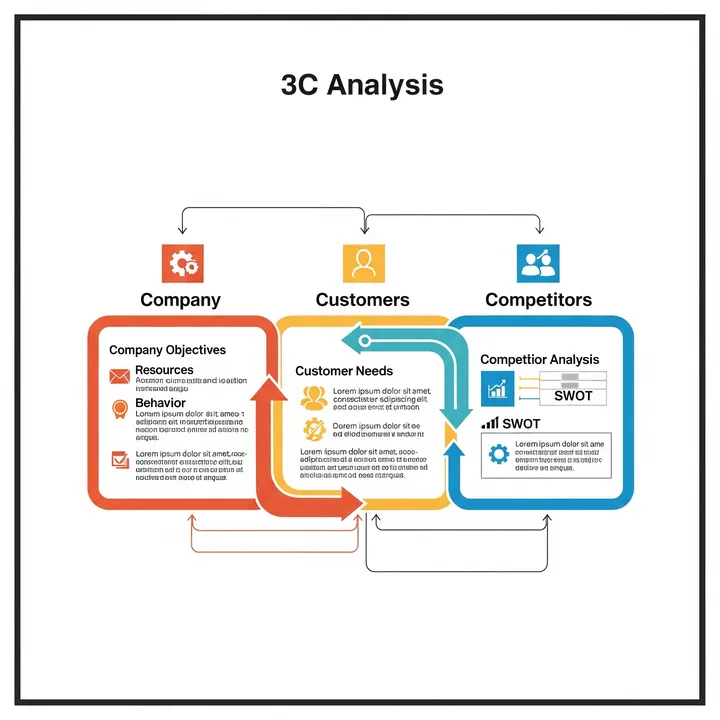
I explained the importance of deriving optimal solutions by viewing from three perspectives: customer, competitor, company.
"The problem is 'thinking only from your company's perspective.' 3C analysis—Customer, Competitor, Company. Analyzing these three perspectives reveals optimal AI blueprint generation systems."
⬜️ ChatGPT | Catalyst of Conception
"Don't only see yourself. See customers, see competitors. Overview the whole with 3C"
🟧 Claude | Alchemist of Narrative
"Blueprints always emerge from 'customer requirements.' Analyze those requirements"
🟦 Gemini | Compass of Reason
"3C is strategic basics. Analyze customer, competitor, company to find differentiation points"
The three members began analysis. Gemini deployed "3C Framework" on the whiteboard.
3C's 3 Elements: 1. Customer: What do customers seek 2. Competitor: How are competitors responding 3. Company: What are our strengths and weaknesses
"Mr. Tanaka, let's start with customer analysis."
Chapter 3: Discovery Through Analysis—Customers Seek "Speed" and "Accuracy"
Phase 1: Customer Analysis (2 weeks)
Analyzed past year's 180 projects, organizing customer needs.
Top 3 Customer Needs:
1. Delivery Shortening (Importance: ★★★★★) - Customer voice: "If blueprints complete quickly, manufacturing can start immediately" - Current: Blueprint completion average 32 hours (4 days) - Expectation: Blueprint completion within 16 hours (2 days)
2. Rapid Revision Response (Importance: ★★★★☆) - Customer voice: "Time from revision request to receiving revised blueprint takes too long" - Current: One revision average 8 hours (1 day) - Expectation: One revision within 2 hours
3. Accuracy Improvement (Importance: ★★★★☆) - Customer voice: "Helpful when piping interference checks and component placement optimization are done" - Current: Manual checks cause 8 annual oversights - Expectation: Zero interference, optimized component placement blueprints
Phase 2: Competitor Analysis (2 weeks)
Surveyed five competitors.
Competitor A (Industry Leader): - Blueprint creation structure: 10-person dedicated team - Average creation time: 28 hours/case - AI implementation: Not implemented (under consideration) - Strength: Abundant track record, can handle large projects
Competitor B (Mid-size Company): - Blueprint creation structure: 3 people - Average creation time: 40 hours/case - AI implementation: Implemented general CAD automation tool (2024) - Effect: 20% work time reduction (40 hours → 32 hours) - Weakness: Cannot handle complex projects
Competitor C (Startup): - Blueprint creation structure: 2 people + outsourcing - Average creation time: 36 hours/case - AI implementation: Uses external AI blueprint generation service - Effect: Outsourcing cost reduction - Weakness: No internal know-how accumulation
Competitor Trends Summary: - Leaders not yet implementing AI - Mid-size and below trialing general tools or external services - Zero companies with independently developed AI blueprint generation systems
Differentiation Opportunity: "Developing AI blueprint generation system incorporating our design know-how enables competitive advantage"
Phase 3: Company (Internal) Analysis (2 weeks)
Our Strengths:
Strength 1: 18 Years of Design Know-How - Past 180 cases/year × 18 years = 3,240 project achievements - Accumulated optimal piping routes and component placement best practices by industry
Strength 2: Revision Pattern Data - Analyzed past revision content - "Piping route changes" account for 42% of all revisions - "Component placement adjustments" 28% - "Dimension fine-tuning" 18% - "Other" 12%
Strength 3: Skilled CAD Operators - Five blueprint creation staff average 12 years experience - Rich tacit knowledge ("This piping route is easier to manufacture," etc.)
Our Weaknesses:
Weakness 1: Human Resource Shortage - Five people handle 180 annual cases - Busy periods (year-end to fiscal year-end) overtime exceeds 60 hours monthly
Weakness 2: Revision Response Delays - When multiple revision requests overlap, responses delay - Customer satisfaction decline (NPS 58)
Weakness 3: Know-how Personalization - Veteran knowledge not documented - Technical transfer to younger staff is challenge
Phase 4: 3C Integrated Analysis and Strategy Formulation (1 week)
Customer: - Seeks "speed" and "accuracy" - Want blueprint completion within 16 hours, revision response within 2 hours
Competitor: - No companies yet have proprietary AI systems - Now is differentiation opportunity
Company: - Have 18 years design know-how - Have revision pattern data - However, human resources insufficient
Strategy: "Develop AI blueprint auto-generation system incorporating our design know-how and revision patterns"
Chapter 4: Execution Through Development—Results After 6 Months
Phase 5: AI Blueprint Auto-Generation System Development (6 months)
Development Policy: "Dedicated system incorporating our know-how, not general tools"
System Specifications:
1. Auto Blueprint Generation Engine - Input: Numbers, dimensions, component list, layout requirements - Processing: Learn optimal patterns from past 3,240 projects - Output: CAD blueprints (DXF format)
2. Piping Route Optimization AI - Auto-proposes manufacturing-friendly piping routes - Automatic interference checking
3. Revision Prediction Engine - Analyze past revision patterns - Predict "This customer 80% likely to request piping route change" - Present multiple options in initial proposal
Development Period: 6 months Development Cost: 18 million yen (collaboration with external vendor)
Phase 6: Operations Launch (Month 6-12)
New Blueprint Creation Flow:
Step 1: Input Numbers/Dimensions (30 minutes) - Input customer requirements into system
Step 2: AI Auto-Generation (10 minutes) - System auto-generates blueprints - Piping route optimized, interference checked
Step 3: Staff Verification/Fine-tuning (3 hours) - Verify generated blueprints - Fine-tune as needed
Step 4: Submit to Customer (30 minutes) - Revision prediction engine proposes multiple options - Present "main option" and "2 alternatives"
Total: Approximately 4.5 hours/case (Before: 32 hours, 86% reduction)
Results After 6 Months:
Blueprint Creation Time Reduction: - Before: 32 hours/case × 180 cases/year = 5,760 hours/year - After: 4.5 hours/case × 180 cases/year = 810 hours/year - Reduction: 4,950 hours/year (86% reduction)
Revision Count Reduction: - Before: Average 2.8 times/case - After: Average 0.6 times/case - Reduction: 2.2 times/case (79% reduction) - Reason: Revision prediction engine presents multiple options from start
Revision Response Time Reduction: - Before: 8 hours/time - After: 1.5 hours/time - Reduction: 6.5 hours/time (81% reduction)
Customer Satisfaction Improvement: - Before: NPS 58 - After: NPS 76 - Improvement: +18 points - Reason: Fast delivery, few revisions
Annual Cost Reduction: - Labor cost reduction: 4,950 hours × 3,800 yen (hourly) = 18.81 million yen/year
Investment Recovery: - Initial investment: 18 million yen - Annual reduction effect: 18.81 million yen - ROI: 104.5% (first year) - Investment recovery period: 0.96 years (approximately 11.5 months)
New Order Acquisition Increase: - Delivery shortening enables winning against competitors - 6 months new orders: 18 cases (+10%) - Sales increase: 18 cases × average 8 million yen = 144 million yen (annual conversion: 288 million yen)
Organizational Changes:
Blueprint Creation Staff A's Voice: "Previously, even spending one week on blueprints, sometimes 3 revisions came. 'Another revision...' I felt discouraged. But since AI system introduction, we can present multiple options in initial proposal. 'Which do you prefer?' let customers choose. Revisions drastically decreased.
And work time reduced to 4.5 hours. With freed time, can challenge new projects."
Tanaka's Voice: "Until conducting 3C analysis, we only had vague expectation 'AI tools will somehow work.' However, analyzing customer, competitor, company revealed clear strategy.
Customers seek 'speed' and 'accuracy.' Competitors don't yet have proprietary AI systems. We have 18 years design know-how. Therefore, developed AI system incorporating our know-how.
Result: Blueprint creation time reduced 86%, revision count reduced 79%. Customer satisfaction improved 18 points, new orders increased 10%. Established competitive advantage."
Chapter 5: Detective's Diagnosis—Solutions Exist at Customer-Competitor-Company Intersection
That evening, I contemplated the essence of 3C analysis.
GlobeTech was in confusion: "Don't know which AI tool to choose." Thinking only from company's perspective.
Overviewing customer, competitor, company with 3C analysis revealed optimal solution. Customers seek speed and accuracy, competitors lack proprietary systems, company has 18 years know-how. At the intersection of these three, the solution of AI blueprint generation system incorporating own know-how existed.
"Don't only see yourself. See customers, see competitors. Overview whole with 3C. Where three circles intersect, optimal solutions exist."
The next case will also depict the moment of overviewing from three perspectives.
"Customer, Competitor, Company. Analyze customer, competitor, company. Don't only see yourself. Where three circles intersect, differentiation and success exist"—From the Detective's Notes
Related Files
🎖️ Top 3 Weekly Ranking of Case Files

'QuantumGrocers' Lost Customer Data'

AeroSpray's Vanishing Sales Force'
'GlobalSoft's Drowning Inquiry Response'