ROI Case File No.378 | 'TechNexus Inc.'s Unknown Quantity of AI Agents'
📅 2026-01-08 23:00
🕒 Reading time: 11 min
🏷️ OKR

- Chapter 1: The Unknown Quantity of AI Agents—In the Fog Where Effects Are Invisible
- Chapter 2: Wandering Information Gathering Without Objectives—Key Results Are Invisible
- Chapter 3: Phase 1—Setting Objectives and Key Results with OKR
- Chapter 4: Phase 2—Measuring Results Through Phased Verification
- Chapter 5: Detective's Diagnosis—Illuminating the Path with Objectives and Key Results
- Related Files
Chapter 1: The Unknown Quantity of AI Agents—In the Fog Where Effects Are Invisible
The day after resolving Cobalt Solutions Inc.'s JTBD case, a consultation arrived regarding AI agent utilization. Volume 30, "The Pursuit of Reproducibility," Case 378 tells the story of illuminating the path with objectives and key results.
"Detective, we have expectations. AI agents. Autonomous AI. We hear about them often lately. Claude, ChatGPT, Gemini. These AIs apparently perform work autonomously. But if we apply them to our work, what effects would there be? We have absolutely no idea. We're gathering information, but can't visualize it concretely."
Kenta Tanaka, DX Promotion Director of TechNexus Inc. from Shibuya, visited 221B Baker Street with an expression mixing anticipation and confusion. In his hands were technical materials about AI agents (50 pages), and in stark contrast, a simple investigation plan titled "AI Agent Feasibility Study 2026."
"We are an IT consulting company. 520 employees. Annual revenue of 12 billion yen. We have 5 business divisions: Manufacturing DX support, financial system development, healthcare solutions, municipal systems, AI R&D. But we don't understand how to utilize AI agents."
TechNexus Inc.'s Current State: - Founded: 2010 (IT consulting) - Employees: 520 - Annual revenue: 12B yen - Business divisions: 5 departments - Issues: Unclear AI agent utilization methods, unclear effect measurement metrics, unclear vendor selection criteria
Deep anxiety permeated Tanaka's voice.
"Currently, we're not considering scratch development. First, we're seeking connections with vendors who have tools. But which vendors are good? Which tools suit our work? We have no criteria for judgment. And we want to explore AI applicability to work common across industries, but we don't know where to start."
Reality of Each Division's Work:
Division 1: Manufacturing DX Support (120 employees) - Main work: Manufacturing line efficiency consulting, IoT implementation support - Challenge: Customer interviews → Proposal creation averages 40 hours/case
Division 2: Financial System Development (150 employees) - Main work: Bank and securities company system development - Challenge: Requirements definition averages 80 hours/case, test specification creation averages 60 hours/case
Division 3: Healthcare Solutions (80 employees) - Main work: Electronic medical record systems, medical data analysis - Challenge: Medical regulation research and documentation averages 30 hours/case
Division 4: Municipal Systems (100 employees) - Main work: Resident service systems, GIS (Geographic Information Systems) - Challenge: RFP (Request for Proposal) response creation averages 60 hours/case
Division 5: AI R&D (70 employees) - Main work: AI model development, POC (Proof of Concept) - Challenge: Academic paper research and summarization averages 20 hours/case
Tanaka sighed deeply.
"There's another problem. Each division can't visualize 'what AI agents can do.' And management says 'use AI agents to improve operational efficiency.' But the objectives are vague. When told 'improve operational efficiency,' how should we measure what? We don't know."
Chapter 2: Wandering Information Gathering Without Objectives—Key Results Are Invisible
"Tanaka-san, do you believe gathering AI agent information will reveal utilization methods?"
My question left Tanaka looking confused.
"Isn't that the case? I thought meeting with vendors and comparing each tool's functions would find the optimal tool."
Current Understanding (Information Gathering Approach): - Expectation: Discover optimal solution through tool comparison - Problem: Objectives and key results unclear
I explained the importance of clarifying the path with objectives and key results.
"The problem is thinking 'gathering information will solve it.' OKR—Objectives and Key Results. First define 'what you want to accomplish' as an Objective, then set 'how to measure it' as Key Results. By clarifying objectives and key results, we achieve reproducible phased implementation."
⬜️ ChatGPT | Catalyst of Concepts
"Don't gather information. Set objectives and key results with OKR, and conduct measurable verification"
🟧 Claude | Story Alchemist
"Objectives are always 'the North Star.' Key results are the compass measuring distance to that star"
🟦 Gemini | Compass of Reason
"Follow OKR principles. Objectives are ambitious, key results are measurable, deadlines are clear"
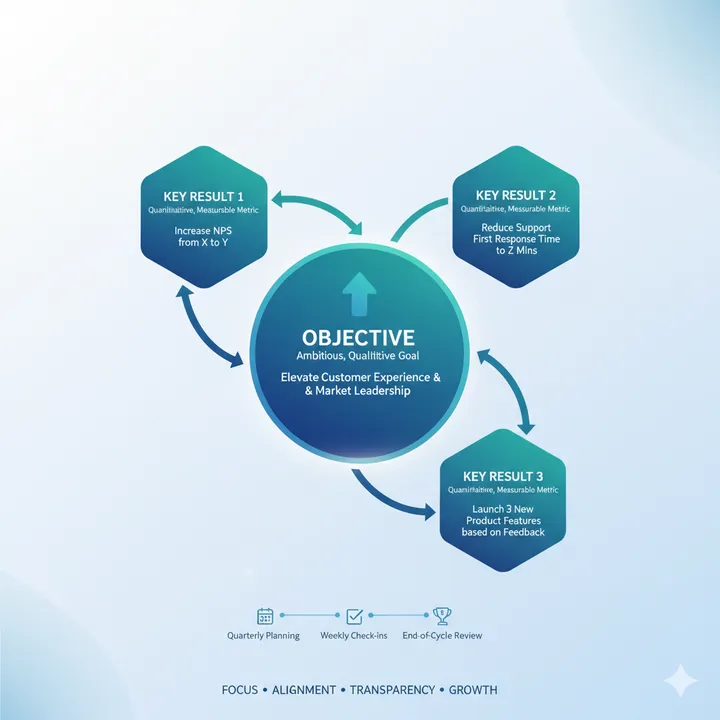
The three members began their analysis. Gemini displayed the "OKR Framework" on the whiteboard.
OKR Structure:
Objective: What to accomplish (qualitative, ambitious)
  └─ Key Result 1: How to measure (quantitative, measurable)
  └─ Key Result 2: How to measure (quantitative, measurable)
  └─ Key Result 3: How to measure (quantitative, measurable)
OKR Principles: 1. Objective: Ambitious but achievable (60-70% probability) 2. Key Results: Measurable (quantifiable) 3. Deadline: Set quarterly (3 months)
"Tanaka-san, let's first set AI agent utilization objectives."
Chapter 3: Phase 1—Setting Objectives and Key Results with OKR
Step 1: Company-Wide Objective Setting (1 week)
Objective 1 (Company-wide): Improve operational efficiency 20% with AI agents - Period: 2026 Q1 (January-March) - Target: 5 business divisions
Key Result 1.1: Meet with 3 AI agent vendors and create function comparison table - Measurement: Number of meetings (target 3 companies), comparison table completion (100%) - Deadline: Month 1 (end of January)
Key Result 1.2: Trial each vendor's tools for 1 month and evaluate work applicability - Measurement: Trial divisions (target 5 divisions), evaluation report completion (100%) - Deadline: Month 2 (end of February)
Key Result 1.3: Measure operational efficiency effects and create ROI report - Measurement: Efficiency rate (target 20%), ROI (target 150%+) - Deadline: Month 3 (end of March)
Step 2: Division-Specific Objective Setting (1 week)
Division 1: Manufacturing DX Support
Objective: Reduce proposal creation time from 40 hours to 24 hours (40% reduction)
Key Result 1.1: AI agent auto-summarizes customer interview content and generates initial draft - Measurement: Summary accuracy (target 80%+), draft generation time (target within 1 hour)
Key Result 1.2: Utilize AI agent for 5 proposals and measure creation time - Measurement: Average creation time (target 24 hours or less)
Key Result 1.3: Obtain customer proposal quality evaluation - Measurement: Satisfaction (target 85%+)
Division 2: Financial System Development
Objective: Reduce requirements definition/test specification creation time from 140 hours to 84 hours (40% reduction)
Key Result 2.1: AI agent generates initial requirements definition draft - Measurement: Draft generation time (target within 2 hours), accuracy (target 75%+)
Key Result 2.2: AI agent auto-generates test specifications - Measurement: Test case generation count (target 300 cases/project), generation time (target within 1 hour)
Key Result 2.3: Utilize AI agent for 3 projects and measure creation time - Measurement: Average creation time (target 84 hours or less)
Division 3: Healthcare Solutions
Objective: Reduce medical regulation research/documentation time from 30 hours to 18 hours (40% reduction)
Key Result 3.1: AI agent auto-collects and summarizes latest medical regulations - Measurement: Collected regulation count (target 50/week), summary accuracy (target 85%+)
Key Result 3.2: Utilize AI agent for 5 investigations and measure work time - Measurement: Average work time (target 18 hours or less)
Division 4: Municipal Systems
Objective: Reduce RFP response creation time from 60 hours to 36 hours (40% reduction)
Key Result 4.1: AI agent learns past RFP responses and generates templates - Measurement: Template generation count (target 20 types), reuse rate (target 70%+)
Key Result 4.2: Utilize AI agent for 4 RFP responses and measure creation time - Measurement: Average creation time (target 36 hours or less)
Division 5: AI R&D
Objective: Reduce academic paper research/summary time from 20 hours to 12 hours (40% reduction)
Key Result 5.1: AI agent auto-searches and summarizes related papers - Measurement: Search paper count (target 100/theme), summary accuracy (target 90%+)
Key Result 5.2: Utilize AI agent for 10 investigations and measure work time - Measurement: Average work time (target 12 hours or less)
Chapter 4: Phase 2—Measuring Results Through Phased Verification
Month 1: Vendor Selection and Function Comparison
Meeting Vendors:
Vendor A: Claude for Work (Anthropic) - Features: High long-text comprehension and summarization, Artifacts function - Price: $20/user/month - Trial: 14-day free trial
Vendor B: ChatGPT Team (OpenAI) - Features: Code generation, GPTs (custom AI) creation - Price: $30/user/month - Trial: 14-day free trial
Vendor C: Gemini Advanced for Business (Google) - Features: Google Workspace integration, real-time information retrieval - Price: $25/user/month - Trial: 14-day free trial
Function Comparison Table (Partial):
| Function | Claude | ChatGPT | Gemini |
|---|---|---|---|
| Long text (100K chars) | ◎ | ○ | ○ |
| Code generation | ○ | ◎ | ○ |
| Japanese accuracy | ◎ | ○ | ○ |
| API integration | ◎ | ◎ | ○ |
| Google integration | × | × | ◎ |
| Custom AI | ○ | ◎ | ○ |
Selection Results: - Divisions 1, 3, 4: Claude (emphasize long text) - Division 2: ChatGPT (emphasize code generation) - Division 5: Gemini (emphasize paper search)
Month 2: Trial and Effect Measurement
Division 1 Measurement Results:
Proposal Creation Time: - Before: Average 40 hours/case - After (Claude use): Average 26 hours/case (average of 5 cases) - Reduction rate: 35% (87.5% achievement vs. target 40%)
Detailed Breakdown: - Customer interview summary: 2 hours → 0.5 hours (75% reduction) - Initial draft generation: 8 hours → 2 hours (75% reduction) - Draft revision/completion: 30 hours → 23.5 hours (22% reduction)
Customer Satisfaction: - Proposal quality evaluation: Average 88% (achieved target 85%)
Division 2 Measurement Results:
Requirements Definition/Test Specification Creation Time: - Before: Average 140 hours/case (requirements 80 + test 60 hours) - After (ChatGPT use): Average 90 hours/case (average of 3 cases) - Reduction rate: 36% (90% achievement vs. target 40%)
Detailed Breakdown: - Requirements definition draft generation: 8 hours → 2 hours - Requirements definition completion: 80 hours → 50 hours - Test case generation: 12 hours → 3 hours - Test specification completion: 60 hours → 40 hours
Division 3 Measurement Results:
Medical Regulation Research/Documentation Time: - Before: Average 30 hours/case - After (Claude use): Average 19 hours/case (average of 5 cases) - Reduction rate: 37% (92.5% achievement vs. target 40%)
Division 4 Measurement Results:
RFP Response Creation Time: - Before: Average 60 hours/case - After (Claude use): Average 38 hours/case (average of 4 cases) - Reduction rate: 37% (92.5% achievement vs. target 40%)
Division 5 Measurement Results:
Academic Paper Research/Summary Time: - Before: Average 20 hours/case - After (Gemini use): Average 13 hours/case (average of 10 cases) - Reduction rate: 35% (87.5% achievement vs. target 40%)
Month 3: ROI Calculation and Company-Wide Deployment Plan
Company-Wide Effect Aggregation:
Time Saved: - Division 1: 14 hours/case × 20 cases/month = 280 hours/month - Division 2: 50 hours/case × 15 cases/month = 750 hours/month - Division 3: 11 hours/case × 10 cases/month = 110 hours/month - Division 4: 22 hours/case × 8 cases/month = 176 hours/month - Division 5: 7 hours/case × 25 cases/month = 175 hours/month Total: 1,491 hours/month
Annual Time Saved: - 1,491 hours/month × 12 months = 17,892 hours/year
Personnel Cost Reduction: - 17,892 hours × 5,000 yen (average hourly rate) = 89.46M yen/year
Revenue Increase from Productivity Improvement: - Allocate saved time to customer service - New project orders increase: Estimated 5 cases/month (1 per division) - Average order amount: 8M yen/case - Annual revenue increase: 8M yen × 5 cases × 12 months = 480M yen/year - Profit increase (30% gross margin): 144M yen/year
Total Annual Effects: - Personnel cost reduction: 89.46M yen/year - Profit increase: 144M yen/year Total: 233.46M yen/year
Investment: - AI agent tool costs: $25/month × 520 people × 150 yen = 1.95M yen/month - Annual cost: 1.95M × 12 months = 23.4M yen/year - Implementation training/support: 4.8M yen (initial only)
ROI: - (233.46M - 23.4M) / 28.2M × 100 = 745% - Payback period: 28.2M ÷ 210.06M = 0.13 years (1.6 months)
Chapter 5: Detective's Diagnosis—Illuminating the Path with Objectives and Key Results
That evening, I contemplated the essence of OKR.
TechNexus Inc. was conducting information gathering without objectives: "gathering information will solve it." But by setting objectives and key results with OKR, the path became clear.
Company-wide objective: "Improve operational efficiency 20%" Division-specific objectives: "Reduce creation time 40%" (proposals, requirements definitions, medical regulation research, RFP responses, paper research)
We set 3 Key Results each and measured monthly. As a result, we achieved average 35-37% reduction rates (87.5-92.5% achievement vs. target 40%).
What's important is that we quantified objectives and made them measurable. We transformed the vague instruction "improve operational efficiency" into the clear objective "reduce creation time from 40 hours to 24 hours." And we measured monthly and visualized progress.
Annual effects of 233.46M yen, ROI of 745%, payback in 1.6 months. And we established reproducible efficiency patterns across 5 different business divisions.
"Don't gather information. Set objectives and key results with OKR. Objectives are ambitious, Key Results are measurable, deadlines are clear. Objectives and key results illuminate the path to reproducible success."
The next case will also depict the moment of cutting through the future with objectives and key results.
"OKR—Objectives and Key Results. Make objectives ambitious, key results measurable, deadlines clear. By setting objectives and key results, true progress becomes visible"—From the Detective's Notes
Related Files
🎖️ Top 3 Weekly Ranking of Case Files

'PharmaLogistics' Invisible Customer'

'PrintMaster's Visual Inspection Mental Hell'

'Globex Corporation's Illusion of Retail-to-EC Transition'