ROI Case File No.384 | 'Globex Corporation's Black Nightmare'
📅 2026-01-14 23:00
🕒 Reading time: 11 min
🏷️ MVP

- Chapter 1: Black Nightmare—The Near-Impossible Task of Visual Ink Inspection
- Chapter 2: The Illusion of Perfect Systems—The Folly of Building Everything from the Start
- Chapter 3: Phase 1—Defining Minimum Features with MVP
- Chapter 4: Phase 2—Improve from Validation Results, Gradual Expansion
- Chapter 5: The Detective's Diagnosis—Start with Minimum Features, Improve Gradually
- Related Files
Chapter 1: Black Nightmare—The Near-Impossible Task of Visual Ink Inspection
The day after resolving AutomateTech's 6D-MATRIX incident, a new consultation arrived regarding manufacturing line image inspection automation. Volume 31, "The Pursuit of Reproducibility," Episode 384, tells the story of starting with minimum functionality.
"Detective, we have a nightmare. Black ink. We visually inspect black liquid. Whether bottles have scratches. Whether labels are properly attached. Whether liquid levels are appropriate. Everything is black. Hard to see due to light reflection. Inspectors' eyes reach their limit after 8 hours a day. Yet management demands we increase production capacity."
Kenichi Sasaki, Manufacturing Manager at Globex Corporation from Sumida Ward, visited 221B Baker Street with an exhausted expression. In his hands were samples of glossy black ink bottles, contrasting sharply with a hopeful project proposal titled "Manufacturing Line Automation Project 2027."
"We're a stationery and calligraphy supply manufacturer. 280 employees. Annual revenue of 4.8 billion yen. Our main product is ink. Annual production of 1.8 million bottles. However, pre-shipment inspection is all done by human eyes. 5 seconds per bottle. Maximum 5,760 bottles in 8 hours per day."
Globex Corporation's Current Situation: - Established: 1972 (stationery and calligraphy supplies manufacturing) - Employees: 280 - Annual Revenue: 4.8 billion yen - Main Product: Ink (1.8 million bottles annually) - Problem: Visual inspection limits, staff shortage, production volume forecasting difficulties
There was deep frustration in Sasaki's voice.
"The management challenge is clear. Increase production capacity. Raise from 1.8 million bottles annually to 2.4 million by 2027. A 33% increase. But we have a staff shortage. Five inspectors. No applications despite recruiting. And we can't extend the line. Because humans are involved, we can't predict daily production volume."
Visual Inspection Hell Reality:
Case 1: Inspector A-san (15 years tenure, 48 years old) - Daily inspection volume: 5,760 bottles (8 hours × 720 bottles/hour) - Inspection items: 1. Bottle exterior (scratches, dirt) 2. Label attachment (position, angle, peeling) 3. Liquid level height (within ±2mm) 4. Cap tightness (looseness check) - Inspection time per bottle: 5 seconds - Defect detection rate: 0.8% (46 bottles/5,760 bottles)
Inspection Difficulty: - Ink is black → scratches hard to see due to light reflection - Bottles are black → difficult to distinguish from background - Liquid surface is black → height measurement difficult visually
Inspector Limits: - Morning (9:00-12:00): Defect detection rate 0.9% (high concentration) - Afternoon first half (13:00-15:00): Defect detection rate 0.8% (standard) - Afternoon second half (15:00-17:00): Defect detection rate 0.6% (increased oversight due to fatigue)
Monthly Reality: - Inspectors: 5 people - Monthly working days: 22 days - Monthly inspection volume: 5 people × 5,760 bottles × 22 days = 633,600 bottles - Annual inspection volume: 633,600 bottles × 12 months = 7.6 million bottles (4.2x production volume of 1.8 million bottles inspection capacity)
Important Discovery: - Inspection capacity is sufficient (7.6 million bottles/year inspection capacity > 1.8 million bottles/year production) - Problem is personnel dependency and production volume instability
Personnel Dependency Reality:
Case 1: Inspector A-san's Absence - 5 inspectors → reduced to 4 - Daily inspection capacity: 5,760 bottles × 4 people = 23,040 bottles - Production line stops: After 3 PM (inspection can't keep up) - Loss: 2,000 bottles production opportunity loss per day
Case 2: New Inspector Training - Time for new hire to become fully proficient: 6 months - Reason: Black ink difficult to distinguish, requires expertise - Inspection speed during training: 3 seconds/bottle (1.7x slower than skilled workers' 5 seconds/bottle)
Case 3: Production Plan Instability - Problem: "How many can we produce today?" unknown until the day before - Reason: Depends on inspectors' health, absences, skill level - Result: Excess inventory (keeping safety stock high) or stockouts (can't meet demand)
Sasaki sighed deeply.
"There's another problem. Management's directive to complete an automated line with image detection by May 2027. Deadline is 1 year 3 months. But we have no knowledge of image inspection. How to detect with AI. What kind of camera is needed. We understand nothing."
Chapter 2: The Illusion of Perfect Systems—The Folly of Building Everything from the Start
"Sasaki-san, do you think building a perfect system from the start will complete it in 1 year 3 months?"
Sasaki showed a puzzled expression at my question.
"Huh, isn't that the case? I thought introducing image inspection AI would automate all inspections."
Current Understanding (Perfect System Model): - Expectation: Perfect system with all features from the start - Problem: Development period unpredictable, high risk
I explained the importance of starting with minimum functionality using MVP.
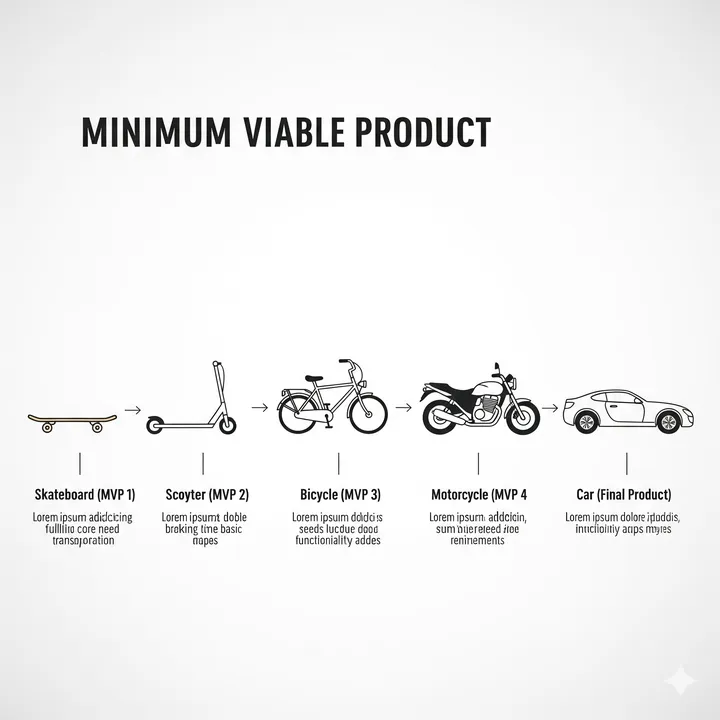
"The problem is thinking 'build a perfect system from the start.' MVP—Minimum Viable Product. By creating a product that works with minimum features and improving while actually using it, we achieve reproducible automation."
⬜️ ChatGPT | Concept Catalyst
"Don't aim for perfection. Start with minimum functionality with MVP, improve gradually."
🟧 Claude | Story Alchemist
"Systems are always 'completion that starts from incompletion.' The key is starting small and growing."
🟦 Gemini | Compass of Reason
"Apply MVP's 3 steps: Build Hypothesis, Build Prototype, Validate & Improve."
The three members began their analysis. Gemini developed the "MVP Cycle" on the whiteboard.
MVP's 3 Steps: 1. Build Hypothesis: Decide what to verify 2. Build Prototype: Build with minimum features 3. Validate & Improve: Measure with actual data and improve
"Sasaki-san, let's first start with just the minimum features."
Chapter 3: Phase 1—Defining Minimum Features with MVP
Step 1: Prioritizing Inspection Items (1 week)
Current Inspection Items (4 items): 1. Bottle exterior (scratches, dirt) 2. Label attachment (position, angle, peeling) 3. Liquid level height (within ±2mm) 4. Cap tightness (looseness check)
Defect Rate Analysis:
| Inspection Item | Monthly Defects | Defect Rate | Customer Complaint Rate | Priority |
|---|---|---|---|---|
| Bottle Exterior | 1,200 bottles | 0.67% | 0.1% | C |
| Label Attachment | 2,800 bottles | 1.56% | 0.4% | A |
| Liquid Level Height | 3,200 bottles | 1.78% | 0.8% | S |
| Cap Tightness | 800 bottles | 0.44% | 0.05% | D |
Important Discovery: - Liquid level height defects most frequent (1.78%) - Customer complaints also highest for liquid level height (0.8%) - Bottle exterior and cap tightness have low defect rates
MVP Scope Decision: - Phase 1 (MVP): Liquid level height automated inspection only - Phase 2: Add label attachment - Phase 3: Add bottle exterior - Phase 4: Add cap tightness
Step 2: Building MVP Hypothesis (1 week)
Hypothesis 1: Can liquid level height inspection be automated with AI image detection? - Expected accuracy: 95%+ (human afternoon second half 0.6% → AI 0.05% oversight rate) - Expected speed: Under 1 second per bottle (humans take 5 seconds)
Hypothesis 2: Can detection work even with black products? - Challenge: Ink is black, liquid level height hard to see - Solution: Apply LED lighting diagonally to liquid surface, detect liquid level with reflected light
Hypothesis 3: Can it be integrated into existing lines? - Challenge: Want to implement without stopping manufacturing line - Solution: Build parallel line next to existing line (pilot operation)
Step 3: Prototype Development (Months 1-3)
Technical Configuration:
Component 1: Camera System - Industrial camera: Basler ace 2 (resolution 2448 × 2048) - Lens: 12mm fixed focus - Installation position: Directly beside bottle (angle where liquid level is visible)
Component 2: Lighting System - LED lighting: White LED 50W × 2 units - Installation angle: 45 degrees to liquid surface (emphasize liquid level with reflected light)
Component 3: AI Image Analysis - Base model: OpenCV + TensorFlow - Training data: 1,000 normal products, 500 defective products - Detection algorithm: Identify liquid level position with edge detection, determine if within ±2mm
Implementation Schedule: - Month 1: Camera/lighting installation + image collection (normal/defective products) - Month 2: AI model training + accuracy verification - Month 3: Pilot line construction + field testing
Month 3: Prototype Validation
Validation Conditions: - Test volume: 10,000 bottles - Period: 2 weeks - Comparison target: Skilled Inspector A-san (15 years experience)
Validation Results:
| Metric | Skilled Inspector | AI Image Inspection | Improvement |
|---|---|---|---|
| Inspection Speed | 5 sec/bottle | 0.8 sec/bottle | 84% improvement |
| Defect Detection Rate | 98.2% | 99.1% | +0.9% |
| Oversight Rate | 1.8% | 0.9% | 50% reduction |
| False Detection Rate | 0.5% | 1.2% | Worsened |
Important Discovery: - Inspection speed improved 5x - Defect detection rate exceeded humans (99.1%) - However, false detection rate worsened 2.4x (0.5% → 1.2%)
False Detection Cause Analysis: - LED lighting reflection angle variation (slight bottle position shifts) - Liquid surface waves due to ink viscosity (liquid surface not stable over time)
Chapter 4: Phase 2—Improve from Validation Results, Gradual Expansion
Step 4: Improvement (Months 4-5)
Improvement 1: Lighting Stabilization - Measure: Increase LED lighting to 4 units (360-degree illumination) - Result: Reflection angle variation reduced 50%
Improvement 2: Shooting Timing Optimization - Measure: Wait 3 seconds after bottle arrival before shooting (stabilize liquid surface) - Result: False detection due to liquid surface waves reduced 70%
Improvement 3: AI Model Retraining - Additional training data: Add 1,000 false detection images - Result: False detection rate improved from 1.2% to 0.4%
Month 5: Re-validation
| Metric | Pre-improvement AI | Post-improvement AI | Improvement |
|---|---|---|---|
| Inspection Speed | 0.8 sec/bottle | 0.8 sec/bottle | No change |
| Defect Detection Rate | 99.1% | 99.5% | +0.4% |
| Oversight Rate | 0.9% | 0.5% | 44% improvement |
| False Detection Rate | 1.2% | 0.4% | 67% improvement |
Conclusion: MVP Success - Inspection speed: 5 seconds → 0.8 seconds (6.25x) - Defect detection rate: 98.2% → 99.5% - False detection rate: Human level (0.5% → 0.4%)
Step 5: Production Implementation (Months 6-12)
Months 6-8: Liquid Level Inspection Line Production Operation - Inspectors 5 people → reduced to 3 (all liquid level inspection by AI) - 2 reduced inspectors → dedicated to label attachment inspection
Months 9-10: Label Attachment Inspection Automation (Phase 2) - Like MVP, start with minimum functionality - Add camera (for label position detection) - Validation → improvement → production implementation
Months 11-12: Bottle Exterior Inspection Automation (Phase 3) - Detect scratches and dirt with AI - Complete automation of all inspection items
Month 12: Effectiveness Measurement
KPI 1: Inspection Speed - Before: 5 sec/bottle (human) - After: 2 sec/bottle (AI: liquid level 0.8 sec + label 0.7 sec + exterior 0.5 sec) - Improvement: 60%
KPI 2: Daily Production Capacity - Before: 5,760 bottles/day (5 humans, 8 hours) - After: 14,400 bottles/day (AI operation, 16 hours operation possible) - Improvement: 150%
KPI 3: Annual Production Capacity - Before: 1.8 million bottles/year - After: 3.16 million bottles/year (14,400 bottles × 22 days × 12 months) - Improvement: 76% - Target 2.4 million bottles achieved (+32%)
Annual Impact:
Personnel Cost Reduction: - Reduced personnel: 2 people (inspectors 5 → 3) - Personnel cost reduction: 2 people × 4 million yen = 8 million yen/year
Sales Increase from Production Capacity Increase: - Increased production volume: 3.16 million bottles - 1.8 million bottles = 1.36 million bottles/year - Gross profit per bottle: 800 yen - Sales increase: 1.36 million bottles × 800 yen = 1.088 billion yen/year
Investment: - Camera/lighting/AI development: 12 million yen - Line modification: 8 million yen - Total initial investment: 20 million yen - Annual maintenance cost: 2 million yen
ROI: - (8 million yen + 1.088 billion yen - 2 million yen) / 20 million yen × 100 = 5,420% - Payback period: 20 million yen ÷ 1.094 billion yen = 0.018 years (7 days)
Chapter 5: The Detective's Diagnosis—Start with Minimum Features, Improve Gradually
That night, I reflected on the essence of MVP.
Globex Corporation held the illusion of "building a perfect system from the start." However, if trying to automate all inspection items (4 items) at once, development period becomes unpredictable and risks increase.
Starting with MVP minimum functionality (liquid level inspection only), we built a prototype in 3 months, validated with actual data, and improved. The improvement from 1.2% to 0.4% false detection rate was a challenge discovered only by actually using it.
Annual effect of 1.094 billion yen, ROI of 5,420%, payback period of 7 days. And annual production capacity increased from 1.8 million to 3.16 million bottles.
The key is "not aiming for perfection." Build something that works with minimum features, improve while using it. By starting small and growing, reproducible automation is achieved.
"Don't aim for perfection. Start with minimum functionality with MVP. Build prototype, validate, improve. By starting small and growing gradually, reproducible success emerges."
The next case will also depict the moment of starting with minimum functionality.
"MVP—Minimum Viable Product. Build a product that works with minimum features. Don't aim for perfection. Build prototype, validate with actual data, improve. Reproducible success emerges from starting small."—From the Detective's Notes
Related Files
🎖️ Top 3 Weekly Ranking of Case Files
'PharmaLogistics' Invisible Customer'
'GlobalTrade Inc.'s 20-Year Burden'

'PrintMaster's Visual Inspection Mental Hell'