ROI Case File No.388 | 'TechWave's Invisible Darkness of Management Meetings'
📅 2026-01-18 23:00
🕒 Reading time: 11 min
🏷️ KPT

- Chapter 1: The Invisible Darkness of Management Meetings—The Despair of Not Reading Problems from Materials
- Chapter 2: The Illusion of Tool Implementation—Current State Not Reflected Upon
- Chapter 3: Phase 1—Reflecting on Current State with KPT
- Chapter 4: Phase 2—Gaining Management Understanding Through Custom AI Development
- Chapter 5: The Detective's Diagnosis—Learn from Reflection, Start Small
- Related Files
Chapter 1: The Invisible Darkness of Management Meetings—The Despair of Not Reading Problems from Materials
The day after resolving Globex Corporation's ROI incident, a new consultation arrived regarding private AI implementation. Volume 31, "The Pursuit of Reproducibility," Episode 388, tells the story of learning from reflection.
"Detective, we have invisible darkness. Management meetings. Each division reports at monthly management meetings. Sales, profits, KPIs. Numbers are lined up. But we can't see problems. Even listening to division managers' explanations, we can't objectively evaluate whether those explanations are really valid. Materials are 50 pages. No time to read."
Kentaro Sato, CFO of TechWave Inc. from Marunouchi, visited 221B Baker Street with an expression full of urgency. In his hands were last month's management meeting materials (PowerPoint 52 pages), contrasting sharply with a simple plan titled "Private AI Implementation Plan 2026."
"We're an IT general trading company. 420 employees. Annual revenue of 18 billion yen. Five divisions (Cloud, Security, AI, Infrastructure, Consulting). But management can't see field reality. Generative AI is available in-house. ChatGPT, Claude, Gemini. All employees can access. But it's not actually being used."
TechWave Inc.'s Current Situation: - Established: 2010 (IT general trading company) - Employees: 420 - Annual Revenue: 18 billion yen - Divisions: 5 divisions (Cloud, Security, AI, Infrastructure, Consulting) - Problem: Generative AI environment exists but not utilized, can't see problems in management meetings
There was deep frustration in Sato's voice.
"Management's honest opinions are as follows. President: 'Want to utilize AI, but don't know which tasks to use it for.' CFO, myself: 'Hard to see problems from management meeting materials. Anxious about accepting division explanations at face value.' COO: 'Feel like field voices aren't reaching management.' All management is positive about AI utilization, but haven't found concrete utilization methods."
Management Meeting Reality:
Case 1: December 2025 Management Meeting - Participants: 5 management members (President, CFO, COO, CTO, CHO) - Reporters: 5 division managers - Time: 3 hours (36 minutes per division) - Materials: 10 pages per division × 5 = 50 pages
Cloud Division Report (10 pages): - Page 1: Sales trend graph (year-over-year +15%) - Page 2: Profit trend graph (year-over-year +8%) - Page 3: Customer acquisition (30 new companies, 5 cancellations) - Pages 4-10: Detailed explanation of each project
Management Questions (couldn't ask during meeting): - President: "Sales +15% is good, but isn't profit +8% low? Why is profit margin declining?" - CFO: "What's the reason for 5 cancellations? Is there a customer satisfaction problem?" - COO: "No time to read project details (Pages 4-10). Just want to know key points."
Essence of Problem: - Too many materials to read (50 pages in 3 hours) - Accept division managers' verbal explanations at face value - Want to question but can't without basis - Anxiety remains after meeting: "Was that really okay?"
Generative AI Environment Reality:
Implemented Tools: - ChatGPT Enterprise: All 420 employees can access - Claude Pro: Only 5 management members - Gemini Advanced: None
Monthly Usage (December 2025): - ChatGPT users: 45 people (10.7% of total) - Average usage: 1.2 times/person/month - Claude users: 1 person (only President among 5 management members)
Why Not Used? (Employee survey results):
| Reason | Response Rate |
|---|---|
| Don't know what to use it for | 68% |
| Don't feel need to use at work | 52% |
| Security concerns | 38% |
| Don't know how to use | 28% |
Sato sighed deeply.
"My vision is this. First introduce custom AI in management meetings, gain management understanding. If management experiences 'AI is this convenient,' AI utilization in each division and task should progress. But what kind of custom AI should we create. What will gain management understanding. I don't know."
Chapter 2: The Illusion of Tool Implementation—Current State Not Reflected Upon
"Sato-san, do you think implementing custom AI tools will make management understand?"
Sato showed a puzzled expression at my question.
"Huh, isn't that the case? I thought analyzing management meeting materials with custom AI would reveal problems."
Current Understanding (Tool-First Model): - Expectation: Problem solved with custom AI tool implementation - Problem: Current state reflection (what's good, what's bad) not done
I explained the importance of reflecting on current state with KPT.
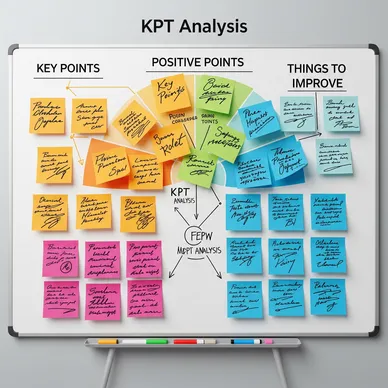
"The problem is thinking 'implementing tools will solve it.' KPT—Keep, Problem, Try. By reflecting on current state and organizing points to maintain (Keep), problems (Problem), and points to try (Try), we achieve reproducible AI utilization."
⬜️ ChatGPT | Concept Catalyst
"Don't solve with tool implementation. Reflect on current state with KPT, organize problems."
🟧 Claude | Story Alchemist
"Improvement always starts from 'past reflection.' The key is reflecting."
🟦 Gemini | Compass of Reason
"Apply KPT's 3 steps: Organize Keep, Extract Problem, Decide Try."
The three members began their analysis. Gemini developed the "KPT Framework" on the whiteboard.
KPT Framework:
Keep (Maintain)    | Problem (Issues)     | Try (Attempt)
-------------------|----------------------|-------------------
What went well     | What was difficult   | What to try next
What to continue   | What to improve      | New challenges
"Sato-san, let's first reflect on the current state of management meetings with KPT."
Chapter 3: Phase 1—Reflecting on Current State with KPT
Step 1: Organizing Keep (Maintain) (1 week)
Good Points About Management Meetings:
Keep 1: Monthly Meeting Establishment - Fixed every 2nd Friday 3:00-6:00 PM - Conducted without fail for 5 years - Regular communication opportunity between management and division managers
Keep 2: Standardized Numerical Reporting - All divisions report in same format (sales, profit, KPIs) - Easy to compare
Keep 3: Management's Active Attitude - President always listens to all reports until the end - Q&A time secured (5 minutes per division)
Reflection: - "Meeting framework is good. Problem is content" (CFO Sato's comment)
Step 2: Extracting Problems (1 week)
Management Meeting Problems:
Problem 1: Too Many Materials to Read - Digest 50 pages in 3 hours → 3.6 minutes per page - Management has no time to read materials in advance (busy with other work) - Result: Accept division managers' verbal explanations at face value
Problem 2: Problems Hard to See - Materials focus on "good results" (sales +15%, etc.) - "Bad results" written small (5 cancellations, etc.) - No problem cause analysis (why were they cancelled?)
Problem 3: Can't Evaluate Validity of Division Explanations - Division Manager: "5 cancellations due to competitor price attacks" - Management: "Is that really all? Aren't there other reasons?" - But no basis to question (can't compare with past data)
Problem 4: Post-Meeting Anxiety - Management: "Was it okay to accept that explanation at face value?" - But no time to reconfirm
Step 3: Deciding Try (1 week)
Try Derived from KPT Analysis Results:
Try 1: AI Analysis of Management Meeting Materials in Advance - Purpose: Automatically extract problems, notify management in advance - Method: Analyze 50 pages of materials with custom AI - Detect sales/profit anomalies (year-over-year -10%+, etc.) - Extract negative words (cancellation, delay, deficit, etc.) - Comparative analysis with previous month/year
Try 2: AI Verification of Division Explanation Validity - Purpose: Verify if division managers' explanations are objectively correct - Method: Cross-reference with past 12 months data - "Competitor price attacks" → Were there past cancellations for same reason? - "Sales +15% is good" → Is it really good compared to industry average?
Try 3: Real-time AI Question Generation During Meeting - Purpose: AI presents points management should question - Method: While listening to division manager explanations, AI suggests "should confirm this point"
Chapter 4: Phase 2—Gaining Management Understanding Through Custom AI Development
Step 4: Custom AI Development (Months 1-3)
Technical Configuration:
Component 1: Material Analysis AI - Base model: Claude 3.5 Sonnet - Input: Management meeting materials (PowerPoint → PDF conversion) - Processing: 1. Convert all pages to text 2. Calculate sales/profit month-over-month, year-over-year 3. Detect anomalies (±10%+ fluctuations) 4. Extract negative words (cancellation, delay, deficit, complaints, etc.) - Output: Problem summary (A4 1 page)
Component 2: Validity Verification AI - Base model: GPT-4 - Input: Division manager explanation text (extracted from minutes) - Processing: 1. Cross-reference with past 12 months database 2. Search for data supporting explanation 3. Detect contradictions (e.g., says "competitor price attacks" but past data shows many cancellations due to company service quality) - Output: Validity score (0-100 points) and basis
Component 3: Question Generation AI - Base model: Gemini Pro - Input: Real-time division manager explanation (audio → text conversion) - Processing: 1. Understand explanation content 2. Cross-reference with past data 3. Generate points to confirm - Output: Question candidate list (3-5 items)
Month 4: Prototype Test (January Management Meeting)
Test Conditions: - Target: Cloud Division report only - Use: Component 1 (Material Analysis AI) only
Component 1 Analysis Results:
Problem Summary (A4 1 page):
【Cloud Division December 2025 Results Problem Summary】

1. Profit Margin Decline
   - Sales: year-over-year +15% (good)
   - Profit: year-over-year +8% (below sales growth rate)
   - Profit margin: 12.5% → 11.8% (0.7% decline)
   - Cause: Not stated in materials (needs confirmation)

2. Cancellation Rate Increase
   - Cancellations: 5 companies (from 3 previous month +67%)
   - Cancellation reason: Materials state "competitor price attacks" but details unclear
   - Comparison with past data: Highest in past 6 months

3. New Acquisition Cost Increase
   - 30 new companies acquired (year-over-year +20%, good)
   - However, acquisition cost per company: 800,000 yen (from 600,000 yen previous year +33%)
   - Cause: Not stated in materials (needs confirmation)
Management Reaction: - President: "This is clear! Problems at a glance" - CFO (Sato): "If we had seen this in advance, could have asked accurate questions" - COO: "Let's implement this for all divisions next time"
Months 5-6: All Division Deployment
February Management Meeting: - AI analyzes all 5 divisions' materials - Distribute problem summary for each division in advance (3 days before meeting) - Management grasps problems in advance → can ask accurate questions
Effectiveness Measurement:
KPI 1: Management Advance Preparation Time - Before: 0 hours (no time to read materials in advance) - After: 1 hour (read A4 5-page problem summary) - Improvement: Advance preparation possible
KPI 2: Questions in Meeting - Before: Average 2 questions/division (superficial questions) - After: Average 5 questions/division (essential questions) - Improvement: +150%
KPI 3: Early Problem Detection - Before: Respond after problems surface (average 2 months later) - After: Detect problem signs 1 month in advance - Improvement: Early response possible
Months 7-12: To Company-wide Deployment
Management Voices: - President: "Realized AI's usefulness. Want each department to use too" - CFO: "Let's share success cases from management meetings company-wide"
Company-wide Deployment Measures: 1. AI utilization training (all employees, once monthly) 2. Post success cases on internal wiki 3. AI utilization contest (monthly MVP selection)
Month 12: Company-wide AI Usage Rate - ChatGPT users: 45 people (10.7%) → 280 people (66.7%) - Average usage: 1.2 times/month → 15 times/month
Annual Impact:
Improved Management Decision Quality (Qualitative Evaluation): - Prevented losses through early problem detection - Specific example: Detected Security Division cancellation surge 1 month early → implemented measures → halved cancellation rate
Meeting Time Reduction: - Before: 3 hours (division explanation 2.5h + Q&A 0.5h) - After: 2 hours (division explanation 1.5h + Q&A 0.5h) - Reduction: 1 hour/month × 12 months = 12 hours/year - Management hourly rate: 10,000 yen (calculated from executive compensation) - Personnel cost reduction: 12 hours × 5 people × 10,000 yen = 600,000 yen/year
Investment: - Claude API cost: 50,000 yen/month × 12 months = 600,000 yen/year - GPT-4 API cost: 30,000 yen/month × 12 months = 360,000 yen/year - System development cost: 2 million yen (initial only)
ROI: - Quantitative effect: 600,000 yen/year (meeting time reduction) - Qualitative effect: Early problem detection (difficult to calculate amount but great value) - Payback period: 2 million yen ÷ 600,000 yen = 3.3 years
Chapter 5: The Detective's Diagnosis—Learn from Reflection, Start Small
That night, I reflected on the essence of KPT.
TechWave Inc. held the illusion that "implementing custom AI tools will make management understand." However, if what to improve (Problem) and what to try (Try) aren't clear, tools won't be utilized.
We reflected on current state with KPT, organizing Keep (monthly meeting establishment), Problem (too many materials, can't see problems), Try (automatically extract problems with material analysis AI). Succeeded in small setting of management meetings, gained management understanding, then deployed company-wide.
Annual quantitative effect of 600,000 yen, qualitative effect of early problem detection. And AI usage rate improved from 10.7% → 66.7%.
The key is not "immediate company-wide deployment" but "start small and show success." Reflect with KPT, organize problems, try small. By accumulating successful experiences, reproducible company-wide deployment is achieved.
"Don't solve with tool implementation. Reflect on current state with KPT, organize problems. By starting small and showing success, reproducible company-wide deployment emerges."
The next case will also depict the moment of learning from reflection.
"KPT—Keep, Problem, Try. Reflect on current state, organize points to maintain, problems, points to try. By starting small and showing success, reproducible improvement is achieved."—From the Detective's Notes
Related Files
🎖️ Top 3 Weekly Ranking of Case Files

'PharmaLogistics' Invisible Customer'
'PrintMaster's Visual Inspection Mental Hell'

'TransLingua's Desperate 2035 Cliff'