ROI Case File No.389 | 'Zenith Solutions' Monthly 150 Cases Manual Input Hell'
📅 2026-01-19 23:00
🕒 Reading time: 12 min
🏷️ SWOT

- Chapter 1: Monthly 150 Cases Manual Input Hell—The Nightmare of 5 Companies, 5 Formats
- Chapter 2: The Illusion of Tool Implementation—Environmental Analysis Not Done
- Chapter 3: Phase 1—Establishing Strategy with SWOT Analysis
- Chapter 4: Phase 2—Ensuring Reproducibility Through Phased Implementation
- Chapter 5: The Detective's Diagnosis—Derive Optimal Strategy from Environmental Analysis
- Related Files
Chapter 1: Monthly 150 Cases Manual Input Hell—The Nightmare of 5 Companies, 5 Formats
The day after resolving TechWave's KPT incident, a new consultation arrived regarding operational efficiency through AI-OCR and RPA. Volume 31, "The Pursuit of Reproducibility," Episode 389, tells the story of developing strategy from environmental analysis.
"Detective, we have hell. Manual input of delivery notes. 150 cases monthly. Tea dispensers, rental cars, stationery, cleaning supplies, copy paper. All consumables. Five vendors. Five different formats. Some handwritten delivery notes. We manually transcribe all of these into the billing system. 15 minutes per case. 37.5 hours monthly. One person in charge. Can't do other work."
Misaki Suzuki, Accounting Manager at Zenith Solutions Inc. from Shinagawa, visited 221B Baker Street with an exhausted expression. In her hands were delivery note samples from 5 companies (all different formats), contrasting sharply with a hopeful plan titled "AI-OCR & RPA Implementation Plan 2026."
"We're an office service company. 85 employees. Annual revenue of 1.2 billion yen. Comprehensive office environment consulting. But back office is full of manual work. Delivery note manual input, invoice reconciliation, all visual. Many mistakes. 8 cases monthly. 2 hours correction per case. 16 hours monthly is correction work."
Zenith Solutions Inc.'s Current Situation: - Established: 2012 (office services) - Employees: 85 - Annual Revenue: 1.2 billion yen - Problem: Delivery note manual input burden, different format handling, handwritten delivery notes, input errors
There was deep frustration in Suzuki's voice.
"The specific workflow is as follows. Delivery notes arrive from vendors (mail or email). While looking at delivery notes, manual input to billing system. Items, quantity, unit price, amount. End of month, visually reconcile delivery notes and invoices. If discrepancies, confirm with vendor. This repeats."
Manual Input Hell Reality:
Case 1: Vendor A (Tea Dispenser Rental) - Format: Excel (email attachment) - Items: Installation location, model, rental fee, consumables cost - Monthly cases: 30 - Input time per case: 10 minutes (few items) - Monthly work time: 5 hours
Case 2: Vendor B (Rental Car) - Format: PDF (email attachment) - Items: Usage date, vehicle type, user, time, mileage, fee - Monthly cases: 40 - Input time per case: 15 minutes (many items) - Monthly work time: 10 hours
Case 3: Vendor C (Stationery) - Format: Handwritten (mail) - Items: Product name, quantity, unit price, amount - Problem: Handwriting hard to read (especially numbers "1" and "7", "0" and "6") - Monthly cases: 20 - Input time per case: 20 minutes (takes time to decipher) - Monthly work time: 6.7 hours
Case 4: Vendor D (Cleaning Supplies) - Format: Custom format (Excel, special item arrangement) - Items: Product code (6 digits), product name, quantity, unit price, tax-included amount - Monthly cases: 35 - Input time per case: 18 minutes (many product code input errors) - Monthly work time: 10.5 hours
Case 5: Vendor E (Copy Paper) - Format: CSV (email attachment) - Items: Order number, product name, quantity, unit price, subtotal, consumption tax, total - Monthly cases: 25 - Input time per case: 12 minutes - Monthly work time: 5 hours
Monthly Total: - Total cases: 150 - Total work time: 37.2 hours - Person in charge: 1 accounting staff (consumes 23% of monthly 160 working hours)
Input Error Reality:
Case 1: Quantity Input Error (Vendor B, Rental Car) - Delivery note: Usage time "8 hours" - Input error: Mistakenly input "8" as "3" - Result: Billing amount 5,000 yen short - Discovery: Found in end-of-month reconciliation work - Correction time: Confirm with vendor (30 min) + re-input (10 min) = 40 min
Case 2: Handwritten Character Misreading (Vendor C, Stationery) - Delivery note: Quantity "17 pieces" (handwritten) - Input error: Misread "1" as "7", input "77 pieces" - Result: Billing amount 60x - Discovery: Noticed due to abnormal amount - Correction time: Reconfirm delivery note (20 min) + re-input (10 min) = 30 min
Case 3: Product Code Input Error (Vendor D, Cleaning Supplies) - Delivery note: Product code "123456" - Input error: "123465" (digits swapped) - Result: Registered as different product - Discovery: Found as discrepancy in invoice reconciliation - Correction time: Identify cause (40 min) + re-input (10 min) = 50 min
Monthly Error Occurrence: - Average 8 cases/month - Correction time per case: Average 40 minutes - Monthly correction time: 5.3 hours
Monthly Total Work Time: - Input work: 37.2 hours - Correction work: 5.3 hours - Reconciliation work: 8 hours (150 cases × 3 min/case) - Total: 50.5 hours/month (31.6% of working hours)
Suzuki sighed deeply.
"The accounting staff's cry: 'Delivery note input alone takes a week. Can't handle other work. Monthly closing is delayed.' Want to automate with AI-OCR and RPA. But there's a problem. All 5 companies have different formats. Some handwritten. Can it really be automated?"
Chapter 2: The Illusion of Tool Implementation—Environmental Analysis Not Done
"Suzuki-san, do you think implementing AI-OCR and RPA tools will automate everything?"
Suzuki showed a puzzled expression at my question.
"Huh, isn't that the case? I thought implementing tools would automatically read delivery notes and automatically input to billing system."
Current Understanding (Tool Panacea Model): - Expectation: Complete automation with AI-OCR + RPA - Problem: Internal environment (strengths/weaknesses) and external environment (opportunities/threats) analysis not done
I explained the importance of organizing environment with SWOT analysis.
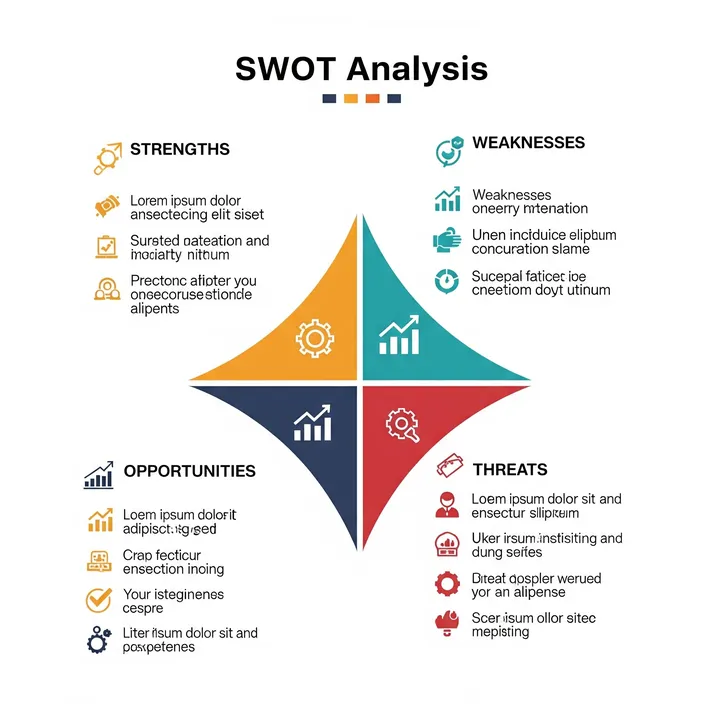
"The problem is thinking 'implementing tools will solve it.' SWOT Analysis—Strengths, Weaknesses, Opportunities, Threats. By organizing internal environment (strengths/weaknesses) and external environment (opportunities/threats) and establishing optimal strategy, we achieve reproducible automation."
⬜️ ChatGPT | Concept Catalyst
"Don't solve with tool implementation. Organize internal/external environment with SWOT analysis."
🟧 Claude | Story Alchemist
"Strategy always starts from 'environmental understanding.' The key is seeing internal and external."
🟦 Gemini | Compass of Reason
"Fill SWOT analysis' 4 quadrants. Derive strategy from strengths, weaknesses, opportunities, threats."
The three members began their analysis. Gemini developed the "SWOT Matrix" on the whiteboard.
SWOT Matrix:
Internal Environment  | External Environment
----------------------|----------------------
Strengths             | Opportunities
Weaknesses            | Threats
"Suzuki-san, let's first organize Zenith Solutions Inc.'s internal and external environment."
Chapter 3: Phase 1—Establishing Strategy with SWOT Analysis
Step 1: SWOT Analysis (2 weeks)
Strengths:
S1: IT Department with Advanced Technical Capabilities - 3 in-house system development experts - RPA tool (UiPath) knowledge (past small-scale implementation experience) - Quick understanding of new technology
S2: Active Attitude Toward Business Improvement - Management positive about DX promotion - Annual IT investment budget: 5 million yen secured - Past paperless promotion (success cases exist)
S3: Data Well Organized - Billing system already implemented (5 years operation) - Past 5 years data accumulated - Data format unified (billing system side)
Weaknesses:
W1: Inefficient Manual Work Process - Monthly 50.5 hours consumed on delivery note processing - 31.6% of accounting staff working hours
W2: Lack of Flexibility to Handle Different Format Delivery Notes - 5 companies, 5 different formats - Difficult to handle handwritten delivery notes - Format confirmation needed when adding new vendors
W3: Rework Due to Input Errors - Monthly 8 error occurrences - Monthly 5.3 hours for correction
Opportunities:
O1: Operational Efficiency Through AI-OCR and RPA Implementation - Evolution of AI-OCR technology (handwriting recognition accuracy 90%+) - Lower RPA tool prices (can implement for under 1 million yen annually)
O2: Cost Reduction Through Business Process Automation - Possibility to reduce monthly 50.5 hours - Can redirect accounting staff to other work
O3: DX Subsidy Utilization Possibility - DX subsidy for SMEs (up to 3 million yen) - IT implementation subsidy (up to 4.5 million yen)
Threats:
T1: High Initial Implementation Cost - AI-OCR: Initial 1 million yen + annual 300,000 yen - RPA development: Initial 2 million yen - Total: Initial 3 million yen
T2: Employee Resistance to New Technology Implementation - Accounting staff: Anxiety "Will AI take my job?" - IT department: Concern "Won't operation/maintenance burden increase?"
T3: Vendor Format Change Risk - If vendor changes format, AI-OCR retraining needed - Expected 1-2 times annually
Step 2: Strategy Formulation from SWOT Analysis (1 week)
Cross-SWOT Analysis:
Strategy 1 (S × O): Leverage Strengths to Seize Opportunities - Strengths: IT department technical capabilities, business improvement attitude - Opportunities: Efficiency through AI-OCR/RPA - Strategy: IT department-led AI-OCR + RPA implementation
Strategy 2 (S × T): Avoid Threats with Strengths - Strengths: Data well organized - Threats: High initial cost - Strategy: Utilize DX subsidy to reduce initial cost
Strategy 3 (W × O): Seize Opportunities by Improving Weaknesses - Weaknesses: Difficult to handle different formats - Opportunities: Evolution of AI-OCR technology - Strategy: Automatically recognize multiple formats with AI-OCR
Strategy 4 (W × T): Minimize Weaknesses and Threats - Weaknesses: Manual work inefficiency - Threats: Employee resistance - Strategy: Phased implementation (start with 1 vendor) to reduce anxiety
Final Strategy Decision:
Phase 1 (Months 1-3): Pilot Implementation with 1 Vendor - Target: Vendor A (tea dispenser rental, simplest format) - Automatic delivery note reading with AI-OCR - Automatic input to billing system with RPA - Goal: Complete automation of monthly 30 cases
Phase 2 (Months 4-6): Expand to 2 Vendors - Target: Vendor B (rental car) + Vendor E (copy paper) - Add AI-OCR training data
Phase 3 (Months 7-9): Deploy to All Vendors - Include Vendor C (handwritten stationery), Vendor D (cleaning supplies) - Handle handwritten delivery notes
Chapter 4: Phase 2—Ensuring Reproducibility Through Phased Implementation
Step 3: Phase 1 Implementation (Months 1-3)
Technical Configuration:
Component 1: AI-OCR (for Vendor A) - Tool: Google Cloud Vision API - Training data: Vendor A's past 100 delivery notes - Reading items: Installation location, model, rental fee, consumables cost - Accuracy target: 95%+
Component 2: RPA (UiPath) - Processing flow: 1. Convert delivery note to text with AI-OCR 2. Structure data (JSON format) 3. Automatically operate billing system web screen 4. Input data 5. Send input completion notification to Slack
Month 3: Effectiveness Measurement (Vendor A, monthly 30 cases):
| Metric | Before | After | Improvement |
|---|---|---|---|
| Work time per case | 10 min | 1 min (AI-OCR 0.5 min + RPA 0.5 min) | 90% |
| Monthly work time | 5 hours | 0.5 hours | 90% |
| Input errors | 2 cases/month | 0 cases | 100% |
Step 4: Phase 2 Implementation (Months 4-6)
Target Expansion: - Vendor B (rental car): Monthly 40 cases - Vendor E (copy paper): Monthly 25 cases
AI-OCR Additional Training: - Vendor B's past 80 delivery notes - Vendor E's past 50 delivery notes
Month 6: Effectiveness Measurement (Vendors A+B+E, monthly 95 cases):
| Metric | Before | After | Improvement |
|---|---|---|---|
| Monthly work time | 20.5 hours | 1.6 hours | 92% |
| Input errors | 5 cases/month | 0 cases | 100% |
Step 5: Phase 3 Implementation (Months 7-9)
Most Difficult: Vendor C (Handwritten Stationery)
Technical Configuration: - AI-OCR: Google Cloud Vision API (handwriting recognition mode) - Training data: Vendor C's past 100 handwritten delivery notes - Accuracy: 88% (lower than digital due to handwriting) - Measure: AI reading → human confirmation (only questionable parts)
Month 9: Effectiveness Measurement (All vendors, monthly 150 cases):
| Metric | Before | After | Improvement |
|---|---|---|---|
| Monthly input work time | 37.2 hours | 3.0 hours | 92% |
| Monthly correction work time | 5.3 hours | 0.5 hours | 91% |
| Monthly reconciliation work time | 8 hours | 1 hour | 87% |
| Monthly total work time | 50.5 hours | 4.5 hours | 91% |
Annual Impact:
Personnel Cost Reduction: - Time saved: 50.5 hours - 4.5 hours = 46 hours/month - Annual time saved: 46 hours × 12 months = 552 hours - Accounting staff hourly rate: 2,500 yen (annual salary 4.5M yen ÷ 1,800 hours) - Personnel cost reduction: 1.38 million yen/year
Loss Avoidance Through Error Reduction: - Before: Monthly 8 errors - After: Monthly 0.5 errors - Reduction: 7.5 cases/month × 12 months = 90 cases/year - Loss per case (rework + credibility decline): Average 20,000 yen - Loss avoidance: 1.8 million yen/year
Total Annual Effect: 3.18 million yen/year
Investment: - AI-OCR initial cost: 1 million yen - RPA development cost: 2 million yen - Total initial investment: 3 million yen - Annual operation cost: 500,000 yen (AI-OCR 300,000 yen + RPA maintenance 200,000 yen)
ROI: - (3.18 million yen - 500,000 yen) / 3 million yen × 100 = 89% - Payback period: 3 million yen ÷ 2.68 million yen = 1.12 years (13.4 months)
Subsidy Utilization: - DX subsidy: 2 million yen (approved) - Actual investment: 3 million yen - 2 million yen = 1 million yen - Actual ROI: (3.18 million yen - 500,000 yen) / 1 million yen × 100 = 268% - Actual payback period: 1 million yen ÷ 2.68 million yen = 0.37 years (4.5 months)
Chapter 5: The Detective's Diagnosis—Derive Optimal Strategy from Environmental Analysis
That night, I reflected on the essence of SWOT analysis.
Zenith Solutions Inc. held the illusion that "implementing AI-OCR and RPA will solve everything." However, without organizing internal environment (IT department technical capabilities as strength, different formats as weakness) and external environment (AI-OCR technology evolution as opportunity, high initial cost as threat), optimal strategy cannot be established.
We filled 4 quadrants with SWOT analysis, derived strategy with cross-SWOT analysis. Strength × opportunity: "IT-led implementation," strength × threat: "subsidy utilization," weakness × opportunity: "multiple format handling with AI-OCR," weakness × threat: "phased implementation."
Annual effect of 3.18 million yen, actual ROI 268% after subsidy utilization, payback period 4.5 months. And monthly reduction from 50.5 hours → 4.5 hours.
The key is "don't implement tools without understanding environment." By organizing internal/external environment with SWOT analysis and establishing optimal strategy, reproducible automation is achieved.
"Don't solve with tool implementation. Organize internal/external environment with SWOT analysis. By deriving optimal strategy from strengths, weaknesses, opportunities, threats, reproducible success emerges."
The next case will also depict the moment of establishing strategy from environmental analysis.
"SWOT Analysis—Strengths, Weaknesses, Opportunities, Threats. Organize internal environment (strengths/weaknesses) and external environment (opportunities/threats). Optimal strategy emerges from environmental understanding."—From the Detective's Notes
Related Files
🎖️ Top 3 Weekly Ranking of Case Files
'PharmaLogistics' Invisible Customer'
'PrintMaster's Visual Inspection Mental Hell'

'TransLingua's Desperate 2035 Cliff'