ROI Case File No.392 | 'GlobalManufacturing's Invisible Root Cause'
📅 2026-01-22 23:00
🕒 Reading time: 12 min
🏷️ 5WHYS

- Chapter 1: The Superficial Symptom of Overwhelmed Indirect Departments—The Five Whys Not Being Asked
- Chapter 2: The Illusion That AI Introduction Automatically Solves Everything—Root Cause Is Not Visible
- Chapter 3: Phase 1—Digging Deep into Root Causes with 5WHYS
- Chapter 4: Phase 2—Executing Solutions for Root Causes
- Chapter 5: The Detective's Diagnosis—Solving Root Causes Changes Everything
- Related Files
Chapter 1: The Superficial Symptom of Overwhelmed Indirect Departments—The Five Whys Not Being Asked
The day after solving the QuantumGrocers 5W1H incident, a consultation arrived regarding operational efficiency improvement in manufacturing. Episode 392 of Volume 32 "Reproducibility" is a story about repeating "why" five times.
"Detective, our indirect departments are catastrophic. General affairs, accounting, human resources, purchasing. All departments have overtime exceeding 80 hours monthly. The board meeting instructed 'use AI.' However, what should we start with? Nobody knows. Employees don't know AI. They've heard of ChatGPT, but never used it. In this state, how can we achieve operational efficiency?"
GlobalManufacturing Corporation's Corporate Planning Director, Kentaro Yamada from Ota Ward, visited 221B Baker Street with an exhausted expression. In his hands, he clutched overtime hour aggregation sheets filled with red ink, alongside an abstract proposal titled "AI Transformation Initiative 2026."
"We're an automotive parts manufacturer. Five hundred eighty employees. Annual revenue 23 billion yen. Fifty-two years established. Main products are engine parts, drivetrain components. However, indirect departments are on the verge of collapse. General Affairs 12 people, Accounting 8 people, HR 6 people, Purchasing 10 people. Total 36 people. Everyone at their limit."
GlobalManufacturing Corporation Current Status: - Established: 1974 (automotive parts manufacturing) - Number of employees: 580 (Manufacturing 450, Indirect departments 130) - Annual revenue: 23 billion yen - Issues: Indirect department work overload (monthly average overtime 80 hours), zero AI knowledge, labor shortage
Yamada's voice carried deep crisis.
"Last year, three people resigned. General Affairs 1, Accounting 1, HR 1. All cited 'excessive workload.' Job postings receive no applications. Young people don't come to manufacturing indirect departments. Work concentrates on remaining staff, overtime increases further. A vicious cycle."
Indirect Department Overtime Reality (FY2025 average):
| Department | People | Monthly Overtime | Annual Overtime | Annual Overtime Pay |
|---|---|---|---|---|
| General Affairs | 12 | 82 hours | 984 hours | 35.42 million yen |
| Accounting | 8 | 95 hours | 1,140 hours | 27.36 million yen |
| HR | 6 | 78 hours | 936 hours | 16.84 million yen |
| Purchasing | 10 | 68 hours | 816 hours | 24.48 million yen |
| Total | 36 | Avg 81 hours | 3,876 hours | 104.1 million yen |
Overtime Hours Trend (Past 5 years): - 2021: Monthly average 52 hours - 2022: Monthly average 58 hours - 2023: Monthly average 67 hours - 2024: Monthly average 74 hours - 2025: Monthly average 81 hours - Increase rate: Annual average +11%
Yamada sighed deeply.
"Executives say 'introduce RPA.' Indeed, we introduced RPA for some routine work. Invoice processing in Accounting, attendance data aggregation in General Affairs. About 20 hours monthly reduction. But it's a drop in the bucket. Even reducing 20 hours from 80 hours monthly overtime, 60 hours remain."
RPA Introduction Results (implemented 2024):
Implemented Tasks: - Accounting: Invoice data entry automation - General Affairs: Attendance data aggregation and transfer
Effects: - Reduced time: 20 hours monthly (0.7% of total overtime 2,916 hours) - Investment: RPA development cost 3 million yen, annual license 600,000 yen
Problems: - Limited reduction effect (only 20 hours monthly) - RPA only handles routine work (non-routine work accounts for 80% of overtime) - Takes 3 months to introduce (overtime increases during this period)
"And AI literacy. We conducted an employee survey. 'Have you used ChatGPT?' Results: only 2 of 36 people said 'yes.' 5.6%. The remaining 94.4% never used it. For 'What do you think AI can do?', 'I don't know' was the most common answer."
AI Literacy Survey Results (36 indirect department staff):
| Question | Response | People | Percentage |
|---|---|---|---|
| Have you used ChatGPT? | Yes | 2 | 5.6% |
| No | 34 | 94.4% | |
| What do you think AI can do? | I don't know | 28 | 77.8% |
| Document creation | 5 | 13.9% | |
| Data analysis | 3 | 8.3% |
"Executives say 'AI enables efficiency.' However, what to start with? Nobody has the answer."
Chapter 2: The Illusion That AI Introduction Automatically Solves Everything—Root Cause Is Not Visible
"Yamada-san, do you believe AI introduction automatically achieves operational efficiency?"
At my question, Yamada showed a confused expression.
"Eh, isn't that the case? I heard AI is like a magic tool. Once introduced, overtime decreases."
Current Understanding (AI Omnipotence Type): - Expectation: AI introduction → Automatic overtime reduction - Problem: Why overtime occurs (root cause) is not analyzed
I explained the importance of identifying root causes with 5WHYS.
"The problem is the root cause of 'why overtime occurs' is not visible. 5WHYS—Five Whys. By repeating 'why?' five times, we identify root causes rather than superficial symptoms. Unless root causes are solved, any tool introduced will have limited effectiveness."
⬜️ ChatGPT | Concept Catalyst
"Don't rely on AI. Repeat 'why' five times with 5WHYS to identify root causes"
🟧 Claude | Story Alchemist
"Problems are always 'the tip of the iceberg.' Finding root causes hidden underwater is essential"
🟦 Gemini | Compass of Reason
"Execute 5WHYS analysis. Solve root causes, not superficial symptoms"
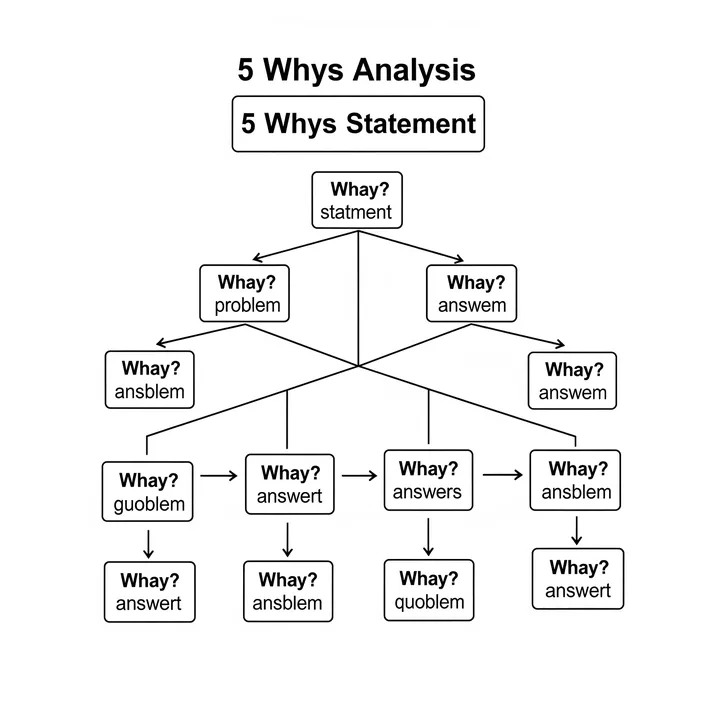
The three members began analysis. Gemini deployed the "5WHYS Analysis Tree" on the whiteboard.
5WHYS Framework: - Why 1: Why is (superficial problem) occurring? - Why 2: Why is (cause of Why 1) occurring? - Why 3: Why is (cause of Why 2) occurring? - Why 4: Why is (cause of Why 3) occurring? - Why 5: Why is (cause of Why 4) occurring? → Root Cause
"Yamada-san, let's first repeat 'why' five times."
Chapter 3: Phase 1—Digging Deep into Root Causes with 5WHYS
Step 1: Why 1—Confirming Superficial Problem (Week 1)
Question 1: "Why are indirect department operations overwhelmed?"
Answer 1: "Because overtime averages 81 hours monthly"
Data Confirmation: - FY2025 average overtime hours: 81 hours/month - 36 people total annual overtime hours: 3,876 hours - Annual overtime pay: 104.1 million yen
Finding: - This is a "symptom," not a "cause" - Need to dig deeper into why overtime hours are increasing
Step 2: Why 2—Workload Analysis (Week 1-2)
Question 2: "Why is overtime averaging 81 hours monthly?"
Answer 2: "Because workload is excessive relative to personnel"
Workload Quantification:
General Affairs Workload Analysis (12 people): - Monthly processing volume: 1,200 cases (equipment orders, facility management, visitor reception, etc.) - Average processing time per case: 45 minutes - Monthly required time: 1,200 cases × 45 minutes = 900 hours - Regular working hours: 12 people × 160 hours/month = 1,920 hours - Difference: 900 hours can be processed within regular working hours → Overtime cause is elsewhere
Accounting Workload Analysis (8 people): - Monthly processing volume: 850 cases (invoice processing, expense settlement, monthly closing, etc.) - Average processing time per case: 1.2 hours - Monthly required time: 850 cases × 1.2 hours = 1,020 hours - Regular working hours: 8 people × 160 hours/month = 1,280 hours - Difference: 1,020 hours can be processed within regular working hours → Overtime cause is elsewhere
Finding: - Workload itself can be processed within regular working hours - Problem is not "workload" but "how work is done"
Step 3: Why 3—Business Process Analysis (Week 2-3)
Question 3: "Why does overtime occur with workload that should be processable within regular working hours?"
Answer 3: "Because business processes are inefficient"
Inefficient Process Reality Investigation:
Accounting Invoice Processing Process (per case): 1. Receive paper invoice (mail or fax) 2. Manual Excel ledger entry (items, amounts, suppliers, etc.) 3. Email to approver (PDF scan) 4. Approver stamps paper with seal 5. Re-enter in Excel (approval date, approver name) 6. Manual entry in accounting system (double entry) 7. File paper invoice
Processing time per case: 1.2 hours - Manual entry (Excel): 20 minutes - Scan and email: 15 minutes - Awaiting approval: 30 minutes (average) - Manual entry (accounting system): 20 minutes - Filing: 5 minutes - Other: 10 minutes
Finding: - Double entry occurs (Excel + accounting system) - Paper and digital mixed (inefficient) - Approval process slow (waiting for stamps)
Step 4: Why 4—Why Business Flows Aren't Improved (Week 3-4)
Question 4: "Why aren't inefficient business processes improved?"
Answer 4: "Because they don't know how to improve operations"
Employee Interviews (30 of 36 people):
| Question | Response | People | Percentage |
|---|---|---|---|
| Do you want to improve business processes? | Yes | 28 | 93.3% |
| No | 2 | 6.7% | |
| Do you know how to improve? | Yes | 3 | 10% |
| No | 27 | 90% | |
| Why not improve? | Don't know method | 22 | 73.3% |
| No time | 5 | 16.7% | |
| Can't get supervisor approval | 3 | 10% |
Finding: - 93.3% want to improve - However, 90% don't know improvement methods - Problem is not "motivation" but "knowledge and skill deficiency"
Step 5: Why 5—Why Knowledge and Skills Are Lacking (Week 4)
Question 5 (Final): "Why don't they know how to improve operations?"
Answer 5 (Root Cause): "Because they haven't received specialized education and training"
Education and Training Reality Investigation:
Past 5 Years Training Results (36 indirect department staff): - Operational efficiency training: 0 times - AI/DX related training: 0 times - RPA training: 1 time (2024, only 2 participants) - Excel training: 1 time (2022, 8 participants)
Annual Training Budget: - Manufacturing department (450 people): Annual 18 million yen (40,000 yen per person) - Indirect departments (36 people): Annual 360,000 yen (10,000 yen per person) - 1/4 of manufacturing department
Root Cause Identification: - Insufficient education investment in indirect departments - No opportunities to learn operational improvement skills - No opportunities to gain AI or RPA knowledge
Chapter 4: Phase 2—Executing Solutions for Root Causes
Month 1-2: Education Program Design and Implementation
Solution 1: Phased AI Education Program (All 3 Phases)
Phase 1: Basics (Week 1-2) - Target: All indirect department staff (36 people) - Content: - ChatGPT basics (prompt writing, text generation, summarization) - Business usage examples (email composition, meeting minutes summarization) - Time: 4 hours per day × 2 days = 8 hours - Instructor: External AI specialist instructor - Cost: 800,000 yen
Phase 2: Practical (Week 3-4) - Target: Department leaders (12 people) - Content: - Business process analysis methods - RPA/AI utilization criteria - Excel automation (macros, Power Query) - Time: 6 hours per day × 3 days = 18 hours - Instructor: External consultant - Cost: 1.5 million yen
Phase 3: Advanced (Week 5-8) - Target: Selected from each department (8 people) - Content: - Business automation tool development (Power Automate, Python) - Advanced AI usage examples (GPT-4 API, data analysis) - Time: 6 hours per day × 5 days = 30 hours - Instructor: External engineer - Cost: 2 million yen
Total Investment: 4.3 million yen
Solution 2: Business Process Improvement Project
Month 3-4: Accounting Invoice Processing Improvement (Pilot Project)
Improvement Content: 1. Paper invoices → Transition to electronic invoices (negotiate with suppliers) 2. Excel manual entry → OCR + AI automatic entry 3. Approval process → Electronic approval (workflow system) 4. Accounting system double entry → Automatic transfer via API integration
Technical Configuration: - OCR: Google Cloud Vision API - AI entry support: GPT-4 (automatic item classification) - Workflow system: Microsoft Power Automate - Accounting system integration: API development
Effect Measurement (Month 4):
| Indicator | Before | After | Improvement |
|---|---|---|---|
| Processing time per case | 1.2 hours | 0.2 hours | 83% reduction |
| Monthly processing time (850 cases) | 1,020 hours | 170 hours | 83% reduction |
| Monthly overtime (Accounting) | 95 hours | 18 hours | 81% reduction |
| Annual reduced time (Accounting) | - | 10,200 hours | - |
Month 5-8: Deployment to All Departments
General Affairs: Equipment Order Process Improvement - Before: Paper order forms + Excel management - After: Web forms + automatic approval flow - Reduced time: 80 hours monthly → 960 hours annually
HR: Attendance Data Processing Improvement - Before: Attendance system → Excel → Payroll system (manual entry) - After: Automatic transfer via API integration - Reduced time: 45 hours monthly → 540 hours annually
Purchasing: Quotation Comparison Work Improvement - Before: Manual comparison of 3 company quotes in Excel - After: AI automatic comparison tool (GPT-4 proposes optimal vendor) - Reduced time: 38 hours monthly → 456 hours annually
Year 1 Comprehensive Effects:
Annual Reduced Time: - Accounting: 10,200 hours - General Affairs: 960 hours - HR: 540 hours - Purchasing: 456 hours - Total: 12,156 hours
Overtime Hours Change: - Before: Annual 3,876 hours (monthly average 81 hours × 36 people × 12 months ÷ 12) - Reduction: 12,156 hours - After: Zero overtime + 9,280 hours surplus time (can allocate to new work)
Labor Cost Reduction: - Overtime pay reduction: 3,876 hours × 3,000 yen per hour = 116.28 million yen/year - Investment recovery: From year 2 onward, 116.28 million yen reduction effect continues annually
Investment: - AI education program: 4.3 million yen - Business process improvement system development: 12 million yen - Annual running cost: 2.4 million yen (API licenses, maintenance) - Total initial investment: 16.3 million yen
ROI: - (116.28 million - 2.4 million) / 16.3 million × 100 = 698% - Investment recovery period: 16.3 million ÷ 113.88 million = 0.14 years (approximately 2 months)
Chapter 5: The Detective's Diagnosis—Solving Root Causes Changes Everything
That night, I contemplated the essence of 5WHYS.
GlobalManufacturing held the illusion that "introducing AI reduces overtime." However, the root cause of the problem wasn't "lack of AI."
We repeated "why" five times with 5WHYS. Why 1 (excessive overtime), Why 2 (excessive workload?), Why 3 (inefficient business processes), Why 4 (don't know improvement methods), Why 5 (haven't received education).
The root cause was "lack of specialized education and training." By investing 4.3 million yen in education programs and 12 million yen in business improvement systems for this root cause, we achieved annual overtime pay reduction of 116.28 million yen, ROI of 698%, and investment recovery in 2 months.
What's important is solving "root causes hidden underwater" rather than addressing "superficial symptoms." By identifying root causes with 5WHYS, reproducible solutions become visible.
"Don't rely on AI. Repeat 'why' five times with 5WHYS to identify root causes. Rather than addressing the tip of the iceberg, solving underwater root causes creates reproducible success."
The next incident will also depict the moment of digging deep into root causes.
"5WHYS—Five Whys. Repeat 'why?' five times. Identify root causes, not superficial symptoms. By finding truth hidden underwater in the iceberg, reproducible solutions emerge."—From the detective's notes
Related Files
🎖️ Top 3 Weekly Ranking of Classified Case Files
What is MVP
What is Agile Development
What is STP Analysis