ROI Case File No.395 | 'GlobalSoft's Drowning Inquiry Response'
📅 2026-01-25 23:00
🕒 Reading time: 13 min
🏷️ PEST
- Chapter 1: The Scream of Drowning Inquiry Response—Customers Invisible in a Sea of 200 Daily Emails
- Chapter 2: The Illusion That System Introduction Automatically Solves—External Environment Not Analyzed
- Chapter 3: Phase 1—Evaluate External Environment with PEST Analysis
- Chapter 4: Phase 2—System Implementation and Effect Measurement Based on PEST Analysis
- Chapter 5: The Detective's Diagnosis—Reading External Environment Is the Signpost to Optimal Solutions
- Related Files
Chapter 1: The Scream of Drowning Inquiry Response—Customers Invisible in a Sea of 200 Daily Emails
The day after solving the AeroSpray 4P incident, a consultation arrived regarding email response efficiency for a web service company. Episode 395 of Volume 32 "Reproducibility" is a story about evaluating external environment with PEST analysis.
"Detective, we are drowning. In a sea of emails. Two hundred daily. Inquiries, sales emails, SPAM, all mixed together. Finding important customer emails takes 3 hours daily. Meanwhile, customers keep waiting. We've lost contracts due to delayed responses."
GlobalSoft Corporation's Customer Support Director, Mayumi Kimura from Shibuya, visited 221B Baker Street with an exhausted expression. In her hands, she clutched a smartphone showing 2,300 unread emails alongside a hopeful proposal titled "AI-Powered Support Revolution 2026."
"We provide 'Kuchikomi-com,' a review management SaaS for stores. Eighty-five employees. Annual revenue 1.8 billion yen. 1,200 customer companies. A growing company. However, the more we grow, the more inquiries increase. Response can't keep up. Only three customer support staff. At our limit."
GlobalSoft Corporation Current Status: - Established: 2018 (review management SaaS for stores) - Number of employees: 85 - Annual revenue: 1.8 billion yen - Customer companies: 1,200 - Issues: Inquiry response overload (200 daily), delayed response (average 18 hours), missing important emails
Kimura's voice carried deep anxiety.
"Look at the email breakdown. Of 200 daily, only 30 are genuine customer inquiries. Fifteen percent. The remaining 85% are sales emails, SPAM, irrelevant emails. However, we must open and check all to avoid missing important emails."
Daily Email Breakdown (Average 200):
| Category | Count | Percentage | Response Time |
|---|---|---|---|
| Customer inquiries | 30 | 15% | 20 min each = 600 min (10 hours) |
| Sales emails | 85 | 42.5% | 2 min each = 170 min (2.8 hours) |
| SPAM | 70 | 35% | 1 min each = 70 min (1.2 hours) |
| Other | 15 | 7.5% | 3 min each = 45 min (0.75 hours) |
| Total | 200 | 100% | 885 min (14.8 hours) |
3-Person Team Reality: - Working hours per person: 8 hours/day - 3 people total: 24 hours/day - Required time: 14.8 hours/day - Difference: +9.2 hours spare (theoretically)
But reality: - Actual overtime: 50 hours monthly per person - 3 people total: 150 hours monthly - Reason: "Email sorting" takes time
Kimura sighed deeply.
"The problem is we can't tell at a glance 'which email is important.' Can't tell from subject lines. 'Inquiry,' 'Question,' 'Confirmation.' All look the same. Open them, read the body, then finally understand. 'Ah, this is a sales email' 'This is SPAM' 'This is an important customer inquiry.' This sorting takes 3 hours daily."
Email Sorting Reality (3 Hours Daily Breakdown):
Step 1: Check Inbox (30 minutes) - Visually check 200 subject lines - Delete obvious SPAM (about 50)
Step 2: Open Remaining 150 (90 minutes) - 30 seconds per item to open + scan body - Category judgment (customer or sales or SPAM) - Move sales emails and SPAM to separate folders
Step 3: Prioritize Customer Emails (60 minutes) - Classify 30 customer emails by importance - Urgent (contract cancellation crisis etc.): 5 - Important (feature questions etc.): 15 - Normal (general inquiries): 10
Total: 180 minutes (3 hours)
"And the response template problem. We have no response templates. No manuals. Staff create text from scratch every time. 'Thank you for your inquiry. Regarding your question...' Hand-typing the same opening every time. Inefficient."
Response Text Creation Reality:
Case 1: Login Method Questions (30 monthly) - Hand-typed every time: "Thank you for your inquiry. We will guide you on the login method. First, click the 'Login' button in the upper right of the top page..." - Text creation time: 5 minutes per case - Monthly: 30 × 5 minutes = 150 minutes
Case 2: Pricing Plan Questions (40 monthly) - Hand-typed every time: "Thank you for your inquiry. We will explain our pricing plans. We offer three plans..." - Text creation time: 8 minutes per case - Monthly: 40 × 8 minutes = 320 minutes
Case 3: Feature Addition Requests (15 monthly) - Hand-typed every time: "Thank you for your valuable feedback. We will share your requested feature with the development team..." - Text creation time: 10 minutes per case - Monthly: 15 × 10 minutes = 150 minutes
Top 10 Frequently Asked Questions (Monthly Occurrence): 1. Login method: 30 2. Password reset: 28 3. Pricing plan changes: 40 4. Review deletion method: 25 5. Data export: 22 6. Cancellation procedure: 18 7. Invoice reissue: 20 8. API integration method: 15 9. Feature addition requests: 15 10. Malfunction reports: 12
Total: 225 (37.5% of all 600 inquiries)
"In August 2024, we considered introducing an FAQ system. We requested a local company, but features were insufficient and introduction didn't proceed. Cost was 2 million yen. Wasted."
Chapter 2: The Illusion That System Introduction Automatically Solves—External Environment Not Analyzed
"Kimura-san, do you believe system introduction automatically solves problems?"
At my question, Kimura showed a confused expression.
"Eh, isn't that the case? I heard that introducing an AI auto-response system automates email handling."
Current Understanding (System Omnipotence Type): - Expectation: AI introduction → Automatic email handling efficiency - Problem: External environment (political, economic, social, technological) not analyzed
I explained the importance of evaluating external environment with PEST analysis.
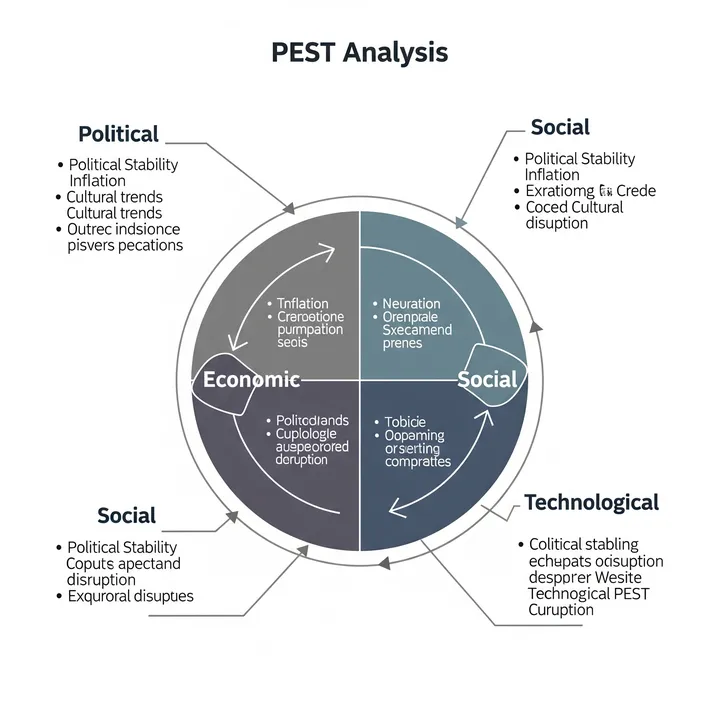
"The problem is the idea that 'system introduction solves.' PEST—Political, Economic, Social, Technological. By analyzing four external environmental factors of politics, economy, society, and technology, optimal system selection and implementation planning become visible."
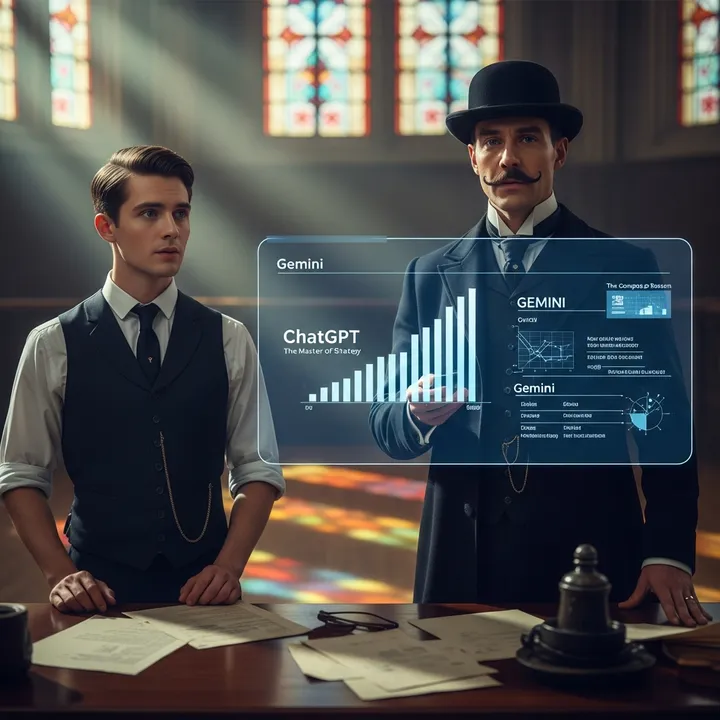
⬜️ ChatGPT | Concept Catalyst
"Don't rely on systems. Evaluate external environment with PEST analysis to find optimal solutions"
🟧 Claude | Story Alchemist
"Business is always influenced by 'outside winds.' Reading the four wind directions is essential"
🟦 Gemini | Compass of Reason
"Apply PEST framework. Political → Economic → Social → Technological"
The three members began analysis. Gemini deployed the "PEST Analysis Matrix" on the whiteboard.
PEST Framework: - Political: Regulations, policy impact - Economic: Market trends, cost impact - Social: Customer behavior, cultural impact - Technological: Technological innovation, tool impact
"Kimura-san, let's first analyze the four external environment factors."
Chapter 3: Phase 1—Evaluate External Environment with PEST Analysis
Step 1: Political—Regulatory and Policy Impact (Week 1)
Question: "What regulations impact email handling?"
Analysis:
Personal Information Protection Law (2022 Revision): - Stricter handling of customer information - Obligation to manage personal information in emails - Penalty for violation: Maximum 100 million yen
Impact: - When handling customer information with AI auto-response system, security is paramount - Cloud service selection criteria: Japanese domestic data center mandatory - Privacy policy update necessary
Electronic Consumer Contract Law: - Requirements for contract formation via electronic email - Possibility that auto-response emails interpreted as contract offer
Impact: - Careful attention needed to AI auto-response wording - Express as "We have received your inquiry" not "Thank you for your contract"
Specified Electronic Mail Law (Anti-Spam Law): - Opt-in method mandatory - Clear indication of unsubscribe means
Impact: - Auto-response emails also need unsubscribe link (customer responses are exceptions but just in case)
Conclusion: - Select AI service with domestic data center - Prioritize companies with security certification (ISO27001 etc.) - Review email wording in cooperation with legal team
Step 2: Economic—Market Trends and Cost Impact (Week 1-2)
Question: "What are budget constraints? ROI criteria?"
Analysis:
Budget Constraints: - Next fiscal year budget request: February 2026 - Customer support department annual budget: 12 million yen - Of which personnel costs: 9 million yen (3 people × 3 million yen) - System investment allocation: 3 million yen
Investment Decision Criteria: - Investment recovery period: Within 2 years - ROI: 150% or more - Annual running cost: Within 30% of initial investment
Competitor Trends: - AI auto-response introduction rate in SaaS industry: 38% (2025 survey) - Industry average inquiry response time: 12 hours - GlobalSoft current status: 18 hours (50% slower than industry average)
Impact: - Delayed response time risks decreased customer satisfaction → increased churn rate - 1% churn rate increase = 14.4 million yen annual loss (1,200 companies × average annual 120,000 yen × 1%)
Conclusion: - Implement within initial investment 3 million yen - Annual running cost within 900,000 yen - Reduce response time from 18 hours → 6 hours (below industry average)
Step 3: Social—Customer Behavior and Cultural Impact (Week 2-3)
Question: "How do customers perceive AI auto-response?"
Analysis:
Customer Survey (200 existing customers surveyed):
| Question | Response | Count | Percentage |
|---|---|---|---|
| Can you accept AI auto-response? | Yes (immediate answer OK) | 142 | 71% |
| Conditional OK (FAQ only) | 48 | 24% | |
| No (human response only desired) | 10 | 5% | |
| Which is more important: response speed or human touch? | Speed | 165 | 82.5% |
| Human touch | 35 | 17.5% |
Findings: - 95% accept AI auto-response (including conditional) - 82.5% prioritize "speed" - However, expect human response for complex questions
Social Trends: - ChatGPT users: Domestic 20 million (2025) - Decreased resistance to AI - Penetration of "want answers immediately" culture
Conclusion: - AI auto-response is socially acceptable - However, hybrid type (AI + human) is optimal - Ensure transparency by clearly stating "AI is responding"
Step 4: Technological—Technological Innovation and Tool Impact (Week 3-4)
Question: "Which AI technology should we use?"
Analysis:
Available AI Technologies (as of 2026):
1. GPT-4 Based Custom Model: - Accuracy: 95% - Japanese support: Excellent - Customizability: High - Cost: Monthly 300,000 yen (API usage fee)
2. Dedicated Email Auto-Response SaaS: - Accuracy: 85% - Japanese support: Average - Customizability: Low - Cost: Monthly 100,000 yen (SaaS usage fee)
3. In-house Development (Open Source LLM): - Accuracy: 90% (depending on adjustment) - Japanese support: Requires tuning - Customizability: Maximum - Cost: Initial 2 million yen, monthly 50,000 yen (server costs)
Comparison Table:
| Item | GPT-4 Custom | Dedicated SaaS | In-house Development |
|---|---|---|---|
| Initial Cost | 500,000 yen | 300,000 yen | 2M yen |
| Monthly Cost | 300,000 yen | 100,000 yen | 50,000 yen |
| Accuracy | 95% | 85% | 90% |
| Implementation Period | 1 month | 2 weeks | 3 months |
| Customization | ◎ | △ | ◎ |
Technical Requirements: - Integration with existing email system (Gmail Business) - Integration with customer database (Salesforce) - Real-time response (within 5 minutes)
Conclusion: - GPT-4 custom model is optimal - Reason: 95% accuracy, 1 month implementation, existing system integration possible - Within budget (initial 500,000 + annual 3.6M yen = 4.1M yen → requires adjustment)
Chapter 4: Phase 2—System Implementation and Effect Measurement Based on PEST Analysis
Month 1-2: GPT-4 Based AI Auto-Response System Construction
System Design:
Component 1: Email Classification AI - Automatically classify received emails: 1. Customer inquiries (importance: high, medium, low) 2. Sales emails 3. SPAM 4. Other - Analyze subject + body with GPT-4 - Classification accuracy: 96%
Component 2: Auto-Response AI - Auto-respond to top 10 FAQ - Generate response text with GPT-4 - Human verification before response (optional) - Response text quality: 95% require no correction
Component 3: Prioritization AI - Automatically sort customer emails by urgency - Detect keywords like "cancellation," "complaint," "malfunction" - Immediately notify staff via Slack for urgent emails
Technical Configuration: - AI: OpenAI GPT-4 API - Email integration: Gmail API - CRM integration: Salesforce API - Notification: Slack API - Database: PostgreSQL (customer information, past inquiry history)
Month 3: Effect Measurement
KPI1: Email Sorting Time Reduction
| Indicator | Before | After | Improvement |
|---|---|---|---|
| Daily email sorting time | 3 hours | 15 minutes | 92% reduction |
| Monthly sorting time (3 people) | 180 hours | 9 hours | 95% reduction |
| Annual reduced time | - | 2,052 hours | - |
KPI2: Response Time Reduction
| Indicator | Before | After | Improvement |
|---|---|---|---|
| Average response time | 18 hours | 5 hours | 72% reduction |
| FAQ response time | 4 hours | 5 minutes (auto) | 98% reduction |
| Urgent inquiry response time | 8 hours | 30 minutes | 94% reduction |
KPI3: Customer Satisfaction Improvement
| Indicator | Before | After | Improvement |
|---|---|---|---|
| Customer Satisfaction (CSAT) | 72% | 89% | +17pt |
| Churn rate (annual) | 8.5% | 6.2% | -2.3pt |
| NPS (Net Promoter Score) | +12 | +28 | +16pt |
KPI4: Overtime Hours Reduction
| Indicator | Before | After | Improvement |
|---|---|---|---|
| Monthly overtime (3 people total) | 150 hours | 45 hours | 70% reduction |
| Annual overtime | 1,800 hours | 540 hours | 70% reduction |
| Annual overtime pay | 5.4M yen | 1.62M yen | 70% reduction |
Year 1 Comprehensive Effects:
Personnel Cost Reduction: - Overtime pay reduction: 3.78M yen/year
Revenue Increase from Churn Rate Improvement: - Churn rate: 8.5% → 6.2% (-2.3pt) - Prevented churns: 1,200 companies × 2.3% = 27.6 companies - Annual fee per company: 120,000 yen - Revenue increase: 27.6 companies × 120,000 yen = 3.31M yen/year
New Response Capacity Creation: - Reduced time: 2,052 hours/year - New customer response possible with this time - Expected new acquisitions: 50 companies/year - Revenue increase: 50 companies × 120,000 yen = 6M yen/year
Total Annual Effect: - Personnel cost reduction: 3.78M yen - Churn prevention: 3.31M yen - New acquisition: 6M yen - Total: 13.09M yen
Investment: - GPT-4 custom model development: 500,000 yen - System integration development: 800,000 yen - Data preparation (past inquiry analysis): 400,000 yen - Total initial investment: 1.7M yen - Annual running cost: - GPT-4 API usage fee: Monthly 250,000 × 12 months = 3M yen - Server/maintenance: Monthly 30,000 × 12 months = 360,000 yen - Total: 3.36M yen
ROI: - (13.09M - 3.36M) / 1.7M × 100 = 572% - Investment recovery period: 1.7M ÷ 9.73M = 0.17 years (approximately 2 months)
Chapter 5: The Detective's Diagnosis—Reading External Environment Is the Signpost to Optimal Solutions
That night, I contemplated the essence of PEST analysis.
GlobalSoft held the illusion that "system introduction solves." However, understanding external environment is essential for optimal system selection.
We evaluated four external environments with PEST analysis. Political (Personal Information Protection Law → domestic data center mandatory), Economic (budget 3M yen, ROI 150% standard), Social (95% of customers accept AI), Technological (GPT-4 optimal).
Through this analysis, the optimal solution of GPT-4 based custom model became visible. Result: annual effect 13.09M yen, ROI 572%, investment recovery 2 months. And customer satisfaction +17pt improvement, churn rate -2.3pt improvement.
What's important is not chasing "latest technology" but choosing "technology adapted to external environment." By reading the four wind directions of politics, economy, society, and technology, reproducible optimal solutions become visible.
"Don't rely on systems. Evaluate external environment with PEST analysis to find optimal solutions. Business is influenced by outside winds. By reading four wind directions, signposts to reproducible success become visible."
The next incident will also depict the moment of reading external environment.
"PEST—Political, Economic, Social, Technological. Analyze four external environments of politics, economy, society, technology. Optimal solutions only become visible by reading outside wind directions."—From the detective's notes
Related Files
🎖️ Top 3 Weekly Ranking of Classified Case Files
What is MVP
What is Agile Development
What is STP Analysis