ROI [🔏CONFIDENTIAL FILE] No. X050 | What is the ECRS Principle
📅 2025-11-15
🕒 Reading time: 15 min
🏷️ ECRS 🏷️ Operational Improvement 🏷️ Learning 🏷️ [🔏CONFIDENTIAL FILE]
- What is the ECRS Principle - Case Overview
- Basic Structure of ECRS - Evidence Analysis
- ECRS Implementation Procedure - Investigation Methods
- Power of ECRS - Solution Capability
- Limitations and Precautions of ECRS - Investigation Warnings
- Related Case Files
- Industry-Specific ECRS Applications - Field Investigation Records
- Investigation Summary - The ECRS Principle
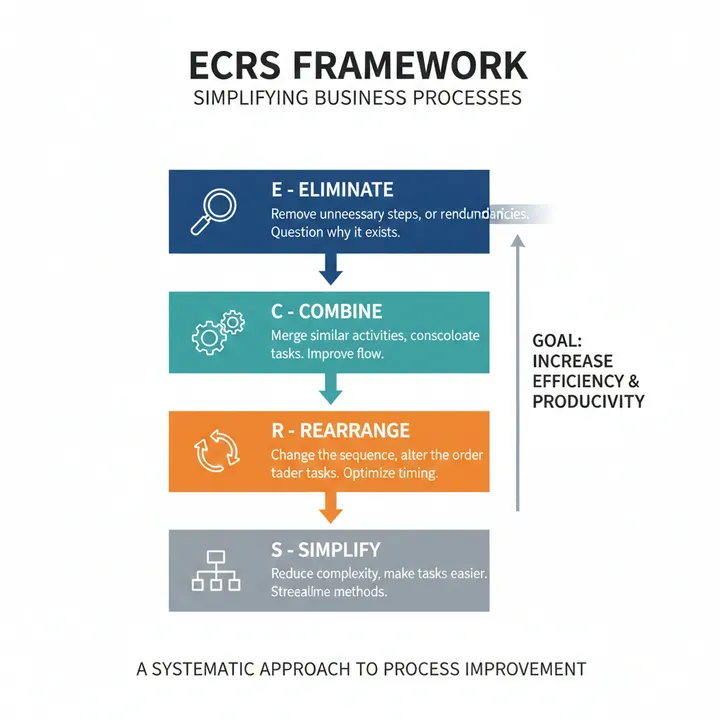
Detective's Memo: The golden rule of operational improvement born from the Toyota Production System - "The ECRS Principle." While many jump to the simplistic conclusion that "efficiency = automation," true improvement begins with a more fundamental question: "Is this task even necessary?" The four perspectives of Eliminate, Combine, Rearrange, and Simplify possess a clear hierarchical structure with explicit priorities. Why consider "stopping" first and "simplification" last? Why does Toyota teach "first make it work manually before automating"? An approval flow consuming 200 hours monthly reduced to 0 hours by "eliminating approval itself." A 30-minute meeting shortened to 15 minutes with "standing meetings." Five systems consolidated into one through "integration" - the essence of improvement lies in the paradox: not "doing things better" but "not doing them at all." Decode the four-stage thinking methodology that circumvents the efficiency trap and liberates true productivity.
What is the ECRS Principle - Case Overview
The ECRS Principle, formally known as the "Four-Stage Thinking Framework for Operational Improvement," is a methodology developed from the Toyota Production System. It is recognized among our clients as a technique that achieves fundamental operational improvement rather than superficial efficiency by examining the four perspectives - Eliminate, Combine, Rearrange, and Simplify - "in this specific order." However, in actual practice, most organizations treat them as "four options" in parallel, failing to understand the hierarchical structure of priorities and the strategic value of "higher-level improvements yielding greater effects."
Investigation Note: Why is the sequence "E→C→R→S" crucial in ECRS? The answer lies in the magnitude of improvement impact. Eliminating unnecessary work (E) achieves 100% labor reduction, while simplification (S) delivers at best 30-50% reduction. Just as the Realization First Principle advocates "realize first, then identify bottlenecks," ECRS advocates "eliminate the unnecessary first, then optimize." Both share the fundamental thinking: "review what to do rather than how to do it."
Basic Structure of ECRS - Evidence Analysis
Core Evidence: Four-stage improvement hierarchy with priority order
E: Eliminate - Can We Stop Doing This?
Definition: Abolish or eliminate the task itself
Thinking Principles:
"Is this task truly necessary?"
"What problems arise if we stop?"
"For whom and for what purpose are we doing this?"
"Was it necessary in the past but unnecessary now?"
Three Patterns of Elimination:
Pattern 1: Obsolete Tasks
Tasks that had meaning in the past but are unnecessary now

Examples:
- Regular meetings started 10 years ago (Participants: "What's the purpose?")
- Reports nobody reads (Creator: "It's customary")
- Unused Excel templates (Maintainer: "Inherited from predecessor")

Pattern 2: Duplicate Work
Same content executed in multiple places

Examples:
- Both paper applications and system entry
- Department A's report and Department B's report are essentially identical
- Same agenda repeatedly discussed in three different meetings

Pattern 3: Excessive Quality
Precision and completeness beyond necessity

Examples:
- Presentation-quality for internal documents (10x creation time)
- Calculating to the penny when estimates suffice
- Daily aggregation when monthly would do
Effects of Elimination:
Labor Reduction: 100% (task completely vanishes)
Cost Reduction: Maximum
Risk Reduction: Task errors and delays also eliminated
Secondary Effects: Related tasks can be eliminated in cascade
ROI Detective Agency Case Example:
Before: "Three-stage internal approval flow" before article publication
- Supervisor approval (2 days) → Manager approval (3 days) → Director approval (5 days)
- 10 articles/month × 10 days = 100 days of waiting time

Improvement: Complete elimination of approval flow
- Writers publish immediately
- Shifted to post-publication review system

Results:
- Waiting time: 100 days → 0 days
- Publication speed: 10 days later → Same day
- Approver workload: 20 hours/month → 0 hours
C: Combine - Can We Consolidate This?
Definition: Integrate multiple tasks or processes
Thinking Principles:
"Can separate tasks be done simultaneously?"
"Are tasks with the same purpose scattered?"
"Can we reduce travel and preparation time?"
"Can data entry be completed in one go?"
Three Patterns of Combination:
Pattern 1: Temporal Consolidation
Execute tasks done at different times simultaneously

Examples:
- Five short weekly meetings → One 60-minute weekly meeting
- Scattered orders → Monthly consolidated ordering
- Individual email replies → Batch replies twice daily

Pattern 2: Spatial Consolidation
Integrate tasks across different locations/systems

Examples:
- Three Excel files → One database
- Dual paper and digital management → Digital only
- Warehouse A and Warehouse B → Consolidated warehouse

Pattern 3: Functional Consolidation
Integrate tasks with similar functions/purposes

Examples:
- Sales reports, expense reports, daily logs → Integrated report
- Multiple small meetings → One large meeting
- Individual approval flows → Unified approval system
Effects of Combination:
Labor Reduction: 30-70% (reducing duplication and preparation time)
Quality Improvement: Error reduction through data centralization
Visibility Enhancement: Information consolidation enables holistic understanding
Case Example: Bank Mortgage Screening:
Before: Screening process scattered across 6 departments
- Identity verification (Teller window)
- Income verification (Screening Dept A)
- Property valuation (Screening Dept B)
- Credit check (Screening Dept C)
- Legal review (Legal Dept)
- Final decision (Loan Dept)
→ Documents circulated between departments, average 15 days per case

Improvement: Centralized processing by specialized team
- Established dedicated mortgage team (integrated all functions)
- Granted all necessary authorities and system access
- Completed within team

Results:
- Processing time: 15 days → 3 days
- Customer satisfaction: Significantly improved
- Inter-department coordination costs: Zero
R: Rearrange - Can We Change Order or Location?
Definition: Modify sequence, timing, location, or assignment of tasks
Thinking Principles:
"Would changing the order make it more efficient?"
"Can we parallel process?"
"Is there a more appropriate person or location?"
"Can we change the timing?"
Four Patterns of Rearrangement:
Pattern 1: Sequence Swap
Change the before-after relationship of tasks

Examples:
- Approval → Work changed to Work → Post-reporting
- Post-completion review to Mid-process review
- Month-end aggregation to Daily automatic aggregation

Pattern 2: Parallelization
Serial processing to parallel processing

Examples:
- Start B after A completes → A and B simultaneously
- Queue → Multiple windows for simultaneous service
- One person for entire process → Multiple people dividing work

Pattern 3: Assignment Change
Transfer to more appropriate person or department

Examples:
- Non-expert handling → Transfer to specialist
- High-cost personnel on routine tasks → Transfer to assistant
- Headquarters centralization → Delegation to field

Pattern 4: Location/Timing Change
Optimize execution location and time

Examples:
- Retrieve from warehouse → Stock at site
- Peak-hour tasks → Shift to off-peak hours
- In-person meetings → Remote meetings
Effects of Rearrangement:
Labor Reduction: 20-50% (reducing wait and travel time)
Speed Improvement: Dramatically shortened through parallel processing
Quality Improvement: Execution by appropriate person at optimal timing
Case Example: Amazon's Warehouse Placement Strategy:
Before: Orderly placement by product category
- Books in book area, electronics in electronics area
- Logically elegant but low picking efficiency
- Popular and unpopular items in distant locations

Improvement: Chaotic Storage
- Randomly place incoming products in available spaces
- System memorizes locations
- Popular items distributed throughout warehouse

Results:
- Picking distance: Average 30% reduction
- Improved efficiency for multi-item simultaneous picking
- Avoided concentration in specific areas
S: Simplify - Can We Make This Easier?
Definition: Simplify task procedures and methods
Thinking Principles:
"Is there a simpler method?"
"Can complex parts be simplified?"
"Can we automate?"
"Can we standardize or create templates?"
Four Patterns of Simplification:
Pattern 1: Procedure Simplification
Simplify complex procedures

Examples:
- 10 steps → Reduce to 3 steps
- 50-page manual → One-page checklist
- Complex formulas → Simple calculation tool

Pattern 2: Automation
Manual work to automatic processing

Examples:
- Manual aggregation → Auto-calculation with Excel functions
- Manual entry → Auto-entry via system integration
- Paper storage → Digitization and auto-classification

Pattern 3: Standardization/Templating
Unify disparate methods

Examples:
- Individual document formats → Unified template
- Person-dependent procedures → Standardized manual
- Inconsistent terminology → Unified glossary

Pattern 4: Tool/System Implementation
Leverage appropriate tools

Examples:
- Handwriting → PC typing
- Calculator → Excel
- Email → Chat tools
- Excel → Dedicated system
Effects of Simplification:
Labor Reduction: 10-50% (tasks remain but become efficient)
Error Reduction: Automation and standardization reduce human errors
Easy Acquisition: Simplicity enables quick training for newcomers
Critical Insight:
Simplification is the "last resort"
→ Simplifying unnecessary tasks (E) still leaves them wasteful
→ First examine E, C, R, then improve remaining necessary tasks with S
Case Example: Starbucks Order System:
Before: Confusion from complex customization
- Countless combinations
- Frequent order mistakes
- Time-consuming staff training

Improvement: Standardized calling method
- Fixed sequence: Size → Customization → Drink name
- Systematized terminology (Tall, Grande, Venti)
- Confirmation process through repetition
- Optimized POS system UI

Results:
- Order mistakes: Significantly reduced
- New hire training period: Shortened
- Processing speed: Improved
- Maintained complex customization capability
Evidence Analysis: The innovation of ECRS lies in arranging the four improvement methods "in order of greatest effect," circumventing the trap of superficial efficiency and achieving fundamental operational improvement through clear prioritization.
ECRS Implementation Procedure - Investigation Methods
Investigation Discovery 1: Toyota Production System Practice Process
Case Evidence (Origin of ECRS):
Phase 1: Visualize Current State
Method: Complete documentation of business processes

Implementation:
1. List all tasks
   - Who, what, when, where, why, how

2. Time measurement
   - Actually measure time required for each task
   - Record wait time and travel time

3. Create flow diagrams
   - Visualize workflow
   - Discover bottlenecks and waste

4. Classify value/non-value
   - Does this task provide value to customers?
   - Is it non-value-adding work (waste)?

Toyota's Seven Wastes:
- Waste of overproduction
- Waste of waiting (idle time)
- Waste of transportation (unnecessary movement)
- Waste of processing itself (excessive quality)
- Waste of inventory (excess stock)
- Waste of motion (inefficient movements)
- Waste of defects (rework)
Phase 2: Thorough Examination of E (Eliminate)
Question Checklist:
□ Is this task truly necessary?
□ What happens if we stop? (Try experimenting)
□ For whom and for what purpose are we doing this?
□ Was it necessary in the past but unnecessary now?
□ Are we doing this "just in case" or "just because"?

Toyota Case Example:
- Eliminated parts inspection process
  Reason: Quality already assured by supplier
  Effect: 100% inspection labor reduction, shortened receiving lead time

- Eliminated intermediate inventory
  Reason: Unnecessary with Just-In-Time production
  Effect: Inventory cost reduction, space savings
Phase 3: Examination of C (Combine)
Question Checklist:
□ Can we consolidate similar tasks?
□ Can we do them at the same place/time?
□ Can we centralize data?
□ Can we reduce travel and preparation time?

Toyota Case Example:
- Shortened setup changeover time (SMED)
  Before: 4 hours for die change (multiple preparation tasks)
  Improvement: Consolidated preparation to external setup (prep during operation)
  After: Die change within 10 minutes

Results:
- Small-lot production enabled
- Inventory reduction
- Multi-variety production realized
Phase 4: Examination of R (Rearrange)
Question Checklist:
□ Would changing the sequence be more efficient?
□ Can we parallel process?
□ Who/where is most appropriate?
□ Can we change timing?

Toyota Case Example:
- Implemented cell production system
  Before: Conveyor belt (serial processing)
  Improvement: U-shaped layout with one person handling multiple processes

Results:
- Multi-skilled workforce
- Flexible production adjustment
- Reduced work-in-progress
Phase 5: Implementation of S (Simplify)
Question Checklist:
□ Is there a simpler method?
□ Can we automate?
□ Can we standardize?
□ Can we improve with tools/jigs?

Toyota Case Examples:
- Andon (automation)
  Production line automatically stops when problems occur
  Anyone can detect and respond to quality issues

- Poka-Yoke (error-proofing)
  Jig design that prevents incorrect assembly
  Prevents mistakes themselves

Results:
- Built-in quality
- No expertise required
- Zero defects
Investigation Discovery 2: Application in Software Development
Case Evidence (GitHub Workflow Improvement):
Pre-Improvement Situation:
Code Review Process:
1. Developer creates Pull Request
2. Request review (manually assign reviewer)
3. Wait for review (average 2 days)
4. Conduct review
5. Request modifications
6. Modification work
7. Request re-review
8. Wait for re-review (average 1 day)
9. Approval
10. Merge
11. Deploy (manual)

Issues:
- Average duration: 5 days
- Review waiting time: 60% of total
- Many manual tasks
- Process dependent on individuals
ECRS Application:
E (Eliminate):
- Introduced review exemption rule for minor fixes
  Examples: Typo corrections, comment additions
  Effect: 20% reduction in review targets

- Eliminated format checking
  Reason: Handled by automatic formatter
  Effect: 30% reduction in review time

C (Combine):
- Integrated Review + Deploy
  Automatic deployment upon approval
  Effect: Eliminated manual deployment process

- Periodically batch review multiple small PRs
  Effect: Reduced reviewer context-switching costs

R (Rearrange):
- Automatic reviewer assignment
  Algorithm considering expertise and workload
  Effect: Eliminated manual assignment time, optimal reviewer selection

- Introduced parallel reviews
  Multiple reviewers check simultaneously
  Effect: Reduced wait time

S (Simplify):
- Enhanced automated testing and static analysis
  Automated human check items
  Effect: Simplified review perspectives

- Review templates and checklists
  Standardized confirmation items
  Effect: Shortened review time, prevented oversights

Post-Improvement Results:
- Average duration: 5 days → 4 hours
- Review waiting time: 60% → 10%
- Deploy frequency: Once weekly → 10+ times daily
Power of ECRS - Solution Capability
Power 1: Maximizing Improvement Effects
Effect differences by priority:
E (Eliminate): Labor reduction 100%
C (Combine): Labor reduction 30-70%
R (Rearrange): Labor reduction 20-50%
S (Simplify): Labor reduction 10-50%

Bad Example (implementing in reverse order):
1. First simplify for 20% improvement
2. Rearrange for 15% improvement
3. Combine for 25% improvement
4. Finally examine elimination → Discover task was unnecessary
→ Previous three steps of improvement effort wasted

Good Example (implementing in ECRS order):
1. First examine elimination → Discover task is unnecessary
→ No further examination needed, immediately achieve 100% reduction
Power 2: Structured Thinking
Vague directive to "improve efficiency"
→ Don't know where to start

Structuring via ECRS:
1. First, everyone examines "Can we stop?"
2. Next, examine "Can we consolidate?"
3. Next, examine "Can we change order/location?"
4. Finally, examine "Can we simplify?"

→ Clear procedure, reproducible process
Power 3: Compatibility with Agile Development
Utilization in Sprint Retrospectives:

"What should we improve from this sprint?"
→ Examine in ECRS order

E: What tasks this time were unnecessary?
C: Can we consolidate scattered tasks?
R: Should we change work sequence/assignment?
S: Can we simplify remaining tasks?

→ Systematic reflection, continuous improvement
Limitations and Precautions of ECRS - Investigation Warnings
Limitation 1: Psychological Resistance to "E"
Problem: People fear "stopping"

Psychology:
- Security of "just in case"
- Anxiety over losing sense of "doing something"
- Avoiding responsibility (insurance for when something happens)
- Organizational inertia

Countermeasures:
- Test small (try stopping for just one month)
- Validate with data (measure if it was truly necessary)
- Gradual reduction (start with half instead of zero)
Limitation 2: Trap of Local Optimization
Problem: Improving just one process doesn't improve the whole
Example: - Made Process A 50% more efficient - But Process B is the bottleneck, overall unchanged - Process A improvement effort wasted
Countermeasures: - Visualize overall flow (establish Baseline of Measurement) - Identify bottlenecks - Improve from bottleneck
Limitation 3: Risk of Excessive Simplification
Problem: Over-simplification degrades quality and safety

Examples:
- Completely eliminated approval flow → Mistakes proliferate
- Simplified checklist → Overlooked critical items
- Reduced procedures → Knowledge silos and black boxes

Countermeasures:
- Risk assessment
- Phased implementation
- Monitoring system
Note: Combined Use with Realization First Principle
Optimal combination:

1. First achieve full realization manually (Realization First)
2. Identify bottlenecks
3. Systematic improvement with ECRS
   E: Is this bottleneck task unnecessary?
   C: Can we consolidate with other tasks?
   R: Can we change order/assignment?
   S: Can we simplify?

→ High-speed cycle of practice → measurement → improvement
Related Case Files
Related frameworks discovered during investigation of this case:
- MVP: Value validation with minimal implementation. Application of ECRS's "E (Eliminate)" to product development philosophy
- Realization First Principle: First realize, then optimize. ECRS functions as "post-realization improvement methodology"
- Agile Development: Iterative improvement process. Utilize ECRS in sprint retrospectives
- Baseline of Measurement: Quantitative measurement of improvement effects. Quantify "how much did ECRS improve"
Industry-Specific ECRS Applications - Field Investigation Records
Manufacturing: Toyota Motor Corporation
E: Complete elimination of intermediate inventory (Just-In-Time)
C: Parts commonalization (platform strategy)
R: Production line rearrangement (cell production)
S: Automation and Poka-Yoke

Result: World-class production efficiency
IT Industry: Netflix
E: Withdrew from DVD rental business (focus on core business)
C: Integration of multiple systems (microservices architecture)
R: Optimal placement of global distribution network (CDN)
S: Simplification of selection via recommendation algorithms

Result: Streaming market leader
Retail: Amazon
E: Elimination of physical stores (online-focused)
C: Unified marketplace sales integration
R: Warehouse optimization via chaotic storage
S: Simplified one-click purchasing

Result: Overwhelming EC market share
Investigation Summary - The ECRS Principle
The ECRS Principle (Eliminate, Combine, Rearrange, Simplify) is the golden rule of operational improvement born from the Toyota Production System. Through its clear priority order of "E→C→R→S," it is a systematic thinking methodology that realizes fundamental improvement rather than superficial efficiency.
While many begin with "S (Simplify)" - "automation" or "systemization" - true improvement starts with "E (Eliminate)" - the fundamental question: "Is this task even necessary?" Nothing is more wasteful than optimizing unnecessary work.
Just as the Realization First Principle advocates "realize first, optimize later," and Agile Development advocates "iterative improvement," ECRS provides "systematic improvement procedures." Combining these three frameworks completes the high-speed cycle of practice → measurement → improvement.
The essence of improvement is not "doing better" but "not doing at all" - this paradox is the shortest path to true efficiency.
ROI Detective Agency Conclusion: Before optimizing, first consider "stopping." There is not a second to invest in unnecessary work.
🎖️ Top 3 Weekly Ranking of Case Files

'Tech Innovators' Loss Through Rework'

'Avalon Systems' ERP Implementation Gamble'

'PharmaLogistics' Invisible Customer'
Solve Your Business Challenges with Kindle Unlimited!
Access millions of books with unlimited reading.
Read the latest from ROI Detective Agency now!
*Free trial available for eligible customers only