ROI Case File No.327 | 'JourneyWorks' Disconnected Experience'
📅 2025-11-19 23:00
🕒 Reading time: 8 min
🏷️ JOURNEY

- Chapter 1: Contract as the End Point—The Illusion That Selling Finishes It
- Chapter 2: The Wall of Fragmentation—Departments Disconnect Customer Experience
- Chapter 3: Discovery Through Mapping—Emotional Fluctuation Creates Departure
- Chapter 4: Bridge as Solution—Connecting Experience Stages
- Chapter 5: The Results of Retention—Customer Retention After 12 Months
- Chapter 6: The Detective's Diagnosis—Journey as Experience
- Related Files
Chapter 1: Contract as the End Point—The Illusion That Selling Finishes It
The week after the Empathy Design EMPATHY Map case was solved, a consultation arrived from Tokyo regarding customer experience at a sales support company. Episode 327 of Volume 27, "The Pursuit of Reproducibility," tells the story of redefining purchase not as an endpoint but as a starting point.
"Detective, our sales team succeeds in acquiring contracts. Monthly contract count achieves targets. However, there's a problem. Post-contract customer satisfaction is low, with repurchase rate only 12%. We can secure contracts, yet why don't customers continue?"
Kenta Tanaka, Customer Success Director at JourneyWorks, a Shinagawa native, visited 221B Baker Street unable to hide his confusion. In his hands were reports showing high contract acquisition rates and, in stark contrast, customer analysis materials marked "frequent post-contract departure."
"We develop and sell sales support tools for small and medium enterprises in Tokyo. Founded 9 years ago. Our flagship product is SFA (Sales Force Automation) that visualizes sales activities. We provide it at ¥50,000 monthly. Our sales team is excellent, contracting with an average of 30 companies monthly."
JourneyWorks' Customer Departure Problem: - Established: 2016 (sales support tools) - Annual revenue: ¥420M - Customers: 240 companies (monthly contracts) - Monthly new contracts: Average 30 companies - Monthly cancellations: Average 28 companies (churn rate 12%) - Repurchase rate: 12% (contract renewal, additional contracts) - Problem: Can secure contracts but customers don't stay
Deep anxiety filled Tanaka's voice.
"The problem is that customers depart between contract and usage start. After contract, we hear 'initial setup is difficult' and 'don't know how to use,' leading to cancellation. Sales focuses only on 'securing contracts,' with thin follow-up afterward."
Typical Customer Departure Pattern:
Customer Company A (manufacturing, 20 employees):
Day 1 (Contract): Sales Rep: "Our SFA tool visualizes sales activities and improves closing rate! ¥50,000 monthly. First month free!"
Company A President: "That's great. We'll contract."
Contract established
Day 3 (Initial setup): Company A president logs in. Admin screen displays.
Screen: "Welcome to JourneyWorks. First, please register users."
Company A President: "User registration...? Enter sales rep names and email addresses... for 5 people? Troublesome..."
15 minutes later: "Too many setup items... I'll do it later."
Logs out
Day 10 (Email from support): Subject: "Have you completed initial setup?"
Body: "Thank you for your business. JourneyWorks support team. Initial setup doesn't appear complete yet. Please let us know if you're having difficulties."
Company A President: "Busy, haven't done setup yet... Even replying to email is troublesome."
No reply
Day 30 (Billing): First bill to Company A: ¥50,000 monthly
Company A President: "Haven't even used it yet, but billing came... Plus setup is complicated and unusable. Let's cancel."
Cancellation procedure
Result: Cancelled within 30 days of contract, never even started using
Tanaka sighed deeply.
"Sales succeeds in securing contracts. But poor subsequent customer experience leads to cancellation. Even contracting with 30 companies monthly, 28 cancel. Net gain only 2 companies. At this rate, we can't grow."
Chapter 2: The Wall of Fragmentation—Departments Disconnect Customer Experience
"Mr. Tanaka, how is coordination currently between sales and support?"
To my question, Tanaka answered.
"When sales secures a contract, they hand off customer information to the support team. However, handoff is only 'company name and contact person.' What customers expected at contract, what challenges they face... such information isn't shared."
Current Approach (Department Fragmentation Type): - Sales: Secure contracts (KPI: contract count) - Support: Teach usage (KPI: inquiry response count) - Problem: Gap between customer expectations and actual experience
I explained the importance of respecting customers' time.
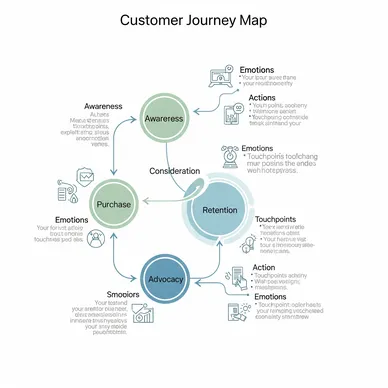
"Customer experience continues across departments. Customer Journey—from awareness through purchase, usage, and retention. Drawing this journey as one continuous line without breaks is key to improving satisfaction."
⬜️ ChatGPT | Concept Catalyst
"Don't finish at sale. Draw the journey. Purchase is chapter one of the story."
🟧 Claude | Story Alchemist
"Respect customers' time. Customer Journey smooths experience."
🟦 Gemini | Compass of Reason
"JOURNEY is experience design technology. Prevent departure through 5 stages: Awareness, Consideration, Decision, Usage, Retention."
The three members began analysis. Gemini deployed the "Customer Journey Framework" on the whiteboard.
Customer Journey's 5 Stages: 1. Awareness: Customers learn about product 2. Consideration: Compare with other companies 3. Decision: Decide to purchase 4. Usage: Actually begin using 5. Retention: Continue using, make additional purchases
"Mr. Tanaka, let's draw JourneyWorks customers' Customer Journey together."
Chapter 3: Discovery Through Mapping—Emotional Fluctuation Creates Departure
Phase 1: Current Customer Journey Analysis (3 weeks)
Interviewed 50 customer companies and visualized emotions and experiences at each stage.
[Analysis showed dramatic emotional drop from Decision to Usage stage]
Key findings: - Emotion at Decision stage: +8 (peak expectation) - Emotion at Usage stage: -3 (frustration, anxiety) - Main departure point: Between Decision and Usage - Reason: Complex initial setup, insufficient support
Chapter 4: Bridge as Solution—Connecting Experience Stages
Phase 2: Bridge Design (2 months)
We designed "bridges" to connect stages without breaks.
Improvement 1: Decision → Usage Bridge (Onboarding Support)
Before: - After contract, only sent email "Please complete initial setup" - Customer left alone - Initial setup completion rate: 28%
After: - Day after contract: Sales calls - "Let's complete initial setup together over phone" (15 minutes) - After setup, "Next, let's try entering sales data. I'll call again next week."
Effect: - Initial setup completion rate: 28% → 82% (+193%)
Improvement 2: Usage Stage Support Strengthening
Before: - Support email-only - Average 48 hours to response
After: - Phone support opened (weekdays 10 AM-6 PM) - Chat support opened (real-time response) - Video manual creation (10 videos under 5 minutes each)
Effect: - Inquiry response time: 48 hours → 2 hours (96% reduction) - Customer self-resolution rate: 12% → 58%
Improvement 3: Usage → Retention Bridge (Regular Follow-up)
Before: - After contract, sales reps focus on next contract - No follow-up for existing customers
After: - 1 week after contract: Sales calls "Have you started using? Any difficulties?" - 1 month after contract: Online meeting (30 min) "Let's review sales activities using report function" - 3 months after contract: Results confirmation meeting "Has closing rate improved? We'll propose next steps"
Effect: - Customer satisfaction: 2.8/5 → 4.3/5 - Churn rate: Monthly 12% → monthly 4% (67% reduction)
Improvement 4: Retention Stage Value Provision (Additional Feature Proposals)
Before: - No additional feature proposals - Customers only use basic features
After: - At 3 months, propose "Sales Analysis Report" function (additional ¥10,000 monthly) - "With your current usage, you're achieving these results. Using analysis reports, you can improve further" - Present specific benefits based on actual usage data
Effect: - Additional feature contract rate: 32% - Customer unit price: ¥50,000/month → ¥66,000/month (+32%)
Chapter 5: The Results of Retention—Customer Retention After 12 Months
Results After 12 Months:
Customer Metrics: - Customer count: 240 → 420 companies (+75%) - Monthly new contracts: Average 30 companies (unchanged) - Monthly cancellations: Average 28 → average 7 companies (75% reduction) - Churn rate: Monthly 12% → monthly 4% (67% improvement) - Repurchase rate (additional features): 12% → 32% (+167%)
Financial Results: - Annual revenue: ¥420M → ¥780M (+86%) - Customer unit price: ¥50,000/month → ¥66,000/month (+32%) - LTV (customer lifetime value): Average ¥600K → average ¥2.4M (+300%)
Customer Satisfaction: - Before: 2.8/5 - After: 4.3/5
Tanaka's Summary:
"Before drawing Customer Journey, we thought 'securing contracts' was the goal. Sales finished after securing contracts. Afterward was left to customers.
However, visualizing customer emotional curves through Customer Journey revealed truth. Expectation peaked at contract, but plummeted at usage stage.
Bridge from Decision to Usage, bridge from Usage to Retention. Smoothing these connections improved churn rate by 67%.
Purchase isn't the goal—it's chapter one of the story. Respecting customers' journeys and not breaking them is true customer experience."
Sales Rep Voice:
Sales A: "Previously, after securing contracts I'd move to the next customer. I thought 'post-contract follow-up is support's job.'
But now, I always call the day after contract. I support them through initial setup until they start using. When customers become able to 'use it,' they say 'thank you.' Those words make me happy."
Customer Company A's Voice (After 12 months):
"One year since contracting with JourneyWorks. Initially I was anxious 'setup looks difficult,' but the sales rep helped me set up over phone.
Afterward, with monthly follow-ups teaching usage, our entire sales team now uses it skillfully. Closing rate improved by 18%.
We considered other companies' tools, but JourneyWorks' thorough support is unmatched elsewhere. Can't let go now."
Chapter 6: The Detective's Diagnosis—Journey as Experience
That night, I reflected on the essence of Customer Journey.
JourneyWorks thought contracts were endpoints. However, for customers, contracts were the journey's beginning.
Visualizing emotional curves through Customer Journey revealed departure points. The bridge from Decision to Usage was missing. The bridge from Usage to Retention was also missing.
"Purchase isn't the goal—it's chapter one of the story. Customer Journey becomes a map that doesn't break experience."
The next case will also depict the moment of respecting customers' time.
"Don't finish at sale. Draw the journey. Awareness, Consideration, Decision, Usage, Retention. Visualize emotions through 5 stages and prevent departure. Purchase is chapter one of the story."—From the detective's notes
Related Files
🎖️ Top 3 Weekly Ranking of Classified Case Files
What is MVP
What is Agile Development
What is STP Analysis