ROI Case File No.328 | 'Mandala Tech's Scattered Thinking'
📅 2025-11-20 11:00
🕒 Reading time: 8 min
🏷️ MANDALA

- Chapter 1: Meeting as Empty Spinning—Ideas Emerge But Don't Coalesce
- Chapter 2: The Trap of Freedom—Lost Because No Structure
- Chapter 3: Order Through Coordinates—8 Perspectives Guide Ideas
- Chapter 4: The Power of Structure—Organizational Change After 12 Months
- Chapter 5: The Detective's Diagnosis—Coordinates as Ideas
- Related Files
Chapter 1: Meeting as Empty Spinning—Ideas Emerge But Don't Coalesce
The week after the JourneyWorks Customer Journey case was solved, a consultation arrived from Tokyo regarding idea generation at a product development company. Episode 328 of Volume 27, "The Pursuit of Reproducibility," tells the story of structuring chaotic ideas into execution plans.
"Detective, our product planning meetings are held weekly for 2 hours. Members generate various ideas. 'If we had this feature' or 'Let's create that service'... However, even after meetings end, nothing is decided. Ideas emerge, yet direction doesn't coalesce, priorities can't be set. And nothing gets executed."
Taro Mandara, Product Planning Director at Mandala Tech, a Shibuya native, visited 221B Baker Street with an utterly exhausted expression. In his hands were 3 months of planning meeting minutes and, in stark contrast, a progress report marked "execution zero."
"We develop and sell IoT devices and cloud services in Tokyo. Founded 5 years ago. Smart home-related devices are our flagship. The market is growing, but competitors are increasing. If we don't release new products, we'll be left behind."
Mandala Tech's Planning Stagnation: - Established: 2020 (IoT device development) - Annual revenue: ¥680M - Staff: 38 (Development 22, Sales 8, Planning 8) - Weekly planning meeting: Every Thursday 2-4 PM (2 hours) - Past 3 months' meetings: 12 times - Adopted ideas: 0 - Problem: Ideas emerge but direction doesn't solidify and nothing executes
Deep anxiety filled Mandara's voice.
"The problem is meetings only diverge without converging. Member A says 'let's create smart lighting,' Member B says 'let's create security cameras,' Member C says 'let's enhance voice assistant features.' All good ideas, but we don't have resources to do everything. Discussion loops on how to prioritize."
Typical Planning Meeting Scene:
Week 1 Meeting:
Mandara: "Today's theme is 'generating ideas for next new product.' Please share opinions freely."
Member A (Development): "How about smart lighting? Auto-adjusts color temperature to improve sleep quality."
Member B (Sales): "Rather than that, security cameras. Many customer requests. Growing market."
Member C (Planning): "We should enhance voice assistant features. Current version has slow response, pointed out in reviews."
Member D (Development): "What about smart locks? Auto-lock feature would differentiate us."
Mandara: "...All good ideas. Then, please research each in more detail by next week."
Week 2 Meeting:
Member A: "Researched smart lighting. Market size is ¥20 billion annually."
Member B: "Security camera market is ¥50 billion. This is larger."
Member C: "Voice assistant has low development cost. Can implement in 6 months."
Member D: "Smart locks are technically difficult but differentiate us."
Mandara: "...Each has pros and cons. Then, let's discuss more."
Discussion continues 2 hours but no conclusion
Week 3 Meeting:
Mandara: "Continuing from last week, I want to narrow down new product ideas."
Member E (Sales): "First, who are our target customers? Youth? Families? Seniors?"
Member F (Planning): "That changes what products we should create."
Member A: "Were we generating product ideas without deciding target?"
Mandara: "...That's right. Then, let's first decide target."
Discussion returns to square one
After 3 months:
After 12 meetings, nothing decided. 48 ideas generated cumulatively, zero adopted.
Mandara sighed deeply.
"We can generate ideas at meetings. But how to organize them, how to prioritize, how to translate to execution plans... we don't know that method."
Chapter 2: The Trap of Freedom—Lost Because No Structure
"Mr. Mandara, what frameworks are you currently using in planning meetings?"
To my question, Mandara answered.
"We're not using particular frameworks. We just say 'please generate ideas freely' and stick post-its on whiteboard. When done, photograph post-its and paste into meeting minutes."
Current Approach (Free Ideation Type): - Method: Brainstorming, post-it sticking - Problem: Ideas scatter and aren't structured - Result: Can't prioritize, nothing executes
I explained the importance of structuring thinking.
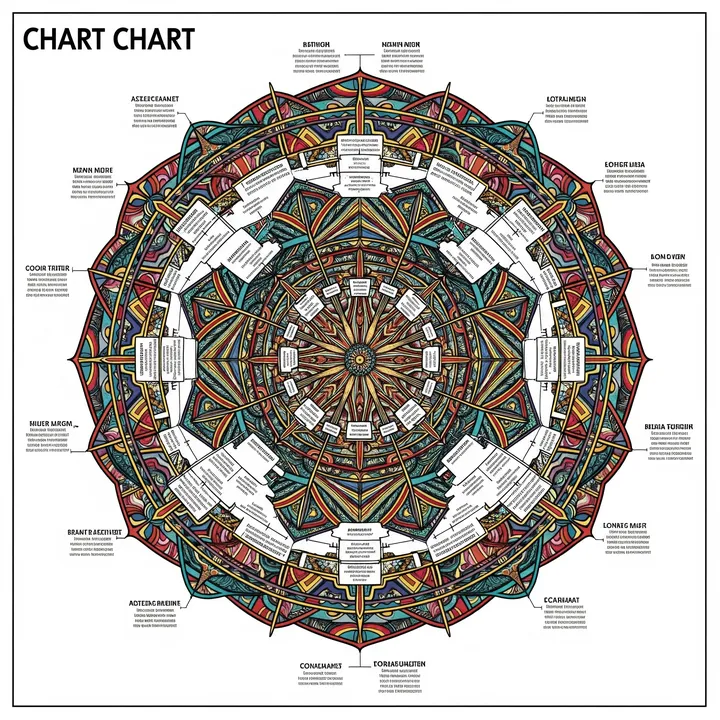
"Ideas need coordinate axes. MANDALA Chart—place theme at center, arrange 8 perspectives around it, further decompose each into 8 cells. This structure transforms chaos into order."
⬜️ ChatGPT | Concept Catalyst
"Don't ideate freely. Structure with MANDALA. Coordinate axes generate ideas."
🟧 Claude | Story Alchemist
"Creation isn't chance. Born from structure. MANDALA becomes a map of thinking."
🟦 Gemini | Compass of Reason
"MANDALA is idea organization technology. Expand central theme into 8 perspectives, further decompose each perspective into 8 elements."
The three members began analysis. Gemini deployed the "MANDALA Chart Framework" on the whiteboard.
MANDALA Chart Structure (9×9 cells):
Place "theme" at center
Arrange "perspectives" in surrounding 8 cells
Further decompose each perspective into 8 cells

┌───┬───┬───┐
│P1 │P2 │P3 │
├───┼───┼───┤
│P8 │CTR│P4 │
├───┼───┼───┤
│P7 │P6 │P5 │
└───┴───┴───┘
"Mr. Mandara, let's structure Mandala Tech's new product planning with MANDALA Chart."
Chapter 3: Order Through Coordinates—8 Perspectives Guide Ideas
Phase 1: Central Theme Setting (1 week)
First, everyone decided central theme of "what do we want to create."
After discussion, decided:
Central Theme: "Smart home products protecting family peace of mind"
Mandara: "Previously our theme was abstract 'new product.' This time we place clear value of 'protecting family peace of mind' at center."
Phase 2: Surrounding 8 Cells Perspective Setting (1 week)
Arranged 8 perspectives around central theme.
┌──────┬──────┬──────┐
│①Customer│②Tech│③Market│
├──────┼──────┼──────┤
│⑧Future│Family│④Value │
│       │Safety│       │
├──────┼──────┼──────┤
│⑦Experience│⑥Competitor│⑤Challenge│
└──────┴──────┴──────┘
8 Perspectives: 1. Customer: For whom creating? 2. Technology: What technology to use? 3. Market: Market size and trends? 4. Value: What value providing? 5. Challenge: What problems solving? 6. Competitor: What competitors doing? 7. Experience: What customer experience? 8. Future: Future vision?
Phase 3: Each Perspective 8-Cell Decomposition (2 weeks)
Further expanded each of 8 perspectives into 8 elements.
Example: ①Customer Perspective (8 elements): 1. Parents with elementary school children 2. Dual-income households 3. Anxiety about child alone at home 4. Want to know "came home safely" 5. Not tech-savvy 6. Budget ¥10,000-30,000 7. Value ease of use 8. Want peace of mind
[Similar 8-element decomposition for all 8 perspectives]
Total: 64 cells filled
Phase 4: Priority Determination (1 week)
From 64 elements, extracted highest priority items.
Top Priority Discovery: "Parents with elementary school children want to know child came home safely"
Product Concept Determined:
Product Name: "Okaeri Camera" (Welcome Home Camera)
Concept: Camera that automatically detects child's return home and notifies parents
Price: ¥12,800 (device) + ¥980/month (cloud service)
Phase 5: MVP Development (3 months)
Based on MANDALA Chart, created specific development plan.
Development tasks extracted from 64 cells: 1. Camera hardware design (from Technology perspective) 2. AI human detection (from Technology perspective) 3. Smartphone app development (from Experience perspective) 4. Cloud notification system (from Technology perspective) 5. Easy UI for parents (from Customer perspective)
Development period: Release MVP (Minimum Viable Product) in 3 months
Phase 6: MVP Release and Test Sales (3 months)
After 3 months, completed MVP and conducted test sales with 100 units.
Test Sales Results: - Sales: 100 units (sold out in 3 days) - Customer satisfaction: 4.6/5 - Review excerpts: - "Was worried about child coming home alone, but now feel reassured" - "When 'Welcome home' notification arrives, feel happy. Child is pleased too" - "Operation simple, even tech-challenged me can use"
Phase 7: Full-Scale Sales Launch (After 6 months)
Following test sales success, started full-scale sales.
Sales Results After 6 Months: - Units sold: 12,000 - Monthly service subscribers: 10,800 - Revenue: - Device sales: ¥154M (¥12,800 × 12,000) - Monthly recurring: ¥10.58M/month (¥980 × 10,800) - Annual projected revenue: ¥280M
Chapter 4: The Power of Structure—Organizational Change After 12 Months
Results After 12 Months:
Product Development: - Ideas adopted from planning meetings: 0 → 1 ("Okaeri Camera") - Period from planning to sales: Infinite loop → 9 months - Product lineup: 3 products → 4 products
Financial Results: - Annual revenue: ¥680M → ¥960M (+41%) - New product revenue: ¥280M (29% of total)
Organizational Change:
Planning Meeting Change: - Before: 2 hours divergence, no conclusion - After: 1 hour conclusion, structured with MANDALA Chart
Employee Satisfaction: - Before: 72% feel "meetings wasteful" - After: 88% feel "meetings meaningful"
Mandara's Summary:
"Before using MANDALA Chart, our planning meetings emphasized 'free thinking.' 'Say anything.' However, too much freedom caused confusion.
Structuring thinking with MANDALA Chart organized ideas. Place theme at center, decompose into 8 perspectives, further decompose each perspective into 8 elements.
Having these coordinate axes clarified 'what should we think about.' Customer, Technology, Market, Value, Challenge, Competitor, Experience, Future... Thinking from these 8 perspectives leaves no gaps.
And by filling 64 cells, priorities naturally emerged. 'This is most important.' Based on those priorities, we could translate to development tasks.
Ideas aren't chance. Born from structure. MANDALA Chart transformed chaos into order."
Member Voices:
Member A (Development): "Previous meetings just said whatever came to mind. But didn't know if it would be adopted. Now, think along MANDALA Chart's 8 perspectives. 'From customer perspective?' 'From technology perspective?' Then ideas gain depth."
Member B (Sales): "Previously, when proposing 'let's create security cameras' at meetings, couldn't answer when asked 'why?' Now, organize 'Challenge,' 'Value,' 'Market' in MANDALA Chart before proposing. So it's persuasive."
Customer Voice:
Purchaser (35, mother): "Dual-income household, 3rd grade daughter comes home alone. Daily worry 'did she get home safely?' After installing 'Okaeri Camera,' notification arrives when daughter comes home. With 'Welcome home' message. Just that brings great reassurance."
Chapter 5: The Detective's Diagnosis—Coordinates as Ideas
That night, I reflected on the essence of MANDALA Chart.
Mandala Tech sought free thinking. However, too much freedom caused confusion. Ideas emerged but didn't coalesce.
Structuring thinking with MANDALA Chart gave ideas order. Decompose central theme into 8 perspectives, further expand each perspective into 8 elements. These coordinate axes ordered chaos.
"Ideas aren't born from chance, but from structure. MANDALA Chart becomes a map of thinking."
The next case will also depict the moment when structure generates creation.
"Don't ideate freely, think with coordinate axes. Expand central theme into 8 perspectives, further decompose each perspective into 8 elements. MANDALA transforms chaos into order."—From the detective's notes
Related Files
🎖️ Top 3 Weekly Ranking of Case Files

'QuantumGrocers' Lost Customer Data'

AeroSpray's Vanishing Sales Force'
'GlobalSoft's Drowning Inquiry Response'