ROI Case File No.331 | 'The Silent Interviewers of Innovative Solutions'
📅 2025-11-22 23:00
🕒 Reading time: 9 min
🏷️ KPT

- Chapter 1: The End Point Called Independence — When Development Stops
- Chapter 2: The Darkness of Black Boxes — What Happens in Interview Rooms
- Chapter 3: The Discovery of Recording — Five Patterns of Excellent Interviewers
- Chapter 4: Evolution Through Sharing — Upskilling All 28 Members
- Chapter 5: Results of Reproducibility — Changes After 6 Months
- Chapter 6: Detective's Diagnosis — Skills Are Reproducible
- Related Files
Chapter 1: The End Point Called Independence — When Development Stops
One week after the Frontier job theory case, a consultation about recruitment interviewing arrived. Volume 27, "The Pursuit of Reproducibility," Episode 331 tells the story of verbalizing invisible skills.
"Detective, our interview trainers stop growing the moment they become independent. After that, no one observes their skills. And the know-how of excellent interviewers exists only in their heads."
Misaki Takahashi, HR Director of Innovative Solutions, originally from Shinagawa, visited 221B Baker Street with a serious expression. In her hands, she held interviewer evaluation sheets alongside an analysis report marked "Skill Visualization: Impossible."
"We conduct approximately 180 IT personnel recruitments annually, centered in Tokyo. We have 28 interviewers in total. However, there's a problem. The success rate of hires varies greatly depending on the interviewer."
Innovative Solutions' Recruitment Structure: - Established: 2012 (IT consulting company) - Employees: 420 - Annual hires: 180 - Interviewers: 28 (internal certification system) - Problem: Interviewer skills are tacit knowledge, development stagnates
Takahashi's voice carried deep urgency.
"There's a three-month training program before becoming an interviewer. Role-playing, evaluation criteria learning, shadowing senior interviewers. We provide solid support until independence. However, the moment they become independent, support stops. After that, they're left to their own judgment."
Typical Problem Cases:
Case 1: Veteran Interviewer A (5 years experience): - One-year retention rate of hires: 92% - High performance rating of hires: 78% - Characteristic: Frequent deep-dive questions like "Why do you think that?" - Problem: Skills not verbalized, not shared with other interviewers
Case 2: Mid-level Interviewer B (2 years experience): - One-year retention rate: 64% - High performance rating: 51% - Characteristic: Asks manual questions but weak at deep-diving - Problem: Receives no feedback after independence
Case 3: New Interviewer C (6 months experience): - One-year retention rate: 72% - High performance rating: 58% - Characteristic: Practices what was learned in training but lacks application skills - Problem: Continues interviewing without knowing "if this approach is correct"
Takahashi sighed deeply.
"There are two problems. First, interviewer skills are invisible. Interviews are conducted in private. No recording or video. So we don't know what anyone is doing. Second, excellent interviewers' know-how isn't shared. Interviewer A produces excellent results, but his skills exist only in his head."
Chapter 2: The Darkness of Black Boxes — What Happens in Interview Rooms
"Takahashi-san, do you currently have a system for evaluating interviewer skills?"
To my question, Takahashi shook her head.
"No. Interviewer evaluation can only be measured by the result of 'how well hired personnel performed after joining.' But that's only known after six months or a year. At the moment of the interview, no one knows what was good or bad."
Current Understanding (Results-based Evaluation): - Analysis: Post-hire performance rate (6 months to 1 year later) - Problem: Interview "process" is invisible
I explained the importance of visualizing interview skills and continuous improvement.
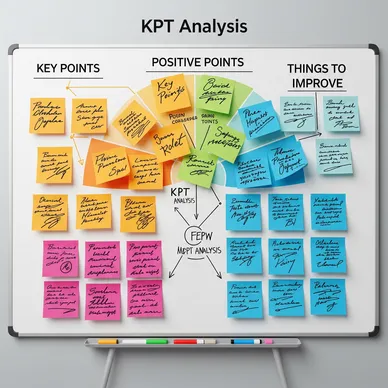
"Interviewer skills exist in the interview 'process.' What questions were asked. What reactions were drawn out. What criteria were used for evaluation. Record, analyze, and improve these. KPT — Keep, Problem, Try. If you verbalize what to continue, problems, and what to try, skills become reproducible."
⬜️ ChatGPT | Catalyst of Concepts
"Visualize skills. Interviews aren't private rooms; they're learning spaces. Run improvement cycles with KPT."
🟧 Claude | Story Alchemist
"Excellent interviewers always have 'why' in their questions. Verbalize those questions."
🟦 Gemini | Compass of Reason
"KPT is the technology of improvement. Make interview skills reproducible with Keep, Problem, and Try."
The three members began analysis. Gemini displayed the "KPT Framework" on the whiteboard.
KPT's 3 Elements: 1. Keep (Continue): What worked well, what should continue 2. Problem: What didn't work, what needs improvement 3. Try (Challenge): What to try next, new approaches
"Takahashi-san, let's first visualize the interviews. We'll record all interview content with an AI transcription tool."
Chapter 3: The Discovery of Recording — Five Patterns of Excellent Interviewers
Phase 1: AI Transcription Implementation (4 weeks)
AI transcription tools were installed in all interview rooms.
Implementation Specifications: - Tool: A certain AI transcription service (98% voice recognition accuracy) - Target: All 28 interviewers, 120 interviews - Recorded content: Spoken content, speaking time, Q&A exchanges - Privacy: Prior consent from applicants, data accessible only to HR
Phase 2: Analysis of Excellent Interviewers (3 weeks)
Analyzed 40 interview records of Interviewer A.
Discovered Patterns:
Pattern 1: Deep-diving "Why" (Frequency: Average 12 times/interview)
Interviewer A: "I see you served as team leader at your previous job. Why did you want to become a leader?"
Applicant: "Because I wanted to contribute to team goal achievement."
Interviewer A: "Why did you want to contribute to goal achievement?"
Applicant: "Because supporting member growth is my joy."
Interviewer A: "Specifically, how did you support member growth?"
Applicant: "I held weekly one-on-ones, organized each member's challenges together. Then set small goals to solve those challenges and supported their achievement."
Keep (What to Continue): - Repeating "why" three or more times makes the applicant's values visible - Drawing out specific episodes confirms reproducibility
Pattern 2: Utilizing Silence (Frequency: Average 8 times/interview)
Interviewer A: "Tell me about your most difficult project."
Applicant: "Yes, it was... (5 seconds silence)... launching a new business."
Interviewer A: (Waits silently for 10 seconds)
Applicant: "Initially, there were no sales at all, and the entire team was exhausted. However, by carefully listening to customer voices and continuously improving the service, we achieved profitability after six months."
Keep (What to Continue): - Don't fear silence, give applicants time to think - Waiting for applicants to speak voluntarily brings out their true feelings
Pattern 3: Hypothesis-Testing Questions (Frequency: Average 6 times/interview)
Interviewer A: "You said you 'value teamwork,' but if team members didn't cooperate at all, how would you act?"
Applicant: "First, I'd understand why they won't cooperate. I'd talk to them individually, grasp their anxieties and dissatisfactions. Then explain the benefits of cooperation and accumulate small successes."
Keep (What to Continue): - Throwing "what if" hypotheses confirms adaptability - Can see not just past successes but future response capabilities
Pattern 4: Repeating Applicant's Words (Frequency: Average 15 times/interview)
Applicant: "I find fulfillment in solving customer challenges."
Interviewer A: "You find fulfillment in 'solving customer challenges.' So what innovations did you make to solve those challenges?"
Keep (What to Continue): - Repeating applicant's words gives them a sense of "being heard" - Creates natural transition to deeper questioning
Pattern 5: Clarifying Evaluation Criteria (Frequency: At interview end)
Interviewer A: "In today's interview, we confirmed your 'problem-solving ability' and 'communication skills.' Specifically, we asked how you analyzed challenges in past projects and cooperated with teams to solve them. Thank you."
Keep (What to Continue): - Communicating what was evaluated at interview end creates transparency - Applicants feel "this company is sincere"
Chapter 4: Evolution Through Sharing — Upskilling All 28 Members
Phase 3: Systematizing KPT Reviews (3 months)
Made post-interview KPT recording mandatory for all interviewers.
KPT Sheet (Linked with AI Transcription):
Interviewer B (2 years experience) Record:
Keep (Continue): - Manual questions provide stability - Small talk to ease applicant tension was effective
Problem: - "Why" deep-diving was shallow, couldn't see applicant's values - Feared silence and moved to next question too quickly
Try (To Try): - Imitate Interviewer A's "repeat why three times" - Wait 10 seconds when applicants are thinking
Phase 4: Monthly KPT Sharing Sessions (6 months)
Established sessions where all interviewers gather to share KPT.
Session Content: - Each interviewer presents this month's "Keep," "Problem," "Try" (3 minutes) - View AI transcriptions of excellent interviewers, learn specific question examples (30 minutes) - Group discussion: "What questions should we ask this applicant?" (20 minutes)
Interviewer C's Feedback: "Until now, I didn't know 'if my approach was correct.' But by writing KPT sheets, I could see my challenges. And by hearing Interviewer A's questions at the sharing session, I learned how effective 'deep-diving why' is. I'll try it in my next interview."
Chapter 5: Results of Reproducibility — Changes After 6 Months
Results After 6 Months:
One-Year Retention Rate of Hired Personnel: - Before: All interviewers average 72% - After: All interviewers average 84% (+12 points)
High Performance Rating of Hired Personnel: - Before: All interviewers average 61% - After: All interviewers average 76% (+15 points)
Improvement by Interviewer:
Interviewer B (2 years experience): - Retention rate: 64% → 81% (+17 points) - High performance rating: 51% → 73% (+22 points) - Change: Now implements "deep-diving why" average 9 times
Interviewer C (6 months experience): - Retention rate: 72% → 80% (+8 points) - High performance rating: 58% → 71% (+13 points) - Change: No longer fears silence, waits for applicants to speak
Organizational Changes:
Training Policy Transformation: - Before: Training ends "until independence" - After: "Continuous KPT cycles" for constant improvement
Interviewer Self-Growth: - KPT sheet completion rate: 100% (all 28 members) - Monthly sharing session participation: 96% - Feedback culture among interviewers emerged
Takahashi's Feedback:
"Until introducing KPT, we had 'excellent interviewer skills' as a black box. Interviewer A produced excellent results, but we thought it was his talent alone.
However, by visualizing interviews with AI transcription and analyzing with KPT, his skills were verbalized. 'Repeat why three times,' 'wait 10 seconds of silence,' 'ask hypothesis-testing questions.' These were skills anyone could practice.
And by having all interviewers write and share KPT, organizational skills improved overall. Hire retention rates increased by 12 points. Interviewers feel 'I'm growing too.'"
Interviewer B's Voice:
"Previously, I didn't know 'if my interviews were good or bad.' But by writing KPT, every interview became learning. 'Today I waited through silence (Keep),' 'but deep-diving was insufficient (Problem),' 'next I'll try hypothesis-testing questions (Try).' This repetition made me grow."
Chapter 6: Detective's Diagnosis — Skills Are Reproducible
That evening, I contemplated the reproducibility of skills.
Innovative Solutions thought "excellent interviewers are geniuses." However, that genius's skills were actually verbalizable. By visualizing with AI transcription, analyzing with KPT, and sharing, they became skills anyone could practice.
Interviewer skills are no longer black boxes. They are techniques anyone can reach through repeating Keep, Problem, and Try.
"Skills aren't talent. They're reproducible processes. Visualize, share, and improve with KPT. Excellent interviewer skills become organizational assets."
The next case will also depict the moment of verbalizing invisible skills.
"Interviews aren't private rooms. They're learning spaces. Repeat Keep, Problem, Try to make skills reproducible. The ability to discern excellent talent can be elevated organization-wide." — From the Detective's Notes
Related Files
🎖️ Top 3 Weekly Ranking of Case Files

'QuantumGrocers' Lost Customer Data'

AeroSpray's Vanishing Sales Force'
'GlobalSoft's Drowning Inquiry Response'