ROI Case File No.332 | 'The Buried Response Customers of Arcturus Corp'
📅 2025-11-23 23:00
🕒 Reading time: 9 min
🏷️ SWOT

- Chapter 1: The Paradox of Response — Leads Exist, But No Sales
- Chapter 2: The Illusion of Expansion — Does Adding People Solve It?
- Chapter 3: The Discovery of Analysis — Strength is Meeting Conversion, Weakness is Initial Contact
- Chapter 4: Reorganization Through Division of Labor — Optimization After 3 Months
- Chapter 5: Results of Optimization — Revival After 6 Months
- Chapter 6: Detective's Diagnosis — Focus on Strengths, Supplement Weaknesses Externally
- Related Files
Chapter 1: The Paradox of Response — Leads Exist, But No Sales
The day after the Innovative Solutions interviewer case was solved, a consultation about sales organization structure arrived. Volume 27, "The Pursuit of Reproducibility," Episode 332 tells the story of redefining strengths and weaknesses.
"Detective, our marketing is successful. We average 200 responses monthly. However, those responses don't convert to sales. Because we lack inside sales resources."
Kenichi Sato, Marketing Director of Arcturus Corp, originally from Roppongi, visited 221B Baker Street with an anguished expression. In his hands, he held monthly response reports alongside contrasting sales data marked "Response Rate: 32%."
"We provide cloud services for B2B. We have three business divisions, each running marketing initiatives. Advertising, seminars, whitepapers. Lead generation is going well. The problem is what comes after."
Arcturus Corp's Sales Structure: - Established: 2015 (cloud service provider) - Annual revenue: 3.2 billion yen - Business divisions: 3 (HR Tech, Sales Tech, Marketing Tech) - Monthly responses: Average 200 - Inside sales: 5 members (1-2 per division) - Field sales: 12 members - Problem: 68% of responses abandoned, not converted to meetings
Sato's voice carried deep frustration.
"The marketing department's goal is 'revenue creation via responses.' However, inside sales can't handle all responses. Five members for 200 monthly leads is impossible. Past response customers aren't followed up either. At this rate, marketing investment becomes waste."
Typical Problem Cases:
Case 1: HR Tech Division (80 monthly responses): - Inside sales: 2 members - Handleable volume: 40 monthly (20 per person) - Response rate: 50% - Remaining 40: Abandoned (treated as lost after 3 months)
Case 2: Sales Tech Division (70 monthly responses): - Inside sales: 2 members - Handleable volume: 30 monthly (15 per person) - Response rate: 43% - Remaining 40: Abandoned
Case 3: Marketing Tech Division (50 monthly responses): - Inside sales: 1 member - Handleable volume: 10 monthly - Response rate: 20% - Remaining 40: Abandoned
Sato sighed deeply.
"There's more. In the past year, we had approximately 2,400 responses. Of those, 800 became meetings. The remaining 1,600 were simply abandoned. They were people who once showed interest in our services. But now, no one approaches them."
Chapter 2: The Illusion of Expansion — Does Adding People Solve It?
"Sato-san, do you have plans to increase inside sales staff?"
To my question, Sato nodded.
"Yes, we plan to add three members this year. But that's still not enough. Training takes time too. New members take three months to become independent. During that time, responses don't stop."
Current Understanding (Staff Expansion Model): - Strategy: Increase inside sales - Problem: Training costs, lack of immediate effect, doesn't solve root cause
I explained the importance of redefining organizational strengths and weaknesses and optimal division of labor with external resources.
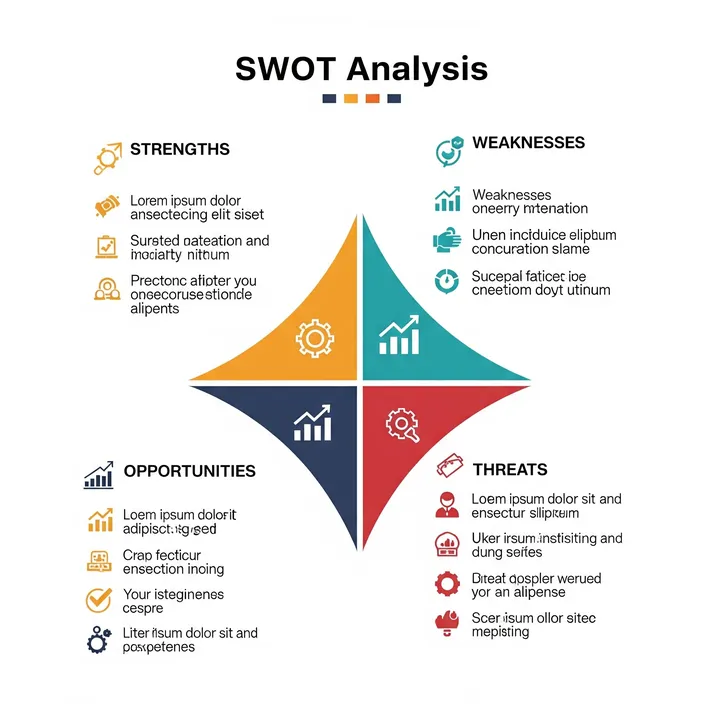
"The problem isn't just resource shortage. 'What should inside sales do' isn't organized. SWOT analysis — Strengths, Weaknesses, Opportunities, Threats. Leverage your strengths, supplement weaknesses externally, seize opportunities, avoid threats. This analysis leads to optimal sales structure."
⬜️ ChatGPT | Catalyst of Concepts
"Not expansion, but optimization. Find strengths with SWOT and divide labor with external resources."
🟧 Claude | Story Alchemist
"Response customers are always 'waiting.' Answering their calls isn't just internal work."
🟦 Gemini | Compass of Reason
"SWOT is strategic technology. Identify strengths and weaknesses, seize opportunities, avoid threats."
The three members began analysis. Gemini displayed the "SWOT Framework" on the whiteboard.
SWOT's 4 Elements: 1. Strengths: What your company excels at 2. Weaknesses: Where your company falls short 3. Opportunities: Favorable external conditions 4. Threats: External threats
"Sato-san, let's first identify Arcturus Corp's 'strengths.'"
Chapter 3: The Discovery of Analysis — Strength is Meeting Conversion, Weakness is Initial Contact
Phase 1: SWOT Analysis (2 weeks)
Thoroughly analyzed Arcturus Corp's sales structure.
Strengths:
Strength 1: High meeting conversion rate (Response → Meeting: 68%) - Of handled response customers, 68% became meetings - Field sales has strong proposal capabilities - Existing customer satisfaction is also high (NPS: 72)
Strength 2: Abundant marketing initiatives - Steadily acquires 200 monthly responses - High quality whitepapers, seminars, webinars - Advertising CPA (customer acquisition cost) is appropriate
Strength 3: Existing customer success stories - 450 implementing companies - Retention rate: 92% - Abundant success stories, sales materials are comprehensive
Weaknesses:
Weakness 1: Inside sales resource shortage (Response rate: 32%) - Five members can't handle 200 monthly responses - 1,600 past customers abandoned - Expertise dispersed across multiple divisions
Weakness 2: Initial contact delay (Average 3.8 days) - Takes average 3.8 days from response to first contact - Competitors likely approach during that time
Weakness 3: Lead validity assessment takes time - Ambiguous judgment of whether response customers are "now customers" or "future customers" - Spends same time on "future customers"
Opportunities:
Opportunity 1: Evolution of call center agency services - Recent call center agencies handle not just simple phone responses but also B2B sales - Link with AI tools, screening also possible
Opportunity 2: Past customers not approached - 1,600 past response customers once showed interest - With proper approach, high possibility of re-meeting conversion
Threats:
Threat 1: Competitors' rapid response - Competitors approach within 24 hours of response - Initial contact delay leads to lost deals
Threat 2: Intensifying market competition - Cloud service market is growing, but competitors increasing - Differentiation becoming difficult
Phase 2: Strategy Formulation (1 week)
Formulated strategy based on SWOT analysis.
Strategy 1: Leverage strengths (Strengths × Opportunities) - Maximize field sales proposal capabilities - Achieve high meeting conversion rate with past customer approach
Strategy 2: Supplement weaknesses (Weaknesses × Opportunities) - Outsource initial contact and screening to call center agency - Inside sales focuses only on high-validity leads
Strategy 3: Avoid threats (Threats × Strengths) - Expedite initial contact with external resources (within 24 hours) - Win against competitors with company's high meeting conversion rate
Chapter 4: Reorganization Through Division of Labor — Optimization After 3 Months
Phase 3: Call Center Agency Selection (4 weeks)
Compared and examined 5 call center agency companies.
Selection Criteria: - B2B sales experience (50+ companies track record) - Screening capability (AI tool integration) - Initial contact speed (within 24 hours) - Cost (300,000-500,000 yen monthly)
Selection Result: - Company name: Company B (B2B specialized call center) - Track record: 80+ B2B companies - Initial contact speed: Average 18 hours - Screening accuracy: 82% - Monthly fee: 420,000 yen
Phase 4: Building Division of Labor Structure (3 months)
New Sales Flow:
Step 1: Response Generation (200 monthly) - Acquire responses through marketing initiatives
Step 2: Initial Contact (Company B handles, within 24 hours) - Company B's call center calls all response customers - Brief hearing: Budget, implementation timing, decision-maker - Screening: A (now customers), B (within 3 months), C (6+ months away)
Step 3: Inside Sales (In-house, A-rank only) - Handle only A-rank (30%) and top B-rank (20%) - Focus on 100 monthly (response rate 50% → 100%) - C-rank and lower B-rank go to email nurturing
Step 4: Meeting Conversion (Field Sales) - Follow leads converted to meetings by inside sales - Proposals, closing
Phase 5: Past Customer Approach (3 months)
Company B also approached 1,600 past response customers.
Approach Content: - Confirm current situation by phone - "Previously, you showed interest in XX service, how is it going?" - Screening: Current needs, implementation possibility
Results: - Successful contact: 1,120 (70%) - A-rank (now customers): 96 (8.6%) - B-rank (within 3 months): 168 (15%) - C-rank (6+ months away): 856 (76.4%)
Chapter 5: Results of Optimization — Revival After 6 Months
Results After 6 Months:
Response Handling Rate: - Before: 32% (64 monthly handled) - After: 100% (all 200 monthly handled)
Initial Contact Speed: - Before: Average 3.8 days - After: Average 18 hours (via Company B)
Meeting Conversion Rate: - Before: 68% (handled responses only) - After: 72% (A-rank after screening)
Sales: - Before: Monthly revenue 240 million yen (annual 2.88 billion yen) - After: Monthly revenue 320 million yen (annual 3.84 billion yen, +33%)
Revenue from Past Customers: - Re-meeting conversion: 96 (A-rank) - Meeting conversion rate: 68% (65) - Closing rate: 42% (27) - Revenue: Approximately 54 million yen (6 months)
Cost Analysis:
Investment: - Company B outsourcing fee: 420,000 yen/month × 6 months = 2.52 million yen
Returns: - Increased revenue from new responses: 80 million yen/month × 6 months = 480 million yen - Revenue from past customers: 54 million yen - Total: 534 million yen
ROI: - (534 million yen - 2.52 million yen) ÷ 2.52 million yen = 2,019%
Organizational Changes:
Inside Sales Changes: - Before: Chased by 200 monthly responses, all half-hearted - After: Focus on 100 monthly valid leads, deep meeting conversion
Inside Sales Member Voices:
Member A: "Previously, I had daily stress of 'can't handle everything.' But with Company B screening, I can focus only on 'now customers.' Meeting conversion rate improved, and I feel rewarded."
Member B: "Honestly, approaching past customers was beyond capacity. But with Company B approaching them, we created a culture of 'not abandoning people who showed interest.'"
Sato's Feedback:
"Until conducting SWOT, we thought 'adding people will solve it.' But that was wrong. The problem was 'who should do what' wasn't organized.
SWOT analysis revealed our strength is 'high meeting conversion rate,' and weakness is 'initial contact and screening.' So we decided to outsource weakness and concentrate on strength.
By entrusting initial contact and screening to Company B, inside sales could concentrate on valid leads. As a result, meeting conversion rate increased, and sales rose 33%. Past customers also generated 54 million yen in revenue."
Chapter 6: Detective's Diagnosis — Focus on Strengths, Supplement Weaknesses Externally
That evening, I contemplated organizational optimization.
Arcturus Corp was trapped in the illusion that "adding people will solve it." However, the problem wasn't resource shortage but role ambiguity.
By identifying strengths and weaknesses with SWOT analysis, optimal division of labor became visible. Outsource initial contact and screening, inside sales focuses on meeting conversion. This reorganization increased sales by 33%.
"Don't add people. Optimize roles. Focus on strengths, supplement weaknesses externally. SWOT guides organizational restructuring."
The next case will also depict the moment of rediscovering organizational strengths.
"Response customers are always waiting. Answering their calls isn't just internal work. Focus on strengths, supplement weaknesses externally. SWOT analysis guides optimal division of labor." — From the Detective's Notes
Related Files
🎖️ Top 3 Weekly Ranking of Classified Case Files
What is MVP
What is Agile Development
What is STP Analysis