ROI Case File No.335 | 'The 10-Year Silence of Globex Corp.'
📅 2025-11-26 23:00
🕒 Reading time: 11 min
🏷️ 5WHYS

- Chapter 1: The 10-Year Stagnation — The Unchangeable System
- Chapter 2: The Trap of Surface — Problems Behind Problems
- Chapter 3: The Discovery of Digging — Five "Whys"
- Chapter 4: Restructuring Through Solution — Standard Packages Were Sufficient
- Chapter 5: Results of Standardization — Revival After 12 Months
- Chapter 6: Detective's Diagnosis — Look at Root, Not Surface
- Related Files
Chapter 1: The 10-Year Stagnation — The Unchangeable System
The week after the Globex EC operational efficiency case was solved, a consultation about aging core system arrived. Volume 27, "The Pursuit of Reproducibility," Episode 335 tells the story of digging into the truth behind surface problems.
"Detective, our core system was developed from scratch over 10 years ago. Features are abundant, but we can't master them. Maintenance costs are 12 million yen annually. Each update costs even more. And ordering operations are still by FAX and phone."
Tatsuya Kinjo, Information Systems Director of Globex Corp., originally from Naha, visited 221B Baker Street with an exhausted expression. In his hands, he held core system specifications alongside contrasting analysis documents marked "Feature Usage Rate: 42%."
"We operate a subsidiary called Kinshu Steel. Steel product wholesale. Approximately 800 client companies. Annual revenue 6.2 billion yen. However, the core system is holding us back."
Globex Corp. (Kinshu Steel) Core System: - Implemented: 2013 (scratch development) - Last replacement: 2013 (at implementation) - Years elapsed: 12 years - Annual maintenance cost: 12 million yen - Feature usage rate: 42% (over half of implemented features unused) - Problems: High maintenance costs, underutilized features, manual data entry, FAX/phone ordering operations
Kinjo's voice carried deep frustration.
"Twelve years ago, we thought 'let's create the best system.' So we developed from scratch. Inventory management, order management, accounting integration, customer management, all integrated. Features are abundant. However, we can't master them. Because the screens are too complex."
Typical Problem Cases:
Problem 1: Manual Ordering Operations (FAX/Phone) - Current: Receive orders from clients by FAX or phone - System has order data integration feature - However, many clients are SMEs that cannot integrate systems - Result: Order staff manually input data (5 minutes per order)
Problem 2: Manual Data Entry Creates High Load - Current: Manually input order data, inventory data, shipment data - Monthly order volume: Approximately 3,000 - Data entry time: 3,000 × 5 minutes = 15,000 minutes (250 hours/month) - Staff: Divided among 8 members
Problem 3: High Maintenance and Update Costs - Annual maintenance cost: 12 million yen - Breakdown: - Regular maintenance (server management, bug fixes): 6 million yen - Updates (feature additions, OS updates): 6 million yen - Reason: Custom-made due to scratch development. Vendor's asking price
Problem 4: Features Not Mastered - Implemented features: 120 - Used features: 50 (42%) - Reasons for non-use: - Screens too complex, don't know how to operate (68%) - Insufficient training (22%) - Unnecessary features to begin with (10%)
Problem 5: Screens Hard to See - UI: 12-year-old design (Windows XP style) - Small fonts, subdued colors - Too many features, can't find what's where
Kinjo sighed deeply.
"We've been considering replacement for the past three years. Requested quotes from multiple vendors. However, every vendor says 'migrating the current system costs over 20 million yen.' And they also say 'standard packages can't handle it.' So we haven't been able to replace it."
Chapter 2: The Trap of Surface — Problems Behind Problems
"Kinjo-san, why do you think replacement isn't possible?"
To my question, Kinjo answered immediately.
"Because the cost is high. Securing a budget of over 20 million yen is difficult."
Current Understanding (Cost Problem Model): - Recognition: Can't replace because cost is high - Problem: Root cause not visible
I explained the importance of digging into the true cause behind surface problems.
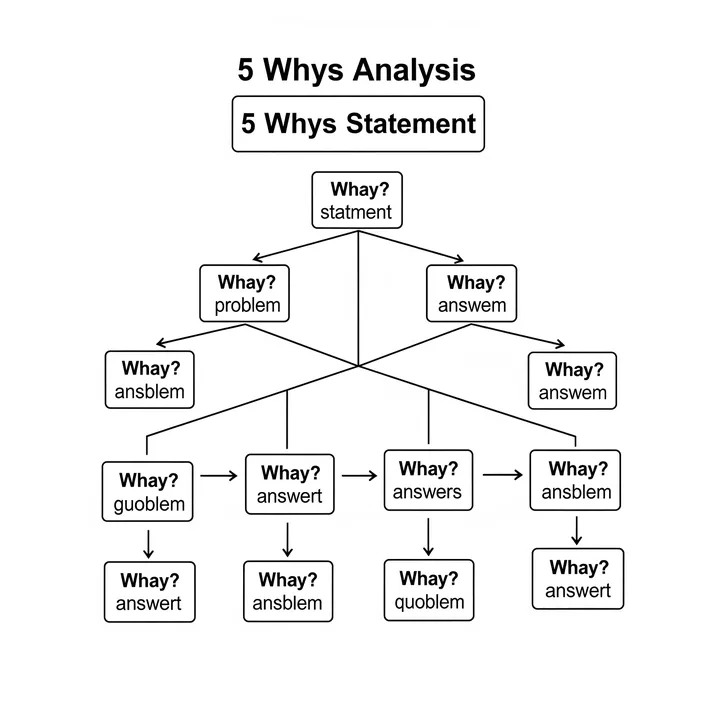
"The problem isn't just cost. 'Why is the cost high?' 'Why can't standard packages handle it?' By repeating this 'why' five times, the root cause becomes visible. 5WHYS — an analysis method that repeats why five times. This guides essential solutions."
⬜️ ChatGPT | Catalyst of Concepts
"Don't look at the surface. Look at the root. Dig into 'why' with 5WHYS to find true causes."
🟧 Claude | Story Alchemist
"10 years of silence always stems from 'the initial choice.' Question that choice."
🟦 Gemini | Compass of Reason
"5WHYS is deep-diving technology. See through root causes behind surface problems."
The three members began analysis. Gemini displayed the "5WHYS Framework" on the whiteboard.
5WHYS Method: 1. Clarify the problem 2. Ask "Why?" (1st time) 3. Ask "Why?" about that answer (2nd time) 4. Ask "Why?" further (3rd-5th times) 5. When root cause is found, establish solution
"Kinjo-san, let's begin. First, please clarify the problem."
Chapter 3: The Discovery of Digging — Five "Whys"
Phase 1: 5WHYS Analysis (2 weeks)
Problem Clarification: "We cannot replace our core system."
WHY 1: Why can't you replace it?
Kinjo: "Because replacement costs over 20 million yen, and we can't secure the budget."
WHY 2: Why does replacement cost over 20 million yen?
Kinjo: "Because the current system is scratch-developed, custom-made. Vendors told us standard packages can't handle it."
Me: "Why can't standard packages handle it?"
Kinjo: "Because our business flow is special. Steel product wholesale has detailed differences by business type. So we thought standard packages couldn't handle it."
WHY 3: Why do you think the business flow is special?
Kinjo: "...(5 seconds silence)... Actually, I don't know if it's truly special. Twelve years ago, when implementing the system, we decided 'our business is special, so let's develop from scratch.' But we never researched what systems other companies use."
Me: "Then let's actually research other companies. What systems do peer companies use?"
Phase 2: Peer Company Research (1 week)
Interviewed 5 steel product wholesale companies about their core systems.
Research Results:
Company A (Annual revenue 8 billion yen): - System: Certain ERP standard package - Implementation cost: 8 million yen - Annual maintenance: 2.4 million yen - Evaluation: "Standard packages handle it sufficiently"
Company B (Annual revenue 5.5 billion yen): - System: Certain cloud-based core system - Implementation cost: 4.5 million yen - Annual maintenance: 1.2 million yen (100,000 yen monthly) - Evaluation: "Cloud, so updates are automatic"
Company C (Annual revenue 7 billion yen): - System: Certain industry-specific package - Implementation cost: 9 million yen - Annual maintenance: 3 million yen - Evaluation: "Customized for steel industry, easy to use"
Discovery: - Many peer companies use standard packages - Implementation costs are 4.5-9 million yen range - Annual maintenance is 1.2-3 million yen (significantly cheaper than Globex's 12 million yen)
WHY 4: Why did you choose scratch development 12 years ago?
Kinjo: "The Information Systems Director at the time (now retired) wanted to 'create the best system.' Vendors also proposed 'your business is complex, so scratch development is optimal.'"
Me: "Who evaluated that proposal? Did you get quotes from multiple vendors?"
Kinjo: "...No, we decided based on one company's proposal only. At the time, no one in-house had system knowledge. So we believed what the vendor said."
WHY 5: Why did you believe what the vendor said as-is?
Kinjo: "Because we lacked system knowledge in-house. And we thought 'if we create the best system, all problems will be solved.' But actually it was different. Even if you implement an expensive system, it's meaningless if you can't master it."
Root Cause Discovery:
By repeating "why" five times, the root cause became visible.
Root Causes: 1. Lacked system knowledge in-house, accepted vendor proposal wholesale 2. Didn't get quotes from multiple vendors, decided with just one 3. Had misconception that "best system = scratch development" 4. Didn't verify whether standard packages could handle it
Chapter 4: Restructuring Through Solution — Standard Packages Were Sufficient
Phase 3: Solution Formulation (2 weeks)
Formulated solutions based on root causes.
Solution 1: Reconsider Standard Packages - Judged standard packages can handle based on peer company research - Requested quotes from 3 package vendors
Solution 2: Review Business Flows - Discard assumption that "our business is special" - Adjust business flows to fit standard packages
Solution 3: Get Quotes from Multiple Vendors - Apply competitive principles to determine appropriate prices
Phase 4: Vendor Selection (4 weeks)
Requested quotes from 3 package vendors.
Vendor D: - System: ERP standard package - Implementation cost: 12 million yen - Annual maintenance: 3.6 million yen - Features: For large enterprises, multi-functional
Vendor E: - System: Cloud-based core system - Implementation cost: 6 million yen - Annual maintenance: 1.8 million yen (150,000 yen monthly) - Features: For SMEs, simple
Vendor F: - System: Industry-specific package - Implementation cost: 8.5 million yen - Annual maintenance: 2.8 million yen - Features: Customized for steel industry
Selection Result: Vendor F
Selection Reasons: - Customized for steel industry, close to business flow - Implementation cost appropriate (8.5 million yen < current system maintenance 12 million yen/year) - Annual maintenance significantly reduced (2.8 million yen < 12 million yen, 76% reduction) - Has EDI integration feature, ordering operations automation possible
Phase 5: Ordering Operations Automation via EDI Integration (6 months)
Vendor F's system had EDI (Electronic Data Interchange) integration feature.
EDI Integration Mechanism: - Some clients (30 major companies) support EDI - Transmit order data electronically - Core system automatically creates order data - No manual input needed
Target: - EDI-capable clients: 30 companies (4% of all 800) - However, revenue ratio: 45% (2.8 billion yen of annual 6.2 billion yen revenue)
Effect: - Monthly order volume: 3,000 - EDI integration: 1,350 (45%) - Manual input: 1,650 (55%) - Time reduced: 1,350 × 5 minutes = 6,750 minutes (112.5 hours/month)
Chapter 5: Results of Standardization — Revival After 12 Months
Results After 12 Months:
Cost Reduction:
Implementation Cost: - Before (12 years ago): Scratch development 35 million yen - After: Standard package 8.5 million yen (76% reduction)
Annual Maintenance Cost: - Before: 12 million yen - After: 2.8 million yen (77% reduction)
Reduction Amount: - Annual 9.2 million yen reduction - Investment recovery period: 8.5 million yen ÷ 9.2 million yen = 0.92 years (approximately 11 months)
Operational Efficiency:
Ordering Operations: - Before: All 3,000 monthly manually input (250 hours/month) - After: Only 1,650 manually input (137.5 hours/month) - Reduction: 112.5 hours/month (45% reduction)
Data Entry: - Before: Complex screens, 5 minutes per item - After: Simple screens, 3 minutes per item - Reduction: 1,650 × 2 minutes = 3,300 minutes (55 hours/month)
Total Reduction: - 112.5 hours + 55 hours = 167.5 hours/month - Annual: 2,010 hours - Labor cost reduction: 2,010 hours × 2,500 yen (hourly rate) = 5.025 million yen/year
Feature Usage Rate Improvement:
Before: - Implemented features: 120 - Used features: 50 (42%)
After: - Implemented features: 80 (only necessary features) - Used features: 72 (90%)
Reasons: - Standard packages have few unnecessary features - Simple UI, operation methods clear - Vendor F provided training (3 days)
Organizational Changes:
System Department Mindset Reform:
Kinjo: "Until conducting 5WHYS, we only thought about 'reasons we can't replace.' Cost is high, business is special, standard packages can't handle it. However, by repeating 'why' five times, the true cause became visible.
Twelve years ago, we had the misconception 'best system = scratch development.' We accepted vendor proposals wholesale and didn't get quotes from multiple companies. And we didn't verify whether standard packages could handle it.
This time, by researching peer companies, we realized 'our business isn't special.' Standard packages could handle it sufficiently. And we achieved 9.2 million yen annual cost reduction and operational efficiency."
Field Staff Voices:
Order Staff A: "The new system is simply easy to use. The previous system had complex screens; I couldn't find what was where. But the new system is simple. I took 3 days of training, but quickly mastered it."
Order Staff B: "EDI integration is excellent. Orders from 30 major clients automatically create order data. We just press the confirm button. This reduced 112 hours monthly."
Chapter 6: Detective's Diagnosis — Look at Root, Not Surface
That evening, I contemplated the importance of root cause analysis.
Globex Corp. only thought about "reasons we can't replace." Cost is high, business is special, standard packages can't handle it. However, these were surface problems.
By repeating "why" five times with 5WHYS, the root cause became visible. The wrong choice 12 years ago — accepting vendor proposals wholesale and choosing scratch development. This was the root of all problems.
By reconsidering standard packages, achieved 9.2 million yen annual cost reduction and operational efficiency. The 10-year silence finally ended.
"Don't look at the surface. Look at the root. Dig into 'why' with 5WHYS to find true causes. Solutions always exist within root causes."
The next case will also depict the moment of digging into root causes.
"Repeat why five times. True causes exist behind surface problems. Question the choice from 12 years ago and standardize. The best system is one you can master." — From the Detective's Notes
Related Files
🎖️ Top 3 Weekly Ranking of Classified Case Files
What is MVP
What is Agile Development
What is STP Analysis