ROI Case File No.351 | 'Avalon Systems' ERP Implementation Gamble'
📅 2025-12-12 23:00
🕒 Reading time: 11 min
🏷️ SWOT

- Chapter One: The September 2026 Deadline—Re-lease or Renewal?
- Chapter Two: The ERP Panacea Misconception—Implementation Doesn't Solve Everything
- Chapter Three: Analysis as Discovery—Invest in Strengths × Opportunities
- Chapter Four: Execution as Results—Changes After 9 Months
- Chapter Five: The Detective's Diagnosis—Strengths × Opportunities Generate Strategy
- Related Files
Chapter One: The September 2026 Deadline—Re-lease or Renewal?
The day after resolving the AI education case at TechSavvy, another consultation arrived regarding core system renewal. Volume 29, "The Pursuit of Reproducibility," Episode 351, tells the story of multiplying strengths and opportunities.
"Detective, our core system support ends in September 2026. Should we extend its life through re-lease, or renew it with ERP implementation? We cannot decide. And whichever we choose, failure would be irreversible."
Makoto Tamura, the information systems manager from Avalon Systems, born in Yokohama, visited 221B Baker Street with barely concealed anxiety. In his hands were the current system's maintenance contract and, in stark contrast, a proposal noting "ERP Implementation Estimate: 38 million yen."
"We specialize in parts supply for manufacturing. One hundred twenty employees. Annual revenue of 4.2 billion yen. Our current core system was implemented 15 years ago, handling payroll, timecards, sales management, and inventory management."
Avalon Systems' Current State: - Established: 1998 (Parts supply for manufacturing) - Employees: 120 - Annual revenue: 4.2 billion yen - Core system: Implemented 15 years ago, support ending September 2026 - Problems: Extensive manual work, insufficient integration between multiple systems
Deep crisis awareness permeated Tamura's voice.
"The problem is the extensive manual input work looking at paper forms. For example, when the sales department receives an order, they print a paper order form. Looking at it, they manually input data into the sales management system. Then they check inventory and send a production order to the manufacturing department. This entire flow is all manual work.
Furthermore, data integration between multiple systems is manual. Attendance data from the timecard system is manually input into the payroll system. Sales data from the sales management system is manually input into the accounting system. Month-end closing takes three days."
Problems in Typical Business Flow:
From Order to Shipment: 1. Sales receives order (paper order form) 2. Manual input into sales management system (15 min/case) 3. Inventory check (search in separate system, 5 min/case) 4. Production order to manufacturing department (paper output, 10 min/case) 5. Shipment instruction (manual input, 10 min/case) Total: 40 min/case
Month-end Closing: 1. Manual input of timecard data into payroll system (8 hours) 2. Manual input of sales management data into accounting system (12 hours) 3. Inventory data and physical inventory reconciliation (8 hours) Total: 28 hours (3.5 days)
Tamura sighed deeply.
"We've received two proposals from vendors. First, re-lease the current system. 380,000 yen monthly. Support continues, but functionality remains the same. Second, ERP implementation. Initial cost 38 million yen, monthly operation cost 650,000 yen. Achieves automatic data integration and paperless operations.
However, we cannot decide. ERP is expensive. Will it truly deliver results? Or should we extend the life through re-lease and wait and see?"
Chapter Two: The ERP Panacea Misconception—Implementation Doesn't Solve Everything
"Mr. Tamura, do you believe implementing ERP will solve all your problems?"
My question showed a confused expression on Tamura's face.
"Yes... The vendor told us 'operational efficiency will improve dramatically.' But I don't know if that's really true. What if we can't master it after implementation? Thirty-eight million yen would be wasted."
Current Understanding (Tool Panacea Type): - Expectation: ERP implementation solves everything - Problem: Company's strengths and weaknesses not visible
I explained the importance of analyzing internal and external environments to derive optimal strategy.
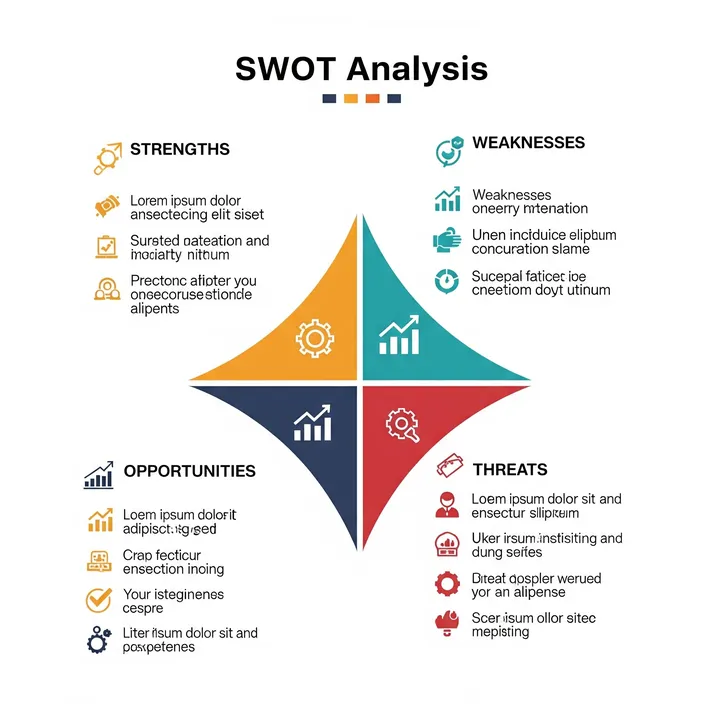
"The problem is that 'your company's strengths and weaknesses, plus external opportunities and threats' remain unorganized. SWOT Analysis—Strengths, Weaknesses, Opportunities, Threats. Analyzing these four elements derives a strengths × opportunities strategy."
⬜️ ChatGPT | Catalyst of Conception
"Don't choose vaguely. Know yourself, know your environment. Derive strategy through SWOT."
🟧 Claude | Story Alchemist
"Core systems are always the 'corporate heart.' Find a way to transplant that heart without stopping it."
🟦 Gemini | Compass of Reason
"SWOT is the foundation of strategy. Analyze internal and external factors, find the optimal solution in the four-quadrant matrix."
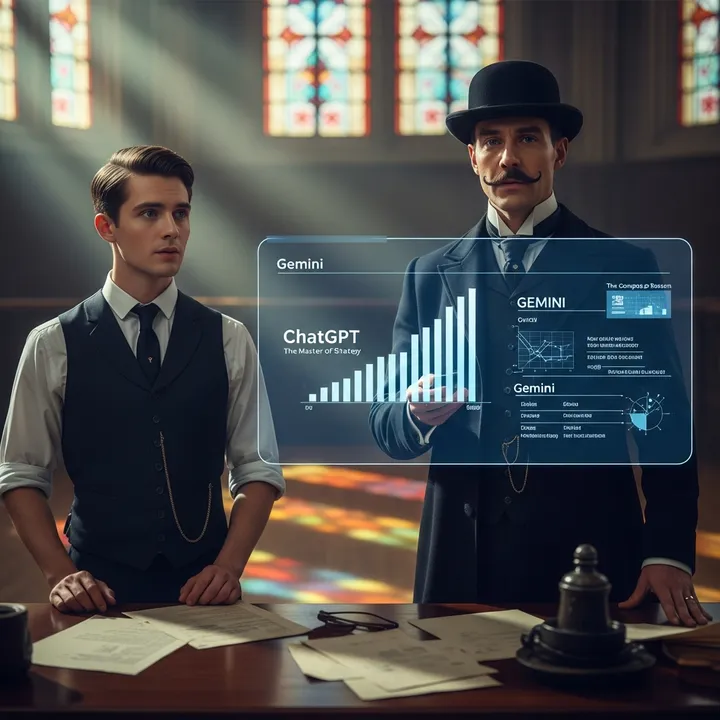
The three members began their analysis. Gemini displayed the "SWOT Framework" on the whiteboard.
The 4 Elements of SWOT: 1. Strengths: Positive factors in internal environment 2. Weaknesses: Negative factors in internal environment 3. Opportunities: Positive factors in external environment 4. Threats: Negative factors in external environment
Cross SWOT Analysis: - Strengths × Opportunities: Aggressive strategy - Strengths × Threats: Differentiation strategy - Weaknesses × Opportunities: Improvement strategy - Weaknesses × Threats: Defense/withdrawal strategy
"Mr. Tamura, let's first identify your company's strengths and weaknesses."
Chapter Three: Analysis as Discovery—Invest in Strengths × Opportunities
Phase 1: Internal Environment Analysis (2 weeks)
Strengths:
Strength 1: 15 Years of Business Flow Understanding - Current system used for 15 years - Business flows completely established - All staff proficient in operations
Strength 2: Data Accumulation - 15 years of order data, inventory data, customer data - Total: 1.8 million orders, 12,000 customers - This data can be leveraged during ERP migration
Strength 3: Staff with Technical Background - Information systems department: 3 people - Manufacturing department staff knowledgeable about systems: 5 people - Internal support structure for post-ERP implementation can be built
Weaknesses:
Weakness 1: Extensive Manual Work - Order input: Monthly average 1,200 cases × 15 min = 300 hours - Inventory check: Monthly average 1,200 cases × 5 min = 100 hours - Month-end closing: 28 hours Total: 428 hours monthly
Weakness 2: Insufficient Data Integration Between Multiple Systems - Sales management, inventory management, accounting, payroll all separate systems - Data integration is manual - Input errors occur monthly average 15 times
Weakness 3: Delayed Paperless Transformation - Paper forms monthly average 3,600 sheets - Storage space required: 12㎡ annually - Poor searchability, time-consuming to reference past data
Phase 2: External Environment Analysis (2 weeks)
Opportunities:
Opportunity 1: Operational Efficiency Through ERP Implementation - Automatic data integration reduces manual work - Real-time inventory checking possible - Significant reduction in month-end closing
Opportunity 2: Risk Management Enhancement Through Cloud Migration - Current system is on-premise - Risk of data loss during disasters - Cloud ERP automates backups
Opportunity 3: Response to Work Style Reform - Remote work becomes possible - Approval/verification from smartphones - Data input from sales staff's remote locations
Threats:
Threat 1: Core System Support Termination (September 2026) - 21 months remaining - Security risks increase after support ends - System failures become unrecoverable
Threat 2: ERP Implementation Initial Cost and Time - Initial cost: 38 million yen - Implementation period: 6-9 months - Impact on operations
Threat 3: Competitor Efficiency Improvements - 60% of industry peers already implemented ERP - May fall behind competitors in order response speed
Phase 3: Cross SWOT Analysis (1 week)
Strengths × Opportunities (Aggressive Strategy): "15 years of business flow understanding and data accumulation" × "Efficiency through ERP implementation" → Strategy: Achieve advanced analysis leveraging data through phased ERP implementation
Strengths × Threats (Differentiation Strategy): "Staff with technical background" × "ERP implementation initial cost" → Strategy: Reduce external consulting costs by leveraging internal support structure
Weaknesses × Opportunities (Improvement Strategy): "Extensive manual work, insufficient data integration" × "Automation through ERP implementation" → Strategy: Prioritize implementation in departments with highest workload
Weaknesses × Threats (Defense/Withdrawal Strategy): "Extensive manual work" × "Support termination deadline" → Strategy: Exclude re-lease from options (not a defensive measure)
Phase 4: Strategy Determination (1 week)
Based on cross SWOT analysis results, the following strategy was formulated.
Optimal Strategy: Phased ERP Implementation
Reasons: 1. Can leverage strengths (business flow understanding, data accumulation) 2. Can maximize opportunities (operational efficiency, cloud migration) 3. Can respond to threats (support termination) 4. Can improve weaknesses (manual work)
Phased Implementation Plan: - Phase 1 (3 months): Pilot implementation (sales management only) - Phase 2 (3 months): Second stage (add inventory management) - Phase 3 (3 months): Company-wide rollout (add payroll, accounting)
Chapter Four: Execution as Results—Changes After 9 Months
Phase 5: Pilot Implementation (Months 1-3)
Target: Sales Management Only - Target staff: Sales department 12 people - Implementation cost: 12 million yen (approximately 30% of total ERP) - Goal: 50% reduction in order input time
Results After 3 Months:
Order Input Time: - Before: 15 min/case - After: 6 min/case (reduced through automatic data import) - Reduction: 9 min/case (60% reduction)
Monthly Impact: - 1,200 cases × 9 min = 10,800 min (180 hours/month) - Personnel cost conversion: 180 hours × 2,800 yen = 504,000 yen/month
Staff Feedback: "At first I thought 'getting used to the new system will be difficult.' But I adapted in three weeks. And order input became surprisingly fast. Customer information and past order history display automatically, so input work reduced dramatically."
Phase 6: Second Stage (Months 4-6)
Target: Add Inventory Management - Additional cost: 12 million yen - Goal: 80% reduction in inventory check time
Results After 6 Months (Cumulative):
Inventory Check Time: - Before: 5 min/case - After: 30 seconds/case (real-time inventory display) - Reduction: 4.5 min/case (90% reduction)
Monthly Impact: - 1,200 cases × 4.5 min = 5,400 min (90 hours/month) - Personnel cost conversion: 90 hours × 2,800 yen = 252,000 yen/month
Cumulative Impact: - Sales management: 504,000 yen/month - Inventory management: 252,000 yen/month - Total: 756,000 yen/month
Phase 7: Company-wide Rollout (Months 7-9)
Target: Add Payroll, Accounting - Additional cost: 14 million yen - Total investment: 38 million yen
Results After 9 Months (Company-wide):
Month-end Closing: - Before: 28 hours (3.5 days) - After: 4 hours (0.5 days) - Reduction: 24 hours (86% reduction)
Payroll Automation: - Timecard data automatically integrated - Before: Manual input 8 hours → After: Verification only 1 hour
Accounting Processing Automation: - Sales management data automatically integrated - Before: Manual input 12 hours → After: Verification only 2 hours
Inventory Reconciliation Efficiency: - Real-time inventory management - Before: Manual reconciliation 8 hours → After: Discrepancy check only 1 hour
Annual Impact (Year 1, 9 months operation):
Personnel Cost Reduction: - Order input: 180 hours/month × 9 months × 2,800 yen = 4.536 million yen - Inventory check: 90 hours/month × 6 months × 2,800 yen = 1.512 million yen - Month-end closing: 24 hours/month × 3 months × 2,800 yen = 202,000 yen - Total: 6.25 million yen (9 months)
Annual Conversion Impact: - Order input: 180 hours/month × 12 months × 2,800 yen = 6.048 million yen - Inventory check: 90 hours/month × 12 months × 2,800 yen = 3.024 million yen - Month-end closing: 24 hours/month × 12 months × 2,800 yen = 806,000 yen - Total: 9.878 million yen/year
Investment Recovery: - Initial investment: 38 million yen - Annual reduction effect: 9.878 million yen - Monthly operation cost: 650,000 yen × 12 months = 7.8 million yen - Annual net effect: 9.878 million yen - 7.8 million yen = 2.078 million yen - Investment recovery period: 38 million yen ÷ 2.078 million yen = 18.3 years
However, including indirect effects:
Indirect Effects: - Cost reduction through paperless transformation: 1.2 million yen annually - Operational efficiency from improved searchability: 800,000 yen annually - Recruitment competitiveness from remote work support: Estimated 1.5 million yen annually
Annual Net Effect (including indirect): - 2.078 million yen + 1.2 million yen + 800,000 yen + 1.5 million yen = 5.578 million yen/year
Revised Investment Recovery Period: - 38 million yen ÷ 5.578 million yen = 6.8 years
Organizational Transformation:
Sales Department Staff A's Voice: "Order input became 60% faster. With the freed time, I increased customer visits. And I can now check inventory from my smartphone while out. Instead of saying 'Let me check inventory and get back to you,' I can answer on the spot."
Accounting Department Staff B's Voice: "Month-end closing went from 3.5 days to 0.5 days. Previously, overtime continued at month-end. But now I can leave on time. And data accuracy improved. Manual input errors became zero."
Tamura's Reflection:
"Until we conducted SWOT analysis, we were troubled by the binary choice of 're-lease or ERP implementation.' However, by organizing strengths, weaknesses, opportunities, and threats, clear strategy emerged.
By multiplying strengths (15 years of business flow understanding and data accumulation) with opportunities (efficiency through ERP implementation), we derived the phased ERP implementation strategy. We verified effectiveness through pilot implementation, then proceeded to second stage and company-wide rollout.
We achieved 9.878 million yen annual personnel cost reduction. Including indirect effects, 5.578 million yen annual net effect. Investment recovery period is 6.8 years. Long-term, returns are certain.
And most importantly, we transformed the threat of 'support termination' into the opportunity of 'operational efficiency.'"
Chapter Five: The Detective's Diagnosis—Strengths × Opportunities Generate Strategy
That evening, I contemplated the essence of SWOT analysis.
Avalon Systems was troubled by the binary choice of "re-lease or ERP implementation." With only vague anxiety and expectations, they could not decide.
By organizing internal environment (strengths/weaknesses) and external environment (opportunities/threats) through SWOT analysis, optimal strategy became visible. Through cross SWOT analysis of strengths × opportunities, they derived the phased ERP implementation strategy.
"Don't choose vaguely. Know yourself, know your environment. Organize the four elements through SWOT, derive strategy through cross SWOT analysis. Strengths × opportunities generate maximum results."
The next case will surely depict another moment of surveying internal and external perspectives.
"Strengths, Weaknesses, Opportunities, Threats. Analyze strengths, weaknesses, opportunities, and threats. Then derive aggressive strategy through cross SWOT analysis of strengths × opportunities. Therein lies reproducibility."—From the Detective's Notes
Related Files
🎖️ Top 3 Weekly Ranking of Case Files

'QuantumGrocers' Lost Customer Data'

AeroSpray's Vanishing Sales Force'
'GlobalSoft's Drowning Inquiry Response'