ROI Case File No.357 | 'GlobeSys' Single-Person Dependency Time Bomb'
📅 2025-12-18 23:00
🕒 Reading time: 12 min
🏷️ PEST

- Chapter One: The Crisis of Single-Person Dependency—Walking a Tightrope with One Staff Member
- Chapter Two: Technical Capability as Criterion—But Environment Not Visible
- Chapter Three: Discovery Through Analysis—Four Environmental Factors Guide Choice
- Chapter Four: Transition as Results—Changes After 6 Months
- Chapter Five: The Detective's Diagnosis—Environmental Adaptation is Key to Partner Selection
- Related Files
Chapter One: The Crisis of Single-Person Dependency—Walking a Tightrope with One Staff Member
The day after resolving the Microsoft 365 case at CosmoTech, another consultation arrived regarding system operation and maintenance partner selection. Volume 29, "The Pursuit of Reproducibility," Episode 357, tells the story of surveying the external environment.
"Detective, we had our in-house system custom-built by an external development company. However, we have no system staff member in-house. No personnel with specialized knowledge. We cannot quickly handle minor modifications or bug fixes, and operational efficiency improvement is not progressing. And with only one person in charge, single-person dependency risk is increasing."
Kenta Yamamoto, business planning manager from GlobeSys, born in Osaka, visited 221B Baker Street with an urgent expression. In his hands were the current system configuration diagram and, in stark contrast, a business analysis report noting "Bug response: Average 5 business days."
"We provide logistics management systems for the distribution industry. Ninety-five employees. Annual revenue of 2.8 billion yen. We had external development companies custom-build SFA for the sales department, voucher system, and inventory management system."
GlobeSys' Current State: - Established: 2006 (Logistics management systems) - Employees: 95 - Annual revenue: 2.8 billion yen - In-house systems: SFA, voucher system, inventory management (all custom development) - Development company: Company X (contracted since 2018) - Problems: No specialized personnel in-house, response delays, single-person dependency, no AI utilization expertise
Deep crisis awareness permeated Yamamoto's voice.
"In-house systems were developed by Company X from 2018 to 2020. Total development cost 28 million yen. Three systems: SFA, voucher system, inventory management. At the time, we expected 'this will enable operational efficiency.'
However, there are problems. We have no system staff member in-house. No personnel with specialized knowledge. So we request Company X for all minor modifications and bug responses. However, response takes time."
Typical Problem Cases:
Case 1: Minor Modification (Screen Text Change) - Request content: Change "Project Name" to "Deal Name" in SFA screen - Request to Company X: November 1, 2024 - Quote from Company X: November 8, 2024 (7 business days later) - Quote amount: 150,000 yen (5 hours work × 30,000 yen) - Modification complete: November 22, 2024 (21 business days from request)
Case 2: Bug Response (Data Output Error) - Occurrence: Error during CSV output in voucher system - Contact to Company X: Immediately - Company X investigation start: 3 business days later - Cause identification: 5 business days later ("data volume too large") - Modification complete: 10 business days later - Impact: 10 days, manual voucher data transcription
Case 3: AI Implementation Consultation - Yamamoto's request: "Want to analyze accumulated data with AI" - Company X's response: "AI development is outside our specialty" - Result: AI implementation not progressing
Yamamoto sighed deeply.
"Furthermore, there's a problem. Company X has only one person in charge. When that person takes vacation or becomes ill, response completely stops. In August 2024, the person in charge took 2-week summer vacation. During that time, 3 minor modification requests accumulated. Response started after vacation, but all were completed at end of September.
We're looking for a new system operation and maintenance partner. However, we don't know what criteria to use for selection. Technical capability? Price? Response speed? Or AI utilization expertise?"
Chapter Two: Technical Capability as Criterion—But Environment Not Visible
"Mr. Yamamoto, do you think selecting a partner with high technical capability is sufficient?"
My question received Yamamoto's immediate answer.
"Yes, I think technical capability is important. But is that alone sufficient? Are there other things to consider? I don't know."
Current Understanding (Technology-focused Type): - Expectation: High technical capability solves everything - Problem: External environment (political, economic, social, technological) not considered
I explained the importance of analyzing four elements of external environment and selecting optimal partner.
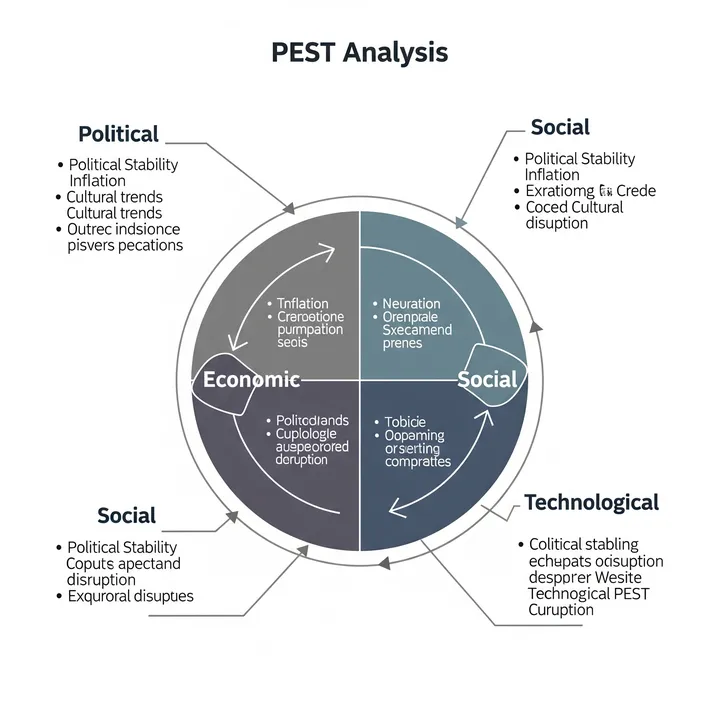
"The problem is 'external environment not visible.' PEST Analysis—Political, Economic, Social, Technological. Politics, economy, society, technology. Analyze these four external environment factors. Partner selection is a choice of environmental adaptation."
⬜️ ChatGPT | Catalyst of Conception
"Don't look at technology alone. Look at environment. Analyze external factors with PEST."
🟧 Claude | Story Alchemist
"Partners should always be selected by 'whether they can adapt to environment.' Look at four environments."
🟦 Gemini | Compass of Reason
"PEST is environmental analysis technique. Survey external environment with Political, Economic, Social, Technological."
The three members began their analysis. Gemini displayed the "PEST Framework" on the whiteboard.
PEST's 4 Elements: 1. Political: Regulations, policies, compliance 2. Economic: Cost, market trends, financial situation 3. Social: Corporate culture, communication, work style 4. Technological: Technology trends, AI utilization, innovation
"Mr. Yamamoto, let's evaluate candidate partners with PEST."
Chapter Three: Discovery Through Analysis—Four Environmental Factors Guide Choice
Phase 1: Listing Candidate Partners (1 week)
3 Candidates: - Company A: Major SI company, 2,000 employees, listed company - Company B: Mid-tier IT company, 150 employees, unlisted - Company C: Startup, 25 employees, AI-specialized
Phase 2: Political Evaluation (2 weeks)
Evaluation Criteria: 1. Data protection law compliance (GDPR, Personal Information Protection Law) 2. Security certifications (ISO27001, P-mark) 3. Compliance structure 4. Contract flexibility
Company A Evaluation: - Data protection law: Full compliance (dedicated team) - Security certification: ISO27001, P-mark, SOC2 - Compliance: Legal department exists, contract review structure perfect - Contract: Standard contract available, minimum modifications - Score: 5 points/5 (perfect)
Company B Evaluation: - Data protection law: Compliant - Security certification: ISO27001, P-mark - Compliance: Coordination with external legal advisor - Contract: Flexible response possible - Score: 4 points/5 (sufficient)
Company C Evaluation: - Data protection law: Basic compliance only - Security certification: P-mark only (ISO27001 not acquired) - Compliance: CEO directly responds - Contract: Flexible but structure uncertain - Score: 2.5 points/5 (somewhat uncertain)
GlobeSys' Required Level: - Handles distribution industry systems, personal information protection important - ISO27001 essential - Evaluation: Company A=5 points, Company B=4 points, Company C=2.5 points
Phase 3: Economic Evaluation (2 weeks)
Evaluation Criteria: 1. Monthly maintenance costs 2. Emergency response additional costs 3. Financial soundness 4. Cost performance
Company A Evaluation: - Monthly maintenance cost: 800,000 yen - Emergency response: Separate quote (50,000 yen per hour) - Financial soundness: Listed company, equity ratio 55% - Cost performance: High quality but high price - Score: 3 points/5 (expensive)
Company B Evaluation: - Monthly maintenance cost: 450,000 yen - Emergency response: Included in monthly fee (up to 5 hours monthly free) - Financial soundness: Unlisted, equity ratio 38% - Cost performance: Good balance - Score: 4.5 points/5 (appropriate price)
Company C Evaluation: - Monthly maintenance cost: 300,000 yen - Emergency response: Separate quote (30,000 yen per hour) - Financial soundness: Startup, equity ratio 15% - Cost performance: Inexpensive but financial risk exists - Score: 3.5 points/5 (inexpensive but risky)
GlobeSys' Budget: - Current Company X: 350,000 yen monthly - Budget ceiling: 500,000 yen monthly - Evaluation: Company B optimal (450,000 yen)
Phase 4: Social Evaluation (2 weeks)
Evaluation Criteria: 1. Corporate culture compatibility 2. Communication style 3. Response speed 4. Dedicated staff structure
Company A Evaluation: - Corporate culture: Large corporate, many procedures - Communication: Email-centered, standardized - Response speed: Standard (SLA: 5 business days) - Staff structure: Team system (5 people), staff may change - Score: 3 points/5 (stable but lacks flexibility)
Company B Evaluation: - Corporate culture: Mid-tier company, flexible - Communication: Phone/email/chat, flexible - Response speed: Quick (SLA: 2 business days) - Staff structure: 2 dedicated staff, backup structure exists - Score: 4.5 points/5 (flexible and quick)
Company C Evaluation: - Corporate culture: Startup, very flexible - Communication: Chat-centered, casual - Response speed: Very quick (SLA: 1 business day) - Staff structure: Founder directly responds (single-person dependency risk) - Score: 3.5 points/5 (quick but single-person dependency)
GlobeSys' Requests: - "Want minor modifications handled quickly" - "Technical terminology communication difficult, want clear explanations" - Evaluation: Company B optimal (flexible and quick, dedicated structure)
Phase 5: Technological Evaluation (2 weeks)
Evaluation Criteria: 1. Custom system maintenance capability 2. AI utilization expertise 3. Latest technology support 4. Innovation proposal capability
Company A Evaluation: - Custom maintenance: Very high (various languages/DB support) - AI utilization: Specialized department exists, 50+ implementation records - Latest technology: Catches up industry trends - Innovation: Annual proposal meeting - Score: 5 points/5 (highest technical capability)
Company B Evaluation: - Custom maintenance: High (major language support) - AI utilization: 10 records, growing - Latest technology: Actively implementing - Innovation: Quarterly proposals - Score: 4 points/5 (sufficient technical capability)
Company C Evaluation: - Custom maintenance: Limited (Python, Node.js centered) - AI utilization: Very high (founder is AI specialist) - Latest technology: Pursues cutting edge - Innovation: Always new proposals - Score: 4.5 points/5 (AI specialized)
GlobeSys' Requests: - "Can maintain existing system (PHP, MySQL)" - "Has AI utilization expertise" - Evaluation: Company A or B optimal (PHP compatible, AI expertise)
Phase 6: PEST Comprehensive Evaluation (1 week)
PEST Score Summary (5-point scale each, 20-point total):
| Company | Political | Economic | Social | Technological | Total |
|---|---|---|---|---|---|
| A | 5 | 3 | 3 | 5 | 16 |
| B | 4 | 4.5 | 4.5 | 4 | 17 |
| C | 2.5 | 3.5 | 3.5 | 4.5 | 14 |
Highest Score: Company B (17 points)
Reasons Company B is Optimal: 1. Political: Sufficient compliance structure (4 points) 2. Economic: Appropriate price, good cost performance (4.5 points) 3. Social: Flexible and quick, dedicated structure (4.5 points) 4. Technological: Sufficient technical capability and AI expertise (4 points)
Selection Result: Company B
Chapter Four: Transition as Results—Changes After 6 Months
Phase 7: Transition from Company X to Company B (Months 1-2)
Transition Process: - Month 1: System handover (documentation, source code) - Month 2: Company B system investigation, improvement proposals
Discoveries After Handover Completion:
Company B's Points: "The system created by Company X has the following issues:" 1. Insufficient documentation (specifications outdated) 2. Low code maintainability (no comments) 3. 3 security vulnerabilities (insufficient SQL injection countermeasures, etc.)
Company B's Proposals: - Documentation improvement: 1.5 million yen - Code refactoring: 3 million yen - Security measures: 800,000 yen - Total: 5.3 million yen
GlobeSys' Decision: - Implement all (for long-term stable operation)
Phase 8: Operations Start (Months 3-8)
Company B's Monthly Support Content:
450,000 yen Monthly Breakdown: - Regular maintenance: 200,000 yen - Emergency response (up to 5 hours monthly): 150,000 yen - Improvement proposals/review: 100,000 yen
Response Speed Improvement:
Minor Modification (Screen Text Change): - Before (Company X): 21 business days from request - After (Company B): 2 business days from request - Improvement: 19 business days reduced (90% reduction)
Bug Response (Data Output Error): - Before (Company X): 10 business days - After (Company B): 2 business days - Improvement: 8 business days reduced (80% reduction)
AI Utilization Proposals: - Company B proposes AI utilization quarterly - Q1: "Sales forecasting through AI analysis of sales data" - Budget: 2.5 million yen - Expected effect: Sales strategy optimization
Results After 6 Months:
Response Time Reduction: - Minor modifications: 12 cases annually - Before: 21 business days/case × 12 cases = 252 business days - After: 2 business days/case × 12 cases = 24 business days - Reduction: 228 business days
Business Impact Reduction: - Before: Business stops waiting for modifications (annual average 30 days) - After: Almost zero modification waiting (annual average 3 days) - Improvement: Avoided 27 days annual business stoppage
Cost Comparison: - Company X: 350K monthly × 12 months = 4.2 million yen/year - Company B: 450K monthly × 12 months = 5.4 million yen/year - Difference: +1.2 million yen/year (increase)
However, including operational efficiency effect: - Business stoppage avoidance: 27 days × 8 hours × 5 people × 4,000 yen = 4.32 million yen/year - Net effect: 4.32M - 1.2M = 3.12 million yen/year
ROI: - Additional investment: 1.2M/year + improvement costs 5.3M = 6.5 million yen - Return: 4.32 million yen/year - First year ROI: (4.32M - 6.5M) / 6.5M = -33.5% (minus) - Year 2 onward ROI: (4.32M - 1.2M) / 1.2M = 260%
Response to PEST Environmental Changes:
Political Environment Change: - January 2025: Revised Personal Information Protection Law enacted - Company B's response: Immediately proposed system response, implementation completed in 2 months - If Company X: Response unclear (no past legal revision response record)
Economic Environment Change: - March 2025: Yen depreciation progresses, server costs increase - Company B's response: Cloud optimization proposal, 50,000 yen monthly reduction
Social Environment Change: - April 2025: Remote work promotion - Company B's response: VPN configuration, cloud access optimization
Technological Environment Change: - June 2025: Generative AI technology evolution - Company B's response: Proposed AI implementation for "automatic sales daily report summarization"
Organizational Transformation:
Sales Department A's Voice: "Previously, even when requesting minor system modifications, we waited 3 weeks. During that time, we worked with inconvenient screens. But after Company B, completion in 2 days. Stress drastically reduced."
System Manager (Yamamoto's) Voice: "Initially, I felt 450,000 yen monthly was expensive. Company X was 350,000 yen. However, by conducting PEST analysis, I understood Company B was optimal.
Political: Has ISO27001, immediately responds to legal revisions. Economic: Good cost performance. Social: Flexible and quick, dedicated structure. Technological: Sufficient technical capability and AI expertise.
As a result, response time reduced 90%, business stoppage reduced by 27 days annually. Including operational efficiency effect, 3.12 million yen annual net effect. From year 2 onward, ROI 260%.
And we're receiving AI utilization proposals. 'AI analysis of sales data' is already under consideration. Company B is not just a maintenance partner. They're an innovation partner."
Chapter Five: The Detective's Diagnosis—Environmental Adaptation is Key to Partner Selection
That evening, I contemplated the essence of PEST analysis.
GlobeSys was about to make a simple judgment: "select a partner with high technical capability." However, they couldn't see the external environment—political, economic, social, technological.
By evaluating four elements with PEST analysis, Company B proved optimal. Political (compliance), Economic (cost performance), Social (flexibility), Technological (technical capability and AI expertise). This comprehensive evaluation created 90% response time reduction and 3.12 million yen annual net effect.
"Don't look at technology alone. Look at environment. Survey external environment with four elements of Political, Economic, Social, Technological. Partner selection is a choice of environmental adaptation."
The next case will surely depict another moment of surveying the external environment.
"Political, Economic, Social, Technological. Analyze external environment with four elements of politics, economy, society, technology. Select partners who can adapt to environment. Therein lies sustainable success."—From the Detective's Notes
Related Files
🎖️ Top 3 Weekly Ranking of Classified Case Files

What is the RICE Framework
What is RFP
What is the Pareto Principle