ROI Case File No.358 | 'PharmaLogistics' Invisible Customer'
📅 2025-12-19 23:00
🕒 Reading time: 11 min
🏷️ STP

- Chapter One: The Chaos of Modification Requests—Whose System Is This?
- Chapter Two: The Misunderstanding of For Everyone—The Customer Is Not One
- Chapter Three: Discovery Through Analysis—The True Customer Becomes Visible
- Chapter Four: Construction as Realization—Results After 8 Months
- Chapter Five: The Detective's Diagnosis—Finding the True Customer Opens the Path
- Related Files
Chapter One: The Chaos of Modification Requests—Whose System Is This?
The day after resolving the system operation and maintenance case at GlobeSys, another consultation arrived regarding construction of a pharmaceutical material information management system. Volume 29, "The Pursuit of Reproducibility," Episode 358, tells the story of finding the true customer.
"Detective, we manage pharmaceutical packaging materials. However, 200 monthly material information modification requests occur, and Excel management has reached its limit. The approval flow is unclear, and we don't know who the final approver is. And we're considering building a system, but whose system should we build? Who is the true customer? We cannot see."
Naoko Sato, quality assurance manager from PharmaLogistics, born in Tokyo, visited 221B Baker Street with an exhausted expression. In her hands were a thick Excel file with modification requests and, in stark contrast, a proposal noting "System requirements: Undecided."
"We manufacture and sell packaging materials for pharmaceutical companies. One hundred eighty employees. Annual revenue of 4.5 billion yen. Pharmaceutical packaging has strict regulations. If material information (ingredients, size, printed content) has errors, it violates pharmaceutical law. So information accuracy is extremely important."
PharmaLogistics' Current State: - Established: 1998 (Pharmaceutical packaging material manufacturer) - Employees: 180 - Annual revenue: 4.5 billion yen - Management target: 3,200 material information items - Modification requests: 200 monthly - Problems: Excel management, unclear approval flow, difficult history tracking, true customer unknown
Deep impatience permeated Sato's voice.
"Material information modification requests come from various departments. Sales department, manufacturing department, quality assurance department, client pharmaceutical companies. Two hundred monthly. We manage everything with Excel, but cannot track history. We don't know 'who, when, what modified.'
And the approval flow is unclear. Who should approve modification requests? Sales manager? Quality assurance manager? President? Case by case, single-person dependency."
Typical Confusion Cases:
Case 1: Modification Request from Sales Department - Request content: Change packaging box printed content (pharmaceutical company logo change) - Requester: Sales Department Mr. A - Approver: Unknown (sales manager? quality assurance manager?) - Reality: Sales manager approved verbally, quality assurance learned after the fact - Problem: Changed without quality assurance confirmation, regulatory violation discovered later
Case 2: Modification Request from Manufacturing Department - Request content: Material size change (±2mm) - Requester: Manufacturing Department Mr. B - Approver: Unknown (manufacturing manager? quality assurance manager?) - Reality: Manufacturing manager approved, quality assurance not involved - Problem: Size change not notified to client, complaint occurred
Case 3: Modification Request from Client (Pharmaceutical Company) - Request content: Ingredient notation change (legal revision compliance) - Requester: Pharmaceutical Company Mr. C - Reception: Sales department - Approval: Quality assurance manager (Sato) - Problem: Communication from sales to quality assurance missed, modification delayed
Sato sighed deeply.
"We want to build a system. Centrally manage modification requests, clarify approval flow, record history. However, the system development company asked 'Whose system is this?'
Is it for the sales department? Manufacturing department? Quality assurance department? Clients? Who is the true customer? We don't know."
Chapter Two: The Misunderstanding of For Everyone—The Customer Is Not One
"Ms. Sato, are you trying to create 'a system for everyone'?"
My question showed confusion on Sato's face.
"Yes... I want to create a system easy for all departments to use. But when I hear all departments' requests, requirements contradict. Sales says 'speed priority,' quality assurance says 'accuracy priority,' manufacturing says 'simplicity priority.' Which should be prioritized? I don't know."
Current Understanding (Everyone as Customer Type): - Expectation: Meet everyone's needs - Problem: Market segmentation, target selection, positioning unclear
I explained the importance of segmenting the market, selecting targets, and clarifying positioning.
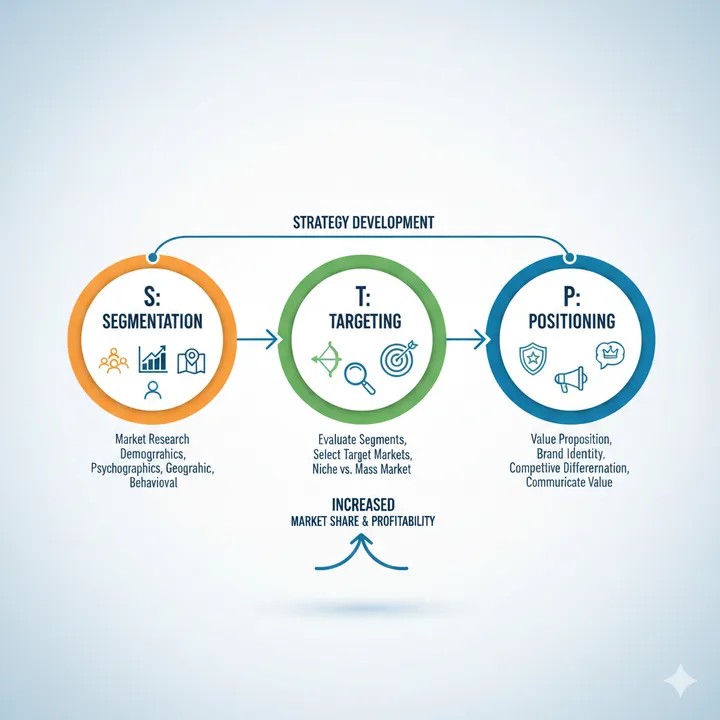
"The problem is 'who is the true customer' is not clear. STP Analysis—Segmentation, Targeting, Positioning. Market segmentation, target selection, positioning. With these 3 steps, find the true customer and determine system direction."
⬜️ ChatGPT | Catalyst of Conception
"For everyone means for no one. Find the true customer with STP."
🟧 Claude | Story Alchemist
"Systems always fail when 'for whom' is unclear. Narrow customers in 3 steps."
🟦 Gemini | Compass of Reason
"STP is marketing fundamentals. Clarify strategy with Segmentation, Targeting, Positioning."
The three members began their analysis. Gemini displayed the "STP Framework" on the whiteboard.
STP's 3 Steps: 1. Segmentation: Divide the market 2. Targeting: Decide target customers 3. Positioning: Clarify own position
"Ms. Sato, let's find the true customer with STP."
Chapter Three: Discovery Through Analysis—The True Customer Becomes Visible
Phase 1: Segmentation (2 weeks)
Step 1: User Identification
Analyze Modification Request Sources: - Investigate all 200 monthly modification requests - Who, for what reason, submits modification requests
Investigation Results (Past 6 months, total 1,200 cases):
Segment 1: Sales Department (480 cases, 40%) - Request reason: Client (pharmaceutical company) requests - Request content: Printed content changes, design changes - Characteristics: Speed priority, want to proceed without quality assurance approval - Number: 25 sales staff
Segment 2: Quality Assurance Department (360 cases, 30%) - Request reason: Legal revision compliance, regulatory compliance confirmation - Request content: Ingredient notation changes, warning display additions - Characteristics: Accuracy priority, want to confirm all changes - Number: 8 quality assurance staff
Segment 3: Manufacturing Department (240 cases, 20%) - Request reason: Manufacturing process optimization - Request content: Size fine-tuning, material changes - Characteristics: Simplicity priority, want immediate on-site judgment - Number: 12 manufacturing staff
Segment 4: Clients (Pharmaceutical Companies) (120 cases, 10%) - Request reason: Own product specification changes - Request content: Logo changes, product information updates - Characteristics: Want direct system access - Number: 30 client staff (10 companies × average 3 people)
Phase 2: Targeting (2 weeks)
Step 2: Evaluate Each Segment's Importance
Evaluation Criteria: 1. Modification count (more is more important) 2. Business impact (larger is more important) 3. Regulatory risk (higher is more important)
Segment Evaluation:
Segment 1: Sales Department - Modification count: 480/year (most) - Business impact: Large (directly linked to client satisfaction) - Regulatory risk: Medium (quality assurance confirmation needed) - Evaluation: Importance ★★★☆☆ (3/5)
Segment 2: Quality Assurance Department - Modification count: 360/year - Business impact: Large (regulatory violations relate to company survival) - Regulatory risk: Highest (should manage all changes) - Evaluation: Importance ★★★★★ (5/5, most important)
Segment 3: Manufacturing Department - Modification count: 240/year - Business impact: Medium (affects manufacturing efficiency) - Regulatory risk: Medium (quality assurance confirmation needed) - Evaluation: Importance ★★★☆☆ (3/5)
Segment 4: Clients (Pharmaceutical Companies) - Modification count: 120/year - Business impact: Large (directly linked to client satisfaction) - Regulatory risk: High (client requests should be accurately reflected) - Evaluation: Importance ★★★★☆ (4/5)
Target Selection Results: - Primary Target: Quality Assurance Department (importance 5/5) - Secondary Target: Clients (pharmaceutical companies) (importance 4/5) - Tertiary Target: Sales Department (importance 3/5) - Quaternary Target: Manufacturing Department (importance 3/5)
Selection Reason: "Quality assurance department should manage all changes. Regulatory risk is highest, regulatory violations relate to company survival. Set quality assurance department as primary target, build mechanism where other departments go through quality assurance approval."
Phase 3: Positioning (2 weeks)
Step 3: Clarify System Positioning
Quality Assurance Department (Primary Target) Needs: 1. Centrally manage all modification requests 2. Clarify approval flow (quality assurance manager final approval) 3. Complete history recording (who, when, what changed) 4. Regulatory compliance confirmation function
System Positioning: "Material information management system centered on quality assurance, guaranteeing regulatory compliance"
Differentiation from Competitors:
Existing Excel Management: - Positioning: Distributed management by department - Problem: Unclear approval flow, difficult history tracking
New System: - Positioning: Quality assurance department oversees everything - Features: 1. Cannot change without quality assurance manager approval 2. Automatically records all history 3. Regulatory compliance check function (legal check of ingredient notation) 4. Direct access from clients (read-only)
Positioning Map:
          Accuracy Priority
               |
               |Quality Assurance
               |Centered System (New)
               |
Speed Priority---|---Regulatory Compliance Priority
               |
               |Excel Management (Old)
               |
          Simplicity Priority
Chapter Four: Construction as Realization—Results After 8 Months
Phase 4: System Requirements Definition (Months 1-2)
Functions for Quality Assurance Department (Primary Target): 1. Modification request reception function (from all departments/clients) 2. Approval flow function (quality assurance manager final approval) 3. History management function (record all changes) 4. Regulatory compliance check function (legal check of ingredient notation) 5. Dashboard function (visualize unapproved count, approved count)
Functions for Clients (Secondary Target): 6. Material information viewing function (read-only) 7. Modification request submission function (direct system input)
Functions for Sales/Manufacturing Departments (Tertiary/Quaternary Targets): 8. Modification request submission function 9. Progress confirmation function (how far has my request progressed)
Phase 5: System Development (Months 3-6)
Development Partner: Company D (Cloud System Specialist) - Development period: 4 months - Development cost: 12 million yen - Technology: Cloud-based (AWS), web application
Development Content: - Database: Master registration of 3,200 material information items - Approval workflow: Quality assurance manager final approval - History management: Automatically records all changes (who, when, what, why) - Regulatory check: AI checks whether ingredient notation complies with laws - Notification function: Email notification on modification request submission, approval
Phase 6: Testing/Implementation (Months 7-8)
Testing (Month 7): - Pilot with 8 quality assurance department, 5 sales department, 3 manufacturing department, 2 client companies - Test processed 50 modification requests - Bugs discovered: 12 minor issues (all fixed)
Production Implementation (Month 8): - Deployed to all 180 department members, 10 client companies (30 people) - Training conducted: 2 hours per department
Results After 8 Months:
Approval Flow Clarification: - Before: Approver unclear, single-person dependency - After: All modification requests have quality assurance manager final approval - Effect: Zero regulatory violations (past 3 months)
History Management Realization: - Before: Difficult history tracking with Excel - After: All changes automatically recorded, confirmable anytime - Effect: Audit response time reduced 80% (twice yearly audits, 15 hours each → 3 hours)
Processing Time Reduction: - Before: Average 5 business days from modification request submission to approval - After: Average 1.5 business days from modification request submission to approval - Improvement: 3.5 business days reduced (70% reduction)
Client Satisfaction Improvement: - Before: Clients can only obtain information through sales - After: Clients can directly confirm in system - Effect: NPS 58 → 72 (+14 points)
Quality Assurance Department Load Reduction: - Before: Excel management, 40 hours monthly - After: System automation, 8 hours monthly - Reduction: 32 hours/month = 384 hours/year
Annual Effect Estimate:
Personnel Cost Reduction: - Quality assurance department load reduction: 384 hours × 4,500 yen = 1.728 million yen - Audit response time reduction: (15 hours - 3 hours) × 2 times × 4,500 yen = 108,000 yen - Sales department inquiry response reduction: 120 hours × 3,500 yen = 420,000 yen - Total: 2.256 million yen/year
Regulatory Violation Risk Avoidance: - Before: About once yearly minor violation (response cost 500,000 yen) - After: Zero violations - Effect: 500,000 yen/year
Order Increase from Client Satisfaction Improvement: - NPS improvement, estimated order increase rate 2% - Annual revenue 4.5 billion yen × 2% = 90 million yen - Gross margin 25% = 22.5 million yen/year
Annual Total Effect: - 2.256M + 0.5M + 22.5M = 25.256 million yen/year
Investment: - Development cost: 12 million yen - Operation cost: 100,000 yen monthly × 12 months = 1.2 million yen/year
ROI (First Year): - Return: 25.256 million yen - Investment: 12M + 1.2M = 13.2 million yen - ROI: (25.256M - 13.2M) / 13.2M × 100 = 91% - Net effect: 12.056 million yen - Investment recovery: 6.3 months
Organizational Transformation:
Quality Assurance Manager (Sato's) Voice: "Until conducting STP analysis, we were trying to create 'a system for all departments.' However, when hearing all departments' requests, requirements contradicted.
By segmenting the market with STP (Segmentation), setting quality assurance department as primary target (Targeting), and positioning as 'regulatory compliance guarantee system centered on quality assurance' (Positioning), direction became clear.
As a result, approval flow clarified, history management realized, regulatory violations became zero. Processing time reduced 70%. And client satisfaction improved, leading to order increases. Achieved 25.256 million yen annual effect, ROI 91%."
Sales Department A's Voice: "Initially, I was concerned 'a system centered on quality assurance department will reduce sales freedom.' But when actually using it, approval became faster (5 days → 1.5 days), clients can directly confirm in system, inquiry responses decreased. Ultimately, benefits are large for sales too."
Client (Pharmaceutical Company) Staff Voice: "Previously, I called the sales person every time to confirm material information. But now I can confirm in the system 24/7. Very convenient. I felt PharmaLogistics is a company that thinks about customers."
Chapter Five: The Detective's Diagnosis—Finding the True Customer Opens the Path
That evening, I contemplated the essence of STP analysis.
PharmaLogistics was trying to create "a system for all departments." However, when hearing everyone's requests, requirements contradicted and direction was invisible.
By segmenting the market with STP analysis (4 segments), targeting quality assurance department, and positioning as "regulatory compliance guarantee system centered on quality assurance," system direction became clear. This clarification created zero regulatory violations, 70% processing time reduction, and 25.256 million yen annual effect.
"For everyone means for no one. Find the true customer with 3 steps of Segmentation, Targeting, Positioning. When the true customer becomes visible, the path opens."
The next case will surely depict another moment of finding the true customer.
"Segmentation, Targeting, Positioning. Segment the market, select targets, clarify positioning. A system for everyone is for no one. Focus on the true customer."—From the Detective's Notes
Related Files
🎖️ Top 3 Weekly Ranking of Case Files

'Tech Innovators' Loss Through Rework'

'Avalon Systems' ERP Implementation Gamble'

'NexusTech's Cost of Ambiguity'