ROI Case File No.359 | 'UrbanDesign's Blueprint Labyrinth'
📅 2025-12-20 23:00
🕒 Reading time: 11 min
🏷️ ECRS

- Chapter One: The Swamp of Checking Work—2.5 Hours Repeated
- Chapter Two: The Idea of Automation—But Wrong Order
- Chapter Three: Discovery Through Elimination—Waste Becomes Visible
- Chapter Four: Execution as Results—Changes After 6 Months
- Chapter Five: The Detective's Diagnosis—Order Determines Results
- Related Files
Chapter One: The Swamp of Checking Work—2.5 Hours Repeated
The day after resolving the material information management case at PharmaLogistics, another consultation arrived regarding design blueprint checking efficiency. Volume 29, "The Pursuit of Reproducibility," Episode 359, tells the story of eliminating waste.
"Detective, our design blueprint checking work takes 2.5 hours per case. Eighty cases monthly, 200 hours total. And 15 monthly reworks occur due to missed checks. Past blueprint searches also take 30 minutes. We want to streamline this work, but don't know where to start."
Yuichi Suzuki, design manager from UrbanDesign, born in Nagoya, visited 221B Baker Street with an exhausted expression. In his hands were thick materials with printed checklists and, in stark contrast, a business analysis report noting "Improvement ideas: None."
"We're an architectural design firm. Sixty-five employees. Annual revenue of 1.8 billion yen. We mainly handle designs for condominiums, office buildings, commercial facilities. Design blueprint quality is our lifeline. However, blueprint checking work has become an enormous burden."
UrbanDesign's Current State: - Established: 2005 (Architectural design firm) - Employees: 65 (45 design staff, 8 checking staff) - Annual revenue: 1.8 billion yen - Blueprint checking: 80 cases monthly, 2.5 hours per case, 200 hours total - Problems: Long checking time, frequent reworks, past blueprint search time
Deep impatience permeated Suzuki's voice.
"Design blueprint checking is performed by 8 dedicated checking staff. Check items total 280. Structure, equipment, regulations, design aesthetics. We confirm everything. 2.5 hours per case. Eighty cases monthly, 200 hours.
And missed checks occur. Fifteen cases monthly. Reworks. Design staff correct blueprints, check again. Takes even more time."
Typical Checking Work Flow:
Step 1: Blueprint Reception (5 min) - Receive blueprint data from design staff - Save to folder
Step 2: Checklist Preparation (10 min) - Print 280-item checklist from Excel - Handwrite project information (property name, floors, use)
Step 3: Structure Check (45 min) - Confirm column/beam placement - Confirm load-bearing wall positions - Confirm foundation dimensions - Handwrite ○× on checklist
Step 4: Equipment Check (40 min) - Confirm air conditioning equipment placement - Confirm piping routes - Confirm electrical wiring - Handwrite ○× on checklist
Step 5: Regulation Check (35 min) - Confirm Building Standards Act compliance - Confirm Fire Service Act compliance - Confirm Barrier-Free Act compliance - Handwrite ○× on checklist
Step 6: Design Aesthetics Check (30 min) - Confirm design consistency - Confirm finishing materials - Confirm fit - Handwrite ○× on checklist
Step 7: Past Blueprint Comparison (30 min) - Search past blueprints of similar properties - Confirm past pointed-out items - Confirm no same mistakes
Step 8: Check Results Summary (15 min) - Aggregate checklist - Summarize pointed-out items in Word - Email to design staff
Total: 2.5 hours (150 min)
Suzuki sighed deeply.
"And reworks occur. Mistakes checking staff missed. After design staff correct, check again. Another 2.5 hours. Fifteen monthly reworks waste 37.5 hours.
Past blueprint search is also problematic. Server stores 8,000 blueprints. Folder names like '2024_CondominiumA_Implementation Design.' Finding similar properties takes 30 minutes.
We want to streamline this work. However, what should we improve how? We don't know."
Chapter Two: The Idea of Automation—But Wrong Order
"Mr. Suzuki, are you thinking of immediately systemizing and automating?"
My question received Suzuki's immediate answer.
"Yes, I think AI automatic blueprint checking could create efficiency. But can AI really accurately check 280 items? I have concerns."
Current Understanding (Automation-First Type): - Expectation: AI automation solves everything - Problem: Business process waste not analyzed
I explained the importance of applying the four principles of business improvement in order.
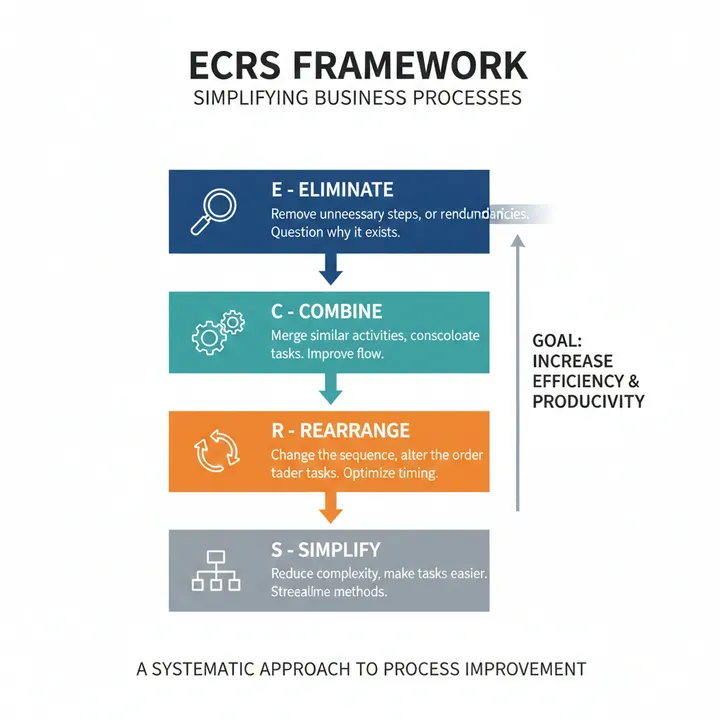
"The problem is not understanding 'what the waste is.' ECRS—Eliminate, Combine, Rearrange, Simplify. Elimination, combination, rearrangement, simplification. Improve work in this order. Automation (Simplify) is last. First, eliminate waste."
⬜️ ChatGPT | Catalyst of Conception
"Delete before automating. Follow ECRS order. Eliminate waste."
🟧 Claude | Story Alchemist
"Work should always question 'why is this step necessary?' Eliminate in E→C→R→S order."
🟦 Gemini | Compass of Reason
"ECRS is improvement technique. Optimize work in order of Eliminate, Combine, Rearrange, Simplify."
The three members began their analysis. Gemini displayed the "ECRS Framework" on the whiteboard.
ECRS's 4 Principles (Application Order): 1. Eliminate: Can it be eliminated? 2. Combine: Can it be combined? 3. Rearrange: Can the order be changed? 4. Simplify: Can it be simplified?
"Mr. Suzuki, let's improve work in ECRS order."
Chapter Three: Discovery Through Elimination—Waste Becomes Visible
Phase 1: Eliminate Application (3 weeks)
Principle: Delete truly unnecessary work
Analysis Target: 280-item checklist
Investigation: - Analyze past year's check results (960 cases) - Aggregate frequency of pointed-out items for each item
Investigation Results:
Frequent Pointed-out Items (>10% rate): 35 items - Example: "Structural column placement inappropriate" (18% rate) - Example: "Fire equipment placement non-compliant with regulations" (15% rate)
Medium Frequency (1-10% rate): 95 items
Low Frequency (0.1-1% rate): 80 items
Zero Pointed-out (not once in past year): 70 items - Example: "Exterior wall material color inconsistent with specifications" (0% rate) - Example: "Stair handrail height below standard" (0% rate) - Reason: Items design staff always confirm, or automatic design tool calculates
Eliminate Decision: - Delete 70 zero-pointed-out items from checklist - 280 items → 210 items (25% reduction)
Reduction Effect: - Check time: 70 items × 0.5 min = 35 min reduction (2.5 hours → 1.9 hours)
Phase 2: Combine Application (2 weeks)
Principle: Consolidate multiple tasks into one
Analysis Target: 8-step checking work
Problem Discovery: - Step 2: Print checklist, handwrite project information - Steps 3-6: Check each field (structure, equipment, regulations, aesthetics) individually, handwrite ○× marks - Step 8: Input pointed-out items to Word while viewing handwritten ○×
Combine Decision 1: Digitize Checklist - Before: Print on paper, handwrite ○× marks - After: Check directly on Excel file, auto-aggregate - Effect: - Print time reduction: 10 min → 0 min - Handwriting time reduction: 15 min → 0 min - Word input time reduction: 15 min → 5 min (auto-transfer from Excel) - Total reduction: 35 min
Combine Decision 2: Integrate Field-by-Field Checking - Before: Check structure→equipment→regulations→aesthetics individually - After: Check all fields simultaneously while viewing blueprint (eliminate waste of reopening blueprint per field) - Effect: Blueprint reopening time reduction: 20 min
Reduction Effect (Combine Total): - 55 min reduction (1.9 hours → 1.0 hour)
Phase 3: Rearrange Application (2 weeks)
Principle: Change work order
Analysis Target: Step 7 (past blueprint comparison) position
Problem Discovery: - Current: Search past blueprints after all checking complete (30 min) - Problem: If same pointed-out items in past blueprints, duplicate effort re-checking already checked items
Rearrange Decision: - Before: Step 7 (past blueprint comparison) is last - After: Conduct past blueprint comparison immediately after Step 1 - Reason: Grasp past pointed-out items first, narrow items to check intensively
Effect: - By confirming items pointed out in past blueprints first, reduce missed checks - Rework reduction: 15 cases/month → 5 cases/month (67% reduction)
Reduction Effect (From Rework Reduction): - Rework 10 cases × 2.5 hours = 25 hours/month reduction
Phase 4: Simplify Application (4 weeks)
Principle: Make easier through automation/tooling
Analysis Target: Remaining work
Simplify Decision 1: Automate Past Blueprint Search - Before: Manual search from 8,000 server files (30 min) - After: AI search tool implementation (auto-search by property name, use, floors) - Effect: 30 min → 3 min (27 min reduction)
Simplify Decision 2: Automate Regulation Checking - Before: Manual check Building Standards Act, Fire Service Act, Barrier-Free Act (35 min) - After: Regulation checking tool implementation (input blueprint data, auto-determine) - Effect: 35 min → 10 min (25 min reduction)
Simplify Decision 3: Auto-Input Checklist - Before: Handwrite project information - After: Auto-input from design database - Effect: Already reduced by Combine
Reduction Effect (Simplify Total): - 52 min reduction (1.0 hour → 0.1 hour)
Phase 5: Business Flow After ECRS Application (Post-Improvement)
New Checking Work Flow:
Step 1: Blueprint Reception (5 min) - No change
Step 2: Past Blueprint Search (3 min) - AI search tool auto-search - Order changed by Rearrange
Step 3: Checklist Preparation (0 min) - Digitized by Combine, auto-input
Step 4: Integrated Check (60 min) - Reduced to 210 items by Eliminate - All fields checked simultaneously by Combine - Check directly on Excel file
Step 5: Regulation Check (10 min) - Automated by Simplify
Step 6: Check Results Summary (5 min) - Auto-transfer by Combine
Total: 1.4 hours (83 min)
Improvement Effect: - Before: 2.5 hours - After: 1.4 hours - Reduction: 1.1 hours (44% reduction)
Chapter Four: Execution as Results—Changes After 6 Months
Phase 6: Tool Implementation (Months 1-3)
Implemented Tools:
Tool 1: AI Blueprint Search System - Development: Collaboration with external partner - Cost: Initial 3 million yen - Function: AI search by property name, use, floors
Tool 2: Regulation Checking Tool - Purchase: Implement existing product - Cost: Initial 2 million yen, annual maintenance 600,000 yen - Function: Auto-determine Building Standards Act, Fire Service Act, Barrier-Free Act
Tool 3: Digital Checklist - Development: Built in-house - Cost: 500,000 yen (external consultant support) - Function: Auto-aggregate with Excel macro, auto-transfer to Word
Total Initial Investment: 5.5 million yen
Phase 7: Operations Start (Months 4-6)
Results After 6 Months:
Checking Time Reduction: - Before: 2.5 hours/case × 80 cases/month = 200 hours/month - After: 1.4 hours/case × 80 cases/month = 112 hours/month - Reduction: 88 hours/month = 1,056 hours/year
Rework Reduction: - Before: 15 cases/month × 2.5 hours = 37.5 hours/month - After: 5 cases/month × 1.4 hours = 7 hours/month - Reduction: 30.5 hours/month = 366 hours/year
Total Reduction Hours: - 1,056 hours + 366 hours = 1,422 hours/year
Personnel Cost Reduction: - 1,422 hours × 4,500 yen = 6.399 million yen/year
Quality Improvement Effect: - Rework reduction: 15 cases/month → 5 cases/month (67% reduction) - Rework response cost reduction from missed checks: 10 cases × 12 months × 50,000 yen = 6 million yen/year (Rework requires design staff rework, client explanation, possibly design change impact investigation)
Annual Total Effect: - 6.399 million yen + 6 million yen = 12.399 million yen
Investment: - Initial investment: 5.5 million yen - Operation cost: 600,000 yen/year
ROI (First Year): - Return: 12.399 million yen - Investment: 5.5M + 600K = 6.1 million yen - ROI: (12.399M - 6.1M) / 6.1M × 100 = 103% - Net effect: 6.299 million yen - Investment recovery: 5.3 months
ECRS Effect Breakdown:
E (Eliminate): Delete 70 check items - Time reduction: 35 min/case × 80 cases = 46.7 hours/month - Personnel cost reduction: 46.7 hours × 4,500 yen × 12 months = 2.52 million yen/year
C (Combine): Digitization, integrated checking - Time reduction: 55 min/case × 80 cases = 73.3 hours/month - Personnel cost reduction: 73.3 hours × 4,500 yen × 12 months = 3.96 million yen/year
R (Rearrange): Advance past blueprint comparison - Rework reduction: 10 cases/month × 12 months = 120 cases/year - Response cost reduction: 120 cases × 50,000 yen = 6 million yen/year
S (Simplify): AI search, regulation automation - Time reduction: 52 min/case × 80 cases = 69.3 hours/month - Personnel cost reduction: 69.3 hours × 4,500 yen × 12 months = 3.74 million yen/year
Total Effect (Excluding Duplicates): - Personnel cost reduction: 6.399 million yen - Rework response cost reduction: 6 million yen - Total: 12.399 million yen
Organizational Transformation:
Checking Staff A's Voice: "Previously, I printed the 280-item checklist and handwrote ○× marks one by one. Took 2.5 hours. And missed checks occurred.
By improving work with ECRS, 70 items deleted (Eliminate), handwriting eliminated through digitization (Combine), reworks reduced by conducting past blueprint comparison first (Rearrange), time shortened by AI search and regulation automation (Simplify).
Completes in 1.4 hours. 44% reduction. And reworks reduced 67%. Checking quality also improved."
Design Staff B's Voice: "Previously, I corrected blueprints many times due to checking reworks. Occurred 1-2 times monthly. But after work improved with ECRS, reworks almost disappeared. Can concentrate on design work."
Design Manager (Suzuki's) Reflection:
"Until conducting ECRS analysis, we thought 'AI automation solves everything.' However, automation (Simplify) is last. First, we needed to eliminate waste.
E (Eliminate): Delete 70 zero-pointed-out items. C (Combine): Eliminate handwriting through digitization, eliminate blueprint reopening through integrated checking. R (Rearrange): Reduce reworks by advancing past blueprint comparison. S (Simplify): AI search and regulation automation.
This order was important. Result: checking time reduced 44%, reworks reduced 67%, achieved 12.399 million yen annual effect. ROI 103%, investment recovery 5.3 months.
By following ECRS order, true efficiency realized."
Chapter Five: The Detective's Diagnosis—Order Determines Results
That evening, I contemplated the essence of ECRS thinking.
UrbanDesign thought "AI automation creates efficiency." However, starting from Simplify means automating while leaving waste.
By following ECRS order—Eliminate, Combine, Rearrange, Simplify—true efficiency realized. First deleted unnecessary 70 items, next consolidated handwriting through digitization, rearranged past blueprint comparison order, finally automated with AI. This order created 44% checking time reduction, 67% rework reduction, 12.399 million yen annual effect.
"Delete before automating. Follow E→C→R→S order. Eliminate waste. Order determines results."
The next case will surely depict another moment of optimizing business processes.
"Eliminate, Combine, Rearrange, Simplify. Improve work in order of elimination, combination, rearrangement, simplification. Automation is last. First eliminate waste."—From the Detective's Notes
Related Files
🎖️ Top 3 Weekly Ranking of Classified Case Files

What is the RICE Framework
What is RFP
What is STP Analysis