ROI Case File No.380 | 'GlobalTrade Inc.'s 20-Year Burden'
📅 2026-01-10 23:00
🕒 Reading time: 12 min
🏷️ DESIGN_THINKING
- Chapter 1: The 20-Year Burden—Slow Operation, Everything Manual
- Chapter 2: The Illusion of System Replacement—Users' True Needs Are Invisible
- Chapter 3: Steps 1 & 2—Empathy and Problem Definition
- Chapter 4: Steps 3 & 4—Ideation and Prototyping
- Chapter 5: Step 5—Testing and Implementation
- Chapter 6: Detective's Diagnosis—Creating True Value Through User-Centered Design
- Related Files
Chapter 1: The 20-Year Burden—Slow Operation, Everything Manual
The day after resolving TechSavvy Inc.'s Double Diamond case, a consultation arrived regarding product management system renewal. Volume 30, "The Pursuit of Reproducibility," Case 380 tells the story of creating true value through user-centered design.
"Detective, our system is a fossil. Product management system. Used for over 20 years. Slow operation. All input is manual. Can't bulk import data from spreadsheets. Must manually input HTML tags. And the system is black-boxed. We've reached our limit."
Kenta Sato, Information Systems Director of GlobalTrade Inc. from Otemachi, visited 221B Baker Street with an exhausted expression. In his hands were system design documents from 20 years ago (10 paper binders, 2,000 total pages), and in stark contrast, the latest system renewal proposal titled "System Modernization Proposal 2026."
"We are an imported goods wholesale business. 180 employees. Annual revenue of 7.8 billion yen. 12,000 product items. However, the product management system is a bottleneck. We're looking for companies that can offer new services or support."
GlobalTrade Inc.'s Current State: - Founded: 1985 (imported goods wholesale) - Employees: 180 - Annual revenue: 7.8B yen - Product items: 12,000 - Issues: Slow system response, much manual work, can't bulk import data, black-boxed
Deep anxiety permeated Sato's voice.
"Current system problems are as follows: Response speed is slow with long wait times. Average 8 minutes per product registration. All data entry is manual, creating heavy burden. Product name, price, inventory count, product description, HTML tags. All manually input. Can't bulk import data from spreadsheets. And the system is black-boxed."
Current System Reality:
System Configuration: - Development year: 2005 - Development language: Visual Basic 6.0 (end-of-support 2008) - Database: Access 2003 (end-of-support 2014) - Server: Windows Server 2003 (end-of-support 2015) - Client: Windows XP (end-of-support 2014)
All end-of-support
Using Departments: - Product Management: 15 people (product registration, inventory management) - Marketing: 8 people (product description creation, web posting) - Sales: 45 people (inventory confirmation, order processing)
Product Registration Work Reality:
Step 1: Product Information Input (Average 8 minutes/item)
1. Start system (startup time: average 2 minutes)
2. Open product registration screen (screen transition: average 30 seconds)
3. Manually input product code (30 seconds)
4. Manually input product name (1 minute)
5. Manually input price (30 seconds)
6. Manually input inventory count (30 seconds)
7. Select product category from dropdown (1 minute)
8. Manually input product description (2 minutes)
9. Manually input HTML tags (1 minute, <p>, <br>, etc.)
10. Click save button (save time: average 30 seconds)
Total: 8 minutes/item
Monthly Performance: - New product registration: 200/month - Product information updates: 800/month - Total: 1,000/month - Monthly work time: 1,000 × 8 minutes = 8,000 minutes (133 hours)
HTML Tag Manual Input Problem:
Example: Product Description Input
<p>Italian luxury leather bag.</p>
<p>Size: W30cm × H25cm × D10cm</p>
<p>Color: Black, Brown, Navy</p>
<br>
<p>【Features】</p>
<ul>
  <li>Genuine leather</li>
  <li>3 internal pockets</li>
  <li>Removable shoulder strap included</li>
</ul>
Problems: - Forgetting to close tags (average 12 cases/month) - Full-width/half-width mixing (average 20 cases/month) - HTML errors preventing web posting (average 8 cases/month)
Sato sighed deeply.
"There's another problem. Can't bulk import data from spreadsheets. Product data (Excel) sent from suppliers must be manually input one by one. Of 200 new monthly products, 150 are Excel data from suppliers. But can't even copy and paste. All manual input. And all staff from development time have left, so we don't understand the system internals."
Chapter 2: The Illusion of System Replacement—Users' True Needs Are Invisible
"Sato-san, do you believe renewing to the latest system will solve all problems?"
Sato answered immediately.
"Yes, I expect that. I've heard that migrating to a cloud-based product management system will improve response speed and enable bulk data import."
Current Understanding (System Replacement Approach): - Expectation: Solve everything at once with latest system - Problem: Users' true needs are invisible
I explained the importance of creating true value through user-centered design.
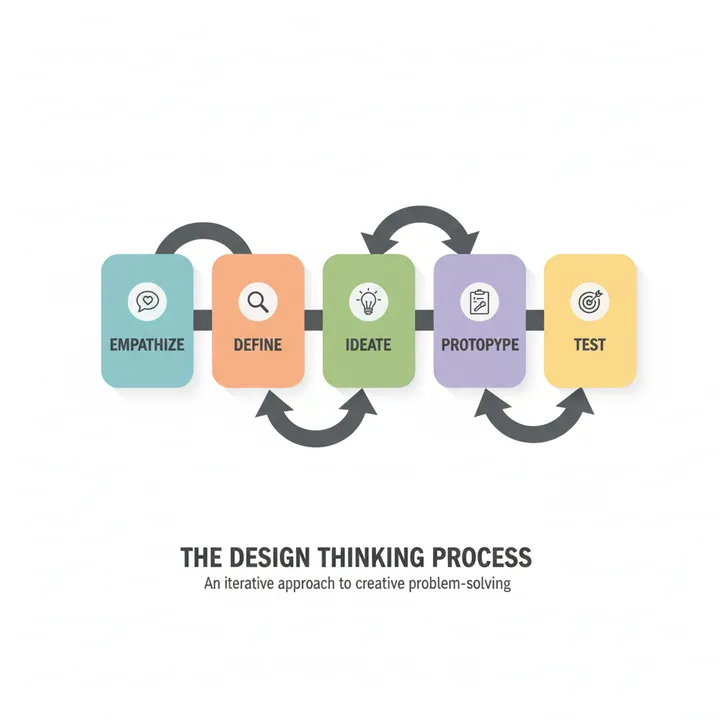
"The problem is thinking 'renewing to the latest system will solve it.' Design Thinking—a problem-solving process starting from user empathy. Empathy, problem definition, ideation, prototyping, testing. By repeating these 5 steps, we achieve reproducible user-centered design."
⬜️ ChatGPT | Catalyst of Concepts
"Don't replace systems. Empathize with users through Design Thinking and discover true needs"
🟧 Claude | Story Alchemist
"Users always harbor 'inexpressible dissatisfactions.' Observation is the first job"
🟦 Gemini | Compass of Reason
"Follow Design Thinking's 5 steps. Empathy, problem definition, ideation, prototyping, testing"
The three members began their analysis. Gemini displayed "Design Thinking's 5 Steps" on the whiteboard.
Design Thinking's 5 Steps: 1. Empathize: Deeply understand users 2. Define: Define essential problems 3. Ideate: Diverge solution ideas 4. Prototype: Give form to ideas 5. Test: Test with users and learn
"Sato-san, let's start by empathizing with Product Management users."
Chapter 3: Steps 1 & 2—Empathy and Problem Definition
Step 1: Empathize - Deeply Understand Users (2 weeks)
Survey Methods:
Interviews (Product Management 15 people, Marketing 8 people) - Deep interviews: 1 hour each - Questions: "What's most painful in daily work?" "What's an ideal system?"
Observation Study (Shadowing) - Period: 5 days - Subjects: 3 Product Management staff - Method: Observe product registration work alongside, time study
Experience Study (Try it yourself) - 3 DX Promotion Office members actually experience product registration - Experience time: 2 hours each
Creating Empathy Map:
Product Management Tanaka-san (35 years old, 8 years tenure) Persona:
What They Say: - "System is slow and frustrating" - "HTML tag input errors lead to multiple redos" - "If I could copy from Excel it would be easier"
What They Do: - Leave product registration screen open, do other work while waiting for system response - Try to copy & paste HTML tags written in Notepad, but can't paste so manually input - After saving, check display on web screen, re-input if errors
What They Think: - "There should be a more efficient method" - "I wonder if a new system would make it easier" - "But learning new system operations is also troublesome"
What They Feel: - Anxiety: "Don't know when the system will stop" - Frustration: "Repeating the same work multiple times" - Fatigue: "8 minutes per task, 25 items daily. 200 hours monthly. At my limit" - Helplessness: "Even submitting improvement requests, nothing changes"
Critical Discovery: - User's greatest pain: "Repetition of same work" and "wait times" - User's latent need: "Want to increase thinking time" (reduce simple tasks) - User's anxiety: "Won't new system operations become complex?"
Step 2: Define - Define Essential Problem (1 week)
Creating POV (Point of View) Statement:
"Users like Product Management's Tanaka-san spend time on simple repetitive tasks (manual input, HTML tag input) and can't focus on their real work (product selection, pricing strategy consideration). This is because the system doesn't support automation and efficiency—everything is manual"
Creating HMW (How Might We) Questions:
- HMW 1: "How might we enable automatic Excel data import?"
- HMW 2: "How might we auto-generate HTML tags?"
- HMW 3: "How might we improve system response speed?"
- HMW 4: "How might we simplify new system operations?"
Chapter 4: Steps 3 & 4—Ideation and Prototyping
Step 3: Ideate - Diverge Solution Ideas (1 week)
Brainstorming (DX Promotion Office members 8 people):
Rules: - No criticism - Quantity over quality (target 100 ideas) - Free and wild - Build on others' ideas OK
Diverged Ideas (Excerpt):
Group 1: Data Entry Automation 1. Excel bulk import function (CSV upload) 2. Extract data from paper product catalogs with AI-OCR 3. Auto-import through API integration with supplier systems 4. Register product information via voice input
Group 2: HTML Tag Automation 5. Input in Markdown notation, auto-convert to HTML 6. WYSIWYG editor (input with Word-like feel) 7. AI auto-generates HTML from product descriptions 8. Template selection system (no HTML tags needed)
Group 3: Response Speed Improvement 9. Migrate to cloud-based system 10. Change database to PostgreSQL 11. Make screen display asynchronous 12. Implement cache function
Group 4: Operability Improvement 13. Create smartphone app (register from outside) 14. Co-create screen design with users 15. Create tutorial videos 16. Introduce shortcut keys
Convergence: Determine Priorities
Evaluation Axes: - Axis A: User impact (1-5 points) - Axis B: Technical feasibility (1-5 points) - Axis C: Cost (1-5 points, lower is higher score)
Top 5: 1. Excel bulk import function: A5 + B5 + C5 = 15 points 2. WYSIWYG editor: A5 + B4 + C4 = 13 points 3. Cloud-based system: A4 + B5 + C3 = 12 points 4. Template selection: A4 + B5 + C5 = 14 points 5. Co-create screen design: A5 + B5 + C5 = 15 points
Step 4: Prototype - Give Form to Ideas (4 weeks)
Prototype Design Principles: 1. Start Lo-Fi (low fidelity): Paper mockups 2. Co-create with users: Weekly review meetings 3. Build quickly: Version up every week
Week 1: Paper Prototype
Product Registration Screen Paper Mockup: - Hand-drawn screen design on A4 paper - Review with 3 Product Management staff - Feedback: "Excel bulk import button is hard to find"
Week 2: Figma Prototype (Medium Fidelity)
Improvements: - Place Excel bulk import button in prominent position at top of screen - WYSIWYG editor placement - Add template selection dropdown
User Review: - All 15 Product Management staff verify operability - Feedback: "Save button position unclear" "Excel bulk import procedure unclear"
Week 3: Figma Prototype (High Fidelity)
Improvements: - Fixed display save button at bottom right of screen - Display Excel bulk import procedure in tooltips - Add preview function (confirm how HTML displays)
Week 4: Implementation Prototype (Working Demo)
Technology Stack: - Frontend: React + TypeScript - Backend: Node.js + Express - Database: PostgreSQL (Cloud: AWS RDS) - WYSIWYG Editor: TinyMCE
Implemented Functions: - Excel bulk import (CSV upload) - WYSIWYG editor (auto-generate HTML tags) - Real-time preview - Template selection (5 types)
Chapter 5: Step 5—Testing and Implementation
Step 5: Test - Test with Users and Learn (2 weeks)
Usability Testing:
Subjects: 5 Product Management staff Tasks: 1. Bulk import Excel file (50 items) 2. Create product description with WYSIWYG editor 3. Confirm in preview then save
Measurement Metrics: - Task completion time - Error occurrence count - Satisfaction (5-point scale)
Results:
Task 1: Excel Bulk Import - Before: 50 items × 8 minutes = 400 minutes (6.7 hours) - After: Bulk import 5 minutes + verification 20 minutes = 25 minutes - Reduction rate: 94%
Task 2: Product Description Creation - Before: HTML tag manual input 2 minutes/item - After: WYSIWYG editor 30 seconds/item - Reduction rate: 75%
Task 3: Error Occurrence Count - Before: Average 40 cases/month (HTML tag errors, full-width/half-width mixing, etc.) - After: Average 2 cases/month (nearly 0 with WYSIWYG editor) - Reduction rate: 95%
Satisfaction: - All 5 "Very satisfied (5 points)"
Feedback: - "Bulk import from Excel is wonderful" - "Can input without being conscious of HTML tags" - "Can confirm in preview so feel secure" - "System response is fast (2 minutes → 5 seconds)"
Months 5-6: Production Implementation and Company-Wide Deployment
Production System Development: - Development period: 2 months - Development cost: 12M yen - Cloud migration cost: 3M yen - Training cost: 800K yen - Total initial investment: 15.8M yen
Annual Effects:
Personnel Cost Reduction (Product Registration Work): - Before: 133 hours/month (1,000 items × 8 minutes) - After: 20 hours/month (drastically reduced with Excel bulk import) - Time saved: 113 hours/month × 12 months = 1,356 hours/year - Personnel cost reduction: 1,356 hours × 3,500 yen = 4.74M yen/year
Error Response Cost Reduction: - Before: 40 cases/month × 2 hours/case × 3,500 yen = 280K yen/month - After: 2 cases/month × 2 hours × 3,500 yen = 14K yen/month - Annual reduction: 266K × 12 months = 3.19M yen/year
Productivity Improvement (Increased Time for Core Work): - Allocate reduced time to product selection and pricing strategy - Effect: New product development increase, gross margin improvement - Estimated effect: 8M yen/year
Legacy System Maintenance Cost Reduction: - Before: Annual maintenance cost 5M yen (specialized vendor dependent) - After: Cloud maintenance cost 1.8M yen - Reduction: 3.2M yen/year
Total Annual Effects: - 4.74M + 3.19M + 8M + 3.2M = 19.13M yen/year
ROI: - (19.13M - 1.8M) / 15.8M × 100 = 110% - Payback period: 15.8M ÷ 17.33M = 0.91 years (10.9 months)
Chapter 6: Detective's Diagnosis—Creating True Value Through User-Centered Design
That evening, I contemplated the essence of Design Thinking.
GlobalTrade Inc. had technology-first thinking: "renewing to the latest system will solve it." However, through Design Thinking's 5 steps, users' true needs became visible.
Empathize: Product Management users "spend time on simple repetitive tasks and can't focus on their real work" Define: "System doesn't support automation and efficiency—everything is manual" Ideate: Diverged 100 ideas and selected Top 5 Prototype: Paper → Figma → Implementation, 3 iterations in 4 weeks Test: Confirmed 94% time reduction in usability testing
What's important is that we empathized with and co-created with users. Rather than designers alone designing, we built screens together with users through weekly review meetings. As a result, we achieved perfect satisfaction scores and 94% product registration time reduction (400 minutes → 25 minutes).
Annual effects of 19.13M yen, ROI of 110%, payback in 10.9 months. And users can now focus on their "real work."
"Don't replace systems. Empathize with users through Design Thinking. Empathy, problem definition, ideation, prototyping, testing. By repeating these 5 steps, reproducible user-centered design emerges."
Volume 30, "The Pursuit of Reproducibility," closes here. However, the journey pursuing reproducibility never ends.
"Design Thinking—Problem solving that begins with user empathy. Empathy, problem definition, ideation, prototyping, testing. By focusing on people rather than technology, true value emerges"—From the Detective's Notes
Related Files
🎖️ Top 3 Weekly Ranking of Classified Case Files
What is ROI
What is the ECRS Principle
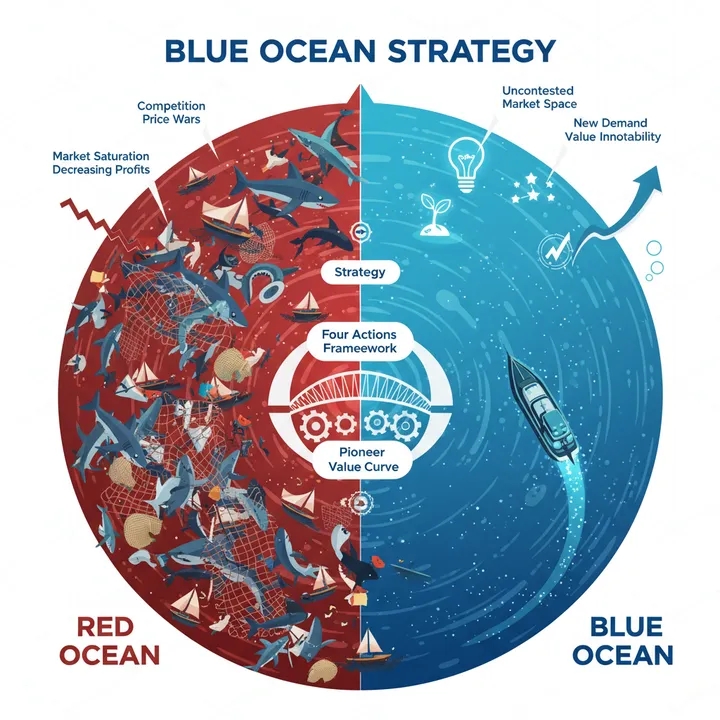
What is Blue Ocean Strategy