ROI Case File No.382 | 'TransLingua's Desperate 2035 Cliff'
📅 2026-01-12 23:00
🕒 Reading time: 9 min
🏷️ BLUE_OCEAN

- Chapter 1: The Desperate 2035 Cliff—The Day 500,000 Lines of COBOL Become Worthless
- Chapter 2: The Illusion of Existing Markets—The Folly of Fighting in the Red Ocean
- Chapter 3: Phase 1—Analyzing Existing Markets and Creating New Markets
- Chapter 4: Phase 2—Value Innovation Balancing Value and Cost
- Chapter 5: The Detective's Diagnosis—Create Competition-Free Markets
- Related Files
Chapter 1: The Desperate 2035 Cliff—The Day 500,000 Lines of COBOL Become Worthless
The day after resolving TechScribe's Scene-Cast incident, a new consultation arrived regarding legacy system migration. Volume 31, "The Pursuit of Reproducibility," Episode 382, tells the story of creating a competition-free market.
"Detective, we have a deadline. 2035. Fujitsu mainframe support termination. Only 9 years left. Our core system is written in COBOL. 500,000 lines. Modified continuously for 40 years since 1985. If this system stops, our business stops."
Makoto Takahashi, CIO of TransLingua Inc. from Otemachi, visited 221B Baker Street with an expression full of urgency. In his hands were yellowed printouts of COBOL source code, contrasting sharply with a three-year plan titled "Legacy Migration Project 2026-2035."
"We're an ERP package vendor for manufacturing. 580 employees. Annual revenue of 15 billion yen. 320 client companies. All clients depend on our COBOL system. But when support ends in 2035, this system will become unusable."
TransLingua Inc.'s Current Situation: - Established: 1985 (ERP packages for manufacturing) - Employees: 580 - Annual Revenue: 15 billion yen - Client Companies: 320 - Problem: Fujitsu mainframe support ending (2035), must migrate 500,000 lines of COBOL
There was deep crisis in Takahashi's voice.
"Manual migration is impossible. We estimated how many person-years it would take to rewrite 500,000 lines of COBOL to C#. Assuming one person can review and convert 100 lines of code per day, 500,000 lines ÷ 100 lines = 5,000 days. With a 20-person team, 250 days. But in reality, you need to understand the logic line by line and redesign it to fit C# design philosophy. Realistically, 20 lines per person per day is the limit."
Desperate Manual Migration Estimates:
Case 1: Optimistic Scenario (100 lines/day) - Total lines: 500,000 - Conversion volume per person per day: 100 lines - Total work days: 5,000 days - With 20-person team: 250 days (about 1 year) - Personnel cost: 5,000 days × 80,000 yen/day = 400 million yen
Case 2: Realistic Scenario (20 lines/day) - Total lines: 500,000 - Conversion volume per person per day: 20 lines (including logic understanding + design + testing) - Total work days: 25,000 days - With 20-person team: 1,250 days (about 5 years) - Personnel cost: 25,000 days × 80,000 yen/day = 2 billion yen
Case 3: Worst-Case Scenario (10 lines/day) - Total lines: 500,000 - Conversion volume per person per day: 10 lines (including complex business logic) - Total work days: 50,000 days - With 20-person team: 2,500 days (about 10 years) - Personnel cost: 50,000 days × 80,000 yen/day = 4 billion yen
Conversion Tool Market Survey Results: - Survey period: January 2024 - December 2025 (2 years) - Companies surveyed: 50 (30 domestic, 20 overseas) - COBOL → Java conversion: Offered by 15 companies - COBOL → C# conversion: 0 companies - COBOL → Python conversion: Offered by 3 companies
Takahashi sighed deeply.
"We searched for 2 years. For a company that could provide COBOL → C# conversion tools. But we found none. COBOL → Java exists. But we need C# that runs on Windows environment. Java doesn't meet our requirements."
Chapter 2: The Illusion of Existing Markets—The Folly of Fighting in the Red Ocean
"Takahashi-san, do you think competing in the existing conversion tool market will find a solution?"
Takahashi showed a puzzled expression at my question.
"Huh, isn't that the case? There are 15 conversion tool vendors in the market. I thought one of them would add C# support."
Current Understanding (Existing Market Competition Model): - Expectation: Existing vendors will add C# support - Problem: Can't differentiate in Red Ocean (highly competitive market)
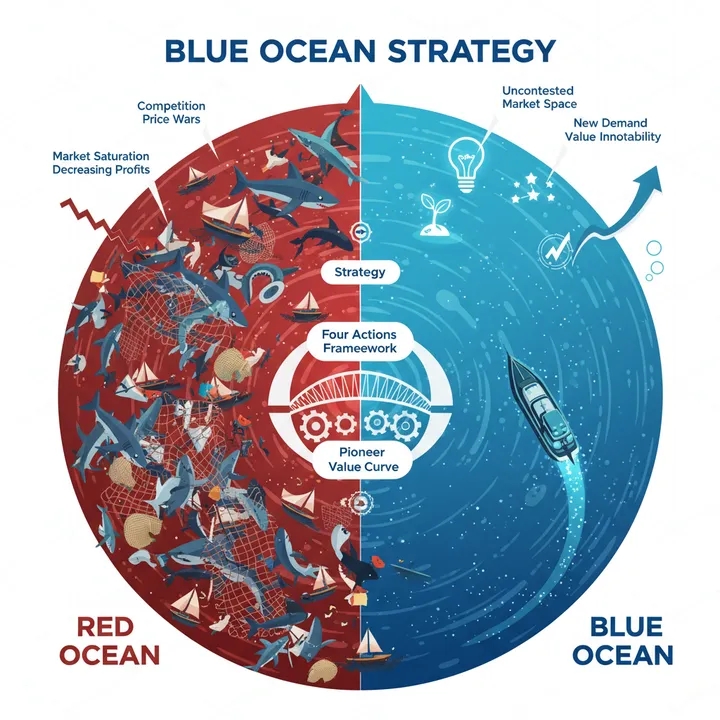
I explained the importance of creating a competition-free market with Blue Ocean Strategy.
"The problem is thinking 'compete in existing markets.' Blue Ocean Strategy. Create unexplored markets without competition, achieving reproducible success through value innovation (combining value and low cost)."
⬜️ ChatGPT | Concept Catalyst
"Don't fight in existing markets. Create competition-free markets with Blue Ocean Strategy."
🟧 Claude | Story Alchemist
"Markets are always 'existing seas' and 'unexplored seas.' The key is cutting new routes in unexplored seas."
🟦 Gemini | Compass of Reason
"Apply Blue Ocean Strategy's 4 Actions: Eliminate, Reduce, Raise, Create."
The three members began their analysis. Gemini developed the "Blue Ocean Strategy Canvas" on the whiteboard.
Blue Ocean Strategy's 4 Actions: 1. Eliminate: Unnecessary elements in industry conventions 2. Reduce: Elements provided excessively 3. Raise: Elements that should exceed industry standards 4. Create: New elements not in the industry
"Takahashi-san, let's first analyze the existing conversion tool market."
Chapter 3: Phase 1—Analyzing Existing Markets and Creating New Markets
Step 1: Existing Market (Red Ocean) Analysis (1 week)
Characteristics of Existing COBOL → Java Conversion Tool Market:
| Element | Industry Average | Takahashi's Evaluation |
|---|---|---|
| Conversion Accuracy | 85% | Insufficient (remaining 15% manual) |
| Supported Languages | Java-centric | Need C# |
| Implementation Period | 6-12 months | Too long |
| Price | 50-200 million yen | Too expensive |
| Customizability | Low (package type) | Need flexibility |
| Support | Only 1 year after implementation | Need long-term support |
15 Competitors' Strategies: - All companies specialize in Java conversion (no C# support) - Target large enterprises (price 50 million yen+) - Package sales (difficult to customize) - Short-term support (1 year after implementation)
Market Problems: - No differentiation: 15 companies competing in same Java conversion market - Price competition: Compete on price due to lack of differentiation - Ignoring customer needs: C# demand exists but no response
Step 2: Creating Blue Ocean Strategy Canvas (2 weeks)
Applying 4 Actions Framework:
1. Eliminate: - ❌ Java specialization (unnecessary for customers needing C#) - ❌ Large-scale packages (excessive for SMEs) - ❌ Short-term support (post-migration maintenance needed)
2. Reduce: - 🔽 Implementation period (6-12 months → reduce to 3-6 months) - 🔽 Initial cost (50 million yen → reduce to 20 million yen)
3. Raise: - 🔼 Conversion accuracy (aim for 95% from 85%) - 🔼 Customizability (handle individual logic) - 🔼 Support period (extend from 1 year to 5 years)
4. Create: - ✨ Full C# support (industry first) - ✨ Phased migration model (module-by-module instead of bulk migration) - ✨ Hybrid operation (allow COBOL+C# parallel operation) - ✨ AI-assisted conversion (logic analysis with GPT-4 + automatic code generation)
Step 3: Defining New Market (Blue Ocean) (1 week)
New Market Name: "COBOL → C# Phased Migration Market"
Target Customers: - Fujitsu mainframe users (estimated 2,500 companies domestically) - Companies requiring Windows environment migration - Companies needing migration by 2035 - Companies wanting to avoid bulk migration risks
Competition: - Zero (no companies offering COBOL → C# conversion tools)
Market Size: - Potential customers: 2,500 companies - Average contract value per company: 30 million yen - Market size: 2,500 companies × 30 million yen = 75 billion yen
Competitive Advantage: - Industry-first C# support - Phased migration for risk distribution - 95% conversion accuracy with AI assistance - 5-year long-term support
Chapter 4: Phase 2—Value Innovation Balancing Value and Cost
Step 4: Solution Design (Months 1-3)
Technical Configuration:
Component 1: AI-Assisted Conversion Engine - Analyze COBOL logic with GPT-4 - Automatically generate C# code - Human review + correction (95% conversion accuracy)
Component 2: Phased Migration Tool - Migrate module by module (no bulk migration) - Allow COBOL+C# hybrid operation - Risk distribution (whole system runs even if one module fails)
Component 3: Test Automation Tool - Automatically compare COBOL and C# version operations - Automatic alerts for differences - Automate regression testing
Implementation Example (Module Migration Flow):
Phase 1 (Months 1-6):
- Convert Module A (order management) from COBOL → C#
- Parallel operation with COBOL version (2 weeks)
- Complete migration to C# after operation confirmation

Phase 2 (Months 7-12):
- Convert Module B (inventory management)
- Similar parallel operation → migration

Phase 3 (Months 13-24):
- Sequentially migrate remaining modules
Step 5: Prototype Development (Months 1-6)
Proof of Concept at TransLingua Inc.:
Target Module: - Order management module (50,000 lines of COBOL)
Conversion Process: 1. Analyze 50,000 lines of COBOL with GPT-4 (1 week) 2. Automatic C# code generation (2 weeks) 3. Human review + correction (3 weeks) 4. Operation verification with test automation (2 weeks) Total: 8 weeks
Effectiveness Measurement:
KPI 1: Conversion Accuracy - Automatic generation accuracy: 88% - After human review: 96% - Target 95% achieved
KPI 2: Conversion Period - Manual estimate: 50,000 lines ÷ 20 lines/day = 2,500 days (about 10 years) - AI-assisted: 8 weeks (56 days) - Reduction rate: 98%
KPI 3: Cost - Manual estimate: 2,500 days × 80,000 yen = 200 million yen - AI-assisted: 56 days × 80,000 yen + AI cost 2 million yen = 6.48 million yen - Reduction rate: 97%
Month 7: Overall Migration Plan
500,000-Line Migration Schedule (3-Year Plan):
Year 1 (2026): - Migrate 10 modules (total 100,000 lines) - Investment: 20 million yen
Year 2 (2027): - Migrate 20 modules (total 200,000 lines) - Investment: 30 million yen
Year 3 (2028): - Migrate remaining 30 modules (total 200,000 lines) - Investment: 30 million yen
Total Investment: 80 million yen
Annual Impact (Upon Year 3 Completion):
Cost Reduction Effect: - Manual estimate: 2 billion yen (realistic scenario) - AI-assisted: 80 million yen - Savings: 1.92 billion yen
Risk Avoidance Effect: - System stops due to 2035 support termination → annual revenue of 15 billion yen lost - Business continuation through migration completion → 15 billion yen/year × 7 years = 105 billion yen business continuation
ROI: - (1.92 billion yen) / 80 million yen × 100 = 2,400% - Payback period: Immediate (Year 1: invest 20 million yen, save 200 million yen)
Chapter 5: The Detective's Diagnosis—Create Competition-Free Markets
That night, I reflected on the essence of Blue Ocean Strategy.
TransLingua Inc. held the illusion of "competing in existing markets." In the COBOL → Java conversion market, 15 companies competed and were exhausted by price competition. However, the COBOL → C# conversion market had zero competitors.
Using Blue Ocean Strategy's 4 Actions (Eliminate, Reduce, Raise, Create), we defined a new market and achieved value innovation (95% conversion accuracy with AI assistance × 97% cost reduction).
Annual cost reduction of 1.92 billion yen, ROI of 2,400%, business continuation value of 105 billion yen.
The key is not "winning competition" but "creating competition-free markets." Rather than bloody battles in Red Oceans, providing monopolistic value in Blue Oceans creates reproducible success.
"Don't fight in existing markets. Create competition-free markets with Blue Ocean Strategy. By cutting new routes in unexplored seas, reproducible monopolistic value emerges."
The next case will also depict the moment of creating a competition-free market.
"Blue Ocean Strategy. Create competition-free markets. With 4 Actions—Eliminate, Reduce, Raise, Create—value innovation is realized. Don't fight in Red Oceans. Create Blue Oceans."—From the Detective's Notes
Related Files
🎖️ Top 3 Weekly Ranking of Case Files

'PharmaLogistics' Invisible Customer'

'GlobalTrade Inc.'s 20-Year Burden'

'PrintMaster's Visual Inspection Mental Hell'