ROI Case File No.386 | 'TechWave's Abandoned Tasks Treasure Mountain'
📅 2026-01-16 23:00
🕒 Reading time: 10 min
🏷️ AGILE_DEVELOPMENT

- Chapter 1: Abandoned Tasks Treasure Mountain—Tasks We Could Do If We Had Time, But Nobody Does
- Chapter 2: The Illusion of Bulk Implementation—The Folly of Trying to Solve Everything at Once
- Chapter 3: Phase 1—Validate Minimum Tasks in Sprints 1-3
- Chapter 4: Phase 2—Full-scale Deployment in Sprints 4-6
- Chapter 5: The Detective's Diagnosis—Validate in Small Increments, Expand Gradually
- Related Files
Chapter 1: Abandoned Tasks Treasure Mountain—Tasks We Could Do If We Had Time, But Nobody Does
The day after resolving Acme Solutions' Realization First incident, a new consultation arrived regarding operational efficiency through AI utilization. Volume 31, "The Pursuit of Reproducibility," Episode 386, tells the story of validating in small increments.
"Detective, we have treasure. But nobody digs it up. 'Tasks we could do with people and time, but have abandoned.' Secondary use of past broadcast content. Subtitle generation for archived videos. Summary creation of long interviews. All could be done if we spent time. But nobody does it. Because there's no time."
Takuya Ito, Digital Strategy Manager at TechWave Inc. from Roppongi, visited 221B Baker Street with an expression full of urgency. In his hands were lists of broadcast content from the past 10 years, contrasting sharply with an abstract plan titled "AI Efficiency Initiative 2026."
"We're a broadcast content production company. 180 employees. Annual revenue of 3.2 billion yen. TV programs, web videos, corporate VPs. Annual production of 800 pieces. But past content sleeps in warehouses. We want secondary use, but can't get to it."
TechWave Inc.'s Current Situation: - Established: 2008 (broadcast content production) - Employees: 180 - Annual Revenue: 3.2 billion yen - Annual Production: 800 pieces - Problem: Past content underutilized, subtitle/summary creation staff shortage
There was deep frustration in Ito's voice.
"Specific 'abandoned tasks' are as follows. Adding subtitles to broadcast content. 8,000 pieces over the past 10 years. 8 hours per piece for subtitle creation. Total 64,000 hours. Interview video transcription. 200 pieces annually. 4 hours to transcribe a 60-minute interview. Total 800 hours/year. Long meeting summaries. 10 cases weekly. 1 hour to summarize a 2-hour meeting into 30 minutes. Annual 520 hours. We want to do all of these, but lack manpower."
Abandoned Tasks Reality:
Case 1: Adding Subtitles to Broadcast Content - Past 10 years accumulation: 8,000 pieces (TV programs, web videos) - Reason for no subtitles: "Unnecessary for broadcast at production time" - Current need: "Want secondary use on YouTube and SNS, but unwatched without subtitles" - Work time per piece: 8 hours (for 60-minute program) - Transcription: 4 hours - Timecode adjustment: 2 hours - Proofreading: 2 hours - Outsourcing unit price: 80,000 yen per piece - Cost if all outsourced: 8,000 pieces × 80,000 yen = 640 million yen
Desperate Estimate: - If handled in-house: 8,000 pieces × 8 hours = 64,000 hours - Assuming 1 person works 1,800 hours annually: 64,000 ÷ 1,800 = 35.6 person-years - "35 years worth of work. We have to give up" (Ito's comment)
Case 2: Interview Video Transcription - Annual production: 200 pieces (corporate VP, documentary) - Average duration: 60 minutes/piece - Work time per piece: 4 hours - Annual work time: 200 pieces × 4 hours = 800 hours - Outsourcing unit price: 30,000 yen per piece - Outsourcing cost: 200 pieces × 30,000 yen = 6 million yen/year
Current Response: - Only 50 pieces outsourced annually due to budget constraints (150 pieces unaddressed) - 150 unaddressed pieces sleep in warehouse
Case 3: Long Meeting Summaries - Target: Management meetings, project meetings (10 cases weekly) - Average meeting time: 2 hours - Summary creation time: 1 hour (summarize 2-hour meeting to 30 minutes) - Weekly work time: 10 cases × 1 hour = 10 hours - Annual work time: 10 hours × 52 weeks = 520 hours - Person in charge: 1 secretary
Current Problem: - 25% of secretary's work hours is summary work (520 hours ÷ 1,800 hours) - Other tasks hindered (schedule adjustment, visitor reception postponed)
Total 'Abandoned Tasks': - Past content subtitles: 64,000 hours (35.6 person-years) - Interview transcription: 800 hours/year - Meeting summaries: 520 hours/year - Total: 65,320 hours (first year)
Ito sighed deeply.
"We've already heard from one company. A certain AI subtitle generation service. They touted 'fully automatic subtitle generation,' but when we saw the demo, accuracy was 70%. Humans need to correct the remaining 30%. That only reduces 8 hours to 5 hours. Isn't there a better method?"
Chapter 2: The Illusion of Bulk Implementation—The Folly of Trying to Solve Everything at Once
"Ito-san, do you think bulk implementation of AI tools will automate all tasks?"
Ito showed a puzzled expression at my question.
"Huh, isn't that the case? I thought entrusting all tasks to AI would eliminate 65,320 hours."
Current Understanding (Bulk Implementation Model): - Expectation: All tasks automated by implementing AI tools - Problem: Large-scale implementation without verification has high failure risk
I explained the importance of validating in small increments with Agile Development.
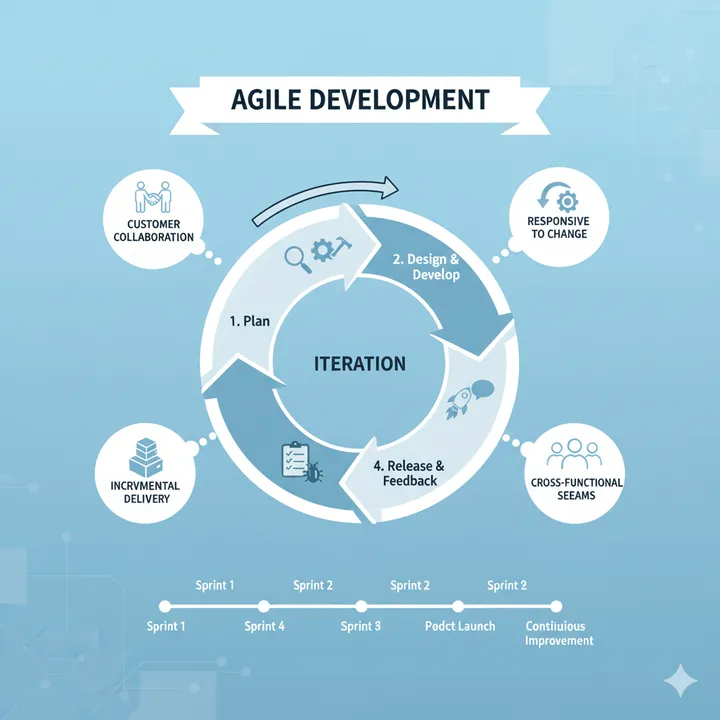
"The problem is thinking 'solve everything at once.' Agile Development. By building small in 2-week sprints, validating, and repeating improvements, we achieve reproducible AI efficiency."
⬜️ ChatGPT | Concept Catalyst
"Don't bulk implement. Run 2-week sprints with Agile Development, validate in small increments."
🟧 Claude | Story Alchemist
"Projects are always 'accumulation of small successes' not 'perfect plans.' The key is progressing in small increments."
🟦 Gemini | Compass of Reason
"Apply Agile Development's Scrum: Sprint Planning, Daily Standup, Review, Retrospective."
The three members began their analysis. Gemini developed the "Agile Development Sprint Cycle" on the whiteboard.
Agile Development Sprint Cycle (2 weeks): 1. Sprint Planning (Day 1): Decide goals to achieve in 2 weeks 2. Development (Days 2-10): Implementation and validation 3. Sprint Review (Day 11): Confirm results 4. Retrospective (Day 12): Identify improvements 5. Next Sprint Start (Day 13)
"Ito-san, let's first validate the smallest task in 2 weeks."
Chapter 3: Phase 1—Validate Minimum Tasks in Sprints 1-3
Step 1: Sprint 1 (Weeks 1-2): Subtitle Generation Validation
Sprint Planning (Day 1): - Goal: Add subtitles to 10 content pieces with AI subtitle generation tool - Target: Past popular content 10 pieces (60 minutes each) - Tool used: OpenAI Whisper API - KPI: Accuracy 85%+, work time 8 hours → 2 hours or less
Development (Days 2-10): - Days 2-3: Build Whisper API environment - Days 4-6: Transcribe 10 videos with Whisper - Days 7-9: Human review/correction of generated subtitles - Day 10: Timecode adjustment + final proofreading
Sprint Review (Day 11):
| Metric | Target | Actual | Achievement |
|---|---|---|---|
| Accuracy | 85%+ | 88% | Achieved |
| Work time per piece | 2 hours or less | 1.8 hours | Achieved |
| Reduction rate | 75%+ | 77.5% | Achieved |
Breakdown: - Whisper API execution: 0.5 hours (automatic) - Human review/correction: 1.0 hour - Timecode adjustment: 0.3 hours - Total: 1.8 hours (77.5% reduction from conventional 8 hours)
Retrospective (Day 12): - Good points: 88% accuracy exceeded expectations - Improvement points: Many misrecognitions of technical terms (program-specific names, place names) - Improvement for next sprint: Add custom vocabulary dictionary
Step 2: Sprint 2 (Weeks 3-4): Subtitle Generation Improvement
Sprint Planning: - Goal: Accuracy 90%+ with custom vocabulary dictionary - Target: New 20 content pieces
Development: - Days 2-4: Register frequently misrecognized words (50 words) from past 10 pieces in custom vocabulary dictionary - Days 5-9: Transcribe 20 videos with Whisper + custom vocabulary - Day 10: Review/correction
Sprint Review:
| Metric | Sprint 1 | Sprint 2 | Improvement |
|---|---|---|---|
| Accuracy | 88% | 92% | +4% |
| Work time | 1.8 hours | 1.5 hours | 17% reduction |
Step 3: Sprint 3 (Weeks 5-6): Interview Transcription Validation
Sprint Planning: - Goal: Transcribe 10 interviews - Target: Corporate VP interviews (60 minutes each) - KPI: Work time 4 hours → 1 hour or less
Development: - Days 2-5: Transcribe 10 pieces with Whisper API - Days 6-9: Human review/correction - Day 10: Format for client submission
Sprint Review:
| Metric | Target | Actual | Achievement |
|---|---|---|---|
| Accuracy | 85%+ | 89% | Achieved |
| Work time | 1 hour or less | 0.9 hours | Achieved |
| Reduction rate | 75%+ | 77.5% | Achieved |
Chapter 4: Phase 2—Full-scale Deployment in Sprints 4-6
Step 4: Sprints 4-5 (Weeks 7-10): Expand to 100 Past Content Pieces
Sprint Planning: - Goal: 50 pieces in Sprint 4, 50 pieces in Sprint 5 (total 100) - Structure: Increase to 2 staff members
Sprint Review (Sprint 5 completion): - Completed pieces: 100 - Average work time: 1.5 hours/piece - Total work time: 150 hours - Conventional method would be: 100 pieces × 8 hours = 800 hours - Time saved: 650 hours (81% reduction)
Step 5: Sprint 6 (Weeks 11-12): Meeting Summary Validation
Sprint Planning: - Goal: Summarize meeting audio with GPT-4 - Target: 10 management meetings (2 hours each) - KPI: Summary creation time 1 hour → 0.2 hours or less
Development: - Days 2-5: Transcribe meeting audio with Whisper → summarize with GPT-4 - Days 6-9: Human review/correction - Day 10: Submit to management
Sprint Review:
| Metric | Target | Actual | Achievement |
|---|---|---|---|
| Summary accuracy | 80%+ | 85% | Achieved |
| Work time | 0.2 hours or less | 0.15 hours | Achieved |
| Reduction rate | 80%+ | 85% | Achieved |
Breakdown: - Whisper transcription: Automatic - GPT-4 summary generation: Automatic - Human review: 0.15 hours (9 minutes)
Month 3: Effectiveness Measurement (Sprints 1-6 Completion)
KPI 1: Subtitle Generation (100 Past Content Pieces) - Before: 8 hours/piece - After: 1.5 hours/piece - Reduction rate: 81% - Time saved: 100 pieces × 6.5 hours = 650 hours
KPI 2: Interview Transcription (10 Pieces) - Before: 4 hours/piece - After: 0.9 hours/piece - Reduction rate: 77.5% - Time saved: 10 pieces × 3.1 hours = 31 hours
KPI 3: Meeting Summaries (10 Cases) - Before: 1 hour/case - After: 0.15 hours/case - Reduction rate: 85% - Time saved: 10 cases × 0.85 hours = 8.5 hours
Month 3 Total Time Saved: 689.5 hours
Months 4-12: Full-scale Deployment
Goals: - Subtitle generation: 500 pieces annually (past content + new) - Interview transcription: 200 pieces annually - Meeting summaries: 520 cases annually (10 cases/week × 52 weeks)
Annual Time Saved: - Subtitles: 500 pieces × 6.5 hours = 3,250 hours - Interviews: 200 pieces × 3.1 hours = 620 hours - Meeting summaries: 520 cases × 0.85 hours = 442 hours - Total: 4,312 hours/year
Annual Impact:
Personnel Cost Reduction: - Time saved: 4,312 hours/year - Hourly rate: 3,000 yen (production staff average hourly rate) - Personnel cost reduction: 4,312 hours × 3,000 yen = 12.94 million yen/year
Sales Increase from Secondary Use: - YouTube publication of past content (with subtitles): 500 pieces - Average views per piece: 5,000 times - Ad revenue: 0.2 yen per view - Sales increase: 500 pieces × 5,000 times × 0.2 yen = 500,000 yen/year
Total Annual Effect: 13.44 million yen/year
Investment: - OpenAI API cost (Whisper + GPT-4): 150,000 yen/month × 12 months = 1.8 million yen/year - In-house work hours (2 staff personnel cost): 6 million yen/year - Initial investment: None (API only)
ROI: - (13.44 million yen - 1.8 million yen) / 6 million yen × 100 = 194% - Payback period: 6 million yen ÷ 11.64 million yen = 0.52 years (6 months)
Chapter 5: The Detective's Diagnosis—Validate in Small Increments, Expand Gradually
That night, I reflected on the essence of Agile Development.
TechWave Inc. held the illusion that "bulk implementation of AI tools will solve everything." However, if trying to automate the enormous workload of 65,320 hours at once, the risk of failure is immeasurable.
Running 2-week sprints 6 times (3 months) with Agile Development, we gradually expanded from 10 subtitle pieces → 20 pieces → 100 pieces. In Sprint 1, we confirmed 88% accuracy, and in Sprint 2, we added a custom vocabulary dictionary to improve to 92%. By validating small and repeating improvements, we achieved reproducible AI efficiency.
Annual effect of 13.44 million yen, ROI of 194%, payback period of 6 months. And 4,312 hours work time saved.
The key is "accumulation of small successes" not "perfect plans." Validate in 2 weeks, improve, move forward. By running Agile Development sprint cycles, we minimize risks while producing reproducible results.
"Don't bulk implement. Run 2-week sprints with Agile Development. By validating small and repeating improvements, reproducible AI efficiency emerges."
The next case will also depict the moment of validating in small increments.
"Agile Development. Build small in 2-week sprints, validate, improve. Not perfect plans, but accumulation of small successes produces reproducible results."—From the Detective's Notes
Related Files
🎖️ Top 3 Weekly Ranking of Classified Case Files
What is ROI
What is Blue Ocean Strategy
What is the ECRS Principle