ROI Case File No.390 | 'TechnoSphere's East Japan Giant Ship'
📅 2026-01-20 23:00
🕒 Reading time: 10 min
🏷️ PDCA

- Chapter 1: The East Japan Giant Ship—AI Utilization Limited to Some Employees
- Chapter 2: The Illusion of Immediate Company-wide Deployment—PDCA Not Running
- Chapter 3: Phase 1—Validate Small in PDCA Cycles 1-3
- Chapter 4: Phase 2—Company-wide Deployment in PDCA Cycles 4-6
- Chapter 5: The Detective's Diagnosis—Continue Running the PDCA Cycle
- Related Files
Chapter 1: The East Japan Giant Ship—AI Utilization Limited to Some Employees
The day after resolving Zenith Solutions' SWOT incident, a new consultation arrived regarding AI agent implementation in a large-scale organization. Volume 31, "The Pursuit of Reproducibility," Episode 390, the final episode, tells the story of continuously running the PDCA cycle.
"Detective, we have a giant ship. The East Japan Business Division. Thousands of employees. Revenue of tens of billions of yen. But we don't know how to move this giant ship. We want to implement AI agents. We want to create an environment where employees can build AI agents themselves with no-code. But where do we start. We can't see the path."
Naoki Takahashi, AI Promotion Team Leader at TechnoSphere Inc.'s East Japan Business Division from Shinjuku, visited 221B Baker Street with a bewildered expression. In his hands were organizational charts of thousands of people, contrasting sharply with an abstract plan titled "AI Agent Rollout Plan 2025-2026."
"We're a business division of a general trading company. East Japan Business Division alone has 3,200 employees. Nationwide, over 10,000. I'm on the AI promotion team, responsible for promoting AI utilization within the company. The goal is clear. After April 2025, promote full-scale AI agent utilization. Prepare an environment where employees can build AI agents with no-code."
TechnoSphere Inc. East Japan Business Division's Current Situation: - Established: 1900 (general trading company) - East Japan Business Division employees: 3,200 - Company-wide employees: 10,500 - Annual Revenue: East Japan 28 billion yen, company-wide 95 billion yen - Problem: AI utilization limited to some employees, task automation not progressing, no AI agent construction know-how
There was deep frustration in Takahashi's voice.
"The purpose is operational efficiency. We're particularly aiming to automate regular tasks, email delivery, document creation. But the current situation is harsh. AI utilization limited to some employees. Only about 5%, 160 people using it. Task automation not progressing. No AI agent construction know-how. Nobody knows how to build them."
Current State of AI Utilization:
Current Implementation Status (January 2026): - ChatGPT Enterprise: All 3,200 employees can access - Monthly active users: 160 people (5%) - Average usage: 2.5 times/person/month - Main uses: 1. Document summarization (40%) 2. Email writing (30%) 3. Translation (20%) 4. Other (10%)
Why Don't 95% Use It? (Employee survey, 800 responses):
| Reason | Response Rate |
|---|---|
| Don't know what to use it for | 72% |
| Don't feel need to use at work | 58% |
| Don't know how to use | 45% |
| No time (too busy) | 38% |
| Security concerns | 22% |
AI Agent Construction Know-how: - People who created "AI agents" in-house: 0 - No-code tool knowledge: 0 - AI promotion team itself doesn't know how to build
Current State of Task Automation:
Regular Tasks (Weekly/Monthly) Reality:
Case 1: Weekly Sales Report Creation (Sales Dept, 120 people) - Frequency: Every Monday 9:00 AM deadline - Work content: Excel → aggregate sales data → create PowerPoint - Work time per person: 2 hours/week - Total work time: 120 people × 2 hours = 240 hours/week - Annual work time: 240 hours × 52 weeks = 12,480 hours
Case 2: Monthly Expense Settlement Check (Accounting Dept, 30 people) - Frequency: Every 25th of month deadline - Work content: Check all employee expense applications (3,200 people) - Check time per application: Average 3 minutes - Total work time: 3,200 people × 3 minutes = 160 hours/month - Annual work time: 160 hours × 12 months = 1,920 hours
Case 3: Regular Email Delivery (General Affairs Dept, 15 people) - Frequency: Twice weekly (Tuesday, Friday) - Work content: Create and send internal announcement emails - Work time per delivery: 1 hour - Total work time: 1 hour × 2 times/week × 52 weeks = 104 hours/year
Total Annual Work Time: - Weekly sales reports: 12,480 hours - Monthly expense settlement: 1,920 hours - Regular email delivery: 104 hours - Total: 14,504 hours/year
Takahashi sighed deeply.
"The plan is this. Initially introduce on small scale for task improvement staff. Gradually expand. We also emphasize post-implementation support system. But how specifically should we proceed. How do we move this giant organization of 3,200 people. We have absolutely no idea."
Chapter 2: The Illusion of Immediate Company-wide Deployment—PDCA Not Running
"Takahashi-san, do you think immediately deploying AI agents company-wide will make 3,200 people use them?"
Takahashi showed a puzzled expression at my question.
"Huh, isn't that the case? I thought introducing no-code tools would make employees create AI agents themselves and automate tasks."
Current Understanding (Immediate Company-wide Deployment Model): - Expectation: Tool implementation → everyone uses - Problem: PDCA cycle not running
I explained the importance of running small with the PDCA cycle.
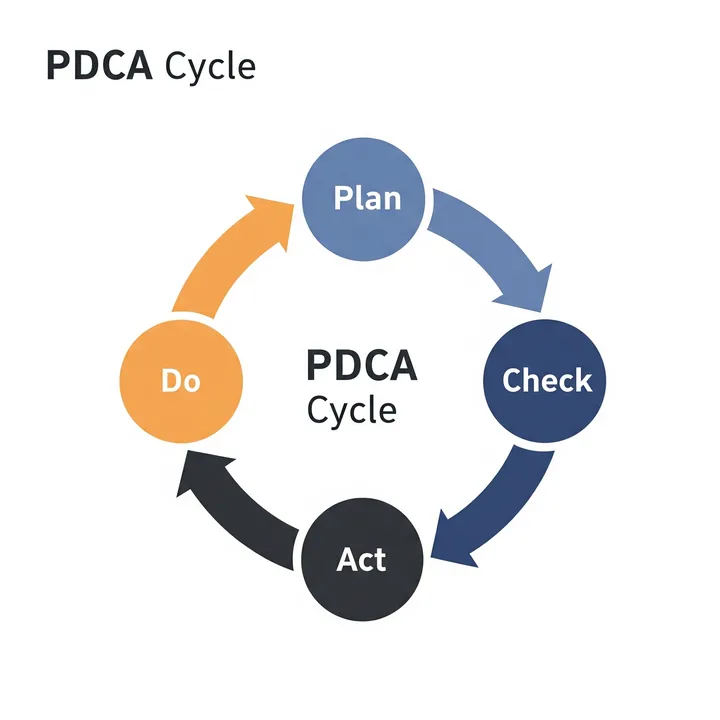
"The problem is thinking 'immediately deploy company-wide.' PDCA—Plan, Do, Check, Act. Plan, execute, check, improve. By running this cycle small and fast, we achieve reproducible organizational transformation."
⬜️ ChatGPT | Concept Catalyst
"Don't immediately deploy company-wide. Run small with PDCA cycle, repeat improvements."
🟧 Claude | Story Alchemist
"Organizational transformation is always 'repetition of small steps' not 'one big step.' The key is continuing to run."
🟦 Gemini | Compass of Reason
"Run PDCA's 4 steps at high speed. Aim for 2-week cycles."
The three members began their analysis. Gemini developed the "PDCA Cycle" on the whiteboard.
PDCA Cycle:
Plan         → Do
    ↑            ↓
Act          ← Check
"Takahashi-san, let's first run PDCA in minimum units."
Chapter 3: Phase 1—Validate Small in PDCA Cycles 1-3
Step 1: PDCA Cycle 1 (Weeks 1-2)
Plan: - Goal: Try AI agent construction with 5 task improvement staff - Target task: Weekly sales report creation (biggest burden) - Tool: Microsoft Power Automate (already contracted) - Period: 2 weeks - KPI: All 5 people can build 1+ AI agents
Do: - Days 1-2: Power Automate basic training (external instructor, 6 hours) - Days 3-5: Each person designs weekly sales report creation flow - Days 6-10: AI agent construction (AI promotion team supports)
Check: - Result: 4 of 5 people succeeded in construction (1 person gave up midway) - Constructed AI agents: 1. Automatic transcription from Excel to PowerPoint (Sales A) 2. Automatic sales data aggregation (Sales B) 3. Automatic graph generation (Sales C) 4. Automatic email sending (Sales D) - Time saved: 4 people × 2 hours/week = 8 hours/week - Problems: - 1 person (Sales E) gave up midway "Operation too difficult" - Power Automate screen too complex - Error messages in English, can't understand
Act: - Improvement 1: Extend training from 6 hours → 12 hours (thorough basics) - Improvement 2: Create Japanese manual (post on internal wiki) - Improvement 3: Create "Common Errors and Solutions" FAQ
Step 2: PDCA Cycle 2 (Weeks 3-4)
Plan: - Goal: AI agent construction with 10 new people - Target task: Monthly expense settlement check - Reflect improvements (12-hour training, provide manual)
Do: - Days 1-3: Power Automate basic training (extended to 12 hours) - Days 4-6: Each person designs while viewing manual - Days 7-14: AI agent construction
Check: - Result: 9 of 10 people succeeded in construction (90% success rate) - Constructed AI agents: 1. Automatic expense application check (rule-based) 2. Automatic anomaly detection (amounts over 100,000 yen, etc.) 3. Automatic check result report creation - Time saved: Monthly 160 hours → 40 hours (75% reduction) - Problems: - 1 person (Accounting F) gave up "Still difficult" - Some people can't understand even with manual
Act: - Improvement 1: Introduce "1-on-1 support system" (individual instruction for those who don't understand) - Improvement 2: Share success cases via video (internal YouTube)
Step 3: PDCA Cycle 3 (Weeks 5-6)
Plan: - Goal: Expand to 20 more people - Target task: Regular email delivery - Reflect improvements (1-on-1 support, video manual)
Do: - Days 1-3: Training (also use video manual) - Days 4-14: AI agent construction - Those in trouble can book 1-on-1 support (AI promotion team responds)
Check: - Result: 19 of 20 people succeeded in construction (95% success rate) - 1-on-1 support users: 3 people (all succeeded) - Time saved: Annual 104 hours → 10 hours (90% reduction)
Act: - Improvement 1: Achieved 95% success rate → Ready for company-wide deployment - Improvement 2: Introduce "AI Agent Construction Certification System" (certification for training completers)
Chapter 4: Phase 2—Company-wide Deployment in PDCA Cycles 4-6
Step 4: PDCA Cycle 4 (Month 2)
Plan: - Goal: Expand to 100 people (Sales 50, Accounting 30, General Affairs 20) - Period: 1 month
Do: - Week 1: Training (video + in-person) - Weeks 2-4: Build individually (1-on-1 support available)
Check: - Result: 92 of 100 people succeeded in construction (92% success rate) - Time saved: 600 hours/month (Sales 400h + Accounting 150h + General Affairs 50h)
Act: - Improvement: Introduce success cases in company newsletter (gain management understanding)
Step 5: PDCA Cycle 5 (Months 3-4)
Plan: - Goal: Expand to 500 people - Period: 2 months
Do: - Certified people (previous cycle successes) support new participants - AI promotion team only oversees overall
Check: - Result: 460 of 500 people succeeded in construction (92% success rate) - Time saved: 2,500 hours/month
Act: - Improvement: Form community (open Slack channel, place to ask questions)
Step 6: PDCA Cycle 6 (Months 5-12)
Plan: - Goal: Deploy to all 3,200 employees - Period: 8 months
Do: - Add 200 people monthly (gradual deployment) - Share knowledge in community
Check: - Year 1 result: 2,880 of 3,200 people succeeded in construction (90% success rate) - Monthly time saved: 12,000 hours (weekly reports, expense settlement, etc.) - Annual time saved: 144,000 hours
Act: - Year 2 goal: Follow up remaining 320 people, expand to new tasks
Year 1 Effectiveness Measurement:
KPI 1: AI Agent Usage Rate - Before: Monthly active users 160 people (5%) - After: Monthly active users 2,880 people (90%) - Improvement rate: +1,700%
KPI 2: Work Time Reduction - Annual time saved: 144,000 hours - Average hourly rate: 3,500 yen (employee average) - Personnel cost reduction: 504 million yen/year
KPI 3: Employee Satisfaction - Survey (1,500 responses): - "Work became easier": 87% - "Happy to create AI agents": 78% - "Want to apply to other tasks": 92%
Annual Impact:
Personnel Cost Reduction: - Annual 144,000 hours × 3,500 yen = 504 million yen
Investment: - Power Automate additional licenses: 1 million yen/month × 12 months = 12 million yen/year - External training cost: 5 million yen (Year 1 only) - AI promotion team personnel cost: 3 people × 8 million yen = 24 million yen/year - Total initial investment: 41 million yen
ROI: - (504 million yen - 12 million yen) / 41 million yen × 100 = 1,195% - Payback period: 41 million yen ÷ 492 million yen = 0.083 years (1 month)
Chapter 5: The Detective's Diagnosis—Continue Running the PDCA Cycle
That night, I reflected on the essence of the PDCA cycle.
TechnoSphere Inc. held the illusion that "immediately deploying AI agents company-wide would make 3,200 people use them." However, transformation from 5% → 90% doesn't happen at once.
We ran the PDCA cycle 6 times. Started with 5 people in Cycle 1, confirmed 80% success rate. Improved in Cycle 2, success rate increased to 90%. Achieved 95% in Cycle 3. Gradually expanded in Cycles 4-6, 2,880 people succeeded in Year 1.
Annual personnel cost reduction of 504 million yen, ROI of 1,195%, payback period of 1 month. And employee satisfaction of 87%.
The key is not "perfect plans" but "high-speed PDCA cycles." Plan, execute, check, improve in 2 weeks. By continuing to run this cycle, reproducible organizational transformation is achieved.
And with this Episode 390, Volume 31 "The Pursuit of Reproducibility" concludes.
Ten cases starting from No.381—Scene-Cast Theory, Blue Ocean Strategy, 6D-MATRIX, MVP, Realization First Principle, Agile Development, ROI Thinking, KPT, SWOT Analysis, and PDCA.
What all cases had in common was "reproducibility." Not personnel-dependent success, but methodology anyone can reproduce. Start small, validate, improve, expand.
"Don't immediately deploy company-wide. Run small with PDCA cycle, repeat improvements. Plan, execute, check, improve. By running this cycle at high speed continuously, reproducible organizational transformation emerges."
The next case—no, the next volume too will continue pursuing reproducible success.
"PDCA—Plan, Do, Check, Act. Plan, execute, check, improve. Continuously running this cycle at high speed is the essence of reproducible organizational transformation. Not perfect plans, but high-speed improvement creates the future."—From the Detective's Notes
Volume 31 "The Pursuit of Reproducibility" Complete
Related Files
🎖️ Top 3 Weekly Ranking of Classified Case Files
What is MVP
What is Agile Development
What is STP Analysis