ROI Case File No.401: Asset Value Dormant in Substation Equipment

Asset Value Dormant in Substation Equipment
Chapter 1: The Client in the Fog
"Director, today's client is the facility management director from BrightVolt."
As Gemini opened the office door, a middle-aged man in work clothes entered. His face bore deep wrinkles carved by years of fieldwork, along with an expression of evident exhaustion.
"Excuse me. I'm responsible for substation equipment maintenance at BrightVolt. I've come to consult about automating our inspection work."
The documents he spread out showed layout diagrams of 13 scattered substation facilities and inspection item lists densely filled with notes.
"Currently, we conduct monthly regular inspections in pairs, requiring approximately 40 minutes per location. Visual inspection, contamination checks, bolt loosening, rust progression, unusual odors... The items mandated by electrical equipment safety regulations are extensive, and with facilities distributed over a wide area, including travel time, it becomes a full day's work."
The client's voice carried the authentic weight of field experience.
"Therefore, we're considering introducing a continuous monitoring system using sensors. However," he paused, "rather than building the entire system, we hope to first propose only the sensor components. While we envision eventually using collected data to predict equipment lifespan, we want to first obtain reliably functioning sensors."
I nodded quietly. This client sought small certainties before major investment—a prudent judgment.
Chapter 2: The Four Faces of Assets
"Gemini, analyze this using the VRIO Model."
At my instruction, Gemini responded immediately, already holding a well-organized analytical framework.
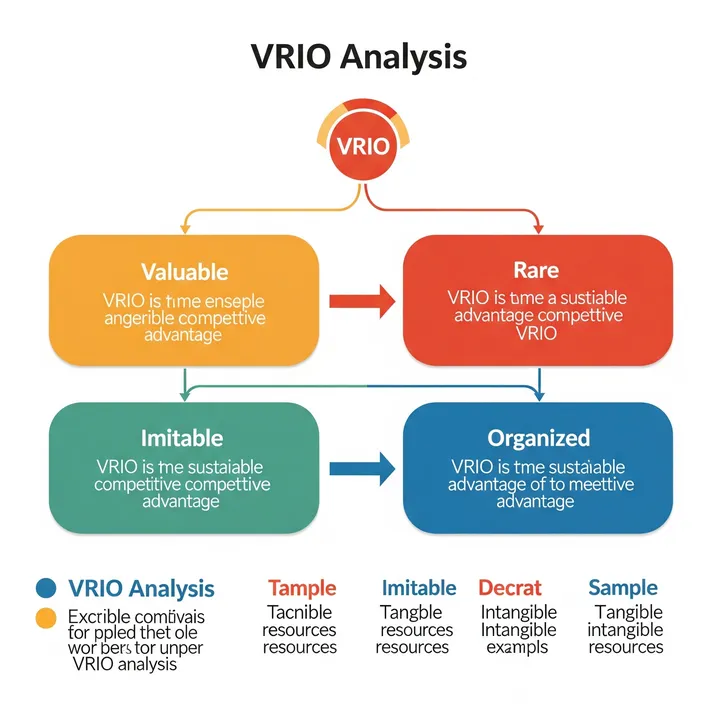
"The VRIO Model is a method that evaluates management resources through four questions," Gemini began explaining. "Value, Rarity, Imitability, Organization—from these four perspectives, we verify whether sensor technology can truly provide competitive advantage for BrightVolt."
The first question was "Value."
"Client, is early anomaly detection difficult with current monthly inspections?"
"Yes," he answered immediately. "Just last month, insulator deterioration was discovered two weeks after inspection, forcing emergency response. If we had continuous monitoring, we could have detected warning signs much earlier."
Sensor introduction would effectively change inspection frequency from "monthly" to "continuous." This represented clear value creation—not just work time reduction, but improved safety through early risk detection.
Next came verification of "Rarity."
"While sensors for substation equipment already exist in the market," Gemini referenced materials, "what BrightVolt seeks is specialized sensors that comprehensively address everything from visual inspection to unusual odor detection. Products meeting these requirements are limited."
Rarity was high. While generic temperature and vibration sensors flooded the market, sensor sets covering the diverse inspection items of electrical equipment safety regulations hadn't yet become commonplace.
The third question: "Imitability."
"While sensor technology itself is imitable," I continued the analysis, "what's crucial is calibration data optimized for BrightVolt's equipment environment. Sensor adjustment tailored to each of the 13 facilities' characteristics requires accumulated time and experience."
The client nodded. "Indeed, each facility has its own personality. The progression of aging varies greatly depending on installation environment."
This accumulation of tacit knowledge created inimitability.
Finally, the question of "Organization."
"Does your organization have systems to utilize data obtained from sensors?"
After brief consideration, the client answered carefully. "Currently, no. That's precisely why we want to start by introducing only the sensor components and begin with data accumulation. We plan to develop operational systems gradually after data accumulates."
Chapter 3: The Compass Called Reproducibility
"Director, this request has an interesting characteristic."
Claude spoke up, her gaze fixed on the client's phrase "only the sensor components first."
"BrightVolt isn't making large investments all at once, but rather taking small, certain steps. Isn't this the same philosophy as our agency's cherished 'building small worlds'?"
Exactly right. The client was starting experiments within controllable scope, planning to proceed to next steps after confirming reproducibility.
"Looking at the VRIO Model analysis results," I began organizing, "sensor introduction has clear value and high market rarity. Moreover, optimization to BrightVolt's unique equipment environment creates inimitability."
"However," Gemini supplemented, "organizational capability remains under development. Building data utilization systems will take time."
The client leaned forward. "So a gradual approach is the right choice?"
"Yes," I answered. "All four VRIO elements needn't be perfectly aligned. What matters is whether you can see a path to gradually strengthen each element."
I turned to the client. "First, conduct trial sensor introduction at one facility and collect data for three months. During that period, record what anomaly detection patterns prove effective and how frequently alerts occur."
"Based on that data, we'll determine whether to expand to the remaining 12 facilities."
"Exactly. If reproducibility is confirmed at the first facility, the same method can be applied to other equipment. That's how to increase certainty in investment decisions."
Chapter 4: Proof of Value
As the client packed documents into his bag, relief showed on his face.
"Actually, upper management questioned 'Why not introduce the entire system at once?' But I lacked confidence. Whether sensors would truly solve our challenges, whether data could really be utilized."
"Those are prudent doubts," I responded. "The VRIO Model teaches whether a technology can 'theoretically' provide competitive advantage. But transforming that into 'actual' competitive advantage requires organizational mastery and accumulated experience."
Claude quietly added, "Introducing technology and mastering technology are separate abilities. BrightVolt is now attempting to acquire both gradually."
The client nodded deeply. "Thank you. Tomorrow, I'll immediately propose the trial introduction plan to upper management."
After he left, I gazed out the window. Beyond the fog, BrightVolt's substation facilities were scattered across the landscape.
"Gemini, what do you think is the essence of the VRIO Model?"
"A framework for evaluating management resources, perhaps."
"That too, but," I continued, "rather, it's training in thought—verifying the question 'what creates value' from four different angles. Value that might be overlooked from a single perspective becomes visible through these four questions."
Claude smiled. "And whether that value is genuine can only be known by testing it in a small world."
Exactly. The VRIO Model is a compass, and verification through small experiments is the map. Only with both can you take certain steps forward.
The following month, a report arrived from BrightVolt. At the trial facility, sensors had detected subtle vibration anomalies that would have been overlooked conventionally.
The first step of reproducibility had been proven.
"Asset value becomes clear through the four questions of VRIO. But true value only becomes reality through testing small, confirming, and accumulating results."
Related Files