ROI Case File No.413 'The Waste Called Redrawing'

The Waste Called Redrawing
Chapter 1: The Pain of Drawing Twice
"Our franchise designers are drawing the same blueprints twice."
The Sales Director of TechVision placed two blueprints side by side. One was a proposal floor plan created by a franchise store. The other was a construction drawing recreated by headquarters. Both contained nearly identical content.
"Our brand, i-FULL HOME, operates nationwide through a franchise system. Franchise stores listen to customer requests and create proposal drawings using CAD. However, that CAD system and the CAD system used by headquarters for construction drawings are different."
Years of dealing with this problem had left fatigue in the Sales Director's voice.
"Drawings created with franchise CAD can't be imported into headquarters' system. Therefore, headquarters' design department manually re-enters everything while looking at the franchise drawings."
The materials he produced recorded annual drawing conversion and re-entry time. Approximately 3,000 contracts per year. Average drawing redrawing time per project: 2 hours.
"In other words, 6,000 hours annually are consumed by redrawing work."
"That's not all," the Sales Director continued. "The franchise CAD system has poor presentation aesthetics and usability. Requests from franchises to 'give us better CAD' never cease. But changing the system requires significant investment, and we lack confidence about whether it's truly worth investing."
It was typical hesitation in investment decisions.
Chapter 2: The True Nature of Invisible Costs
"This case is precisely the origin of our agency's name."
Gemini smiled. ROI—Return on Investment.
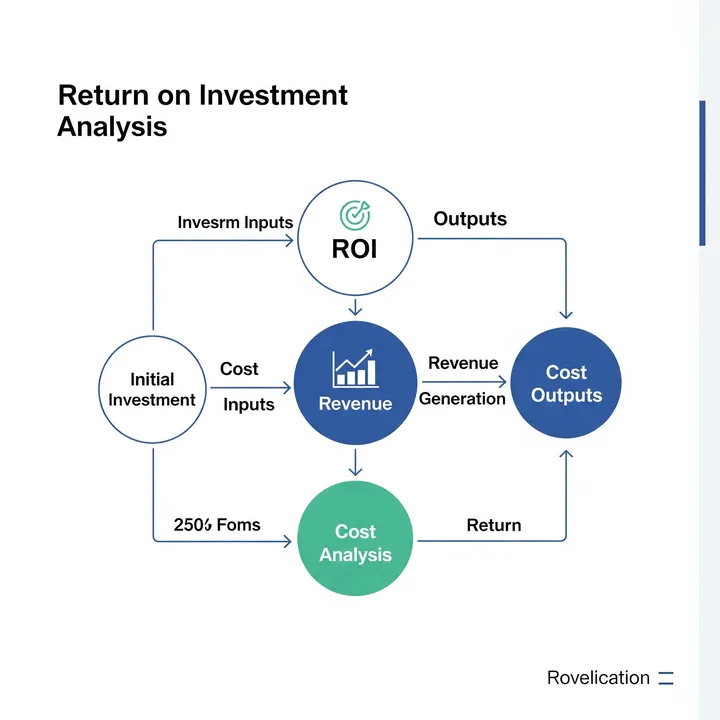
"The ROI model," I began explaining, "divides the profit gained from investment by the investment amount. But what many companies overlook in ROI calculations is 'the cost of maintaining the status quo.'"
"In other words," Claude supplemented, "you need to accurately grasp not only the cost of introducing a new system, but also what's being lost by continuing to use the current system."
The Sales Director leaned forward. "What's being lost?"
"Yes," I answered. "What TechVision is currently losing is time, opportunities, and trust. Let's convert these to monetary amounts."
[Hidden Cost 1: Redrawing Time]
"First, the most obvious is redrawing time," Gemini began calculating.
"6,000 hours annually. Assuming headquarters design department labor cost of 3,000 yen per hour, that's an annual cost of 18 million yen."
The Sales Director showed a surprised expression. "That much?"
"But that's not all," Claude continued. "Because redrawing takes time, the lead time until construction start lengthens. Customers are kept waiting, and franchises can't move on to the next project."
"Quantifying this opportunity loss is difficult, but," I continued, "if lead time is shortened by one week, franchises can contract 2-3 more projects annually."
"Assuming gross profit of 500,000 yen per project," Gemini calculated, "if 300 franchise stores each contract 2 more projects annually, that's 300 million yen in total sales increase."
[Hidden Cost 2: Proposal Quality Degradation]
"Next, the quality of the franchise CAD system," I pointed out.
"The current system has poor presentation aesthetics, you said."
The Sales Director nodded. "Yes. The 3D rendering quality is low, sometimes giving customers a 'cheap' impression."
"How often do you lose customers at the proposal stage?" I asked.
"We don't know exactly, but," the Sales Director answered, "when compared with competitors' proposals, we sometimes look inferior."
"Hypothetically," Claude estimated, "if proposal material quality improvement raises the contract rate by 5%, 300 of the 6,000 annual proposals would convert additionally. At 500,000 yen gross profit per project, that's 150 million yen in annual profit increase."
[Hidden Cost 3: Franchise Dissatisfaction]
"The third cost is the least visible," I emphasized. "Franchise dissatisfaction and the resulting departure risk."
The Sales Director's expression clouded. "Certainly, CAD system dissatisfaction casts a shadow over franchise relationships."
"What's the cost if a franchise departs?" Gemini asked.
"Including franchise fees and training costs, developing one store costs about 5 million yen. And we lose annual royalty income from departed franchises."
"Assuming annual royalty of 3 million yen per store," Claude calculated, "if CAD system dissatisfaction causes 5 stores annually to consider departing, the potential loss is 15 million yen per year."
[Calculating Investment Amount]
"So how much does introducing a new CAD system cost?" I asked.
The Sales Director checked the materials. "We've gotten quotes from multiple companies, but initial implementation costs about 80 million yen. Annual maintenance costs about 10 million yen."
"In other words," Gemini organized, "total first-year investment is 90 million yen."
"Meanwhile, what's being lost by maintaining the status quo," Claude calculated, "is redrawing cost of 18 million yen, opportunity loss of 300 million yen, proposal quality loss of 150 million yen, franchise departure risk of 15 million yen—totaling about 480 million yen."
The Sales Director drew a breath. "The cost of maintaining the status quo is over 5 times the investment amount?"
Chapter 3: Small Proof
"However," I added cautiously, "this estimate is just a hypothesis. Whether we can actually achieve these effects won't be known until we try."
The Sales Director showed an anxious expression. "Then what should we do?"
"The essence of the ROI model," Claude answered, "is predicting effects before investment, measuring actual effects after investment, and comparing predictions with results."
"Specifically," Gemini proposed, "first conduct a pilot implementation at 10 franchise stores. Period: three months. During this period, collect the following data."
I wrote items on the whiteboard.
"First, drawing creation time. How much does the new system shorten proposal drawing creation time?"
"Second, redrawing time. Does headquarters drawing redrawing time truly become zero?"
"Third, proposal contract rate. Is there a difference in contract rates between using new system proposal materials and using conventional system?"
"Fourth, franchise satisfaction. Measure new system satisfaction on a 5-point scale."
"And," I emphasized, "based on this data, recalculate ROI. If predictions are correct, you can confidently proceed with rollout to the remaining 290 stores. If predictions are wrong, analyze what differed from assumptions and revise the plan."
The Sales Director asked. "What's the pilot implementation cost?"
"For 10 stores, initial cost would be about 10 million yen," Gemini answered. "About 10% of total investment."
"This 10 million yen investment," Claude continued, "greatly increases certainty of the remaining 80 million yen investment decision. This is how to move forward while minimizing risk."
Chapter 4: Numbers as Evidence
The Sales Director gazed at the estimates written on the whiteboard.
"Until now, I only saw CAD system implementation as an '80 million yen investment.' But maintaining the status quo actually cost 480 million yen."
"What the ROI model teaches us," I answered, "is that investment decisions aren't 'do it or don't,' but comparing 'cost of doing it' with 'cost of not doing it.'"
Claude quietly added words. "And both costs should be reduced to measurable numbers, not speculation. That becomes the foundation of certain decision-making."
The Sales Director stood and bowed deeply. "Thank you. Next month, I'll submit a proposal for pilot implementation."
After he left, Gemini said admiringly, "The ROI model is simple but powerful."
"Yes," I answered. "But the most difficult part of ROI calculation is visualizing 'invisible costs.' Only when that's achieved does true ROI become visible."
Outside the window, winter sunlight illuminated the office.
Three months later, a report arrived from TechVision.
Data analysis from the 10 pilot stores confirmed effects exceeding predictions.
Drawing creation time reduced by an average of 40%. Headquarters redrawing time: zero. Proposal contract rate rose from the conventional 52% to 61%, a 9-point increase. Franchise satisfaction averaged 4.3 on a 5-point scale.
The most important discovery was that franchise sales staff reported "increased customer dialogue time." The time saved from drawing creation allowed them to listen more deeply to customer needs and make better proposals.
The numbers proved the hypothesis.
"Investment value cannot be measured by input amount alone. What's being lost by maintaining the status quo—time, opportunities, trust—only when these are accurately quantified does true ROI become visible. And by testing small before large investment, hypothesis transforms into certainty."
Related Files