ROI Case File No.414 'The Labyrinth Called Quotations'

The Labyrinth Called Quotations
Chapter 1: The Endless Transcription
"Every morning at 9 AM, we're swamped with quotation sending work."
The Operations Director of TechInnovate pointed to a stack of quotations on the desk. Each had customer names, product names, quantities, and amounts handwritten on them.
"We sell parts for the manufacturing industry, and receive about 30 quotation requests daily. Sales creates handwritten quotations, which we in the operations department transcribe into the system, generate PDFs, and send by email. This series of tasks takes about 3 hours every day."
Fatigue permeated the Operations Director's voice.
"What's worse is transcription errors. Product number input mistakes, quantity digit errors, unit price transcription omissions—5-6 times per month, customers point out 'the amount is wrong.'"
The materials he produced recorded six months of error occurrences and the time spent dealing with them.
"When an error is discovered, sales goes to apologize, recreates the quotation, and resends it. This series of responses takes about 2 hours per incident."
"In other words," Claude calculated, "5 errors per month means 10 hours lost."
"Yes," the Operations Director nodded. "So we're considering RPA automation. However, we tried automation for a different task before and it didn't go well."
Fear of failure floated in his expression.
"What was the problem?" I asked.
"The automation itself succeeded, but we couldn't maintain it afterward. When there were slight system changes, the RPA stopped working. However, the company we commissioned for development no longer supported us, so we eventually returned to manual work."
It was a typical automation failure pattern.
Chapter 2: Three Perspectives
"The KPT model approach is effective for this case."
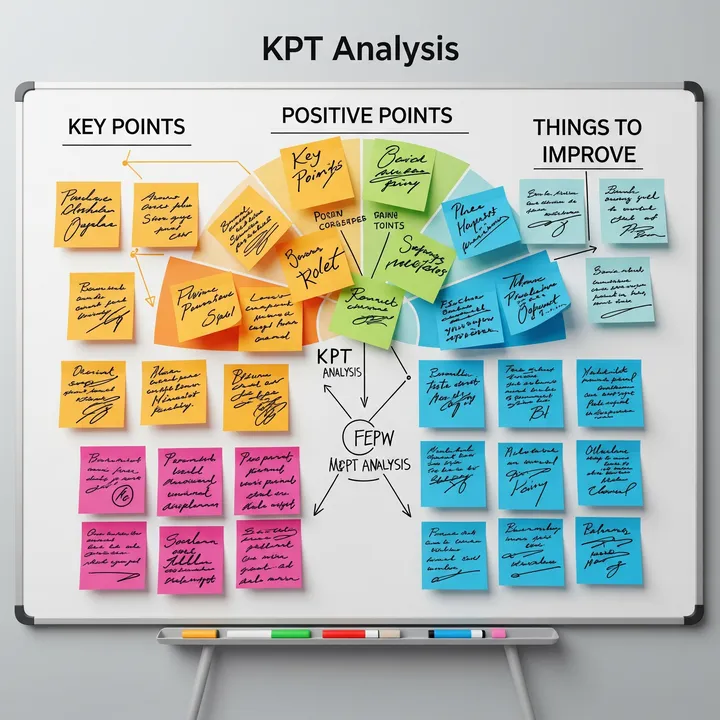
Gemini drew three circles on the whiteboard. Keep, Problem, Try—a framework for retrospection and improvement.
"The KPT model," I began explaining, "is a method that organizes the current situation from three perspectives and decides next actions. Keep—what to continue. Problem—issues to solve. Try—new initiatives to attempt."
"Many improvement activities fail," Claude continued, "because they focus only on problems and overlook what's working well. The KPT model visualizes both good and bad points."
The Operations Director asked. "But are there any good points to keep in our operations?"
"Finding them is the first step," I answered.
[Keep: What to Continue]
"First, let's identify the parts of the current quotation creation process that are working well," Gemini proposed.
The Operations Director pondered. "Working well..."
"For example," Claude prompted, "does the process of sales creating handwritten quotations have any advantages?"
"Ah," the Operations Director showed a look of realization. "Sales handwritten quotations contain information born from conversations with customers, preserved as notes. Annotations like 'urgent,' 'special discount requested,' 'strict delivery deadline.'"
"That's important information," I pointed out. "When automating, we need to ensure this information isn't lost."
"What else?" Gemini asked.
"The quotation format has been refined over many years and is highly polished. Customer evaluation is also good."
"In other words," Claude organized, "Keep—recording customer information contained in sales handwritten notes. And maintaining the current quotation format. These are elements that should continue even after automation."
[Problem: Issues to Solve]
"Next, problems," I continued.
The Operations Director answered immediately. "Transcription work takes time. And transcription errors occur."
"Is that all?" I asked.
The Operations Director thought a bit before answering. "Actually, the illegibility of sales handwriting is also a problem. The operations department sometimes struggles to decipher it, and each time calls sales for confirmation."
"What else?" Gemini prompted.
"The previous automation failed because we lacked a maintenance system. When RPA stopped, no one could fix it."
"In other words," Claude organized, "Problem—transcription work hours. Occurrence of transcription errors. Difficulty reading handwriting. And lack of maintenance system. These are the issues to solve."
[Try: What to Attempt]
"And finally, Try—defining what new things to attempt," I explained.
"RPA automation naturally goes in Try," the Operations Director said.
"Yes," Gemini answered. "But the important point of the KPT model is positioning Try as 'experiments.' We don't know if it will work. That's precisely why we test small."
"Specifically," I proposed, "for the first month, process only 5 quotations per day with RPA. The remaining 25 are handled manually as before."
The Operations Director showed a surprised expression. "We're not automating everything?"
"No," Claude answered. "If you automate everything from the start, when problems occur, the impact range becomes large. By running in parallel, we minimize risk."
"And," Gemini added, "after one month, we retrospect again with KPT. What worked well in automation, where were the problems? Based on that, we decide next month's Try."
"In other words," I emphasized, "the KPT model isn't one-and-done. We continuously cycle through retrospection and improvement."
Chapter 3: Climbing the Spiral Staircase
The Operations Director asked. "So specifically, what should we try in the first Try?"
"Three things," I answered.
"First, RPA transcription automation. Scan sales handwritten quotations, recognize text with OCR, and auto-input into the system."
"Second, addressing the handwriting legibility problem. When OCR can't recognize parts, RPA automatically sends a confirmation alert to the operations department."
"Third, building a maintenance system. In addition to a maintenance contract with the RPA development company, train an internal person who can handle simple fixes."
Gemini supplemented. "Try these three things for one month. Then retrospect with KPT at month-end."
"What should we check in the retrospective?" the Operations Director asked.
Claude answered. "Keep—what worked well this month? For example, RPA processing speed met expectations, OCR recognition accuracy was higher than expected, etc."
"Problem—what problems occurred this month? For example, OCR misrecognized handwritten '3' and '8,' RPA stopped on specific product numbers, etc."
"Try—what new things to attempt next month? For example, increase OCR learning data, distribute handwriting guidelines to sales, increase automation targets to 10 per day, etc."
"By cycling through this," I explained, "improvements accumulate little by little, like climbing a spiral staircase."
The Operations Director's expression brightened. "So instead of aiming for perfection, we gradually improve."
"Exactly," I answered. "The essence of the KPT model is abandoning perfectionism. Next month better than this month, the month after better than next month—continuing to move forward is what's important."
Chapter 4: The Power of Retrospection
The Operations Director gazed at the three KPT circles drawn on the whiteboard.
"Until now, I thought automation was a binary choice of 'success or failure.' But with the KPT model, it's a mindset of 'we progressed this far this month, let's progress a bit more next month.'"
"Yes," I answered. "Many projects fail because they aim for perfection from the start. But in reality, there are countless things you can't know until you try."
Claude quietly added words. "The KPT model transforms 'failure' into 'learning.' What didn't work also becomes a hint for the next Try."
Gemini added. "And by retrospecting regularly, we can address small problems before they become large."
The Operations Director stood and bowed deeply. "Thank you. Next week, I'll schedule the first KPT meeting."
After he left, Claude said admiringly, "The KPT model is simple but practical."
"Yes," I answered. "But the true value of KPT isn't just as a retrospection method. It's about establishing a culture in the organization of 'not fearing change, testing small, and continuing to learn.'"
Outside the window, afternoon sunlight illuminated the office.
Three months later, a report arrived from TechInnovate.
First month: 5 successful automations. OCR recognition accuracy was 92%, with 8% requiring human confirmation.
Second month: distributed guidelines to sales for "writing numbers in block letters," improving OCR accuracy to 97%. Increased automation targets to 10.
Third month: expanded automation targets to 20. Transcription errors: zero. Operations department work time reduced from 3 hours to 1 hour.
And the most important discovery was that monthly KPT meetings became established as a "place to discuss improvement." Not just the operations department, but sales also participated, and ideas like "we could do it this way" kept emerging.
The spiral staircase was certainly being climbed.
"Improvement is not a single large transformation, but an accumulation of small advances. Retrospecting from the three perspectives of Keep, Problem, and Try, learning, and taking the next step. By continuing this cycle, like climbing a spiral staircase, we can reliably reach greater heights."
Related Files