ROI Case File No.415 'The Peril of Dependence on One Mind'

The Peril of Dependence on One Mind
Chapter 1: The 72-Year-Old Memory
"Without Mr. Tanaka, the system stops."
The CTO of GloTech Solutions handed over a business card. It read "Tanaka Computer Services, Representative Taro Tanaka."
"Our IBMi system operates 24/7/365. Inventory management, order processing, accounting—all business runs on this system. And for 15 years, we've entrusted its maintenance to Mr. Tanaka alone."
Urgency filled the CTO's voice.
"Mr. Tanaka is now 72 years old. He seems to be considering retirement soon. However, the system documentation is old, and the latest modification details exist only in Mr. Tanaka's head."
The materials he spread out recorded past troubleshooting history. Late-night system crashes, database anomalies, communication errors—all resolved with a single phone call to Mr. Tanaka.
"Last month, Mr. Tanaka was hospitalized. Fortunately it was minor, but during those three days, I couldn't sleep worrying about what would happen if the system had issues."
"Don't you have documentation?" I asked.
"We have materials from the initial implementation 15 years ago," the CTO answered. "But subsequent modification history is almost unrecorded. The state of 'just ask Mr. Tanaka' had become normalized."
It was a time bomb called knowledge concentration.
Chapter 2: Four Windows
"SWOT model analysis is suitable for this case."
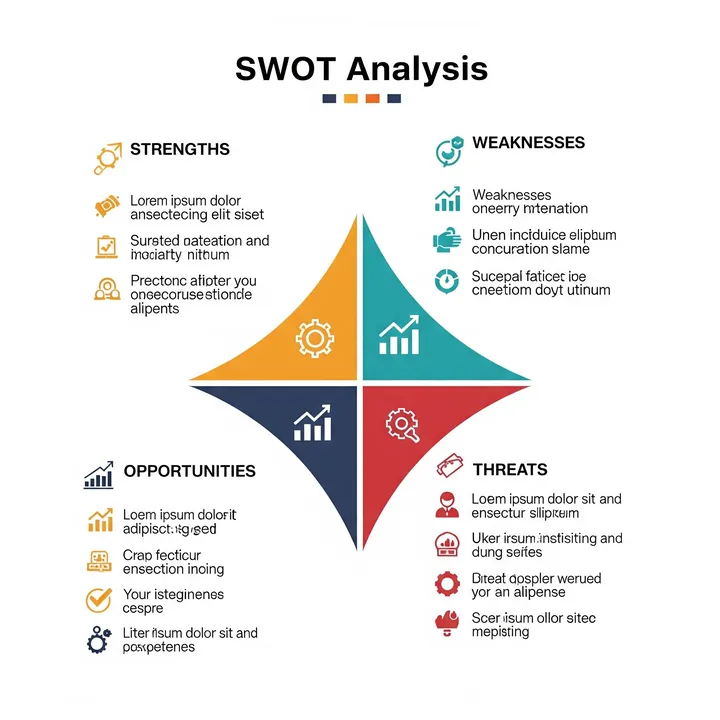
Gemini drew four quadrants on the whiteboard. Strengths, Weaknesses, Opportunities, Threats—the basic framework for strategic planning.
"The SWOT model," I began explaining, "is a method that provides an overview of the current situation from four perspectives: internal environment (strengths/weaknesses) and external environment (opportunities/threats)."
"And importantly," Claude supplemented, "deriving strategic direction from combinations of these four elements."
The CTO asked. "But our situation seems to have only 'weaknesses' and 'threats.'"
"Is that so?" I answered. "First, let's calmly fill in the four quadrants."
[Strengths]
"What are GloTech Solutions' strengths?" Gemini asked.
The CTO pondered. "Strengths..."
"The system has operated stably for 15 years, hasn't it?" Claude prompted.
"Yes," the CTO nodded. "Major troubles occur only 1-2 times per year. Downtime is minimal."
"That's a major strength," I pointed out. "System stability and years of operational track record. This becomes the foundation when transitioning to a new maintenance company."
"What else?" Gemini prompted.
"The IBMi platform is robust and highly reliable. And it's optimized for our business flow."
"In other words," Claude organized, "Strengths—15 years of stable operation, robust IBMi platform, business-optimized system configuration. These are strengths to leverage going forward."
[Weaknesses]
"Next, weaknesses," I continued.
The CTO answered immediately. "Dependence on Mr. Tanaka. That says it all."
"Let's break it down a bit more specifically," Gemini proposed.
"Lack of documentation," the CTO listed. "Unrecorded modification history. Knowledge concentration in troubleshooting."
"The absence of IBMi engineers in-house is also a weakness," Claude pointed out.
"Yes. IT department members are familiar with Windows and Linux, but have no IBMi experience."
"In other words," I organized, "Weaknesses—dependence on a specific individual, lack of documentation, absence of internal engineers, knowledge not transferred. These create current vulnerabilities."
[Opportunities]
"Next is opportunities—positive factors in the external environment," Gemini explained.
The CTO looked puzzled. "Positive factors?"
"For example," Claude proposed, "do companies specializing in IBMi maintenance exist in the market?"
"Yes, several exist," the CTO answered. "From major IT companies to small-to-medium enterprises specializing in IBMi."
"That's an opportunity," I pointed out. "Candidates exist who can take over maintenance. And because they have multiple clients, they have organizational response capabilities."
"What else?" Gemini prompted.
"Recently, cloud migration support has also become more robust. There's also the option of operating IBMi in a cloud environment."
"In other words," Claude organized, "Opportunities—existence of specialized maintenance companies, possibility of transitioning to organizational maintenance structure, cloud migration options. These are external forces that can improve the current situation."
[Threats]
"Finally, threats," I continued.
"Mr. Tanaka's retirement," the CTO answered immediately. "That's the biggest threat."
"What else?" Gemini asked.
"Mr. Tanaka's sudden illness or accident. Sudden inability to respond."
"The market decrease of IBMi engineers is also a threat," Claude added. "IBMi is a mature platform, but young engineers are declining."
"And," I pointed out, "there's also the risk that while competitors migrate to advanced systems, only GloTech Solutions continues depending on an old system."
"In other words," Gemini organized, "Threats—maintenance personnel retirement risk, sudden response inability risk, market decrease of technical personnel, widening technology gap with competitors. These are external threats."
Chapter 3: Strategic Crossroads
"We've organized the SWOT four quadrants," I said. "Next, we combine these to derive strategies."
The CTO asked. "Combine?"
"There are four strategic patterns," Claude began explaining.
"First, SO strategy—leverage strengths to seize opportunities. For GloTech Solutions, it's a strategy to partner with 'specialized maintenance companies' as an opportunity, using 'stable operation track record' as a strength."
"Second, ST strategy—avoid threats with strengths. A strategy to prepare for the threat of 'maintenance personnel retirement' while maintaining the strength of 'robust IBMi.'"
"Third, WO strategy—compensate for weaknesses with opportunities. A strategy to supplement the weakness of 'lack of documentation' with the opportunity of 'specialized maintenance company know-how.'"
"Fourth, WT strategy—address both weaknesses and threats. A strategy to transition to 'organizational maintenance structure' to address both the weakness of 'knowledge concentration' and the threat of 'technical personnel decrease.'"
Gemini organized. "For GloTech Solutions, the most important is WT strategy—eliminating knowledge concentration and preparing for future technical personnel shortages."
"Specifically," I proposed, "a three-phase approach."
"Phase one: conduct thorough knowledge transfer with Mr. Tanaka's cooperation. For three months, specialized maintenance company engineers accompany Mr. Tanaka to document all system configuration, troubleshooting procedures, and modification history."
"Phase two: establish a parallel operation period. For six months, create a structure where both Mr. Tanaka and the specialized maintenance company can respond. When problems occur, the specialized maintenance company responds first, and if they can't resolve it, Mr. Tanaka backs them up."
"Phase three: complete transition. After confirming no problems during parallel operation, completely hand over to the specialized maintenance company. However, keep Mr. Tanaka as an advisor with an emergency advisory contract."
The CTO asked. "How much will it cost?"
"Currently, monthly maintenance fees to Mr. Tanaka are about 300,000 yen," Gemini confirmed. "For a specialized maintenance company, about 800,000 yen monthly. An annual increase of 6 million yen."
"But," Claude added, "knowledge concentration risk is eliminated, a 24/7/365 response structure is established, and multiple engineers can respond."
"And most importantly," I emphasized, "the time bomb called Mr. Tanaka's retirement is reliably defused."
Chapter 4: Visualizing Risk
The CTO gazed at the SWOT analysis drawn on the whiteboard.
"Until now, I'd been in analysis paralysis thinking 'we have no choice but to rely on Mr. Tanaka.' But when organized with SWOT, we have strengths to leverage and opportunities to seize."
"The value of the SWOT model," I answered, "is viewing problems from multiple angles. If you focus only on weaknesses, you despair, but if you also see strengths and opportunities, you find breakthrough strategies."
Claude quietly added words. "And by visualizing threats, vague anxiety of 'we must address this someday' transforms into clear action of 'we must address this now.'"
The CTO stood and bowed deeply. "Thank you. Next week, I'll consult with Mr. Tanaka and specialized maintenance companies."
After he left, Gemini said admiringly, "The SWOT model has power to organize complex situations."
"Yes," I answered. "But SWOT's true value isn't in organizing, but in prompting action. By viewing the current situation through four windows, 'what must be done' naturally emerges."
Outside the window, winter twilight colored the office.
Six months later, a report arrived from GloTech Solutions.
Knowledge transfer to the specialized maintenance company progressed smoothly, and all 5 troubles occurring during the parallel operation period were resolved solely by the specialized maintenance company.
And Mr. Tanaka officially retired and signed an advisory contract. Once monthly, he meets with specialized maintenance company engineers for "heritage meetings" where he discusses the system's history and design philosophy.
The system that had depended on one mind for 15 years was now supported by organizational strength.
"Strengths, weaknesses, opportunities, threats—by viewing the current situation through four windows, despair transforms into strategy. What the SWOT model teaches is: grasping problems from multiple angles, combining internal and external forces, and taking reliable steps forward. And confirming reproducibility during a small transition period is the path to avoiding major risks."
Related Files