ROI Case File No.416 'Humans Sell, Machines Sell'

Humans Sell, Machines Sell
Chapter 1: The Limits of Sales
"We have the world's largest database. But only 20 salespeople sell it."
The Marketing Director of GlobeSurvey placed a thick market research report on the desk. The cover read "Global Semiconductor Market Analysis 2025." List price: 380,000 yen.
"We provide industry-specific and region-specific market research reports. 200,000 to 500,000 yen per report. Essential information for corporate strategic planning."
Pride mixed with frustration in the Marketing Director's voice.
"However, sales completely depend on human sales resources. Listing prospective customers, making calls, getting appointments, visiting, explaining, closing. On average, 3 visits are needed per contract."
The materials he produced recorded monthly activity volume per salesperson. 200 calls, 20 appointments obtained, 15 visits, 3 contracts.
"20 salespeople, 60 contracts monthly. 720 annually. But our database contains over 3,000 reports. In other words, most reports remain unseen."
"Furthermore," he continued, "sales can only handle large corporations' strategy departments and research departments. We can't respond to small-to-medium enterprises or customers who need information urgently."
It was typical opportunity loss where valuable assets weren't being utilized.
Chapter 2: Rotating Improvement
"You're considering building a web-based sales platform," I confirmed.
"Yes," the Marketing Director nodded. "But where to start, what to measure, how to improve—everything is trial and error."
"The PDCA model approach is optimal for this case."
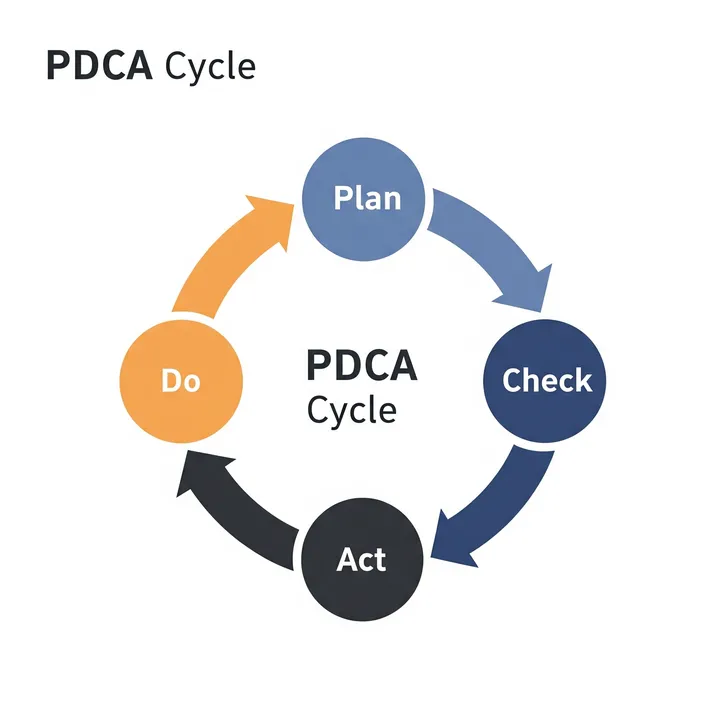
Gemini drew a circle on the whiteboard. The circle was divided into four quadrants. Plan, Do, Check, Act—the basic cycle of continuous improvement.
"The PDCA model," I began explaining, "is a framework that moves forward reliably by repeating four steps: plan, execute, verify, and improve."
"Many projects fail," Claude continued, "because they try to create a perfect plan and can't move to execution, or they execute and stop there without verification and improvement."
The Marketing Director asked. "So in our case, how should we cycle PDCA?"
[Plan: Hypothesis Design]
"First, Plan," Gemini explained. "What's important here is clarifying 'what you want to achieve.'"
"What's GlobeSurvey's goal?" I asked.
"We want web sales of 50 million yen annually," the Marketing Director answered.
"That's a result goal," Claude pointed out. "In PDCA, in addition to result goals, you also need a hypothesis about 'why it can be achieved.'"
"For example," I proposed, "the hypothesis that 'if we show report content in detail, customers will purchase on their own.' Or the hypothesis that 'if we lower prices, buyers will increase.' Which do you want to verify?"
The Marketing Director pondered. "First, I want to start by showing report content in detail. Keep prices the same for now."
"Then the first Plan is this," Gemini organized. "Hypothesis—'if we display report table of contents, sample pages, and data sources in detail, customers will decide to purchase without sales.' Goal—50 million yen in web sales in the first 3 months."
"To verify this hypothesis," Claude added, "we specify what functions to implement. Report detail pages, sample PDF downloads, online payment, immediate download after purchase—these are the Do step."
[Do: Minimum Implementation]
"Next, Do," I explained. "What's important here is not aiming for perfection."
The Marketing Director showed a surprised expression. "Not aiming for perfection?"
"Yes," Gemini answered. "The essence of PDCA is cycling quickly. If you try to implement all functions from the start, it takes time and hypothesis verification is delayed."
"Specifically," Claude proposed, "the initial implementation targets only the top 20 best-selling reports. Don't try to handle all 3,000."
"And keep design simple," I continued. "Elaborate animations or complex UI are unnecessary. Just display necessary minimum information clearly. That's sufficient."
"Implementation period," Gemini proposed, "one month. Don't take longer. Speed is important."
[Check: Verification by Data]
"Third is Check," I explained. "Verify with data whether the implemented platform actually functions as hypothesized."
"What indicators should we measure?" the Marketing Director asked.
Claude organized. "Track four indicators."
"First, visitor count. How many people visited the site?"
"Second, report detail page view rate. What percentage of visitors viewed report details?"
"Third, sample download rate. What percentage of people who viewed details downloaded samples?"
"Fourth, purchase conversion rate. What percentage of people who downloaded samples actually purchased?"
"By tracking these four numbers," Gemini explained, "we can see where the bottleneck is."
"For example," I showed concrete examples, "many visitors but low detail page view rate—this means poor navigation on the top page."
"Or, high sample download rate but low purchase conversion rate—this suggests prices are too high or there's a problem with the payment process."
[Act: Executing Improvement]
"Finally, Act," I continued. "Based on data obtained from Check, decide improvement plans for the next cycle."
"For example," Claude proposed, "suppose first 3-month data analysis reveals '70% of people who downloaded samples purchased.'"
"That's a wonderful number," the Marketing Director said.
"Yes. In other words, sample quality is sufficiently high. The problem is 'how to increase people who download samples,'" Gemini organized.
"The next cycle's Plan," I continued, "is a new hypothesis: 'if we communicate report value more clearly, sample download rate will increase.'"
"Specifically," Claude proposed, "add customer testimonials. Post actual user comments like 'strategic planning became smooth with this report.'"
"Or," Gemini added, "create short videos showing how to use reports. Visually demonstrate 'how to utilize this information.'"
"Like this," I emphasized, "PDCA isn't one-and-done. Plan→Do→Check→Act cycles, moving to the next Plan. While drawing this spiral, we reliably improve."
Chapter 3: Measurement as Compass
The Marketing Director asked. "But in a rapidly changing business phase, is a planned approach like PDCA possible?"
"Rather," I answered, "precisely because change is rapid, PDCA is necessary."
Claude explained. "In conventional waterfall development, you create a perfect plan first and implement over several months. But during that time, the market changes and customer needs change."
"In PDCA," Gemini continued, "implement in 1 month, collect data in 1 month, improve in 1 month. You can cycle once in 3 months."
"And," I emphasized, "data obtained in each cycle becomes the compass for the next cycle. You can make decisions based on facts, not speculation."
The Marketing Director's expression changed. "So PDCA and agile development are compatible."
"Exactly," I answered. "PDCA shows its true value in an agile environment. Test quickly, learn quickly, improve quickly—that's the only way to adapt to change."
Chapter 4: Progress Within Rotation
The Marketing Director gazed at the PDCA circle drawn on the whiteboard.
"Until now, I thought 'create a perfect platform before launching.' But in PDCA thinking, it's 'launch even if imperfect, collect data, and improve.'"
"Yes," I answered. "Waiting for perfection means missing opportunities. Launch at 80% completion and improve the remaining 20% while watching data—that actually produces better results."
Claude quietly added words. "What PDCA teaches us is 'plans are just hypotheses.' That's precisely why we need to verify quickly, learn, and revise."
Gemini added. "And by cycling this, a 'learning culture' takes root in the organization."
The Marketing Director stood and bowed deeply. "Thank you. Next week, I'll hold the first Plan formulation meeting."
After he left, Claude said admiringly, "The PDCA model is simple but universal."
"Yes," I answered. "But PDCA's true value is in continuing to cycle. You don't achieve perfection in one go. But you definitely improve with each cycle. That's PDCA's essence."
Outside the window, signs of spring were beginning to appear.
Four months later, a report arrived from GlobeSurvey.
First month: 20 reports published. Monthly visitors: 5,000. Report detail page view rate: 60%. Sample download rate: 30%. Purchase conversion rate: 15%. Web sales: 2.7 million yen.
Second cycle: added customer testimonials and data visualization. Purchase conversion rate improved from 15% to 22%. Sales: 4 million yen.
Third cycle: expanded target reports to 50. Visitors increased to 8,000. Sales: 6.2 million yen.
And the most important discovery was that "purchases from small-to-medium enterprises not visited by sales account for 40% of total." Web sales were cultivating a new customer segment.
The PDCA spiral was reliably ascending.
"Perfect plans don't exist. Plans are hypotheses, execution is experimentation, verification is learning, and improvement is the next hypothesis. By continuing to cycle through Plan, Do, Check, and Act, uncertainty transforms into certainty, and speculation transforms into fact. That is the power of continuous improvement."
Related Files