ROI Case File No.417 'The Language Called Drawings'

The Language Called Drawings
Chapter 1: Three CADs, One Ship
"We're designing the same ship in three different languages."
The Information Systems Director of TechFusion displayed three drawings side by side. All were cross-sections of the same vessel, but each created with different CAD systems.
"We lead technological innovation in the shipbuilding industry, but internally, CAD systems are mixed. Hull design uses CAD-A, engine design uses CAD-B, electrical design uses CAD-C—each a different software."
Years of confronting this problem had left fatigue in the Information Systems Director's voice.
"What's even more complex is information coordination between group companies. We send drawings created at headquarters to partner companies. But because partner companies use different CAD systems, they can't open the data. Eventually, we convert to PDF and send, and partner companies manually re-enter."
The materials he produced recorded annual drawing conversion and re-entry time. About 12,000 hours annually. Per ship, about 500 hours consumed in drawing conversion work.
"So we're considering introducing a PLM—Product Lifecycle Management system. Integrate all CAD systems and centrally manage information. But," he paused, "where to start, who takes responsibility, by when to complete—everything is ambiguous."
It was a state of paralyzed thinking when confronted with a complex problem.
Chapter 2: Six Questions
"Let's start this case by organizing the problem."
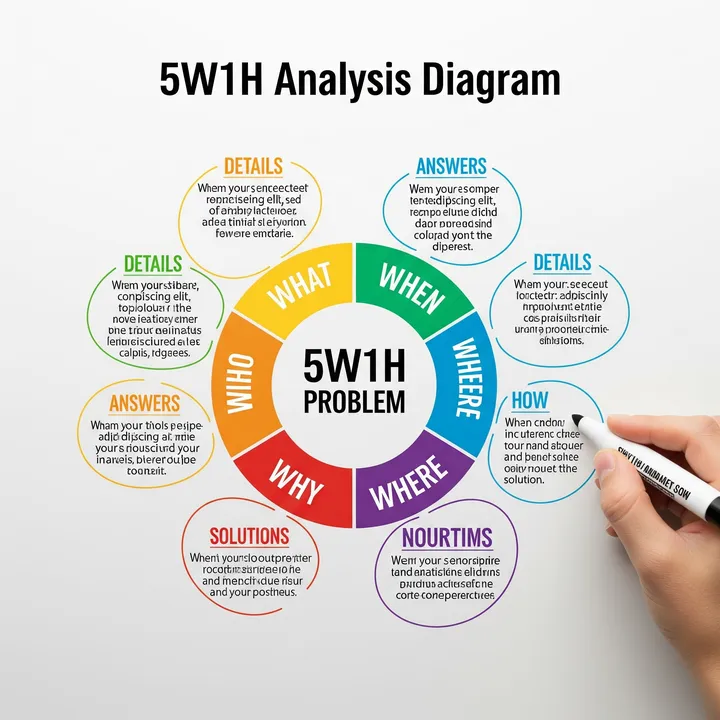
Gemini wrote six words on the whiteboard. What, Why, Who, When, Where, How—5W1H, the basic framework for structuring problems.
"The 5W1H model," I began explaining, "is a method that unravels complexly intertwined problems from six perspectives."
"Many projects fail," Claude continued, "because they jump to partial solutions without grasping the overall picture of the problem."
The Information Systems Director asked. "But our problem is clear. The mixed CAD systems are the problem, aren't they?"
"That's the surface problem," I answered. "Why are they mixed, what do we gain by solving it—if this 'why' isn't clear, we can't find appropriate solutions."
[What: What to Achieve]
"First, What," Gemini explained. "What does TechFusion want to achieve with the PLM system?"
The Information Systems Director answered. "We want to facilitate information coordination between CAD systems."
"Is that all?" I asked.
"No," he continued. "Design change history management is also a challenge. Currently, we can't track who changed what and when. And we also want to realize automatic parts list generation."
"In other words," Claude organized, "What—①data coordination between CAD systems, ②design change history management, ③automatic parts list generation. These three are what must be achieved."
"But," I pointed out, "what's the priority? Trying to achieve everything simultaneously inflates the project."
The Information Systems Director pondered. "Most urgent is data coordination between CAD systems. Without this, coordination with partner companies becomes difficult."
[Why: Why Necessary]
"Next, Why," I continued. "Why is solving this problem necessary? Without clarifying this, investment decisions can't be made."
"You said drawing conversion takes 12,000 hours annually," Gemini confirmed.
"Yes," the Information Systems Director nodded.
"At 3,000 yen per hour, that's an annual cost of 36 million yen," Claude calculated. "But it's not just monetary cost, is it?"
"Exactly," the Information Systems Director answered. "Because conversion work takes time, when design changes occur frequently, schedules delay. Delivery delays affect customer relationships."
"Furthermore," he continued, "manual re-entry carries error risk. In the past, we had to remake parts because of dimension transcription errors."
"In other words," I organized, "Why—①annual cost reduction of 36 million yen, ②preventing delivery delays, ③reducing quality risk. These are the reasons for PLM implementation."
[Who: Who Will Drive It]
"Third is Who," Gemini explained. "Who drives the project? If this is ambiguous, the project won't progress."
The Information Systems Director showed a troubled expression. "That's the problem. It's undecided whether the Information Systems Department should lead or the Design Department should lead."
"Who uses the PLM system most?" I asked.
"The Design Department," he answered.
"Then the Design Director should become project owner," Claude proposed. "The Information Systems Department plays a supporting role on the technical side."
"But," the Information Systems Director expressed concern, "the Design Director isn't a system expert."
"That's precisely why," I answered, "cooperation between both is necessary. The Design Director decides 'what to achieve,' and the Information Systems Director supports 'how to achieve it.' Please clarify this role division."
"Furthermore," Gemini added, "include representatives from group companies. They're the actual parties who will use the system."
[When: By When to Complete]
"Fourth is When," I continued. "Projects without deadlines never end."
"Due to budget, we want it operational by early 2027," the Information Systems Director answered.
"That's about 10 months from now," Claude confirmed. "But is implementing all functions in 10 months realistic?"
The Information Systems Director shook his head. "Probably impossible."
"Then," Gemini proposed, "divide into phases. Phase one—implement highest priority CAD data coordination function in 6 months. Phase two—add design change history management in additional 4 months. Phase three—implement automatic parts list generation next fiscal year."
"In other words," I emphasized, "When—Phase one by end of August 2026, Phase two by end of December 2026, Phase three within FY2027. This phased schedule is realistic."
[Where: Where to Implement]
"Fifth is Where," Claude explained. "Company-wide simultaneous implementation or starting with specific departments?"
"The PLM system will be implemented at headquarters and main manufacturing sites," the Information Systems Director answered. "And we have rollout to all group companies in view."
"But," I pointed out, "implementing at all sites from the start means large impact range when problems occur."
"Then what should we do?"
"Pilot implementation," Gemini proposed. "For the first 3 months, trial operation with just one design team at headquarters. Identify problems, improve, then expand to other sites."
"In other words," Claude organized, "Where—Phase one is headquarters hull design team, Phase two is entire headquarters, Phase three is group companies. This phased rollout minimizes risk."
[How: How to Achieve]
"Finally, How," I explained. "This becomes the most concrete execution plan."
"We need to start with PLM system selection," the Information Systems Director said.
"Before that," Gemini pointed out, "detailed investigation of current CAD systems is necessary. What versions are being used, what data formats, what customizations have been made—identify all of these."
"And," Claude continued, "in discussions with PLM vendors, confirm 'which CAD systems coordination is possible with.' A PLM that supports all CADs may not exist."
"In other words," I organized, "How—①current state investigation (1 month), ②requirements definition (1 month), ③PLM selection (1 month), ④pilot implementation (3 months), ⑤full rollout. Proceed with these 5 steps."
Chapter 3: Structured Clarity
The Information Systems Director gazed at the 5W1H organized on the whiteboard.
"Until now, we only had the vague goal of 'implement PLM.' But when organized with 5W1H, what, why, who, by when, where, how—everything becomes clear."
"The value of the 5W1H model," I answered, "is decomposing complex problems into answerable forms, one by one."
Claude quietly added words. "And by answering the six questions, the overall project picture emerges. You can't fight invisible enemies, but you can solve visible problems."
Gemini added. "What's more important is sharing this organization with all stakeholders. If What, Why, and Who are shared, the entire team faces the same direction."
The Information Systems Director stood and bowed deeply. "Thank you. Next week, I'll hold a kickoff meeting gathering the Design Director and partner companies."
After he left, Claude said admiringly, "5W1H is simple but powerful."
"Yes," I answered. "But 5W1H's true value isn't in asking questions, but in clarifying answers. Ambiguity is the enemy of projects. Clarity alone enables reliable progress."
Outside the window, ships moored in the harbor were visible.
Ten months later, a report arrived from TechFusion.
Three months of pilot implementation successfully achieved hull design team CAD data coordination. Drawing transmission time to partner companies was reduced from the conventional 2 hours to 15 minutes.
And there was an unexpected discovery. Visualizing design change history through the PLM system revealed "which design changes occur frequently," providing hints for standardization.
The six questions had produced reliable steps.
"Before complex problems, people experience analysis paralysis. What, Why, Who, When, Where, How—by structuring problems with six questions, chaos transforms into order. And by confirming with small pilots, theory becomes reality. Clear questions and small verification—that is the path to breaking through complexity."
Related Files