ROI Case File No.418 'The Well Dug by Five Whys'

The Well Dug by Five Whys
Chapter 1: The Labyrinth Called Labeling
"New product package design takes two weeks."
The Product Development Director of Innovative Solutions pointed to a stack of checklists on the desk. Each was densely filled with red pen correction instructions.
"We're a food manufacturer. When developing new products, package design labeling checks are mandatory. Ingredient names, allergen labeling, nutritional component display, expiration date position—all strictly regulated by food labeling laws."
Fatigue permeated the Product Development Director's voice.
"When designers create a first draft, first the legal department checks legal requirements. Next, quality control checks component labeling. Then manufacturing checks feasibility. Going through each department in sequence takes three days per round."
The materials he produced recorded one year of design approval processes. An average of five revisions occurred, taking about 14 days until final approval.
"What's worse is coordination with advertising agencies. We need to prepare TV commercials and store POPs before new product launches, but advertising rollout delays when package design isn't finalized."
"In other words," Claude organized, "design approval delays become a bottleneck for overall marketing."
"Exactly," the Product Development Director nodded. "So we're considering business efficiency using AI. But what's the bottleneck, what should be automated—we only see surface problems."
It was a state of seeing only symptoms, not the root cause.
Chapter 2: The Question That Digs Wells
"The 5WHYS model approach is optimal for this case."
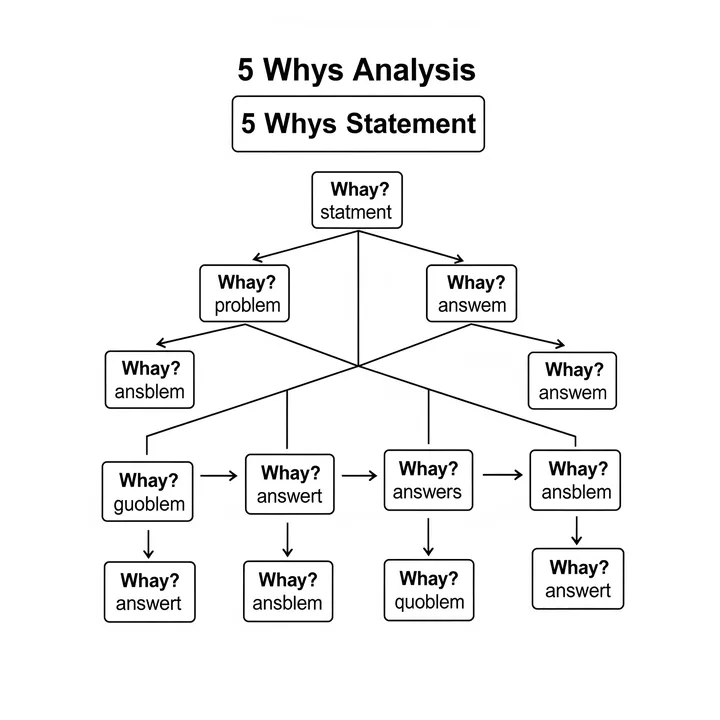
Gemini drew five-step stairs on the whiteboard. Each step had "Why?" written on it.
"The 5WHYS model," I began explaining, "is a method that reaches the root cause of problems by repeating 'why' five times."
"Many improvement activities fail," Claude continued, "because they're satisfied addressing surface symptoms. But without solving the root cause, problems recur in different forms."
The Product Development Director asked. "But why 'five times'?"
"Five is a guideline," I answered. "What's important is continuing to ask until you can't dig deeper."
[First Question: Why Does Labeling Check Take Time]
"So, the first question," Gemini began. "Why does labeling check take two weeks?"
The Product Development Director answered. "Because we need to go through each department in sequence."
"Why do you need to go in sequence?" I asked.
"Because each department can't check simultaneously."
"This is the answer to the first 'why,'" Claude organized. "Each department can't check simultaneously—then why can't they check simultaneously becomes the next question."
[Second Question: Why Can't They Check Simultaneously]
"Why can't each department check simultaneously?" Gemini asked.
The Product Development Director pondered. "Because checklist items are recorded on paper sheets, which we circulate in sequence."
"Paper sheets?" I confirmed.
"Yes. Legal checks and stamps, then passes to quality control. Quality control checks and stamps, then passes to manufacturing—this flow."
"In other words," Claude pointed out, "physical constraints prevent parallel work. Then why paper sheets are used becomes the next question."
[Third Question: Why Use Paper Sheets]
"Why use paper sheets instead of digital tools?" I asked.
The Product Development Director answered. "Because appropriate digital tools haven't been implemented."
"Why haven't they been implemented?" Gemini asked.
The Product Development Director hesitated. "That's... because we haven't advocated the necessity of digitalization to management."
"Then why haven't you advocated it?" Claude continued.
"Because we couldn't show clear cost-effectiveness. When told 'we can do it with paper,' we couldn't argue back."
"This is the third 'why,'" I organized. "Couldn't show cost-effectiveness—then why couldn't you show cost-effectiveness?"
[Fourth Question: Why Couldn't Cost-Effectiveness Be Shown]
"Why couldn't you show digitalization's cost-effectiveness?" Gemini asked.
The Product Development Director thought deeply. "Because we weren't accurately grasping costs incurred by current operations."
"For example," I prompted.
"We weren't measuring how much time each department spends on labeling checks. We weren't recording how much unnecessary coordination occurs with advertising agencies."
"In other words," Claude organized, "'invisible costs' don't become material for investment decisions. Then why weren't costs being measured?"
[Fifth Question: Why Weren't Costs Being Measured]
"Why weren't operational costs being measured?" I asked.
The Product Development Director answered quietly. "Because company-wide, digitalization's priority was low."
"Why was priority low?" Gemini asked.
"Because management didn't recognize digitalization's strategic importance."
Silence filled the room.
"This is the root cause," I said quietly. "Design approval takes time—at the root lies 'management's lack of understanding about digitalization.'"
Chapter 3: From Root to Branch
The Product Development Director gazed at the five "whys" drawn on the whiteboard.
"At first, I thought 'introducing AI tools will solve it.' But when digging down with 5WHYS, the problem's root was much deeper."
"The essence of the 5WHYS model," I answered, "is distinguishing symptoms from causes."
Claude explained. "'Labeling check takes time' is a symptom. 'Each department can't check simultaneously' is also a symptom. But 'management's lack of understanding about digitalization' is the root cause."
"So," the Product Development Director asked, "to solve the root cause, what should we do?"
"Address in reverse order," Gemini answered. "From root to branch, solve in sequence."
I began writing solutions on the whiteboard.
"Step one: presentation to management. Visualize current operational costs and show digitalization's cost-effectiveness."
"Specifically," Claude supplemented, "measure how much time each department spends annually on labeling checks. For one month, record time in all approval processes."
"Probably," Gemini estimated, "legal, quality control, and manufacturing representatives each spend 5 hours weekly on checking. Three departments, 15 hours weekly, about 720 hours annually. At 3,000 yen per hour labor cost, that's an annual cost of 2.16 million yen."
"Step two: digital tool selection," I continued. "Implement a cloud-based workflow management system, creating an environment where each department can check simultaneously."
"Step three: pilot operation," Claude proposed. "For the first month, trial operation with just one new product. Run in parallel with the conventional paper process, measuring how much time is reduced."
"And step four," Gemini continued. "After confirming effectiveness, company-wide rollout."
The Product Development Director asked. "But can we persuade management?"
"The root cause reached through 5WHYS," I answered, "is simultaneously the key to persuasion. 'Management doesn't recognize digitalization's importance'—then show that importance with numbers."
Chapter 4: From the Bottom of the Well
"The 5WHYS model has another important aspect," Claude said.
"It's searching for 'what's wrong,' not 'who's wrong.'"
The Product Development Director nodded. "Certainly, through repeating 'why,' we saw systemic problems rather than blaming someone."
"And," Gemini added, "by reaching the root cause, structural solutions emerge rather than ad hoc responses."
The Product Development Director stood and bowed deeply. "Thank you. Next week, we'll start one month of operational time measurement."
After he left, Claude said admiringly, "5WHYS is simple but deep."
"Yes," I answered. "But the difficulty of 5WHYS is the courage to keep asking 'why.' The deeper you dig, the more you confront your organization's fundamental problems. Not looking away from that is the first step toward true improvement."
Outside the window, winter sunlight illuminated the office.
Two months later, a report arrived from Innovative Solutions.
One month of operational time measurement revealed that about 800 hours annually, equivalent to 2.4 million yen in labor costs, were spent on labeling checks.
Based on these numbers, a presentation at the management meeting resulted in approval for digitalization budget.
And in pilot operation, the approval process was reduced from 14 days to 5 days. The ability for each department to check simultaneously eliminated 9 days of waiting time.
The five "whys" had certainly reached the bottom of the well.
"Only looking at problems' surfaces won't achieve true solutions. Repeat 'why' five times, from symptoms to causes, from causes to deeper causes—by digging a well with layered questions, you reach the root cause. And by solving from root to branch in order, problems never recur. That is the power of the 5WHYS model."
Related Files