ROI Case File No.419 'The Habit Called Ordering'

The Habit Called Ordering
Chapter 1: The Morning Ritual
"Every morning at 9 AM, store managers grip handheld terminals."
The Operations Director of NexTech picked up a small handheld terminal. It was a barcode scanner commonly seen in convenience stores.
"We operate 8 convenience stores. At each store, morning ordering work is a daily routine. Store managers and assistant managers walk around the store, check inventory on shelves, and input order quantities on handheld terminals."
The Operations Director's voice carried the reality of someone who had witnessed this operation for years.
"Each store handles about 300 items. Checking everything takes 30 minutes to an hour. If both the store manager and assistant manager work together, about 1.5 hours of human resources are spent on ordering per day."
The materials he produced recorded monthly ordering work hours for 8 stores. 45 hours per store monthly. 360 hours for 8 stores. About 4,300 hours annually.
"What's more serious," the Operations Director continued, "is rising labor costs and declining working population. Recruiting excellent store managers is getting harder each year. To achieve low-cost operation with fewer people, we have no choice but to automate ordering work."
"So you're considering implementing an AI automatic ordering system," I confirmed.
"Yes," the Operations Director nodded. "But the issue isn't technology—it's people. Store managers have been ordering the same way for 15 years. If we say 'leave it to AI,' will they trust us? Won't they resist?—that's our anxiety."
It was a challenge not of technology implementation, but of human behavior change.
Chapter 2: Five Stages to Change
"The essence of this case is behavior change, not technology implementation."
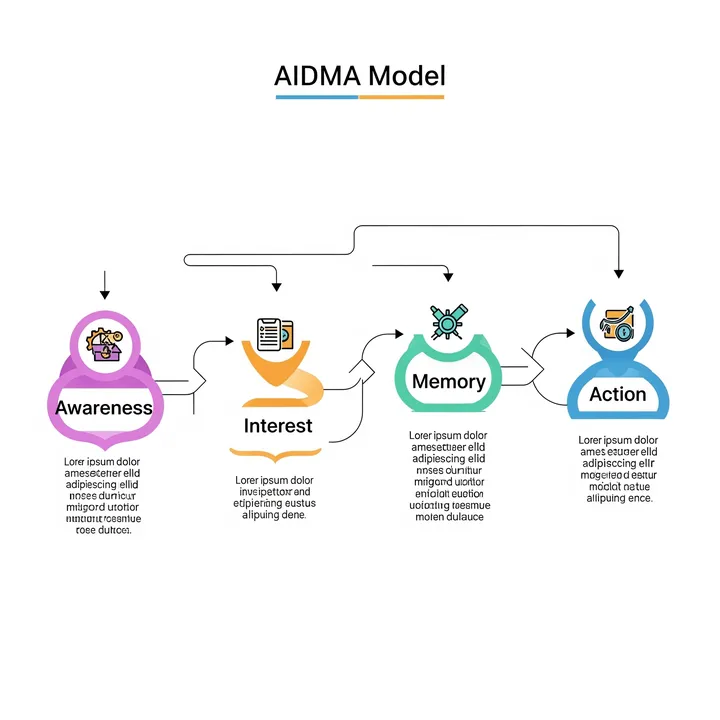
Gemini drew five stairs on the whiteboard. Attention, Interest, Desire, Memory, Action—the AIDMA model, the psychological process before people take action.
"The AIDMA model," I began explaining, "originally a consumer behavior model used in advertising and marketing, can also be applied to implementing new systems within organizations."
"For people to take new actions," Claude continued, "they need to go through five stages. First attract attention (Attention), generate interest (Interest), create desire (Desire), retain in memory (Memory), and then take action (Action)."
The Operations Director asked. "But store managers already know about 'AI automatic ordering systems.' Isn't Attention already cleared?"
"Knowing and paying attention are different," I answered. "We need to proceed carefully through each AIDMA stage."
[Attention: Attracting Attention]
"The first step is Attention—directing store managers' attention to AI automatic ordering," Gemini explained.
"How can we attract attention?" the Operations Director asked.
"Visualize current challenges with numbers," Claude answered. "Share the fact that 'ordering work takes 1 hour daily' at a store manager meeting."
"And," I added, "ask 'if ordering work were automated, what would you want to use that 1 hour for?'"
The Operations Director pondered. "Store managers would probably answer 'customer service' or 'sales floor creation.'"
"That's important," Gemini pointed out. "AI implementation doesn't steal store managers' jobs, but enables them to use time for more valuable work—attract attention from this perspective."
[Interest: Generating Interest]
"The next step is Interest—arousing interest in AI automatic ordering," I continued.
"Specifically, how?"
"Demonstration," Claude answered. "Show case studies from other companies. How other companies in the same industry utilize AI automatic ordering and what results they've achieved."
"And," Gemini added, "let store managers actually touch the system. Not just showing screens, but the experience of actually operating it deepens interest."
"What's more important," I emphasized, "is answering store managers' questions and anxieties on the spot. 'What if AI makes mistakes?' 'Is judgment of best-selling products accurate?'—answer these questions with technical basis."
[Desire: Creating Want]
"The third step is Desire—making them think 'I want this system,'" Gemini explained.
The Operations Director asked. "Aren't being interested and wanting different?"
"Very different," Claude answered. "Between thinking 'sounds interesting' and thinking 'I want to implement this in my store,' there's a big wall."
"To cross this wall," I continued, "make store managers themselves imagine the concrete future after implementation."
"For example," Gemini proposed, "select one pilot store and trial implement for three months. Have that store's manager share weekly results with other store managers."
"'Ordering time reduced by 30 minutes,' 'used that time to create new POPs,' 'increased customer conversations'—hearing such concrete changes makes other store managers think 'I want to realize this in my store too,'" Claude explained.
[Memory: Retaining in Memory]
"The fourth step is Memory—retaining the system's existence and effectiveness in memory," I explained.
"What does this mean?" the Operations Director asked.
"Humans are forgetful creatures," Gemini answered. "Even if they think 'AI automatic ordering seems good' once, they forget in daily work. Enthusiasm for implementation cools."
"To prevent this," Claude continued, "a mechanism for regular reminders is necessary. Always report pilot store results at monthly store manager meetings. Display a countdown to implementation on the internal bulletin board. Keep store managers' consciousness continuously directed toward AI implementation."
"Furthermore," I added, "name it 'AI Automatic Ordering Implementation Project' and involve all store managers as 'project members.' Recognizing themselves as part of the project makes it easier to retain in memory."
[Action: Taking Action]
"The final step is Action—actually starting to use it," Gemini explained.
"This is most important," the Operations Director said.
"Yes," I answered. "But suddenly saying 'please use it at all stores from tomorrow' won't work."
"Implement in stages," Claude proposed. "First, establish a success case at the pilot store. Next, expand to 2-3 stores managed by enthusiastic store managers. Then, after confirming results, roll out to remaining stores."
"At each stage," Gemini continued, "implementing store managers take on the role of 'AI implementation supporters,' answering other store managers' questions. Create a culture where store managers help each other, not headquarters pushing it."
"And what's important," I emphasized, "is running conventional manual ordering and AI automatic ordering in parallel for the first month. Store managers make final decisions while seeing AI suggestions. This parallel period builds store managers' trust."
Chapter 3: The Resistance Called Habit
The Operations Director gazed at the AIDMA five stages drawn on the whiteboard.
"Until now, I thought 'if we introduce the system, they'll use it.' But changing people's behavior requires this many stages."
"The essence of the AIDMA model," I answered, "is that people don't move by rational judgment alone."
Claude quietly added words. "Changing a habit continued for 15 years is harder than understanding new technology. That's precisely why we need to understand psychological processes and climb the stairs one step at a time."
Gemini added. "And even after Action occurs, continuous support is necessary. For the first three months, hold weekly follow-up meetings to share difficulties."
The Operations Director stood and bowed deeply. "Thank you. Next month, we'll start selecting pilot stores."
After he left, Claude said admiringly, "The AIDMA model is originally for marketing, but it can be applied to organizational change too."
"Yes," I answered. "The essence of changing people's behavior is the same whether external customers or internal employees. Attract attention, generate interest, create desire, retain in memory, enable action—this sequence cannot be skipped."
Outside the window, the morning commute rush was beginning.
Five months later, a report arrived from NexTech.
Three months of trial operation at the pilot store reduced ordering time from 60 minutes to 15 minutes. The store manager focused on sales floor layout changes and customer service with the freed time, resulting in an 8% increase in that store's sales compared to the previous year.
Seeing these results, other store managers naturally voiced "I want to implement it in my store too."
And half a year later, rollout to all 8 stores was complete. Store managers now say "AI ordering is natural."
The five stages of behavior change were certainly climbed.
"New technology alone won't be used. To change people's behavior, attract attention, generate interest, create desire, retain in memory, and enable action—proceed carefully through AIDMA's five stages. And by visualizing small successes and spreading horizontally, resistance transforms into trust. That is the path to reliable implementation."
Related Files