ROI Case File No.421 'Until the Day It Lines the Shelves Abroad'

Until the Day It Lines the Shelves Abroad
Chapter 1: Beyond the Subscription
"The articles are being read. But readers aren't satisfied with articles alone."
The head of Globex Corp's digital division turned her laptop screen toward us. Displayed was the dashboard for their lifestyle media platform, "HalmekUp." Monthly active users: 120,000. Paid subscription members: 8,000.
"HalmekUp delivers articles on health, beauty, and fashion, primarily targeting women in their 40s to 60s. Subscription revenue is approximately four million yen per month, and it's stable."
The division head scrolled down. Engagement data for each article was laid out before us.
"The problem is right here."
She pointed to the comment section of a fashion article. "Where can I buy this product?" "Is there a purchase link?"—such comments averaged 15 per article.
"Readers want to buy the products featured in our articles. But all we do is write articles—we don't sell products. We're letting readers with purchase intent slip away to external sites."
"In other words," Claude summarized, "you're unable to convert the buying motivation your content generates into your own revenue."
"Exactly," the division head nodded. "That's why we want to create a new category called 'Select' within HalmekUp, selling curated fashion items. We're thinking of a small start with just ten products."
"Will you be building your own EC system?" I asked.
The division head's expression darkened. "That's the dilemma. Modifying our existing site was quoted at a minimum of eight million yen. But eight million for just ten products is too heavy an investment. We'd like to start at low cost using an external EC platform, but we can't see the criteria for choosing the right one."
At first glance, it seemed like a straightforward platform selection issue. But lurking beneath were environmental factors that could not be overlooked.
Chapter 2: Four Blind Spots
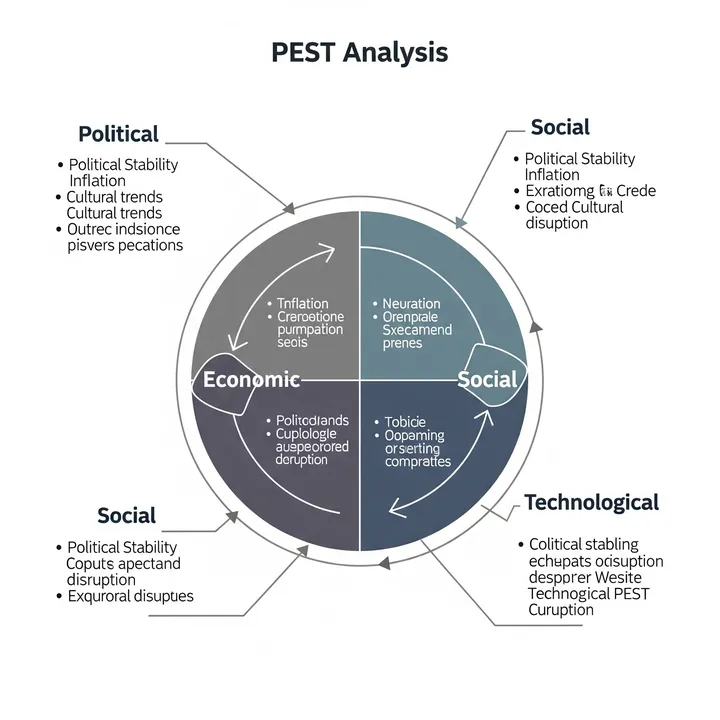
"This case demands an environmental analysis using the PEST model."
Gemini drew four quadrants on the whiteboard. Political, Economic, Social, Technological—a framework for structurally analyzing the external environment.
"The PEST model," I began to explain, "is a method for identifying external environmental factors beyond a company's control, examined from four perspectives. Many companies focus solely on their strengths and competitive comparisons, overlooking these 'shifts in the external environment.'"
"Why would platform selection require an external environmental analysis?" the division head asked.
"Because," Claude answered, "platform selection isn't simply a feature comparison. Regulations, economic conditions, shifts in consumer behavior, and technological evolution—these factors can fundamentally change what the right choice looks like."
[Political: The Invisible Wall of Regulation]
"First, Political—the perspective of politics and regulation," Gemini said, pointing to the first quadrant.
"Regulations are relevant to an EC site?" the division head asked, looking surprised.
"Very much so," I replied. "First, there's the Act on Specified Commercial Transactions. When selling products on an EC site, there are disclosure requirements for business name, address, return conditions, and more. When using an external platform, these disclosures depend on the platform's specifications."
"Furthermore," Claude continued, "there's the issue of the Act against Unjustifiable Premiums and Misleading Representations. HalmekUp is an article-based media outlet. If you introduce products in articles and readers navigate directly to a purchase page from those articles, it may be considered 'advertising.' Failing to clearly delineate articles from advertising creates legal risk."
The division head's expression changed. "We hadn't considered that."
"And," I added, "is there a possibility you'll carry international brand items in the future?"
"Yes, given reader demand, carrying international brands is on our radar."
"In that case," Gemini pointed out, "you'll need to address customs duties, import regulations, and consumer protection laws in each country. At the platform selection stage, you should verify each platform's cross-border EC capabilities."
[Economic: The Economic Rationality of Starting with Ten]
"Next, Economic—the economic perspective," I continued.
"Let's compare the cost structures of each platform," Gemini proposed. "Which platforms are you currently considering?"
The division head answered. "Shopify, BASE, and STORES."
"Comparing the monthly fees, sales commissions, and payment processing fees for each," Claude began calculating, "assuming monthly sales of 500,000 yen—Shopify runs about 4,000 yen per month plus a 3.4% payment fee, for a monthly cost of roughly 21,000 yen. BASE has no monthly fee, but charges 6.6% plus 40 yen per transaction, coming to about 37,000 yen. STORES is 2,980 yen per month plus a 3.6% fee, roughly 21,000 yen."
"At first glance, Shopify appears favorable," I noted. "But what matters is the break-even point when monthly sales fluctuate."
Gemini organized the analysis. "At monthly sales below 300,000 yen, BASE's zero initial cost is advantageous. Above 500,000 yen, Shopify or STORES win on lower commission rates. And beyond one million yen monthly, the fee differential amounts to hundreds of thousands of yen annually."
"If you're starting with just ten products," Claude concluded, "the optimal platform offers low initial costs and scales as you grow. That means selection should account not just for current scale, but for growth scenarios six months and a year from now."
[Social: Shifts in Purchasing Behavior Among Women in Their 40s]
"Third is Social—the societal perspective," I explained.
"HalmekUp's readership is women in their 40s to 60s, correct?" Claude confirmed. "What characteristics define this demographic's purchasing behavior?"
The division head replied. "Looking at our access logs, roughly 70% of traffic comes from smartphones. And reading times concentrate at 7 AM and 9 PM."
"In other words," Gemini analyzed, "they read articles during commuting hours and relaxation time before bed. When purchase intent strikes in those moments, the key question is whether they can complete a purchase seamlessly on their smartphone."
"Even more critical," I added, "is that women in this age group tend to rely heavily on 'recommendations from trusted sources' as purchase motivation. Because they trust HalmekUp's articles, they think, 'If this article recommends it, it must be reliable.'"
"This means," Claude summarized, "the platform selection criteria should include 'the seamlessness between media and EC.' If the HalmekUp experience breaks the moment a reader navigates to a purchase page, that trust is damaged."
The division head nodded deeply. "Design customizability is far more important than I realized."
[Technological: Designing the Seams]
"Finally, Technological—the technical perspective," Gemini said, pointing to the fourth quadrant.
"The challenge is how to integrate HalmekUp's existing system with an external EC platform," I explained.
"Specifically," Claude outlined the technical requirements, "there are three key points. First, seamless transitions from article pages to product pages—embedded within the page via API, or a redirect to another domain? Second, user data integration—can subscription member information be utilized on the EC side? Third, consolidation of inventory and order data management interfaces."
"The first point is the most critical," Gemini emphasized. "As our Social analysis revealed, the risk of user drop-off at the 'seam' between article and purchase is high. The technical design of this seam will significantly impact sales."
"After checking each platform's API capabilities," I reported, "Shopify offers a robust Storefront API that allows embedding purchase buttons within the existing site. BASE and STORES have more limited API availability."
Chapter 3: The Reproducibility of Choice
The division head studied the complete PEST analysis laid out on the whiteboard.
"I was trying to make the platform selection as a simple feature comparison. But regulations, economic conditions, customer behavior, and technical integration—without considering all of these, the right choice can't be made."
"And what's crucial," I emphasized, "is that each element of PEST changes over time. Regulations get amended, economic conditions fluctuate, consumer behavior shifts, and technology evolves."
"That's precisely why," Claude added, "it's important to build a system for continuously scanning environmental changes, rather than treating this as a one-time analysis."
Gemini summarized a specific proposal. "We recommend a small start with Shopify, for three reasons: integration with article pages through the Storefront API, scalability as monthly sales grow, and extensibility for cross-border EC."
"However," I cautioned, "the conclusion itself isn't what matters most. What matters is that you arrived at this conclusion through the process of PEST analysis. If you run the same analysis six months from now, environmental changes might lead to a different conclusion. The ability to re-verify using the same process at that point—that is reproducibility."
The division head stood and bowed deeply. "Thank you. Next week, we'll share the PEST elements internally and make our final platform decision."
Chapter 4: The Moment Readers Become Customers
After she left, Gemini murmured, "PEST analysis doesn't just improve the quality of decision-making—it also leaves the decision-making process within the organization."
"Yes," I replied. "Many companies fail to record 'why they made a particular decision.' So when faced with a similar decision, they must start from scratch. By structuring environmental analysis through PEST, the rationale behind past decisions is preserved, becoming a baseline for future decision-making."
Outside the window, delivery trucks moved back and forth.
Three months later, a report arrived from Globex Corp.
Using Shopify's Storefront API, they had launched their EC by embedding purchase buttons directly within article pages. Of the initial ten items, three that were featured in articles sold out in the first month.
And the most noteworthy data point: the purchase conversion rate through articles was 8.2%. Considering that the typical EC site conversion rate is 2–3%, the power of integrating media and EC was unmistakable.
Furthermore, to address the risk flagged by the PEST analysis regarding misleading representation laws, they had established guidelines clearly separating editorial content from product introductions. In coordination with their legal team, they introduced "PR" labels on all product-featured articles.
At the end of her report, the division head had written: "The PEST analysis framework is being applied repeatedly when adding new products or considering new categories. Decision-making is no longer dependent on individuals, and our entire team can now share the rationale behind each judgment."
The four perspectives of environmental analysis were not a one-time map, but a compass that could be used again and again.
"Whether it's platform selection or launching a new business, the decision itself is a one-time event. But what the PEST model provides is not the decision—it's the process of arriving at one. Structuring the external environment from four perspectives, recording it, and periodically re-verifying—that process is the only way to bring reproducibility to an organization's decision-making."
Related Files