ROI Case File No.422 'What Three Months of Silence Reveal'

What Three Months of Silence Reveal
Chapter 1: New Hires Who Don't Grow
"It takes three months for a new hire to work independently. During those three months, one veteran disappears from the floor."
The executive vice president of NextWave spread a staff schedule across the table. Sections circled in red marker indicated time allocated to training. A third of the schedule was red.
"We operate 12 fitness clubs across the Tokyo metropolitan area. Front desk staff handle membership registrations, facility tours, and member inquiries. It may sound simple, but we have 8 pricing plans, 15 add-on options, and campaigns that change every season."
The executive produced another document—turnover data for the past year.
"Our annual turnover rate for front desk staff is 42%. Average tenure is 14 months. In other words, new hires we spent three months training are gone within a year."
"What does the training cost look like?" I asked.
"A veteran's hourly rate is 1,500 yen, three hours per day, over 60 business days. Training one new hire costs roughly 270,000 yen. With approximately 40 new hires per year, that's 10.8 million yen annually on training alone."
The weight of that number shifted the air in the office.
"But," the executive continued, "the real problem isn't the cost. It's that training quality varies wildly depending on which veteran handles it. At some locations, new hires can work independently in six weeks. At others, they're still making basic mistakes after three months. We don't know where this gap comes from."
"Do you have a training manual?" Claude asked.
"Yes. A 150-page paper manual. But I've never seen a new hire open it on the floor."
This wasn't a manual problem. There was a structural flaw in the way knowledge was being transferred.
Chapter 2: The Absence of Feedback
"The core issue here isn't digitizing the training program."
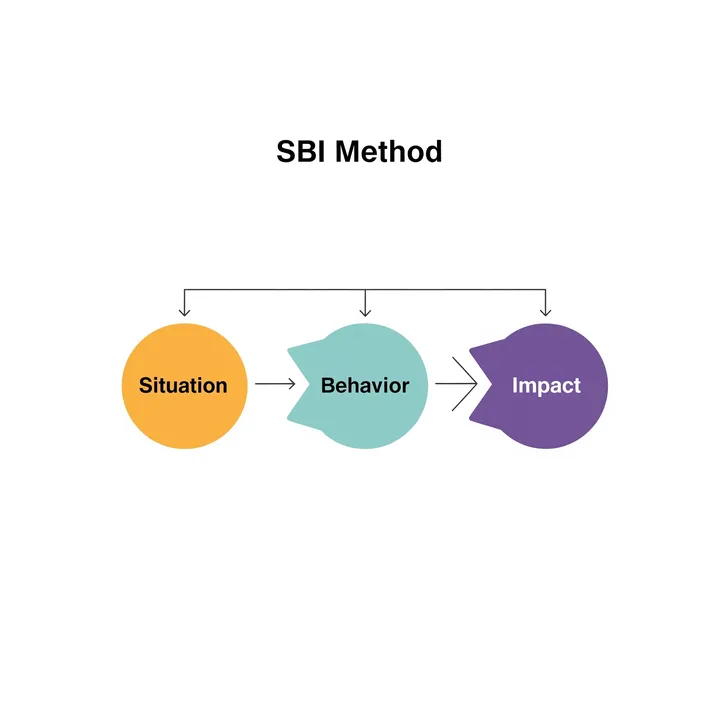
Gemini drew a diagram on the whiteboard. Three elements connected by arrows—Situation, Behavior, Impact. The SBI model.
"The SBI model," I began to explain, "is a framework for structuring feedback. Situation—what was the context? Behavior—what specific action was taken? Impact—what effect did that action produce? By communicating through these three elements, feedback becomes concrete and reproducible."
The executive tilted his head. "This is about feedback? I came to discuss implementing an LMS—a learning management system."
"An LMS is a means," Claude replied calmly. "But implementing an LMS alone won't resolve the inconsistency in training quality. The root cause is the absence of feedback."
"What do you mean?"
"Let me ask," I said. "During the training period, what kind of feedback do veterans give new hires?"
The executive thought for a moment. "I believe they give verbal corrections on the spot."
"Then—do you know which veterans at which locations give feedback in which situations, and in what words?"
"No."
"That's the problem," Gemini pointed out. "The difference between a veteran who can develop a new hire in six weeks and one who takes three months likely isn't what they teach—it's the quality of their feedback."
[Situation: Identifying the Context]
"Let's start with SBI's first element, Situation—identifying the context," I proposed.
"Where do the most mistakes occur during training?" Claude asked.
The executive answered immediately. "Membership registration. Specifically, explaining pricing plans and option selection. New hires frequently recommend plans that don't match the customer's needs."
"Describe that scenario more specifically," Gemini prompted.
"For example—Saturday morning. A customer comes to the front desk after a trial lesson. They say, 'I only want to come on weekday evenings.' But the new hire recommends the full-time plan that covers all hours. There's a 3,000-yen-per-month difference."
"That is your Situation," I clarified. "'Saturday morning, a customer expressed interest in joining after a trial, and was recommended a plan that didn't match their stated preference'—specifying the context to this level of detail is the first step of SBI."
[Behavior: Observing Actions]
"Next, Behavior—describing the specific action the new hire took in that situation," Claude continued.
"What's critical here," I emphasized, "is recording the action as fact, not judgment. 'They weren't listening properly' is a judgment. 'After the customer stated they only wanted weekday evenings, the staff began explaining all plans from the top of the pricing sheet'—that's a fact."
The executive looked startled. "You're right. On the floor, veterans just say, 'Listen better.' They never specify what exactly went wrong."
"That's why there's no reproducibility," Gemini noted. "'Listen better' doesn't tell anyone what to listen for, when, or how. But 'Confirm the customer's preferred usage times first, then present only the matching plans'—that makes the expected behavior explicit."
[Impact: Making the Effect Visible]
"Finally, Impact—communicating the effect that action produced," I explained.
"This element gives feedback its persuasive power," Claude added. "'As a result of recommending an unsuitable plan, the customer felt overcharged and put their membership on hold. They later joined a competitor'—the more specific the impact, the more the new hire understands the weight of their actions."
"But," the executive asked, "isn't that level of detailed feedback too much of a burden on veterans?"
"That's exactly where the LMS comes in," I answered. "Not an LMS that simply lines up video tutorials. You need an LMS built around SBI's three elements."
Chapter 3: Building It into the System
"Specifically, what kind of LMS should we design?" the executive leaned forward.
Gemini began sketching a design on the whiteboard.
"It should consist of three modules. Module one—scenario videos. Film actual membership registration scenarios showing both correct and incorrect responses. New hires watch and identify the differences on their own."
"Module two," Claude continued. "SBI feedback records. When veterans give new hires feedback, they enter three fields in an app: 'Situation,' 'Behavior,' and 'Impact.' The format is designed to be completed in 30 seconds, minimizing the burden."
"Module three," I added. "Feedback data analysis. Aggregate SBI records from all locations to visualize which scenarios produce which behavioral errors, and at what frequency. This feeds directly into improving the training program."
The executive asked, "How do you address the quality gap between different veterans' feedback?"
"The SBI format itself is the standardization mechanism," Gemini answered. "The process of filling in the format forces veterans to think structurally about 'what to communicate and how.' Through repeated practice of recording facts rather than judgments, the overall quality of feedback is elevated."
"And," Claude added, "the SBI records of your best veterans become templates for others. How the veteran who develops new hires in six weeks gives feedback—in which situations, with what words—that tacit knowledge accumulates as data within the organization."
"What's crucial," I emphasized, "is to start the pilot at one location with three new hires. Collect data over three months and verify whether the time to independence shortens. Use those results to decide whether to roll out across all 11 other locations."
Chapter 4: When Silence Becomes Words
The executive studied the SBI model and LMS design sketched on the whiteboard.
"Until now, I thought the training problem was about the materials—'the manual is outdated,' 'we don't have videos.' But the real problem was that feedback wasn't structured—meaning veteran coaching skills were personal and never accumulated within the organization."
"The essence of the SBI model," I replied, "is transforming feedback from individual intuition into organizational infrastructure. Situation, Behavior, Impact—simply recording along these three dimensions produces feedback of consistent quality, regardless of who delivers it. That is reproducibility."
Claude added quietly, "The reason a 150-page manual goes unread isn't because new hires are lazy. Knowledge only becomes action when it's delivered at the right moment, tied to a specific situation."
The executive stood and bowed deeply. "Thank you. We'll begin the LMS pilot at our first location next month."
After he left, Gemini murmured, "The SBI model serves not just as a feedback tool, but as a foundation for organizational learning."
"Yes," I replied. "It converts the tacit knowledge of exceptional individuals into the explicit knowledge of the organization. The SBI format is the conversion device. Because there's a format, you can record. Because there are records, you can analyze. Because there's analysis, you can improve. This chain is what reproducible talent development truly looks like."
Outside the window, morning joggers moved back and forth.
Four months later, a report arrived from NextWave.
All three new hires at the pilot location had achieved independence in two months—a full month shorter than the previous three. Per-person training cost dropped from 270,000 yen to 180,000 yen.
But the most important discovery lay beyond the numbers. Analysis of SBI feedback records revealed a pattern common among new hires who reached independence fastest. It was a single behavioral habit: "confirming the customer's purpose for using the facility before starting the registration process." New hires who adopted this behavior within their first week saw a 72% reduction in plan recommendation errors.
This pattern was something one veteran had been doing unconsciously in their coaching—and the SBI format had given it words. It is now taught as a priority on the first day of training at every location.
Wisdom that had existed in silence became words, then systems, then organizational strength.
"Converting an exceptional instructor's intuition into a format anyone can use. What the SBI model demonstrates is that feedback is neither instinct nor talent—it is structure. Identify the situation, describe the behavior, make the impact visible—by recording these three steps continuously, personalized coaching evolves into a reproducible development system."
Related Files