ROI Case File No.423 'Those Who Read the Tide of Bidding'

Those Who Read the Tide of Bidding
Chapter 1: Blind Beyond Kansai
"There are over 1,700 municipalities in Japan. We're monitoring about 80 of them."
The head of ParkEase's bicycle parking division spread an A3 sheet printed with a map of Japan. Only the Kansai area was filled in with red marker. The rest remained white.
"Our company handles bicycle parking facility management and develops parking applications for bicycle lots. The revenue pillar is municipal operations contracts, accounting for approximately 65% of annual sales—roughly 400 million yen."
The division head removed the marker cap and pointed at the Kanto region on the map.
"The problem is this white area. Municipalities across the country post bicycle parking-related bids, but we can only track information from 80 municipalities in Kansai. Our staff manually checks each municipality's website every morning. That's about two hours of work per day."
"Roughly 500 hours per year," Gemini calculated instantly.
"Yes. And that's just for Kansai. Scaling nationwide would mean over ten times that workload. It's physically impossible."
"How often do you miss bidding opportunities?" I asked.
The division head's expression darkened. "Last month, we missed a major bid in Nagoya. It was an operations contract for three bicycle parking facilities, with an estimated annual contract value of 80 million yen. The posting period was 14 days, but by the time we noticed, only two days remained before the deadline. We couldn't prepare a proposal in time."
"An 80-million-yen opportunity loss," Claude said quietly.
"So," the division head continued, "we want to develop a system that automatically collects bidding information from municipal websites nationwide. We received a quote from an external systems company: 12 million yen in initial development costs, plus 400,000 yen per month in operating expenses."
"And you're unsure whether to accept that proposal."
"Yes. Opinions are split internally. The sales department insists we should implement immediately. The accounting department objects, saying the cost-effectiveness is unclear. Management can't decide which side to favor."
This wasn't a systems development problem. There was another challenge lying beneath—internal consensus building.
Chapter 2: Turning Conflict into Structure
"Setting aside the technical challenges for now, the first thing to resolve is internal consensus."
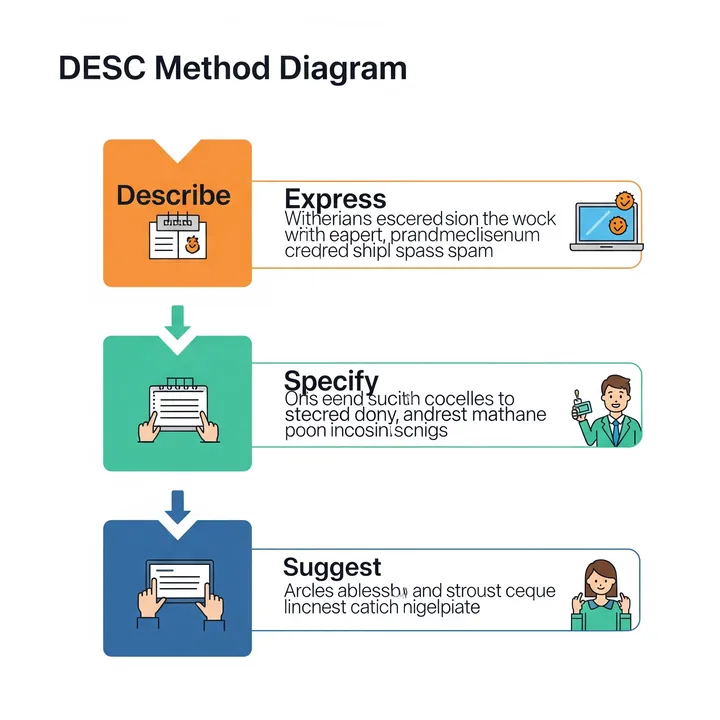
Gemini wrote four words on the whiteboard. Describe, Express, Specify, Consequence—the DESC model.
"The DESC model," I began to explain, "is an assertion framework for transforming opposing opinions into constructive dialogue. Rather than pushing your own position or yielding to the other side, you structure facts, emotions, and proposals in a way that guides everyone toward a mutually acceptable conclusion."
"You want to use DESC to sort out the conflict between sales and accounting?" the division head asked.
"Precisely," Claude answered. "Most conflicts arise when people look at the same facts but interpret them differently. The DESC model first establishes shared facts, then surfaces the differences in interpretation, and presents a concrete proposal. By following these steps, emotional confrontation transforms into logical discussion."
[Describe: Stating the Facts]
"DESC's first step, Describe—objectively depicting the facts," Gemini explained.
"What's critical here," I emphasized, "is presenting only facts that anyone would agree on, without any opinions or interpretations."
"For example," Claude offered a concrete illustration. "'The automated collection system is too expensive' is an opinion. The facts are: 'Currently, 500 hours per year are devoted to collecting bidding information from 80 Kansai municipalities. Covering 1,700 municipalities nationwide would require over 10,000 hours under the current system. The external proposal quotes 12 million yen in initial costs, 400,000 yen monthly, and 4.8 million yen in annual operating expenses.'"
"And another fact," I added. "'Last month, a Nagoya bid estimated at 80 million yen was missed due to delayed information gathering. Over the past year, there have been zero bid submissions for opportunities outside Kansai.'"
The division head nodded. "When you lay it out like this, you can see the facts that both sales and accounting would agree on."
"That's the power of Describe," Gemini said. "Without shared facts, constructive discussion cannot begin."
[Express: Voicing Concerns]
"Step two, Express—candidly voicing the emotions and concerns prompted by the facts," I continued.
"Here," Claude explained, "we articulate the concerns of both the sales and accounting departments. Sales' concern: 'If we stay confined to Kansai, competitors expanding nationwide will capture our market share. The longer we wait, the greater our opportunity loss.' Accounting's concern: 'It's unclear whether the 12-million-yen initial investment will deliver a reliable return. The risk is significant if the development stalls.'"
"Both concerns are legitimate," I pointed out. "The DESC model doesn't dismiss either one. What matters is getting both concerns 'on the table.'"
The division head looked impressed. "Until now, our meetings have been the sales team giving passionate speeches while accounting throws cold water on everything. We never thought to treat both concerns as parallel."
"Conflict becomes emotional," Gemini added, "when people feel their concerns are being ignored. Simply making everyone's concerns visible in the Express step can dramatically change the tone of the discussion."
[Specify: Presenting a Concrete Proposal]
"Step three, Specify—a concrete action proposal," Claude explained.
"Both 'implement immediately' from sales and 'postpone' from accounting are too vague as proposals," I said. "In DESC's Specify step, you design a third option that addresses both concerns simultaneously."
Gemini began writing the proposal on the whiteboard.
"Proposal—a three-phase small start. Phase one: invest 1.5 million yen to develop a pilot version targeting 200 municipalities in the Kanto region. Timeline: two months. Phase two: collect data for three months with the pilot to verify how many bidding opportunities can actually be captured. Phase three: based on the verification results, make the investment decision for nationwide rollout."
"With this proposal," I summarized, "the sales department's concern—'the risk of doing nothing'—is addressed by the immediate start of the pilot. Accounting's concern—'unclear return on investment'—is addressed by the small 1.5-million-yen stake and the verification data available in three months."
"Additionally," Claude suggested, "clearly articulate why the pilot targets Kanto. Kanto has the highest number of municipalities and the strongest demand for bicycle parking. Starting with the area that has the highest probability of success increases the persuasiveness of the verification data."
[Consequence: Showing the Outcomes]
"The final step, Consequence—presenting the outcomes of accepting or rejecting the proposal," I explained.
"If the proposal is accepted," Gemini laid out, "a 1.5-million-yen investment automates bidding information collection for the Kanto region. In three months, you'll have data to decide whether nationwide expansion is warranted. Even if the pilot fails, losses are capped at 1.5 million yen."
"If the proposal is rejected," Claude continued, "the status quo of monitoring only 80 Kansai municipalities continues. Annual opportunity loss is on the scale of 80 million yen from the Nagoya case alone. If competitors achieve nationwide coverage first, even existing Kansai contracts could be threatened."
"What's essential," I stressed, "is that Consequence is not used as a threat. It's presented dispassionately as information necessary for decision-making, showing both scenarios. The decision belongs to management."
Chapter 3: The Reproducibility of Consensus
The division head studied the four DESC steps laid out on the whiteboard.
"Until now, we tried to resolve internal disagreements by determining 'who is right.' But the DESC model takes the approach of 'assuming both sides are right, and searching for a third path.'"
"And DESC's greatest value," I replied, "is that this process is reproducible. It can be applied with the same four steps in any future decision-making scenario, not just this system investment discussion."
"Share the facts, lay out the concerns, present a specific proposal, and compare the outcomes," Claude summarized. "If you embed this procedure into your organization's decision-making process, conclusions will be reached through structured dialogue rather than individual persuasiveness or who speaks the loudest."
The division head stood and bowed deeply. "Thank you. I'll present at next week's management meeting following DESC's four steps."
Chapter 4: The Day the Tide Turns
After he left, Gemini remarked, "The DESC model was originally an assertion technique—for self-advocacy—but it's equally applicable to organizational consensus building."
"Yes," I answered. "DESC's essence isn't resolving conflict—it's converting conflict into constructive dialogue. When people with different positions examine the same facts and follow the same procedure, a certain quality of discussion is guaranteed regardless of who participates. That shared procedure is what reproducibility in consensus building looks like."
Outside the window, commuters on bicycles headed toward the station parking lot.
Four months later, a report arrived from ParkEase.
The management meeting presentation, structured around DESC's four steps, received unanimous approval for the pilot development. The accounting director commented, "With this proposal format, we can evaluate risk quantitatively."
The pilot was completed on schedule in two months. Data was collected from 200 Kanto municipalities over three months. The result: 87 bicycle parking-related bids were automatically captured. The company submitted proposals for 12 and won 3, with a total contract value of 120 million yen on an annual basis.
Against a pilot investment of 1.5 million yen, the first-year return was 120 million yen. Neither accounting nor sales had any objections to nationwide expansion.
And in his report, the division head had written: "The DESC model has since been applied repeatedly in new business proposals and budget negotiations. The four-step sequence of 'facts → concerns → proposal → outcomes' has become a shared language within the company, and meeting productivity has visibly improved."
The four steps that turn conflict into dialogue had become a path that, once walked, could be used again and again.
"Disagreement is not organizational weakness—it is the expression of diverse perspectives. What the DESC model teaches is not to eliminate conflict, but to structure it. Describe the facts, express the concerns, specify a concrete proposal, and show the consequences—by embedding these four steps into the organization, constructive consensus can be reached regardless of who participates in the discussion. That is the only way to guarantee the quality of decision-making as an organization."
Related Files