ROI Case File No.424 'The Man Who Diagnoses a Building's Veins'

The Man Who Diagnoses a Building's Veins
Chapter 1: One Person Managing Three Buildings
"My phone never stops ringing. From 7 AM to 10 PM."
The head of DX at Globex Corporation showed us his smartphone's call history. An average of 23 calls per day. The caller IDs read "HQ Building Security Office," "Facilities Contractor," "Cleaning Company," "Tenant Company A."
"We're a stationery manufacturer listed on the Prime Market. Building management for our headquarters was handled as a side task by the general affairs department. But three years ago, we established a dedicated building management division to address the aging of our headquarters and improve operational efficiency."
The DX head spread out floor plans. Twelve floors above ground, two below. Seven tenants. Facilities management, cleaning, security, parking operations—14 external contractors in total.
"Currently, three people including myself manage this building. But starting next fiscal year, we've been assigned to manage two additional buildings in other prefectures. Three buildings total, managed by three people with no additional headcount."
"What are the annual management costs?" I asked.
"For the headquarters alone, 140 million yen per year. The breakdown: 52 million for facilities management, 28 million for cleaning, 31 million for security, and 30 million for repair reserves. The projected total for all three buildings is approximately 350 million yen."
"Three people managing 350 million yen in operations," Gemini summarized. "That's over 100 million yen of responsibility per person."
"That's exactly why we need DX," the DX head said emphatically. "Automate inquiry handling with AI chatbots. Detect equipment anomalies automatically with IoT sensors. Reduce patrols with remote cameras. We've already received multiple proposals from vendors along these lines."
"However," he lowered his voice, "every proposal looks like it only optimizes one piece. Even with a chatbot, the phone still rings when equipment breaks. Even with sensors, someone still needs to make decisions and dispatch contractors. Stacking individual tools without seeing the big picture is meaningless."
This was a case that required understanding the structure of the building management market itself before selecting any DX tools.
Chapter 2: Reading the Five Forces
"Before designing a DX blueprint, let's first understand the competitive structure of the market."
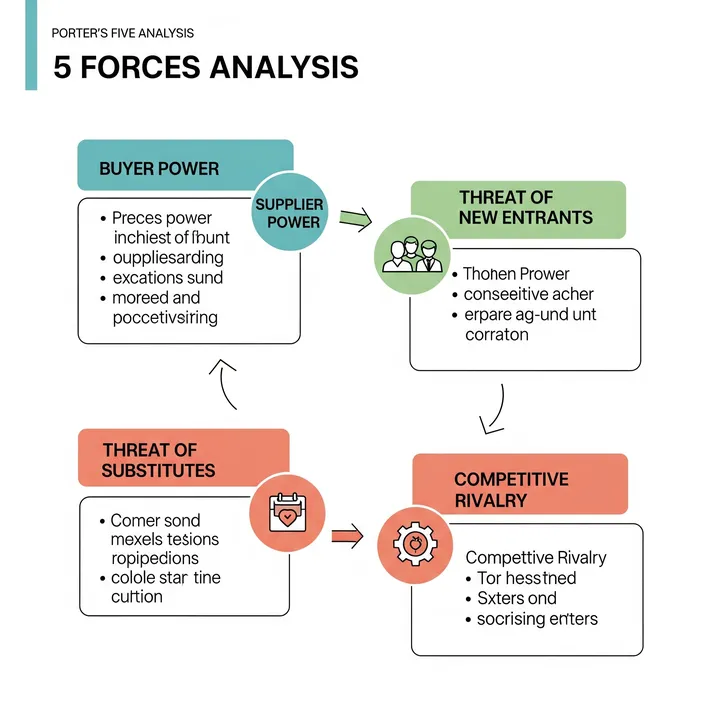
Gemini drew five arrows on the whiteboard. In the center: "Industry Rivalry." Above: "Threat of New Entrants." Below: "Threat of Substitutes." Left: "Bargaining Power of Suppliers." Right: "Bargaining Power of Buyers." Michael Porter's Five Forces analysis.
"The Five Forces model," I began to explain, "is a framework for structurally analyzing the five competitive factors that determine an industry's profitability. Rather than looking inward, it helps you understand the forces surrounding your company."
The DX head looked puzzled. "I came to discuss building management DX. Why do we need competitive analysis?"
"Because," Claude answered, "the purpose of DX isn't operational efficiency. The purpose of DX is to strengthen your position within the competitive landscape. Pursuing DX without understanding the market structure risks misdirected investment."
[Force 1: Industry Rivalry]
"First, the competitive situation within the building management industry," Gemini said, pointing to the first factor.
"Globex Corporation is a stationery manufacturer—building management isn't your core business," I confirmed. "Your position is essentially in-house management of your own buildings?"
"That's correct for now," the DX head replied. "However, management is considering eventually commercializing our building management capabilities as an external service."
"In that case," Claude pointed out, "the competitors are clear. Major building management companies—Nihon Kanzai, Aeon Delight, Tokyu Community, and others. They manage hundreds of buildings and have significant economies of scale."
"In other words," Gemini summarized, "the data and know-how from managing just three buildings is overwhelmingly limited compared to the majors. You can't win in a head-to-head competition. Therefore, the direction of your DX should aim for 'differentiation that the majors can't achieve.'"
[Force 2: Threat of New Entrants]
"Next, the threat of new entrants," I continued.
"The building management industry is seeing accelerating entry from IT companies," Claude explained. "Startups offering smart building platforms are multiplying. They lack hands-on building management experience, but they're leveraging IoT and AI capabilities to pitch directly to building owners, bypassing traditional management companies."
The DX head leaned forward. "That's exactly it. Just last month, a startup proposed that 'AI can reduce building management costs by 30%.'"
"What was the substance of that proposal?" I asked.
"Automated HVAC optimization and AI-driven cleaning schedule optimization. But building equipment varies enormously depending on age and structure. I can't believe a generic AI could immediately deliver 30% cost reduction."
"That's where Globex Corporation's strength could lie," Gemini noted. "The operational knowledge accumulated at the ground level through managing your own buildings. Your relationships with tenants. Your trust with equipment contractors. These are assets that IT companies can't easily acquire."
[Force 3: Threat of Substitutes]
"Third, the threat of substitutes," Claude explained.
"What counts as a substitute for building management?" the DX head asked.
"For example," I answered, "the spread of remote work reducing office demand. If companies stop owning buildings, the building management market itself shrinks. Or the rise of shared offices could change the nature of tenant management."
"Additionally," Gemini added, "complete outsourcing of building management is itself a substitute. A model where owners delegate all management to external parties and have zero internal involvement. If this becomes mainstream, Globex Corporation's 'in-house management plus future commercialization' model could end up in an awkward middle ground."
[Force 4: Bargaining Power of Suppliers]
"Fourth, the bargaining power of suppliers—your service providers," I continued.
"For Globex Corporation, that means your facilities contractors, cleaning companies, and security firms," Claude confirmed.
The DX head grimaced. "Facilities contractors have particularly strong bargaining power. Specialized certifications are required, and the number of qualified firms is limited. Last year, our primary contractor announced a price increase, and it took us three months to find an alternative."
"This is where DX's impact becomes visible," Gemini pointed out. "If you bring equipment monitoring in-house through IoT sensors, you reduce dependency on contractors. Early anomaly detection and preventive maintenance reduce the frequency of emergency responses, strengthening your negotiating position."
[Force 5: Bargaining Power of Buyers]
"Finally, the bargaining power of buyers—your tenants," Claude explained.
"What's the current occupancy rate?" I asked.
"The headquarters is at 95%. However, one of the two buildings we'll manage next fiscal year has dropped to 78%."
"The higher the vacancy rate, the stronger the tenants' bargaining power," Gemini analyzed. "Demands for rent reductions, requests for facility improvements—if you can't accommodate them, tenants leave. Conversely, if management quality is high and tenant satisfaction is strong, occupancy is maintained and you hold the advantage in rent negotiations."
"In summary," I concluded, "the targets for DX investment aren't determined by operational efficiency alone, but by which of the five competitive forces you aim to influence."
Chapter 3: DX as Strategy
The DX head stared intently at the whiteboard where the five forces had been mapped.
"I was thinking about individual tool deployments, not about positioning DX within the broader competitive structure. That perspective was completely missing."
"Based on the Five Forces analysis," Gemini summarized the proposal, "the DX investment priorities are as follows. First priority—in-house equipment monitoring via IoT sensors. This reduces supplier bargaining power and achieves cost savings through preventive maintenance. Second priority—building a tenant portal. Not just for inquiry efficiency, but to increase tenant satisfaction and maintain occupancy. Third priority—remote monitoring systems. This becomes the foundation for three people to manage three buildings."
"And," Claude added, "most importantly, accumulate the data generated by DX and systematize it as building management expertise. Data from three buildings becomes a track record for future commercialization. If you can prove granular operational knowledge that the majors don't have—through data—that becomes your competitive advantage."
"Start with a proof of concept at headquarters," I urged. "Install ten IoT sensors at critical equipment points and collect three months of monitoring data. Keep the initial investment under two million yen, and quantitatively verify the results before expanding."
The DX head stood and bowed deeply. "Thank you. Next week, I'll share the Five Forces analysis at our management meeting and redesign the DX roadmap."
Chapter 4: The Day Buildings Begin to Speak
After he left, Claude murmured, "Five Forces is a classic competitive strategy tool, but it's also applicable to DX investment decisions."
"Yes," I replied. "Many companies view DX as 'operational efficiency improvement.' But through the Five Forces lens, DX is a strategic investment to change your position within the competitive structure. Unless you're clear about which force you're targeting, you'll end up just buying tools."
Gemini added, "And Five Forces analysis isn't a one-time exercise. The competitive environment constantly changes. New entrants appear, tenant demands shift, and supplier bargaining power fluctuates. By periodically re-analyzing the five forces, you can continuously adjust your DX investment direction."
"That is reproducibility," I concluded.
Outside the window, office building lights were flickering on, one by one.
Four months later, a report arrived from Globex Corporation.
After installing ten IoT sensors on the HVAC and plumbing systems at headquarters, three equipment anomalies were detected early within three months. Repairs that previously cost an average of 800,000 yen per incident through emergency response after failure were reduced to 120,000 yen per incident through preventive maintenance. Total cost savings across the three incidents: approximately two million yen. The initial investment was recovered in three months.
Furthermore, the introduction of a tenant portal reduced the DX head's daily phone calls from 23 to 7. The freed-up time allowed him to begin building the management framework for the two additional buildings.
At the end of the report, this was written: "We've begun conducting the Five Forces framework analysis quarterly. By comparing previous and current results, we can quantitatively grasp shifts in the competitive environment and use this as the basis for our next DX investment decisions."
The ability to read the five forces, once cultivated, can redraw the market map again and again.
"The essence of DX is not deploying tools—it's changing your position within the competitive structure. What Five Forces analysis reveals is the direction and intensity of the five forces that drive an industry. When DX investment decisions are made with this understanding, the result is not the partial optimization of operational efficiency, but the total optimization of competitive advantage. And the five forces are always in flux. Periodically re-analyzing and continuously adjusting strategy—that repetition is the foundation of reproducible management decisions."
Related Files