ROI Case File No.425 'The Vein of Gold Hidden Beneath a Mountain of Paper'

The Vein of Gold Hidden Beneath a Mountain of Paper
Chapter 1: The Machine That Can't Read
"The OCR accuracy is 62%."
The head of Globex Corporation's Business Reform Office placed three types of documents on the desk. Purchase orders, delivery slips, and invoices. All of them had arrived on paper.
"We're a specialized trading company for industrial components. We deal with 280 suppliers and 450 customers. The total number of documents arriving each month is approximately 4,800. Our accounting team of five enters them into the system manually."
The office head punched numbers into a calculator.
"Average input time per document is four minutes. At 4,800 documents, that's 320 hours per month. Per accounting staff member, that's 64 hours—roughly 40% of monthly working hours consumed by transcribing documents."
"That's 3,840 hours per year," I calculated. "In labor costs?"
"At 2,500 yen per hour, approximately 9.6 million yen annually."
That figure was equivalent to one accounting employee's annual salary.
"Six months ago, we ran an OCR pilot," the office head continued. "The results were dismal. Purchase order accuracy: 78%. Delivery slips: 65%. Invoices: 43%. The overall average was 62%."
"A 38% misread rate means," Claude pointed out, "38% of 4,800 documents—roughly 1,800—still need human review and correction."
"Exactly. Even after introducing OCR, verification work was still required, and labor hours barely decreased. In fact, the task of cross-referencing OCR output against originals increased the workload, and for some documents it took longer than manual entry."
The office head's expression was a mix of disappointment and urgency.
"Management has directed us to 'achieve operational efficiency through OCR.' But if accuracy doesn't improve, implementation is pointless. On the other hand, high-accuracy OCR solutions cost over eight million yen upfront. Six months have passed with no investment decision made."
This wasn't a technology problem. Treating all 4,800 documents as a single mass was clouding the judgment.
Chapter 2: Sorting Documents into Four Quadrants
"Aren't you trying to treat all 4,800 documents the same way?"
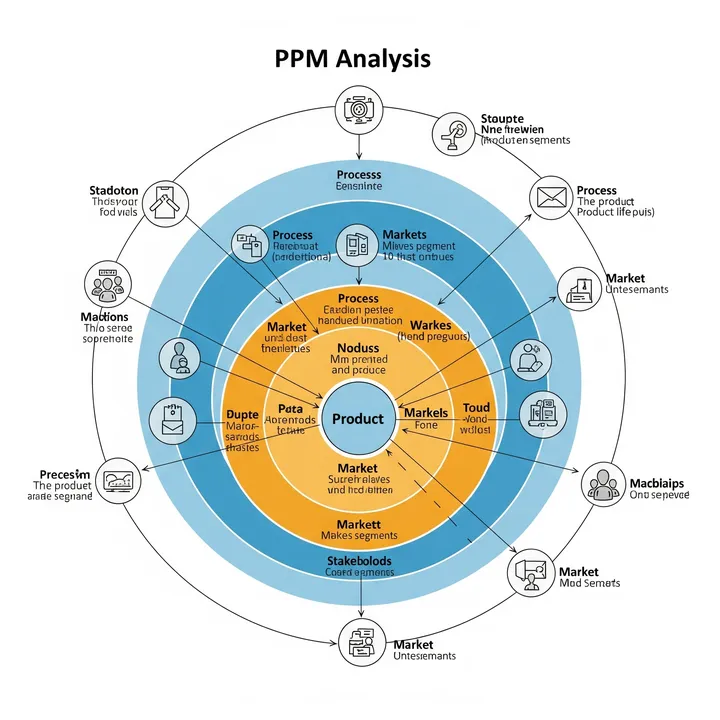
Gemini drew a two-axis chart on the whiteboard. The vertical axis labeled "Market Growth Rate," the horizontal axis "Relative Market Share." The four quadrants read "Stars," "Cash Cows," "Question Marks," and "Dogs." PPM—Product Portfolio Management.
"PPM," I began to explain, "is a framework developed by the Boston Consulting Group for optimizing resource allocation across businesses or products. It's traditionally used for business portfolio analysis, but today we'll apply it to a 'document portfolio.'"
The office head tilted his head. "You're applying portfolio analysis to documents?"
"Yes," Claude answered. "You can't make decisions because you're looking at 4,800 documents as a single block. Classify documents by type and map each one based on 'automation improvement potential' and 'current processing efficiency' across four quadrants. Then it becomes clear which documents should receive OCR investment first."
[Vertical Axis: Improvement Potential Through Automation]
"We'll define the vertical axis as 'improvement potential through automation,'" Gemini explained. "In other words, how much labor reduction can be expected if OCR is introduced."
"What determines the improvement potential?" the office head asked.
"Three factors," I answered. "First, document volume. The higher, the greater the improvement potential. Second, the number of input fields per document. More fields mean higher automation impact. Third, frequency of input errors. Documents with more errors have greater room for quality improvement through automation."
"Then, please give us the breakdown for each document type," Claude prompted.
The office head read out the data. "Monthly breakdown: purchase orders at 1,200 documents with an average of 8 input fields. Delivery slips at 2,000 documents with an average of 5 fields. Invoices at 1,100 documents with an average of 12 fields. Other documents at 500 with varying field counts."
"And the error frequency?"
"Invoices are the highest, with approximately 45 errors per month. Most are transcription errors in amounts. Purchase orders have about 20 per month, delivery slips about 12."
[Horizontal Axis: Current OCR Accuracy]
"We'll define the horizontal axis as 'current OCR reading accuracy,'" Gemini continued. "That is, how accurately can existing OCR technology read them."
"From the earlier pilot results," Claude organized, "purchase orders were at 78%, delivery slips at 65%, and invoices at 43%. What causes this accuracy gap?"
The office head explained. "Purchase orders use our standardized format, so the layout is uniform. But delivery slips come from 280 suppliers, each using their own format. As for invoices, some are even handwritten."
"Format standardization determines accuracy," I confirmed.
"Precisely."
[Placing Documents in the Four Quadrants]
Gemini began positioning each document type on the chart.
"Upper right, 'Stars'—high improvement potential and high current accuracy. This is purchase orders. 1,200 documents, 78% accuracy, standardized format. The top priority target for OCR investment."
"Upper left, 'Question Marks'—high improvement potential but low accuracy. Invoices fall here. 1,100 documents with the highest field count at 12 and the highest error frequency. But at 43% accuracy, deploying OCR as-is won't deliver results."
"Lower right, 'Cash Cows'—moderate improvement potential with decent accuracy. No clear match. None of the current document types fit this quadrant definitively."
"Lower left, 'Dogs'—low improvement potential and low accuracy. The 500 miscellaneous documents land here. Low volume, inconsistent formats. The lowest return on automation investment."
"And," Claude highlighted a critical finding, "delivery slips sit right on the boundary between the upper right and upper left. They have the largest volume at 2,000, but accuracy is at 65%. If format standardization is pursued, they have the potential to move into the Stars quadrant."
The office head's expression shifted. "So rather than applying OCR uniformly to all documents, the strategy should differ by document type."
"Exactly," I replied.
Chapter 3: Designing Resource Allocation
"Now let's develop a concrete investment plan based on the PPM analysis," Gemini proposed.
"For the Star—purchase orders," I explained, "the existing OCR solution achieves 78% accuracy. Since the format is standardized, preparing AI training data is straightforward. With an additional investment of 1.2 million yen for customization, accuracy above 95% is achievable."
"For the Question Mark—invoices," Claude continued, "the 43% accuracy stems from format diversity. Before trying to improve OCR accuracy, request format standardization from suppliers. Covering all 280 may be difficult, but the top 50 by transaction value should cover approximately 70% of all invoices."
The office head nodded. "Indeed, the top 50 suppliers account for 72% of our transaction value."
"Request format standardization from those 50, then remeasure OCR accuracy after three months. This is the process for converting the Question Mark into a Star," Gemini outlined.
"For the Dog—the 500 miscellaneous documents," I concluded, "continue with manual entry for now. The volume is too low to justify automation investment. However, keep recording the data in case volumes increase in the future."
"As for delivery slips," Claude added, "first establish a success track record with purchase order OCR, then apply that know-how laterally. The purchase order success story also serves as evidence when negotiating format standardization."
The office head confirmed. "So the investment sequence is: purchase orders → invoice format standardization → invoice OCR → delivery slips."
"What's critical," I emphasized, "is running the purchase order OCR as a three-month pilot, quantitatively measuring accuracy and labor reduction. Those numbers become the basis for the next investment decision. The quadrant positions in PPM aren't fixed—they should be periodically reviewed based on data."
Chapter 4: A Map of the Paper Mountain
The office head gazed at the document portfolio mapped across the four quadrants.
"I was lumping all 4,800 documents together and lamenting that 'OCR accuracy is too low.' But when you break it down by document type, it's clear which ones can yield immediate results and which require preparation."
"The essence of PPM," I replied, "is concentrating limited resources where they'll have the greatest effect. Trying to do everything simultaneously means nothing gets done properly. Prioritize, tackle them in sequence. PPM is the map for determining that sequence."
Claude added quietly, "And that map isn't drawn just once. When purchase order OCR succeeds, the delivery slip's quadrant position shifts. When invoice format standardization progresses, the Question Mark moves to Stars. PPM is a dynamic resource allocation tool."
The office head stood and bowed deeply. "Thank you. We'll start the purchase order OCR pilot next month."
After he left, Gemini murmured, "Applying PPM to document management is a fascinating approach."
"Yes," I replied. "PPM's range of application is broad. Whether for businesses, products, documents, or tasks—whenever resource allocation decisions are needed, the approach of classifying along two axes and prioritizing across four quadrants applies. The true value of a framework lies not in a specific domain, but in its reproducibility as a way of thinking."
Outside the window, a delivery worker was wheeling a dolly stacked with cardboard boxes. Inside those boxes, surely, were documents someone would enter by hand.
Four months later, a report arrived from Globex Corporation.
The OCR pilot for 1,200 purchase orders achieved 96.2% accuracy. Monthly input labor for purchase orders alone dropped from 53 hours to 4 hours. Annualized, that's approximately 590 hours saved, or about 1.48 million yen in labor costs. The 1.2-million-yen initial investment was projected to be recovered within ten months.
Simultaneously, format standardization negotiations had begun with the top 50 suppliers by transaction value. Presenting the purchase order OCR results with concrete figures served as persuasive evidence, and within three months, 38 companies agreed to adopt the standardized format.
The office head wrote in the report: "We update the PPM quadrants at our monthly process improvement meetings. Now that purchase orders have stabilized from Stars to Cash Cows, the next stage is moving invoices from Question Marks to Stars. Having the document portfolio map means the entire team shares a clear view of 'what to do next.'"
A mountain of paper, when decomposed, reveals the order of attack. And the map that draws that order can be redrawn as many times as needed.
"Try to solve everything at once, and nothing gets done. What PPM teaches is to classify targets along two axes and identify where to concentrate resources. And one success shifts the next quadrant, generating the next success. Designing this chain and periodically reviewing the portfolio—that is the true nature of reproducibility in resource allocation."
Related Files