ROI Case File No.426 'The Trail of the Missing Invoice'

The Trail of the Missing Invoice
Chapter 1: The Day the Mailbox Overflows
"Every month on the 25th, the accounting department's desks disappear under paper."
The accounting director of Globex Corporation lifted a cardboard box. Inside, unopened envelopes were packed tight.
"We're a wholesale distributor of construction materials. We have 320 suppliers and 580 customers. The total number of invoices per month is approximately 1,400 issued and 1,800 received. That's 3,200 invoices exchanged on paper."
The director opened one of the envelopes. Out came an A4 invoice and a copy of a delivery slip.
"Seventy percent of what we issue is sent by postal mail. The remaining 30% is sent as PDFs by email. For received invoices, 80% arrive by mail. Printing, stuffing envelopes, affixing stamps, mailing—this work alone consumes 40 hours per month."
"What are the mailing costs?" I asked.
"Per letter: 84 yen for postage, 8 yen for the envelope, 5 yen for printing. With roughly 980 outgoing letters per month, that's about 95,000 yen monthly. Approximately 1.14 million yen annually. But the labor hours are a more serious problem than the cost."
The director produced another document—a monthly task breakdown for the six-person accounting team.
"Invoice issuance—printing, verification, envelope stuffing, mailing—takes 96 hours per month. Opening received invoices, sorting, and entering them into the system takes 120 hours per month. That's 216 hours total. Roughly 22% of the accounting department's total working hours vanishes into the physical processing of invoices."
"That's 2,592 hours per year," Gemini calculated. "Approximately 6.5 million yen in labor costs."
"The CEO is aware of this problem," the director continued. "But when it comes to digitization, we don't know where to start. Asking all business partners to switch to digital at once isn't realistic, and we have almost no experience with system implementations."
"Are any of your partners already using electronic invoicing?" Claude asked.
"Some are. A few of our larger suppliers send invoices as PDFs. But the majority are still on paper. Smaller regional suppliers in particular say, 'We're not good with computers,' and decline."
This was a classic case where trying to treat all partners uniformly was paralyzing action.
Chapter 2: Viewing Partners Through Three Axes
"Aren't you treating all 900 business partners as one group?"
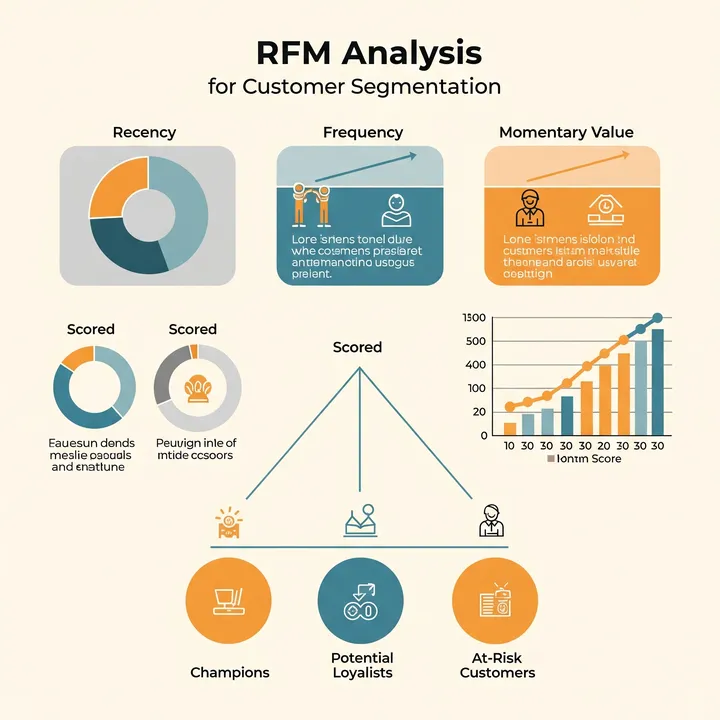
Gemini drew three axes on the whiteboard. R, F, M—Recency, Frequency, Monetary. The RFM model.
"The RFM model," I began to explain, "is a segmentation method that classifies customers along three axes. R—Recency: how recently a transaction occurred. The more recent, the higher the score. F—Frequency: how often transactions occur. The more frequent, the higher the score. M—Monetary: transaction value. The larger, the higher the score."
"It's traditionally used for customer loyalty analysis," Claude continued, "but today we'll apply it to prioritize invoice digitization. Rather than digitizing all partners at once, we'll use RFM scores to migrate the highest-impact partners first, in stages."
The director showed interest. "The effect of digitization differs depending on the partner?"
"Significantly," I answered. "Digitizing a small supplier you transact with once a month saves minimal labor. But digitizing a key supplier you transact with weekly, with monthly invoicing exceeding five million yen, delivers an impact of a completely different magnitude."
[R (Recency): Recent Transaction Activity]
"First, we classify by the R axis—recent transaction activity," Gemini explained.
"Let's designate partners with transactions within the past three months as A, within six months as B, and beyond that as C," Claude proposed.
The director checked the data. "A is approximately 620 companies, B about 180, and C about 100."
"The 100 in category C," I pointed out, "haven't had a transaction in over six months. Digitizing invoices for these partners is the lowest priority. There are virtually no invoices being exchanged with them."
"True—there's no point asking dormant partners to go digital," the director agreed.
[F (Frequency): Transaction Frequency]
"Next, the F axis—transaction frequency," I continued.
"We'll classify partners with four or more transactions per month as high frequency, one to three as medium frequency, and below that as low frequency," Gemini defined.
The director worked through the spreadsheet. "High frequency: approximately 85 companies. Medium frequency: approximately 340. Low frequency: approximately 475."
"For just those 85 high-frequency partners," Claude calculated, "how many invoices per month are we talking about?"
"Issued and received combined, approximately 1,600. That means half of all invoices are covered by 85 companies—about 9% of all partners."
"A textbook Pareto distribution," Gemini remarked. "But the RFM model allows for even more precise classification."
[M (Monetary): Transaction Value]
"Finally, the M axis—transaction value," Claude explained.
"Let's define monthly transactions above one million yen as large, 300,000 to one million as medium, and below 300,000 as small," I proposed.
The director pulled the data instantly. "Large: approximately 60 companies. Medium: approximately 210. Small: approximately 630. The 60 large partners account for approximately 820 million yen in monthly transactions—76% of the total."
"Let's integrate the analysis so far," Gemini organized on the whiteboard.
[Segmentation by RFM Score]
"Combining the three axes clearly segments your business partners," I explained.
"Top priority segment—R: A, F: High frequency, M: Large. Partners with recent transactions, frequent invoicing, and high value. Approximately 45 companies qualify. These 45 alone cover roughly 40% of monthly invoice volume and approximately 65% of transaction value."
"Second priority segment—R: A, F: Medium frequency, M: Medium or above. Partners with recent transactions generating one to three invoices per month at mid-scale. Approximately 130 companies," Claude continued.
"Third priority and below—everyone else. Low volume, low value, and limited return on digitization investment," Gemini summarized.
The director looked astonished. "Focusing on just 45 companies covers 40% of invoices? I was overwhelmed because I thought we had to address all 900 at once."
"That's the power of the RFM model," I replied. "You don't need to treat everyone equally. Start with the segment that delivers the greatest impact, establish a success pattern, and then expand to the next."
Chapter 3: Designing the Migration
"So how do we proceed with digitization for the top 45 partners?" the director leaned forward.
"We'll proceed in three steps," Gemini proposed.
"Step one—assess the current status of the 45 partners. Classify them into those already capable of PDF exchange, those with electronic invoicing systems in place, and those still paper-only. Switching the already-capable partners first minimizes negotiation costs."
"Step two," Claude continued. "Select an electronic invoicing platform. At the scale of 45 partners, a cloud service costing 20,000 to 30,000 yen per month is sufficient. The key is minimizing the burden on the partner side. Choose a service that requires no dedicated software installation and can be operated from a browser."
"Step three," I added. "A three-month pilot operation. Start with the ten most cooperative of the 45 partners. Quantitatively record labor hours before and after digitization, and make the results visible. Those numbers become the persuasion material for the remaining 35."
"What if partners resist digitization?" the director expressed concern.
"Partners with high RFM scores are important to you—but you're also an important partner to them," Gemini pointed out. "The strength of the relationship forms the foundation for negotiation. But don't force it. Set up a parallel operation period with both paper and digital, and transition gradually."
"And," Claude added, "the data from the pilot isn't just for expanding to the second-priority 130 companies—it's also for reporting to management. 'Digitizing 45 partners saved X hours per month and Y yen in annual costs'—that track record becomes the justification for company-wide digitization."
Chapter 4: The Day the Envelopes Disappear
The director gazed at the cardboard box on the desk.
"I assumed we had to digitize all 900 partners at once. But with RFM classification, starting with just 45 delivers 40% of the impact. I never had that perspective."
"The essence of the RFM model," I replied, "is not treating everything equally. Customers, partners, tasks—their importance is not uniform. Classify along three axes, concentrate resources on the highest-impact segment, and then replicate the success pattern across subsequent segments."
Claude added quietly, "And RFM scores aren't fixed. Relationships with partners constantly change. New partners grow into major accounts; existing major accounts scale down. By periodically updating the RFM analysis, optimal priorities remain visible at all times."
The director stood and bowed deeply. "Thank you. Next month, we'll begin with a status survey of the top 45 partners."
After he left, Gemini remarked, "The RFM model has broad applications well beyond marketing."
"Yes," I answered. "What RFM's three axes teach is a principle of prioritization: 'Start with partners you've had recent contact with, who you interact with frequently, and whose scale is significant.' This applies not just to customer analysis, but to process improvement, sales strategy, and any scenario. Classify along three axes, then repeat the cycle of concentration and lateral expansion—anyone who holds this pattern can see where to start on any challenge. That is reproducibility."
Outside the window, a mail carrier was pushing envelopes into the neighboring building's mailbox.
Four months later, a report arrived from Globex Corporation.
Of the top-priority 45 partners, invoice digitization had been completed with 38. Monthly invoice processing labor for the affected scope dropped from 86 hours to 11 hours. Annualized, that's 900 hours saved—approximately 2.25 million yen in labor costs. After deducting the 360,000 yen annual platform fee, the net savings were approximately 1.89 million yen per year.
An even more interesting ripple effect had emerged. Of the 38 partners who completed digitization, 12 proactively suggested digitizing delivery slips as well. "Since invoicing got easier, we'd like to go digital with delivery slips too"—the digitization experience had prompted behavioral change on the partner side.
The director wrote in the report: "We update the RFM analysis quarterly. Each time new partners are added, we calculate their scores and automatically determine digitization priority. We're now entering the rollout phase for the second-priority 130 partners."
A mountain of 900 companies, when you start chipping away at 45, begins to crumble on its own. The three axes that locate the starting point were a surveying tool that could be used again and again.
"Try to change everything at once, and nothing changes. What the RFM model reveals is finding the single most effective point and concentrating there. Recency, Frequency, Monetary—classify targets along three axes and establish a success pattern in the top-priority segment. That success moves the next segment, and eventually the whole transforms. Classify, concentrate, expand laterally—as long as this sequence can be repeated, a reproducible path can be charted for transformation of any scale."
Related Files