ROI Case File No.427 'The Eye That Counts, the Eye That Doesn't'

The Eye That Counts, the Eye That Doesn't
Chapter 1: The Limits of the Human Eye
"Every day, human eyes count. One, two, three—8,000 pieces a day."
The production manager at TechGlobal played a factory line video on his tablet. Small metal components streamed one after another down a conveyor belt. Beside it stood a worker holding a counter.
"We manufacture precision components for automobiles. Eighty-five employees, approximately 1.2 billion yen in annual revenue. Our flagship product is an 8-millimeter bearing ball, with daily output of roughly 8,000 units. Workers count them visually and record the numbers on handwritten tally sheets."
The production manager showed us the sheets. Handwritten numbers lined the columns. Here and there, traces of correction fluid were visible.
"There are three problems," he said, counting on his fingers. "First, counting errors. Visual counting with manual tallying produces an average deviation of 1.2% per day. That's 96 out of 8,000. Over a month, approximately 2,000 units' worth of data is unreliable."
"That's roughly 24,000 units of deviation per year," I confirmed.
"Yes. Inventory data and actual counts don't match, and every inventory audit requires three days of discrepancy investigation. The second problem is the lack of real-time visibility. Production numbers are entered into the system only after being written on tally sheets and batch-uploaded in the evening. No one knows the exact inventory count at any given moment."
"And the third?" Claude prompted.
"Workforce availability. Counting is simple work, but it requires maintaining focus while standing for eight hours straight. Young people don't apply for this job. Our current counting staff average 58 years of age. Within five years, all of them will reach retirement."
The production manager closed his tablet.
"That's why we want to introduce IoT sensors to automate production counting. A vendor has proposed a package of photoelectric sensors and a cloud dashboard at 3.5 million yen upfront, plus 80,000 yen monthly in operating costs."
"What's making you hesitate?" I asked.
"The CEO's question. 'If all we're doing is installing sensors, can't competitors copy it immediately? Is that worth 3.5 million yen?'"
It was the right question. The case wasn't about technology adoption itself—it was about whether that technology would create competitive advantage, questioning the essence of the investment as a management resource.
Chapter 2: Four Questions
"Let's answer the CEO's question head-on."
Gemini wrote four letters on the whiteboard. V, R, I, O.
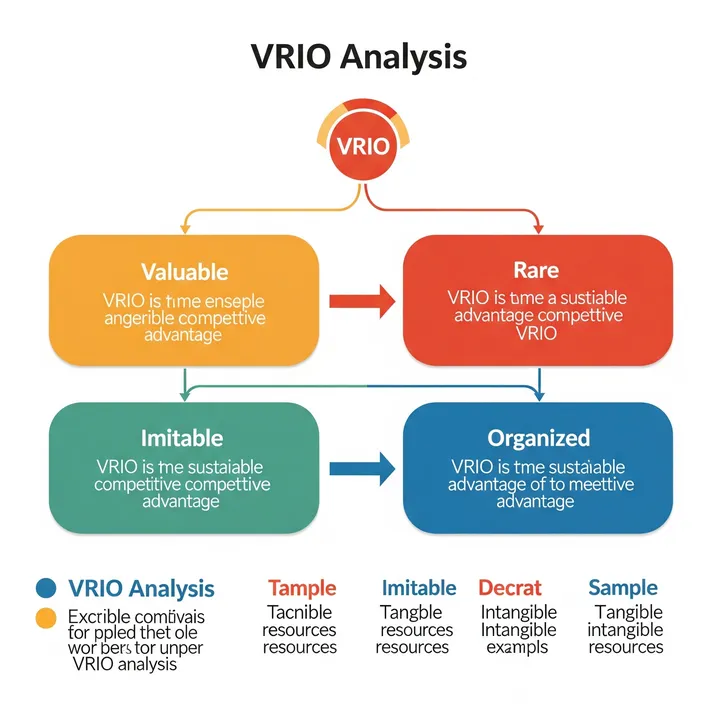
"The VRIO model," I began to explain, "is a framework that tests whether a management resource can deliver sustained competitive advantage through four questions. Value—is the resource valuable? Rarity—is it rare? Imitability—is it difficult to imitate? Organization—does the company have the structure to exploit it?"
"If all four answers are Yes, you have a sustained competitive advantage," Claude added. "If even one is No, the investment direction needs reconsideration."
The production manager braced himself. "Sounds like a tough analysis."
"It's for making an accurate judgment," I replied. "Before investing 3.5 million yen, let's verify what this investment will actually deliver, from four perspectives."
[Value: Is the Resource Valuable?]
"The first question, Value—does automated counting through IoT sensors deliver value to TechGlobal?" Gemini posed.
"Let's quantify the value," I organized. "First, eliminating counting errors. If the annual 24,000-unit deviation drops to zero, twelve days of inventory discrepancy investigation per year—three days times four audits—are eliminated. That's approximately 360,000 yen in labor costs."
"Next, real-time inventory visibility," Claude continued. "If accurate inventory can be reported instantly upon receiving an order, delivery accuracy improves. Currently, delays in inventory confirmation cause an average of three rush-order responses per month. The cost per emergency response is?"
"About 80,000 yen, including overtime and express shipping," the production manager answered.
"That's approximately 2.88 million yen per year," Gemini calculated. "Additionally, there's the labor cost of the counting staff. Two full-time employees with combined annual labor costs of approximately 6.4 million yen. If sensor implementation allows these two to be reassigned to other processes, it directly increases production capacity."
"Inventory audit labor at 360,000 yen, emergency responses at 2.88 million yen, workforce optimization—Value is clearly Yes," I concluded.
[Rarity: Is the Resource Rare?]
"The second question, Rarity—is this technology rare?" Claude asked.
Here, the production manager's expression clouded. "Honestly, photoelectric sensors and cloud dashboards are both commodity technologies. Competitors could adopt them whenever they want."
"You're correct," Gemini acknowledged. "The sensor technology itself has no rarity. Rarity is, at this point, No."
"Then is there no point in investing?" the production manager asked anxiously.
"Not at all," I shook my head. "The VRIO model doesn't say that all four must be Yes or the investment is worthless. A resource with low Rarity won't deliver sustained competitive advantage, but it does become a minimum requirement for competition—what's called 'competitive parity.'"
"In other words," Claude elaborated, "if you don't adopt sensors, TechGlobal falls behind the moment competitors do. Adopting them at least puts you on the same playing field. The next question is how to create rarity on top of that."
[Imitability: Is the Resource Difficult to Imitate?]
"The third question, Imitability—difficulty of imitation," I continued. "The sensors themselves are easy to copy. But what about the way the data they generate is utilized?"
Gemini hit the core point. "This is the fork in the road. Just attaching sensors makes you the same as competitors. But the ability to analyze accumulated data and apply it to production process improvement—that's not easily replicated."
"Specifically," Claude explained, "accumulating production data from 8,000 units per day over one year yields approximately 2.9 million data points. Variations in production speed by time of day, defect rate changes due to temperature and humidity, correlations between equipment maintenance cycles and production efficiency—the analytical know-how derived from this data can only be generated by companies that possess the data."
"In summary," I organized, "imitability doesn't exist in the sensors as 'hardware.' But it can emerge in the 'software-like capability' of data accumulation and analysis. However, this isn't something you acquire the moment you install sensors—it's built over time. Imitability is currently No. But there's potential to change it to Yes in the future."
[Organization: Is the Organizational Structure in Place?]
"The final question, Organization—is there an organizational structure to leverage the data?" Gemini asked.
The production manager answered honestly. "We don't have any data analysis specialists. IT systems management is handled part-time by one person in general affairs."
"This is the biggest challenge," I pointed out. "No matter how excellent the sensors, if there's no organizational capability to interpret data and translate it into improvement actions, the investment won't pay off."
"However," Claude added, "a company of 85 people doesn't need to hire a data scientist right away. What's needed first is a habit where you, the production manager, check the dashboard every day and record what you notice."
"Start small," Gemini suggested. "For the first three months, check the dashboard numbers every morning and investigate the cause when you spot anomalies. That alone is sufficient. Advanced data analysis methods can be learned after you've mastered reading the basic numbers."
Chapter 3: The Path to Competitive Advantage
The production manager studied the results of the four questions.
"Value—Yes. Rarity—No. Imitability—currently No, with potential for future Yes. Organization—No, but can be built incrementally. An honest result."
"Even when not all VRIO answers are Yes," I replied, "it doesn't mean you shouldn't invest. What matters is accurately understanding your current position and mapping out which elements to strengthen to move toward competitive advantage."
"Concretely," Gemini summarized the proposal, "Phase 1—sensor installation and data accumulation. Initial investment: 3.5 million yen. Start by installing on one production line and establishing basic data utilization practices over three months."
"Phase 2," Claude continued. "Begin analyzing accumulated data. Aim to identify at least three production efficiency improvement patterns by the six-month mark. At this stage, engaging an external data analysis consultant on a short-term basis could also be effective."
"Phase 3," I concluded. "Embed data utilization know-how into the organization. By one year, the goal is for sensor-data-driven production improvement to be part of daily operations. At that point, Imitability definitively becomes Yes. Even if competitors install sensors, they can't catch up to a year's worth of data and proven improvements."
"Frame your report to the CEO this way," I advised. "'Sensor installation alone doesn't create competitive advantage. But by incrementally building data accumulation and utilization capabilities, it can be transformed into a difficult-to-imitate competitive advantage within one year. The 3.5 million yen is not an investment in sensors—it's the first step toward data-driven management.'"
The production manager stood and bowed deeply. "Thank you. Next week, I'll present the VRIO analysis results and roadmap to the CEO."
Chapter 4: The Day Data Becomes Eyes
After he left, Claude murmured, "VRIO's four questions structure what executives sense intuitively. The CEO's feeling that 'competitors could copy this immediately' was an instinctive concern about Rarity and Imitability."
"Yes," I replied. "VRIO's value isn't in the Yes-or-No verdicts themselves—it's in clarifying which elements are No, and what's needed to turn them into Yes. Accurately knowing your current weaknesses sets the direction for investment. And these four questions can be applied repeatedly as technology evolves and the competitive environment changes. Continuously posing the same questions to your own company—that is reproducibility in evaluating management resources."
Outside the window, trucks in the industrial park were loading components.
Five months later, a report arrived from TechGlobal.
Installing photoelectric sensors on one line raised counting accuracy to 99.7%. Monthly inventory discrepancies dropped to zero, and emergency responses fell from three per month to 0.5. One worker previously dedicated to counting was reassigned to the inspection process, reducing the defective product outflow rate from 1.8% to 0.6%.
And the most important change was in the production manager's behavior. The habit of checking the dashboard at 8 AM every morning took hold, and in the third month, he made a discovery: "Production speed drops 3% every Thursday afternoon." Investigating the cause, he found that the belt tension setting shifted slightly after Wednesday night maintenance. That single adjustment alone increased weekly production by approximately 240 units.
The CEO wrote in the company newsletter: "Sensors are eyes. But the ability to interpret what those eyes see exists only within people. We are currently cultivating that ability."
VRIO's four questions illuminated not just the entry point for investment, but the growth trajectory itself.
"New technology doesn't deliver competitive advantage the moment it's installed. What the VRIO model asks is: does the technology have value, is it rare, is it difficult to imitate, and is there an organization to leverage it—these four questions. Even if not all are Yes, accurately identifying which are No and mapping a roadmap to turn them into Yes is what matters. And repeating the same four questions every time the environment changes—that repetition is the reproducible method for forging management resources into true competitive advantage."
Related Files