ROI Case File No.428 'The Silence Spoken by a Thousand Flyers'

The Silence Spoken by a Thousand Flyers
Chapter 1: The Copy-and-Paste Chain
"To create a single flyer, we enter the same number seven times."
The creative department manager at Globex Corporation pointed at an Adobe InDesign file open on screen. It was a promotional flyer for a consumer electronics retailer. Around a photograph of a refrigerator, product codes, prices, specs, and campaign details were meticulously arranged.
"We're the Japanese subsidiary of an overseas home appliance manufacturer. We produce promotional flyers, catalogs, and banner ads for retail chains and EC sites. We handle approximately 240 product models. Monthly output is about 80 flyers, 4 catalog editions, and roughly 200 banners. That's approximately 280 deliverables per month."
The manager walked through the workflow.
"Each flyer features an average of 12 products. For each product—model number, price, specs, JAN code—we copy each field one by one from the product database Excel and paste it into the InDesign template. Data entry for a single flyer takes about 45 minutes."
"At 280 deliverables per month," I calculated.
"Data entry alone consumes about 210 hours monthly. Roughly 33% of the four-person creative team's total working hours vanishes into copy-and-paste work that has nothing to do with creativity."
"How frequent are input errors?" Claude asked.
The manager grimaced. "About 15 per month on average. Price transcription errors are the most common, followed by spec value mistakes. Last month, we entered a refrigerator's capacity as '408L' instead of '480L' and had to reprint 5,000 copies. The reprint cost was approximately 350,000 yen."
"Annualized," Gemini calculated instantly, "if input errors cause roughly 180 reprints per year, at an average correction cost of 50,000 yen each, that's approximately 9 million yen in annual losses."
The manager nodded. "That's why we're considering implementing an RPA tool. We want to automatically feed product data from Excel into InDesign, eliminating both the copy-and-paste work and the errors."
"What's the RPA vendor's quote?" I asked.
"Initial development: 2.8 million yen. Monthly license: 120,000 yen. Annual total cost of roughly 4.24 million yen. Compared to the 9 million in losses from input errors, the ROI seems obvious."
"By the numbers alone, it does," I replied. "But before deciding on RPA implementation, there's something we should verify first."
The manager looked puzzled. "What's that?"
"Where this creative operation sits within the market."
Chapter 2: Three Perspectives
"RPA will solve the problem—that may be an oversimplification."
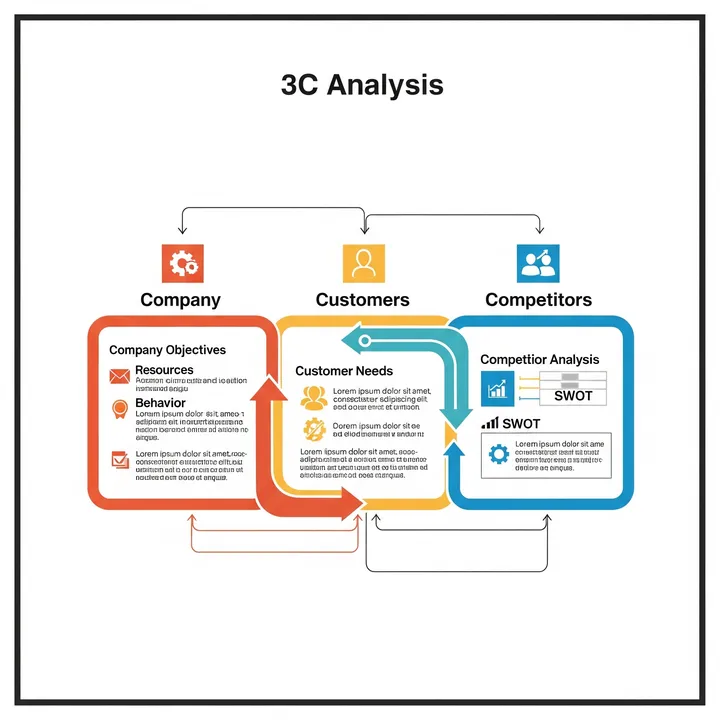
Gemini drew three circles on the whiteboard. Company, Customer, Competitor. The 3C model.
"The 3C model," I began to explain, "is a strategic analysis framework advocated by Kenichi Ohmae. Company, Customer, Competitor—by examining the business environment from these three perspectives simultaneously, you can determine strategic direction."
"Why does improving creative workflow efficiency require market analysis?" the manager asked.
"Because," Claude answered, "efficiency is a means, not an end. After RPA eliminates input time, what will you create with that freed-up time? To decide that, you need to understand what customers demand and what competitors are providing."
[Customer: What Do Customers Want?]
"First, Customer—the customer's perspective," Gemini said, pointing to the first circle.
"Who are the customers for Globex Corporation's creative output?" I asked.
"The direct clients are retail chain buyers and our own marketing department," the manager answered.
"What do those customers expect from flyers?" Claude probed deeper.
The manager thought for a moment. "Accurate product information and strict deadline adherence. Retail buyers in particular need flyers submitted by Wednesday for weekend sales, so they're extremely demanding about timelines."
"And what's the most common complaint from customers?" I asked.
"Data errors and slow correction turnaround. When a correction is requested for an input error, it takes an average of four hours. Buyers keep telling us, 'Can't you fix things faster?'"
"So," Gemini summarized, "what customers value most is 'accuracy' and 'response speed.' Before beautiful design or innovative layouts, they want zero errors first, and fast corrections second. Understanding this priority order is essential."
"One more thing," Claude said. "Are customer demands changing? Is there any difference between three years ago and now?"
The manager answered. "The biggest change is the increase in production volume. Three years ago it was about 150 deliverables per month; now it's 280. The surge in EC site banners is the main driver. But the creative team has stayed at four people."
"Production volume nearly doubled in three years, with no headcount change," I confirmed. "That means without increasing per-person productivity, either quality or deadlines will be sacrificed. Quality is already being sacrificed—in the form of input errors."
[Competitor: What Are Competitors Doing?]
"Next, Competitor—the competitive perspective," I continued.
"Who are the competitors in creative production?" the manager asked. "We're an in-house creative team, so we don't have direct competitors."
"Think about it on two levels," Claude explained. "First, external production agencies. If Globex Corporation were to outsource its creative work, who would take it on? And how far along are they with automation?"
"Second," Gemini added, "the in-house creative teams of competing appliance manufacturers. How they're streamlining creative operations indirectly affects Globex Corporation's competitiveness."
"Regarding external agencies," the manager answered, "we once requested quotes. A major agency had already implemented an automated typesetting system that directly links product databases to DTP software. Their per-flyer production cost was 20% lower than our in-house operation."
"That's critical information," I pointed out. "If outsourcing is cheaper than in-house production, management could switch to outsourcing if they pursue cost reduction. For the in-house team to survive, it needs to deliver value that external agencies can't."
The manager's expression shifted. "RPA implementation isn't just about efficiency—it's about the team's survival?"
"That awareness matters," Claude nodded.
[Company: What Are Your Strengths?]
"Finally, Company—your own perspective," Gemini said, pointing to the third circle.
"What are the in-house team's strengths? What can you do that external agencies can't?" I asked.
The manager thought carefully before answering. "Deep understanding of our own products. We know the features, target demographics, and competitive differentiators of all 240 models. That knowledge lets us create materials that capture the buyer's intent. When we outsource, every job requires extensive briefing, and the deliverables often miss the mark."
"There's another," Claude noted. "Response speed. Being in-house means you can act on urgent revision requests immediately. With external agencies, one correction typically takes a minimum of 24 hours."
"So," I integrated the three Cs, "Customer—customers prioritize accuracy and speed. Competitor—external agencies have a cost advantage but fall short on product knowledge and responsiveness. Company—in-house strengths are product expertise and agility. With these three factors in view, the strategic significance of RPA implementation becomes clear."
"If RPA automates data entry," Gemini concluded, "accuracy improves and customer complaints decrease. The 210 hours freed from input work can be redirected to product-knowledge-driven planning proposals. As a result, the cost gap with external agencies can be reversed through added value."
Chapter 3: What Lies Beyond Automation
The manager studied the diagram of three overlapping circles.
"I thought this was about making things easier with RPA. But analyzed through 3C, RPA isn't a 'tool to eliminate copy-and-paste'—it's a 'strategic investment staking the team's survival and competitiveness.'"
"The essence of the 3C model," I replied, "is placing yourself within the context of the market. Looking only at yourself leads to 'just improve efficiency' and stops there. But adding the customer and competitor perspectives reveals 'what to do after you've improved efficiency.'"
"As a concrete step," Claude proposed, "first implement RPA to automate data entry. Then use the freed-up time to begin planning proposals for retail buyers—store layout suggestions, seasonal promotional plans. This becomes in-house value that external agencies cannot provide."
"Start the pilot with the 80 monthly flyers, which have the highest production volume," Gemini added. "Over three months, record the reduction in input labor, changes in error counts, and how the freed-up time is utilized. These three data points become the basis for deciding on full-scale rollout."
The manager stood and bowed deeply. "Thank you. Next month, I'll submit the RPA pilot proposal to management. With the 3C analysis attached."
Chapter 4: Beyond the Flyer
After he left, Gemini said, "The 3C model can serve as the entry point for any decision."
"Yes," I replied. "Whether it's a tool implementation, a new business proposal, or an organizational restructuring—deciding by looking only at yourself makes it self-serving. What do customers want, what are competitors doing, and where do your strengths lie within that context? Posing these three questions simultaneously dramatically improves decision quality."
Claude added quietly, "And each element of the 3C is always in motion. Customer demands shift, competitors evolve, and your own strengths can become obsolete. If you make it a habit to review the three Cs even once every six months, you'll never fall behind market changes. That habit itself is reproducibility."
Outside the window, retail store signs were beginning to glow under neon lights.
Four months later, a report arrived from Globex Corporation.
The RPA pilot for 80 flyers reduced data entry labor from 60 hours to 3 hours per month. Input errors dropped to zero, and reprint costs during the pilot period were zero yen.
But the most significant change was beyond the numbers. Using the freed 57 hours, the creative team delivered "Seasonal Promotional Plan" proposals to three retail buyers. Two of the three responded with offers to "co-develop next quarter's promotional plan together."
The manager wrote in the report: "We've begun updating the 3C analysis quarterly. In the previous analysis, the customer's biggest frustration was 'data errors.' Now that errors are at zero, customer interest has shifted to 'planning capability.' Competitor trends are also moving toward AI-powered automatic design generation. What our Company element needs to strengthen over the next three months is clear."
Three perspectives, once established, become an observation deck from which the view can be refreshed again and again.
"Efficiency is not the objective—it's a means to strengthen competitiveness. What the 3C model reveals is positioning your own improvements within the context of customers and competitors. Customer—what do they value? Competitor—how far ahead have they progressed? Company—where do your strengths lie? By repeating these three questions, the true strategy beyond efficiency remains visible. That is the reproducible way of thinking for surviving in the market."
Related Files