ROI Case File No.429 'The Sleepless Nights of the Underwriter'

The Sleepless Nights of the Underwriter
Chapter 1: The Weight of 72 Hours
"We must respond with a lending decision within 72 hours. But we don't have enough underwriters."
The CEO of FinTech Innovations pointed to a workflow diagram pinned to the wall. Three A3 sheets were connected horizontally. Countless sticky notes covered them, most of them red.
"We develop AI agents for loan underwriting, serving regional banks. Currently, we work with five partner banks to streamline small and medium enterprise loan assessments."
The CEO peeled off one of the red sticky notes. It read "Data Collection: Average 14 hours."
"The underwriting process consists of six major stages. Stage one: application receipt and document verification. Stage two: financial data collection and organization. Stage three: counterparty and industry research. Stage four: AI model risk scoring. Stage five: underwriter's final judgment. Stage six: result notification and contract procedures."
"How long does each stage take?" I asked.
"Application receipt averages 2 hours. Data collection: 14 hours. Counterparty research: 12 hours. AI scoring: 0.5 hours. Underwriter's final judgment: 8 hours. Notification and contracts: 4 hours. The total is approximately 40.5 hours—about 5 business days."
"Against a 72-hour response deadline, five business days doesn't make it," Gemini noted.
"Exactly. We currently handle about 120 assessments per month. But with only six underwriters, each can manage a maximum of 20 per month. Despite growing loan demand, the underwriting bottleneck is causing us to miss opportunities."
The CEO showed another document—assessment delay data from the past six months.
"Only 58% of cases received a response within 72 hours. The remaining 42% were delayed, and of those, about 15%—roughly 18 cases per month—were withdrawn due to slow response. With an average loan amount of 20 million yen and a 1.5% lending fee, that's approximately 5.4 million yen per month in lost opportunity."
"Approximately 65 million yen annually," Claude said quietly.
"We've already deployed an AI model and completed a proof of concept. However, the AI only handles stage four—risk scoring. That's just 0.5 hours out of the total 40.5. Despite using AI, the overall assessment speed has barely changed."
This wasn't a question of expanding AI's scope—it was a case requiring identification of where value and waste existed across the entire underwriting process.
Chapter 2: Dissecting the Chain of Value
"Before expanding AI's application scope, let's visualize the value structure of the entire assessment process."
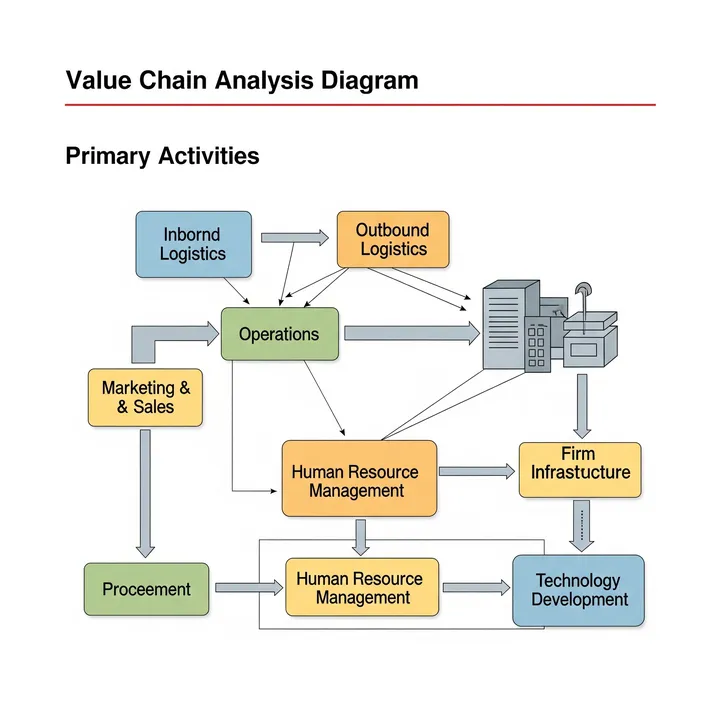
Gemini drew a horizontal arrow on the whiteboard, divided it into six sections, and labeled the top "Support Activities" and the bottom "Primary Activities." Michael Porter's Value Chain analysis.
"The Value Chain," I began to explain, "is a framework that views business activities as a 'chain of value,' analyzing how much value each stage generates. It distinguishes between primary activities—stages that directly create value—and support activities—stages that indirectly enable the primary ones, providing a bird's-eye view of the whole."
"In loan underwriting, what constitutes 'value'?" Claude posed the question.
The CEO answered. "Accurately assessing the borrower's repayment capacity and making appropriate lending decisions."
"Then," I pressed, "of the six stages, which ones directly produce that 'value'?"
The CEO considered. "Stage four, AI scoring, and stage five, the underwriter's final judgment—those two."
"A combined 8.5 hours," Gemini calculated. "Out of the total 40.5 hours, the stages that directly create value account for only 21%. The remaining 79% is preparatory work supporting those value-creating stages."
[Analyzing Primary Activities: The Value-Creating Stages]
"Let's first analyze the primary activities—the two stages that directly create value," I proposed.
"Stage four, AI scoring, at 0.5 hours. This is already automated and accuracy is stable," Claude confirmed. "The issue is stage five—the underwriter's final judgment at 8 hours. Can you break down those 8 hours?"
The CEO explained. "Reviewing the AI scoring results takes 1 hour. Verifying the reliability of collected data takes 2 hours. Cross-referencing with industry trends and making qualitative judgments takes 3 hours. Writing the assessment report takes 2 hours."
"Here's a critical discovery," I pointed out. "Of those 8 hours, the underwriter's experience and judgment are truly essential for only 3 hours—the qualitative judgment. Data reliability verification could potentially be automated with checklists and rules. Report writing could be dramatically shortened with templates and AI text generation."
"In other words," Gemini summarized, "of the 8 primary activity hours, only 3 require uniquely human value judgment. The remaining 5 are merely supportive tasks."
[Analyzing Support Activities: The Value-Enabling Stages]
"Now let's analyze the support activities—the preparatory work enabling the value-creating stages," Claude continued.
"Stage one, application receipt, at 2 hours. This involves checking documents for completeness and registering basic information into the system," the CEO explained.
"Routine work," I confirmed. "Are the check items standardized?"
"Yes. The checklist has 22 items, with virtually no room for subjective judgment."
"Then it's a candidate for automation," Gemini determined.
"Stage two, data collection, at 14 hours. This is the biggest bottleneck," the CEO said emphatically. "Financial statements, closing reports, tax filings—these are gathered manually from multiple systems and paper documents. Digitizing paper-submitted financial statements is particularly time-consuming."
"Stage three, counterparty research, at 12 hours. Also primarily manual," Claude confirmed. "Searching credit agency databases, collecting industry reports, checking news articles—underwriters do each of these one by one."
"Data collection at 14 hours and counterparty research at 12 hours. A combined 26 hours," I noted. "That's 64% of the total, spent on gathering and organizing information. These stages don't directly produce the value of lending decisions. Yet without them, no decision can be made."
"From the Value Chain perspective," Gemini analyzed, "the challenge is how to compress those 26 hours. They can't be eliminated entirely, but AI agents could dramatically reduce them."
[Redesigning the Value Chain]
"Based on the Value Chain analysis, let's redesign the scope of AI agent application," I proposed.
"Currently, AI handles only 0.5 hours in stage four," Claude organized. "But our analysis shows the greatest impact lies in stages two and three—the combined 26 hours of information collection and organization."
Gemini began sketching a specific design. "Stage two—automated financial data collection and structuring. Retrieve data directly from banking systems via API integration; read paper documents with OCR. Estimated reduction: from 14 hours to 3 hours."
"Stage three—automated counterparty and industry research," Claude continued. "Automated credit database searches, industry report summary generation, automated news collection with risk flagging. Estimated reduction: from 12 hours to 2 hours."
"Stage five—supporting the underwriter's final judgment," I added. "Automated data reliability verification and draft report generation. Estimated reduction: from 8 hours to 4 hours."
"Totaling all stages," Gemini calculated, "the current 40.5 hours is projected to shrink to approximately 15.5 hours. About 2 business days. The 72-hour response deadline can be met comfortably."
The CEO's eyes lit up. "The assessment capacity ceiling changes too."
"Yes," I answered. "Per-underwriter monthly processing capacity expands from 20 to approximately 50 cases. With six underwriters, that's 300 per month—2.5 times the current capacity of 120."
Chapter 3: A System to Protect the Chain
The CEO studied the redesigned Value Chain diagram.
"Expanding AI's scope from scoring alone to information collection and report writing. It seems obvious in hindsight, but I was so fixated on improving stage four's accuracy that I lost sight of the overall flow."
"The essence of Value Chain analysis," I replied, "isn't optimizing individual stages—it's surveying the entire chain of value and identifying where bottlenecks exist. The stage consuming the most time isn't necessarily the one creating the most value."
"For implementation steps," Claude proposed, "start with automating data collection in stage two. Two reasons: first, it has the largest labor hours of any stage, so the compression impact is greatest. Second, as routine data processing, the technical barrier to AI adoption is relatively low."
"Run the pilot on 20 assessment cases," Gemini added. "Conduct automated and manual collection in parallel, comparing data accuracy and processing time. After three months of verification data, decide whether to expand to stage three."
"And critically," I emphasized, "continuously monitor the processing time of each Value Chain stage. Every time AI's scope is expanded, record how many hours were reduced at which stage. These records become the criteria for the next improvement investment."
The CEO stood and bowed deeply. "Thank you. Next month, we'll begin the pilot with one partner bank."
Chapter 4: When the Chain Accelerates
After he left, Claude said, "Value Chain analysis has a strong manufacturing image, but it's equally effective for financial services."
"Yes," I replied. "What the Value Chain perspective teaches is that not all stages create value equally. Distinguishing between stages that directly create value and stages that support them, then compressing the support stages to concentrate resources on primary activities—this way of thinking applies regardless of industry."
Gemini added, "And the Value Chain isn't fixed. As technology evolves, stages that only humans could handle yesterday may be automatable by AI tomorrow. Periodically re-analyzing the chain and continuously updating the boundary of automation—that is reproducibility in process improvement."
Outside the window, the lights of a bank's ATM area glowed quietly.
Five months later, a report arrived from FinTech Innovations.
In the pilot with one partner bank, stage two data collection time dropped from 14 hours to 2.8 hours. The 72-hour response rate improved from 58% to 89%. Monthly application withdrawals decreased from 18 to 3, with an estimated annual reduction in opportunity loss of approximately 49 million yen.
But the most important discovery lay elsewhere. With data collection automated, underwriters could devote more time to qualitative judgment—evaluating management character and business potential. As a result, the post-lending default rate dropped 0.3 percentage points year over year.
The CEO wrote in the report: "We conduct Value Chain analysis quarterly, tracking processing time for each stage. Now that stage two automation has stabilized, we're tackling stage three—counterparty research. Each time we compress one link in the chain, underwriters gain more time to focus on their core judgment work. This cascading improvement cycle is becoming our greatest competitive advantage."
The chain of value accelerates every time one stage is refined. Recording how each stage is refined and repeating that process—that was the organization's reproducibility.
"Not all stages create value equally. What Value Chain analysis asks is which stages create value and which stages support it—that distinction. Compressing support stages frees resources for primary activities. And every time one stage is improved, the balance of the entire chain shifts. Periodically re-analyzing the Value Chain and continuously updating improvement priorities—that repetition is the essence of reproducibility in process optimization."
Related Files