ROI Case File No.430 'The Morning the 26th Key Turns'

The Morning the 26th Key Turns
Chapter 1: One Person Holding Seven Keys
"Our 26th property opens in July. But there's no budget for additional staff."
The head of operations at Sunrise Hotels pointed to a board printed with a world map. Tokyo, Osaka, Bangkok, Singapore, Bali, Ho Chi Minh City—red pins marked 25 locations. A 26th pin sat on the table, not yet placed.
"We're a boutique hotel chain expanding across Asia. Each property has 30 to 80 rooms. Across all 25 properties, we manage approximately 1,200 rooms in total. Annual revenue is roughly 3.8 billion yen."
The operations head pulled up an organizational chart on his tablet.
"Reservation management, rate setting, inventory management, and information updates across OTAs—our revenue management team handles all of this with eight people. Each person is responsible for three to seven properties."
"One person handling seven properties," I confirmed. "What's the daily workload per property?"
"Per property, daily reservation checks and rate adjustments take about 40 minutes. Updating information across 30 OTA channels takes about 25 minutes. Modifying sales plan settings takes about 20 minutes. That's roughly 85 minutes per property. A staff member handling seven properties spends approximately 10 hours a day on routine tasks alone."
"That exceeds the standard eight-hour workday," Claude noted.
"Yes. Overtime has become the norm. Average monthly overtime per person is 42 hours. Across the entire team, that's 336 hours of overtime per month."
The operations head picked up the 26th pin.
"When the 26th property is added, someone's portfolio goes to eight. But managing eight properties alone is physically impossible. Unless we fundamentally change something, the team will collapse."
"Can any part of this be addressed through system implementation?" I asked.
"That's what I can't figure out. There's too much work, and I can't see where to start. There are too many things to do, everything is intertwined, and I don't know where to begin untangling it—"
Those words said everything. Having a mountain of challenges with no idea where to start—that itself was the most serious challenge.
Chapter 2: From the Center in Eight Directions
"When challenges are entangled, that's exactly when you need structure."
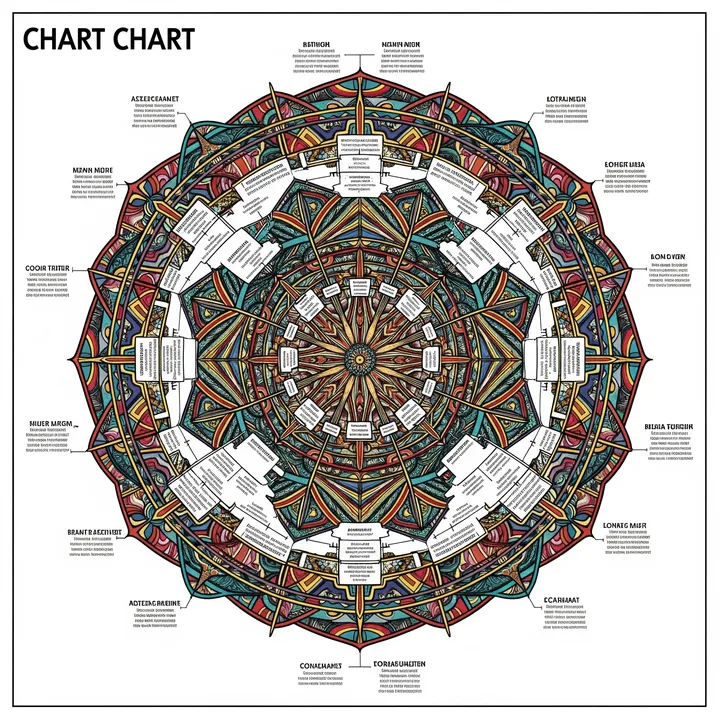
Gemini drew a grid of nine squares on the whiteboard. One in the center, eight surrounding it. Then, from each of the eight surrounding squares, another eight squares radiated outward. A Mandala Chart.
"The Mandala Chart," I began to explain, "places a core objective in the center, with eight elements needed to achieve it arranged around the perimeter. Each of those eight elements is then expanded into eight specific actions. One objective ultimately decomposes into 64 concrete actions."
"It became famous when Shohei Ohtani used it in high school," Claude added. "But the Mandala Chart's true essence lies in goal decomposition and prioritization. It's a thinking tool that breaks vague challenges down to an actionable level of granularity."
The operations head asked, "You're going to decompose the challenge of running 26 properties with eight people using a Mandala Chart?"
"Yes," I replied. "First, we place the core objective in the center."
[Center: Setting the Core Objective]
Gemini wrote in the central square. "Core objective—'Build a structure enabling 8 people to manage 26 properties.'"
"Let's identify the eight elements needed to achieve this goal," I prompted.
"Coming up with eight all at once is daunting," the operations head hesitated.
"Let's explore them one by one," Claude offered. "First, which task currently consumes the most time?"
"OTA information updates. We update rates, availability, and promotional information individually across 30 channels. It's 25 minutes per property, but across 25 properties, over 10 hours a day disappears into this task."
"That's element one," Gemini wrote. "Element 1—Streamlining OTA information updates."
"Next," I continued. "What's the second most time-consuming task?"
"Rate adjustments. Changing daily room rates based on demand forecasts. We also have to check competitor hotel pricing. About half of the 40 minutes per property goes to this."
"Element 2—Automating rate setting," Gemini added.
One by one, eight elements emerged.
"Element 3—Automating reservation confirmation. Element 4—Simplifying sales plan settings. Element 5—Automated report generation. Element 6—Cross-property knowledge sharing. Element 7—Standardizing staff skills. Element 8—Establishing emergency response flows."
The operations head looked surprised. "Laid out like this, I can see they do fall into eight distinct areas. In my head, it was all one tangled mass."
[Expansion: From Elements to Concrete Actions]
"Now comes the real work," I said. "For each of the eight elements, we expand into concrete actions. You don't need to tackle everything at once. Start by selecting the element with the greatest impact and drill down from there."
"The greatest impact," Claude analyzed, "is Element 1—OTA information updates. The entire team spends over 10 hours per day—roughly 220 hours per month. Compressing this creates the most capacity."
"Let's expand Element 1 into eight concrete actions," Gemini said, beginning a new Mandala.
"Action 1—Implement a channel manager. A system that enables bulk updates across all 30 OTAs simultaneously. Monthly cost is approximately 15,000 yen per property," Claude proposed.
"Action 2—Review update frequency," I continued. "You currently update all channels daily, but do all channels truly need daily updates?"
The operations head thought carefully. "Actually, 80% of reservations come from the top 5 channels. The remaining 25 channels account for only 20% combined."
"Then," Gemini pointed out, "update the top 5 channels daily and switch the remaining 25 to twice-weekly updates. That alone reduces update labor by approximately 40%."
"Action 3—Template standardization. Action 4—Establish seasonal bulk-update rules. Action 5—Create update procedure manuals. Action 6—Automate error checking. Action 7—Dashboard for update results. Action 8—Monthly retrospective."
"Eight actions are complete," I organized. "But again, you don't need to execute all of them simultaneously. Action 1, the channel manager, and Action 2, the frequency review—these two alone should eliminate approximately 70% of OTA update labor."
[Prioritization: Choosing a Path from the 81-Square Map]
"If you repeat this expansion for the remaining seven elements," Claude explained, "you'll end up with 64 concrete actions. But executing all 64 with current resources is impossible."
"That's precisely why," I emphasized, "the Mandala Chart's true value lies in prioritization after decomposition. From the 64 actions, select the three that deliver the greatest impact in the shortest time. Execute only those three first."
Gemini summarized the proposal. "Top three priorities: first, implement the channel manager. Second, review OTA update frequency. Third, introduce rate-setting automation tools. These three are projected to save approximately 5 hours of labor per day."
"About 110 hours per month," Claude calculated. "That's roughly one-third of the team's total 336 overtime hours. More than enough capacity to absorb the 26th property's operations."
Chapter 3: See the Whole, Choose One Point
The operations head gazed at the 81-square Mandala Chart. The 26th pin still sat on the table.
"The challenges swirling in my head—once they're structured like this, I feel a strange sense of calm. Just seeing the full picture eases the anxiety."
"The essence of the Mandala Chart," I replied, "is not trying to do everything at once. By drawing the full 81-square picture, what becomes clear is actually 'what doesn't need to be done right now.' Of the 64 actions, 61 can wait. That peace of mind generates the focus needed for the remaining three."
Claude added quietly, "And once the first three are complete, you revisit the Mandala and select the next three. This is the cycle. There's no magic that solves everything at once. But with a structured map, you can always choose the next step."
"Start the pilot at 3 properties," Gemini added. "Implement the channel manager and frequency review first, and measure the change in labor hours over one month. Use those numbers to decide on rollout to the remaining 22 properties."
The operations head stood, picked up the 26th pin, and bowed deeply. "Thank you. Next week, I'll hold a Mandala Chart workshop with the team."
Chapter 4: The Day the Pin Meets the Map
After he left, Gemini said, "The Mandala Chart is often used for personal goal-setting, but it's equally effective for organizing organizational challenges."
"Yes," I replied. "The Mandala's power lies in the depth of its decomposition. Break a vague challenge into eight parts, then break each into eight more. This two-level decomposition reduces even the most complex problem to 64 concrete actions. Then, prioritize within those 64 and select just three. This 'expand then narrow' process works regardless of the type of challenge—launching a new business, improving operations, developing talent—the same thinking pattern applies. That is reproducibility."
Claude added, "And the Mandala Chart itself becomes an organizational record. When you review today's chart three months or six months from now, you can see at a glance what's been completed, what remains untouched, and what's been newly added. The evolution of challenges becomes visible."
Outside the window, travelers pulling suitcases headed toward the station.
Four months later, a report arrived from Sunrise Hotels.
The channel manager implementation and frequency review at the three pilot properties reduced OTA update labor from 25 minutes to 7 minutes per property per day. Across the three properties, a monthly reduction of approximately 27 hours was achieved.
Based on these results, rollout to all 25 properties was completed in two months. The team's total monthly overtime dropped from 336 hours to 148 hours. And in July, the 26th property opened on schedule. Without adding any new staff, the eight-person team began managing 26 properties.
But the change the operations head was most proud of lay beyond the numbers. During the Mandala Chart workshop held with the entire team, each staff member began creating their own Mandala for their assigned properties. "The Bali property's challenge is monsoon-season pricing strategy." "The key for the Bangkok property is increasing the corporate booking ratio." Each individual had learned to structure their own challenges, prioritize, and act accordingly.
The operations head wrote in the report: "We update the Mandala Chart at every monthly team meeting. Of the 64 actions, 9 have been completed in these four months. The remaining 55 sit quietly on the map, waiting for their turn. Because the whole picture is visible, there's no rush. What to do next is always clear."
The 26th pin was firmly placed on the map. And the 81-square map would surely still be useful on the day a 27th pin was needed.
"When challenges pile up and you're paralyzed, what you need isn't a solution—it's structure. What the Mandala Chart provides is a thinking pattern: decompose one objective into eight, then expand each into eight more. By drawing the full 81-square picture, 'the three to do now' and 'the 61 that can wait' become clear. And every time three are completed, you revisit the chart and select the next three. Continuing this cycle of 'expand, narrow, execute, and review'—that is the reproducible method for conquering complex challenges."
Related Files