ROI Case File No.431 'The Room Where Twelve Minds Sleep'

The Room Where Twelve Minds Sleep
Chapter 1: The Hidden Cost of Free
"Every employee with a personal account is widening a security gap."
The CTO of Quantum Dynamics showed us a screenshot—an internal chat log. One of the engineers had pasted a fragment of proprietary control program code into the free version of ChatGPT via a personal account, asking it to help debug.
"We develop control programs for industrial equipment. We're a twelve-person organization, executives included. Small, yes—but some of our technology is patent-pending."
The CTO scrolled through the screen. Similar exchanges were visible from multiple team members.
"Right now, everyone is using free versions of ChatGPT or Copilot at their own discretion. I understand the appeal. Summarizing patent literature, polishing email drafts, code completion—when twelve people are wearing multiple hats, the temptation to lean on AI is perfectly natural."
"The problem," I confirmed, "is that they're handling business data through personal accounts."
"Exactly. Free-tier services may use input data for training. Management has grown concerned about the risk of leaking control program logic or pre-filing patent information to the outside."
"So you want to standardize on a paid, company-approved tool," Claude summarized.
"That's right. But—" The CTO's voice caught. "For a twelve-person company, a few thousand yen per person per month adds up to a meaningful annual expense. To convince the leadership, 'it's more secure' isn't enough. I need to explain what return this investment will bring to the entire company—and I can't."
This wasn't a tool selection problem. In an organization of twelve, the challenge was how to visualize the value of AI investment and connect it to executive decision-making. What was missing was the blueprint.
Chapter 2: Four Coordinates
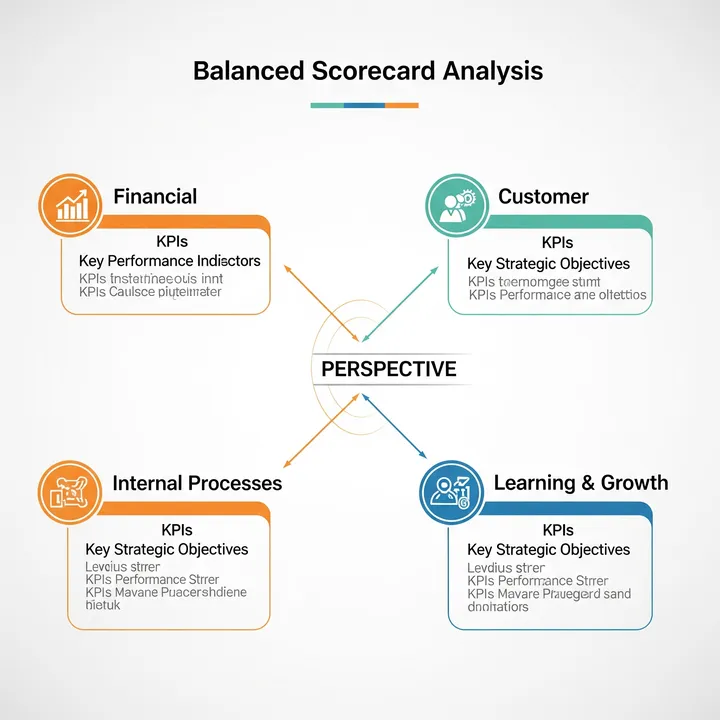
"This case calls for the BSC—the Balanced Scorecard."
Gemini drew four rectangles vertically on the whiteboard, labeling them from top to bottom: "Financial," "Customer," "Internal Process," and "Learning & Growth."
"The BSC," I began to explain, "is a framework that evaluates corporate strategy from four perspectives simultaneously. Many companies make investment decisions based solely on one point—'Will it cut costs?' But when you look only at financial metrics, you miss cases where short-term cost reduction undermines long-term growth."
"Why do we need four perspectives for a generative AI tool rollout?" the CTO asked.
"Because," Claude answered, "the effects of tool adoption can't be measured by cost savings alone. Customer value delivery, changes to business processes, employee skill development—these interact in a chain reaction. Only then does the full picture of the investment come into focus."
[The Financial Perspective: ROI for Twelve]
"Let's start with the financial perspective," I said, pointing to the first rectangle.
"Let's lay out the current situation in numbers," Claude suggested. "What's the estimated monthly cost per person for a paid tool?"
The CTO answered. "The ChatGPT Team plan runs about 4,000 yen per person per month. For twelve people, that's 48,000 yen per month, or 576,000 yen annually."
"And how much work time could AI tools replace in your current operations?" I asked.
"By our estimate—patent literature summarization averages about three hours per person per week. Email drafting, one hour. Code debugging assistance, two hours. Drafting documents, two hours. That's eight hours per person per week, or ninety-six hours across twelve people."
"Assuming an average hourly rate of 3,500 yen for engineers," Gemini calculated, "ninety-six hours of weekly reduction translates to approximately 17.5 million yen annually in labor cost equivalence. Against an investment of 576,000 yen, that's roughly a 30x return."
"However," I cautioned, "there's a trap in this math. Unless the hours freed up by AI tools are redirected to genuinely valuable work, that return on paper never materializes. That's exactly why the financial perspective alone isn't enough."
[The Customer Perspective: Delivery Speed as Trust]
"Next, the customer perspective," Gemini said, pointing to the second rectangle.
"What kind of value are Quantum Dynamics' clients seeking?" Claude asked.
The CTO thought for a moment. "Quality of control programs is a given, but—the most frequent request lately is delivery speed. Clients want us to shorten prototype program delivery from three weeks to two."
"The question is how a generative AI tool rollout addresses that demand," I framed. "If code completion and debugging support shorten the development cycle, that directly improves delivery speed."
"As a KPI," Gemini suggested, "measure the average number of days to deliver prototype programs, comparing before and after adoption. The target: a reduction from three weeks to two—a 30% improvement."
"When customer trust deepens," Claude added, "it influences repeat rates and additional project wins. Here emerges a path to revenue growth that financial metrics alone would never reveal."
[The Internal Process Perspective: Eliminating Key-Person Dependencies]
"Third is the internal process perspective," I continued.
"The greatest danger in a twelve-person organization," Claude pointed out, "is when knowledge and expertise held by one person are shared with no one else—key-person dependency. Patent literature interpretation, control logic design philosophy—locked inside a single individual's head."
The CTO nodded deeply. "That's exactly right. Last year, when one person took extended leave, a project stalled for two weeks."
"Generative AI tools can be used to break these dependencies," I explained. "For example, if you establish rules for auto-generating technical document summaries and glossaries, knowledge that lived only in someone's head accumulates as documentation. Position AI as a knowledge conversion engine."
"As a KPI," Gemini suggested, "track the number of new documents registered in the internal knowledge base. Set a target of ten per month and review effectiveness at three months."
[The Learning & Growth Perspective: The Twelfth Person's Skill Sets the Ceiling]
"Finally, the learning and growth perspective," Gemini said, pointing to the fourth rectangle.
"Unless all twelve people can use the generative AI tools effectively, it's meaningless," I emphasized. "If even one team member can't leverage the tool, their work becomes the bottleneck. In a twelve-person organization, the least skilled member determines the productivity ceiling for the entire group."
"What's critical, then," Claude added, "is designing a phased skill-building program alongside the rollout. Phase one: basic text generation and summarization. Phase two: code completion and debugging support. Phase three: advanced usage through prompt engineering."
"As a KPI," I proposed, "measure each member's AI tool usage frequency and conduct monthly proficiency checks by phase. The target: all members clearing phase two within three months."
Chapter 3: Four Perspectives on a Single Page
The CTO stared at the four rectangles and their KPIs on the whiteboard.
"I thought the generative AI tool rollout was just a cost-cutting measure. But delivery speed for clients, elimination of key-person dependencies, team skill development—they're all connected."
"The essence of the BSC," I emphasized, "is that the four perspectives are linked by cause and effect. When learning and growth advance, internal processes improve. When internal processes improve, customer value increases. When customer value increases, financial results follow. Visualizing this chain transforms the case you present to leadership."
"Instead of 'Security is covered for 48,000 yen per month,'" Claude put concretely, "'A 48,000-yen monthly investment delivers labor cost savings equivalent to 17.5 million yen annually, a 30% improvement in delivery speed, reduced key-person dependency risk, and an AI skill uplift across the entire team.' Presenting these four coordinates raises the precision of investment decisions."
"For implementation," Gemini suggested, "start with a three-person pilot team running the paid tool for one month. Measure baselines for each of the four KPIs, compare against one-month results, then decide on expansion to the remaining nine."
"And," I added, "revisit the four BSC KPIs every quarter after rollout. Tool capabilities evolve and business needs change. Locking in KPIs makes you unable to adapt to a shifting environment."
The CTO stood and bowed deeply. "Thank you. I'll share these four perspectives at next week's board meeting."
Chapter 4: The Morning Twelve Chairs Begin to Move
After he left, Gemini murmured, "I always thought the BSC was a strategic tool for large enterprises, but it works for a twelve-person organization too."
"Indeed," I answered. "If anything, the BSC is more powerful in smaller organizations. In a large corporation, when one metric deteriorates, other departments can compensate. But in a twelve-person organization, a blind spot in one perspective impacts everything directly. That's precisely why the comprehensiveness of evaluating investment from four perspectives matters."
Outside the window, lights in small office buildings began flickering on one by one.
Three months later, a report arrived from Quantum Dynamics.
Following a pilot with three team members, the paid tool had been rolled out to all twelve. The time to summarize a single patent document dropped from an average of forty-five minutes to twelve. Average prototype program delivery improved from eighteen days to thirteen.
But the biggest change lay beyond the numbers. The skill-building program designed under the BSC's "Learning & Growth" perspective resulted in all members clearing phase two within three months. And one veteran engineer independently built an automated technical document summarization workflow using AI. This workflow was registered in the internal knowledge base and shared in a reusable format for other team members.
At the end of the report, the CTO wrote: "The BSC's four perspectives have become a shared language in our board meetings. Every time a new investment proposal comes up, the question 'What about the customer, process, and learning perspectives—not just financial?' arises naturally. Because we're a small organization of twelve, having everyone looking at the same coordinates means everything."
The four coordinates weren't criteria for selecting a tool. They were a shared language for organizational decision-making.
"Many companies make investment decisions from a single financial point. But cost-reduction numbers alone cannot reveal the full picture of an investment. What the BSC—Balanced Scorecard—provides are four coordinates: Financial, Customer, Internal Process, and Learning & Growth. When these four are linked by cause and effect, an investment ceases to be mere expense and becomes an engine that moves the organization. Draw the four coordinates on a single map, keep updating KPIs at regular intervals—that repetition is what brings reproducible investment decision-making to an organization."
Related Files