ROI Case File No.432 'The Silence Behind the Catalog'

The Silence Behind the Catalog
Chapter 1: Inside the Top Seller's Mind
"They're proposing the exact same products, yet one closes deals at three times the rate."
The head of sales planning at Globex Corporation placed two proposals side by side on the table. One was prepared by their top salesperson, Ms. A. The other, by Mr. B, now in his second year.
"We're a specialized trading company for commercial HVAC equipment. We carry approximately 1,200 product lines. Eighteen sales representatives each manage between fifty and eighty corporate clients."
The planning director pointed to Ms. A's proposal. The client's industry, floor area, headcount, current equipment model numbers—based on all of these, three products were recommended in prioritized order.
"Ms. A's close rate is 42%. The industry average is 14%, so she's more than tripling it. But when I ask her, 'Why did you choose those three?' she just says, 'Years of experience—you just know.'"
Then she showed us Mr. B's proposal. It was simply the key specs pulled from the product catalog PDF and sorted by price.
"Mr. B's close rate is 9%. It's not that he lacks product knowledge—he has the specs memorized perfectly. What he's missing is the narrative that connects the customer's challenges to the right product."
"How is your product information managed?" I asked.
"Excel. Product names, model numbers, specs, prices—roughly 1,200 rows in a single sheet. Sales reps build proposals while referencing this sheet. But a list of specs doesn't show the customer what the value means for them."
"So you want to build a digital catalog," Claude summarized.
"Yes. But not just a digitized product list. Eventually, we want it at a quality level where salespeople can show it directly to clients during proposals. We've been looking at no-code and low-code tools for development, but we can't even settle on the design philosophy—what the catalog should actually contain."
This wasn't a tool problem. What was needed was to translate the thinking process inside Ms. A's head—the circuit that connects customer challenges to products—into the form of a catalog.
Chapter 2: Seven Steps
"Before we dive into catalog design, we need to understand the customer's experience."
Gemini wrote seven steps vertically on the whiteboard. Empathize, Map, Prioritize, Align, Test, Hone, Yield—the EMPATHY model.
"The EMPATHY model," I began, "is a framework that starts from the customer's perspective to uncover challenges and build solutions in stages. As the first letter suggests, the starting point is empathy—Empathize. Not your company's convenience, but what the customer feels, struggles with, and seeks. That's where design begins."
"Why does a digital catalog need customer empathy?" the planning director asked.
"Because," Claude answered, "a catalog isn't a showcase for your products—it's a roadmap to solving your customer's problems. Ms. A's proposals achieve high close rates not because she's good at explaining products, but because she understands the customer's challenges and selects products that fit that context."
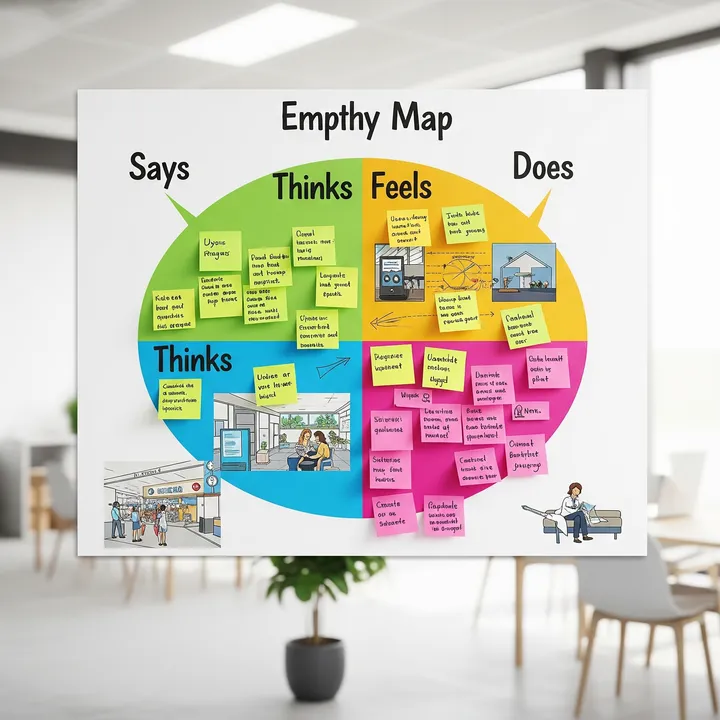
[Empathize: Hearing the Unspoken Voice]
"Let's begin with the first step—Empathize," I suggested.
"What does that look like in practice?" the planning director asked.
"You conduct interviews with both the sales team and customers," Gemini explained. "On the sales side, ask: 'What questions do customers ask most during proposals?' and 'When a deal falls through, what's the most common reason?' On the customer side: 'What's your top criterion when selecting equipment?' and 'What's missing from the proposals you currently receive?'"
"When I checked with Ms. A," the planning director added, "the most common question from clients is, 'What are companies in the same industry and similar size using?'"
"That's a crucial finding," I pointed out. "Customers don't want spec comparisons. They want success stories from companies like theirs. Whether you capture this insight or not changes the catalog's entire design from the ground up."
[Map: Drawing the Information Landscape]
"Step two—Map. We chart the current information landscape," Claude continued.
"We're reorganizing the 1,200-item Excel data from the customer's point of view," I explained. "Right now, it's organized by product: model number, specs, price. But what customers want is information organized by challenge. 'Office space of 200 square meters, 30 employees, want to cut summer electricity costs by 15%'—input those conditions and get the optimal product. That's the information architecture you need."
"In other words," Gemini summarized, "a transformation from a product catalog to a solution catalog. The data content stays the same; it's the arrangement that changes fundamentally."
[Prioritize: What to Show First]
"Step three—Prioritize. Decide the order of information," I continued.
"You don't need all 1,200 items in the catalog," Claude pointed out. "Analyzing Ms. A's proposal data, 80% of closed deals are concentrated in the top 120 items—just 10% of the total. Start by building the catalog around those 120."
"Furthermore," Gemini added, "within those 120, prioritize the ones where you can attach industry-specific adoption case data. As the empathy stage revealed, what customers want most is seeing what their peers have done."
[Align, Test, Hone: Refining as an Organization]
"Steps four through six," I explained, "are Align—share the catalog's design philosophy with the entire sales team; Test—use the prototype in actual sales meetings; and Hone—improve based on feedback. Run this three-step cycle in one-month iterations."
"What's critical," Claude emphasized, "is having not only Ms. A but also less experienced salespeople like Mr. B test the prototype. It's expected to work for Ms. A. Whether Mr. B's close rate improves—that's the true measure of the catalog's value."
[Yield: Returning Results to the Organization]
"And step seven—Yield. Validate the outcomes and roll out company-wide," Gemini concluded.
"Run the pilot with a team of six, including both Ms. A and Mr. B, over three months," I proposed. "Track three KPIs. First, proposal creation time. Second, lead time from client interview to proposal delivery. Third, changes in close rate. Pay special attention to how much the close rate improves for less experienced salespeople."
Chapter 3: Converting Experience into Structure
The planning director studied the seven EMPATHY steps on the whiteboard.
"I was going to start the catalog design with tool selection. No-code or low-code, which platform is best—that's all I was thinking about. But the real first step was listening to the customer."
"The essence of the EMPATHY model," I responded, "is not rushing to a solution. Start with empathy, organize the information, set priorities, align the organization, test, refine, and only then do you reach outcomes. Not skipping any of the seven steps is what prevents costly rework."
"Tool selection," Claude added, "can wait until after step four—Align—is complete. Once you've decided what goes in the catalog and how it's structured, the tool requirements become self-evident. If you pick the tool first, the tool's constraints end up dictating the catalog's design."
"And one more thing," I added. "This process itself is a mechanism for converting Ms. A's tacit knowledge into organizational explicit knowledge. The thinking she does unconsciously—connecting customer challenges to products—gets verbalized through the seven EMPATHY steps and embedded into the catalog's structure. Even if Ms. A leaves the company, her wisdom remains in the catalog."
The planning director stood and bowed deeply. "Thank you. Starting next week, we'll begin by designing the customer interview process."
Chapter 4: When Silence Becomes a Catalog
After she left, Gemini murmured, "The EMPATHY model is a customer understanding framework, but it also has the effect of making tacit organizational knowledge visible."
"Exactly," I answered. "The wisdom inside Ms. A's head was never articulated. Because it wasn't articulated, it couldn't be shared. Because it couldn't be shared, it became dependent on one person. The seven EMPATHY steps start from customer empathy, but they also shine a light inward on the organization. In the process of structuring what customers want, you discover for the first time what you yourselves actually know."
Outside the window, business professionals with briefcases in hand were scattering into the afternoon streets.
Four months later, a report arrived from Globex Corporation.
Following the EMPATHY model's seven steps, they first conducted interviews with twenty clients. The most common request was, as predicted, "adoption case studies from companies in our industry." Based on these results, they restructured the top 120 products by industry and challenge type, building a digital catalog prototype with a no-code tool.
After a six-person pilot team used it for three months, average proposal creation time dropped from ninety minutes to thirty-five. And the most noteworthy data point was the close rate of less experienced salespeople. Mr. B's close rate improved from 9% to 21%—surpassing the industry average of 14%.
But what the planning director valued most wasn't the catalog itself. Through the seven EMPATHY steps, a forum emerged where the entire sales team discussed, "What do customers really want to know?"
At the end of the report, the planning director wrote: "We update the catalog every quarter. But we're not just updating product information. We incorporate new customer interview findings, rotate the featured case studies, and revisit priorities. Each time we repeat the seven EMPATHY steps, the catalog's precision improves—and our sales team's customer understanding deepens in parallel."
The wisdom that had lived in the top seller's silence had, through seven steps, been transformed into the organization's shared language.
"A top salesperson's proposal skill is born not from product knowledge, but from empathy with the customer. What the EMPATHY model shows is seven steps for converting that empathy from individual talent into organizational infrastructure. Empathize, map, prioritize, align, test, hone, yield. Each time you repeat these seven steps, intuitive sales ability evolves into a reproducible proposal system. The record of that repetition is the true nature of reproducibility."
Related Files