ROI Case File No.433 'Three Hundred Million Yen Sleeping in the Warehouse'

Three Hundred Million Yen Sleeping in the Warehouse
Chapter 1: A Mountain Built on Gut Feeling
"Behind this shelf, three hundred million yen worth of materials are sitting idle."
The head of procurement at Globex Corporation displayed a warehouse photo on his tablet. Cardboard boxes stacked nearly to the ceiling. Labels stamped with dates from two years ago.
"We're an industrial machinery manufacturer. Annual revenue is approximately 12 billion yen. We use about 4,800 material items in our products, with roughly 40% sourced internationally. We deal with over 200 suppliers, both domestic and overseas."
The procurement director opened another screen—an inventory trend graph for the past year. A red line marked the optimal inventory level; a blue line showed actual inventory. The blue line snaked far above the red, swaying erratically.
"The excess inventory currently stands at approximately 320 million yen. Annual carrying costs alone—warehousing, insurance, deterioration losses—run about 48 million yen."
"And stockouts are occurring as well," Claude confirmed.
"Yes. Over the past year, there were forty-seven delivery delays caused by stockouts. Between late-delivery penalties and premium costs for emergency procurement, the annual loss comes to approximately 62 million yen."
"Excess inventory and stockouts happening simultaneously," I pointed out. "That means it's not a shortage of inventory—it's a misallocation."
"Exactly," the procurement director said, lowering his voice. "Demand forecasting relies entirely on individual judgment and experience. Staff download historical shipment data from our internal system, aggregate it in Excel, and estimate: 'Around this time last year we shipped about this much, so this year should be similar.' Global developments and market trends are assessed by reading the news and making personal calls."
"You do have an automated ordering system in place, though," Gemini noted.
"It's built in-house. But the reorder points and quantities are fixed values, so it can't keep up with demand fluctuations. We automated invoice processing with RPA, but the decision itself—what to order, when, and how much—hasn't been automated."
"And now you're considering AI," I confirmed.
"Yes. But I don't believe AI will solve everything. The problem is that the entire flow—from demand forecasting to ordering, receiving, shipping, and supplier coordination—I can't see where and how it's getting stuck. The big picture is missing."
This wasn't a problem with AI as a tool. It was a case that required mapping the entire journey of materials from origin to the customer's hands—surveying every leg, identifying where value exists and where connections are broken.
Chapter 2: Seven Stages of the Journey
"Let's reframe the inventory problem as the journey of a material."
Gemini drew a long horizontal arrow on the whiteboard and divided it into seven segments. The JOURNEY model.
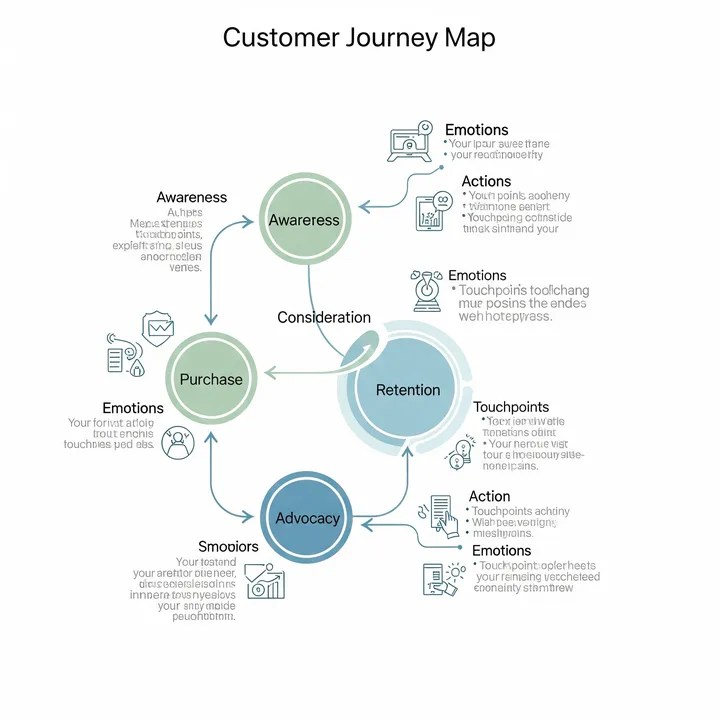
"The JOURNEY model," I began, "is a framework that breaks the path traveled by a customer or a physical object into seven stages and visualizes the experience and challenges at each. In marketing, it's known as the customer journey, but its essence is a way of thinking that asks, 'Across the entire flow from start to finish, where does friction exist?' Today, we'll map the journey from the moment a material is ordered to when it reaches the customer as a finished product."
[Stage One: Sensing Demand]
"The journey begins with sensing demand," I said, pointing to the first segment.
"How do you currently capture demand?" Claude asked.
"The sales department gathers pipeline information from clients and shares it with procurement. But the timing varies wildly—sometimes it comes up in a monthly meeting as a verbal report; other times it's relayed in a rush just before an order is confirmed."
"In other words," Gemini pointed out, "the frequency and granularity of demand input are both inconsistent. This is the first break in the journey. No matter how precise an AI prediction model may be, if the input data is unstable, the output will be unstable too."
[Stage Two: Forecasting Demand]
"Stage two is converting sensed demand into a forecast," I continued.
"This is the part currently dependent on individual intuition," Claude confirmed. "Beyond historical shipment data, what external variables should be considered?"
The procurement director listed them. "Exchange rates, raw material prices, fluctuations in ocean freight lead times, key customers' business performance, and geopolitical risk. Last year, supply from one overseas supplier was suspended for two months. The Red Sea shipping route disruption forced container ships to reroute."
"Tracking these external variables in Excel is humanly impossible," I stated. "An AI demand forecasting model should be deployed at this second stage. However, improving the model's accuracy requires stable demand information input from stage one as a prerequisite."
[Stage Three: The Ordering Decision]
"Stage three is determining order quantities and timing based on forecasts," Gemini explained.
"The current automated ordering system uses a fixed reorder point method," Claude confirmed. "When inventory drops below a set level, a set quantity is ordered."
"That can't respond to demand waves," I pointed out. "You need dynamic ordering linked to AI forecasts—a mechanism that adjusts reorder points and quantities in real time based on demand predictions. Applying this to all 4,800 items isn't practical, so start with the top 20% by value—roughly 960 items. Following the Pareto principle, these 960 items should account for 80% of your inventory value."
[Stage Four: Supplier Coordination]
"Stage four covers the span from ordering to receiving—coordination with suppliers," I continued.
The procurement director's voice grew firm. "This is the part that gives us the most headaches. We have over 200 suppliers, but even when we share production plans, we can't see each supplier's inventory levels or production capacity in real time. Several small and mid-size suppliers are also facing succession issues, so we're carrying latent supply disruption risk."
"For supplier information coordination," Gemini proposed, "a two-phase approach works well. Phase one: build a portal with the top twenty suppliers for sharing monthly production plans and inventory data. Phase two: feed that data into the AI forecasting model and add a mechanism to detect supply risks in advance."
[Stages Five Through Seven: Receiving, Storage, and Shipping]
"The remaining three stages—receiving inspection, warehouse storage, and shipping with delivery—" Claude organized, "are already partially covered by your existing RPA and warehouse management system. However, when defective goods are found during stage-five receiving inspection, the alternative procurement flow is manual, creating a three-to-five-day time lag."
"For these three stages," I decided, "prioritize improving stages one through four first, confirm the results, then address these. Trying to improve all seven stages simultaneously will scatter resources and leave everything half-finished."
Chapter 3: The Meaning of Carrying a Journey Map
The procurement director stared at the seven segments drawn on the whiteboard.
"I was only thinking about implementing AI demand forecasting. But even if prediction accuracy improves, if the stages before and after it have breaks, the impact will be limited."
"The essence of the JOURNEY model," I responded, "isn't optimizing individual stages—it's surveying the entire journey and identifying the largest breaks. In this case, the biggest breaks are stage one—the instability of demand information input—and stage two—the reliance on individual intuition for forecasting. Unless you close those gaps first, improvements from stage three onward will spin their wheels."
"In terms of implementation priority," Claude proposed, "first, establish a rule for the sales department to share structured demand information on a weekly basis. Second, build an AI demand forecasting model targeting the top 960 items. Third, introduce dynamic ordering logic linked to forecast results. Execute these three steps on a phased, six-month roadmap."
"For the pilot," Gemini added, "start with the fifty items that experience the highest stockout frequency. Measure demand forecast accuracy and stockout rate improvement for these fifty items over three months, then use those results to decide on expanding to 960 items."
"And what's critical," I emphasized, "is continuously monitoring processing time and accuracy at each of the seven stages. How many days does each stage take? Where do errors occur? That record becomes the basis for the next improvement investment decision."
The procurement director stood and bowed deeply. "Thank you. Next month, we'll start by establishing the demand information sharing protocol with the sales department."
Chapter 4: The Day Materials Reach the Right Shelf
After he left, Claude said, "Applying the JOURNEY model to inventory management was a fresh perspective. It works not just for customer journeys but for the journey of physical goods."
"Indeed," I answered. "The essence of JOURNEY is decomposing the flow from start to finish and shining a light on the junction points between stages—the moments when information or goods are handed off from one department to another, from one system to another. That's where the breaks exist. No matter how excellent each individual stage may be, if the junctions are broken, the journey stops. This perspective works across industries, whether you're looking at inventory management or customer experience."
Gemini added, "And a journey map isn't something you draw once and set aside. Supplier situations change, market conditions shift, new technologies emerge. Periodically redrawing the journey and updating where the breaks are—that's what reproducibility means in continuous improvement."
Outside the window, a large truck was rounding the corner of the warehouse district.
Five months later, a report arrived from Globex Corporation.
First, as a stage-one improvement, they launched weekly demand information sharing meetings with the sales department. They established a rule for quantifying pipeline confidence on a three-tier scale (high, medium, low) and delivering structured data to the procurement team.
Next, for stage two, they deployed an AI demand forecasting model targeting the top fifty items. In addition to three years of historical shipment data, they incorporated exchange rates, raw material market prices, and ocean freight lead times as external variables.
The results for the fifty pilot items were clear. Demand forecast accuracy improved by an average of 28% compared to intuition-based predictions. Monthly stockout incidents dropped from an average of 6.2 to 1.8. Simultaneously, excess inventory for the target items was compressed from approximately 47 million yen to 21 million yen.
But what surprised the procurement director most was an unexpected side effect. The stage-one improvement—the weekly meetings with sales—went beyond mere data sharing and fostered a collaborative relationship between sales and procurement. Sales representatives began sharing qualitative insights like, "This client's deal will likely gain confidence in three months," and the quality of input data feeding the AI prediction model improved continuously.
The procurement director wrote in his report: "We've posted the seven JOURNEY stages on the wall and update KPIs for each stage monthly. Based on the results from the fifty pilot items, we're expanding to 960 items next month. Because we have the journey map, we can decide without hesitation which stage to improve next. And every time we improve one stage, positive effects ripple into adjacent stages. Recording this chain of improvements is becoming the foundation of reproducibility in our inventory management."
The three hundred million yen that had been sleeping deep in the warehouse, now that the journey map was drawn, had begun to slowly move toward the right shelves.
"Improving demand forecast accuracy and improving inventory management are not the same thing. What the JOURNEY model asks is: across the entire journey from sensing demand to delivering to the customer, where are the breaks? AI is a powerful tool, but it is merely a tool for improving one stage of the journey. Survey all seven stages, close the largest breaks first, and periodically inspect the junctions between stages—that repetition is the essence of reproducibility in supply chain management."
Related Files