ROI Case File No.434 'Three People Deciphering Ten Thousand Slips'

Three People Deciphering Ten Thousand Slips
Chapter 1: The Handwritten Labyrinth
"It takes an average of twelve minutes to enter a single order form into the system."
The logistics director at DataStream Solutions placed a stack of fax papers on the table. Corners were worn round, ink was smudged in places. Some were covered in handwriting, others had handwritten additions on printed templates, and some were printed emails marked up in red pen—formats were all over the place.
"We're a wholesale distributor of industrial materials. Annual revenue is approximately 4.5 billion yen. We serve about 320 clients. On an average day, we receive eighty order forms. That's roughly 1,700 per month, or about 20,000 per year."
The logistics director picked up one of the fax sheets. Handwritten numbers lined the page, but in places it was difficult to tell whether a digit was a "7" or a "1."
"Order forms arrive in three formats—fax, email-attached PDFs, and scanned handwritten slips. The format differs by client, with no standardization. Three staff members read these visually and manually enter them into the sales management system."
"Twelve minutes per form, eighty forms a day," Claude calculated. "That's 960 minutes—sixteen hours per day. Even split among three people, each spends over five hours on transcription."
"Yes. But the problem isn't just time," the logistics director said, showing another document—an error tally from the past six months.
"We average thirty-eight input errors per month. Misread part numbers, quantities off by a digit, wrong delivery addresses—when these surface downstream, we face shipment holds, redeliveries, and customer apologies. The estimated annual loss from input errors, including redelivery costs, customer discounts, and overtime, is approximately 24 million yen."
"And now you're considering AI-OCR," I confirmed.
"Yes. We've heard that handwriting recognition accuracy has improved, and we're envisioning a system where AI-OCR reads the forms and RPA handles the data entry. But—"
The logistics director stared at the stack of fax papers.
"I can't be sure that OCR alone will solve everything. Can a machine really read order forms accurately when formats vary this much? Even if it can read them, how does the downstream process change? Will we end up with just partial automation?"
This wasn't a technology adoption problem. It was about redesigning the entire business flow—from the moment an order form arrives until the shipping instruction is complete.
Chapter 2: Five Stages
"Let's reframe order processing automation as a service."
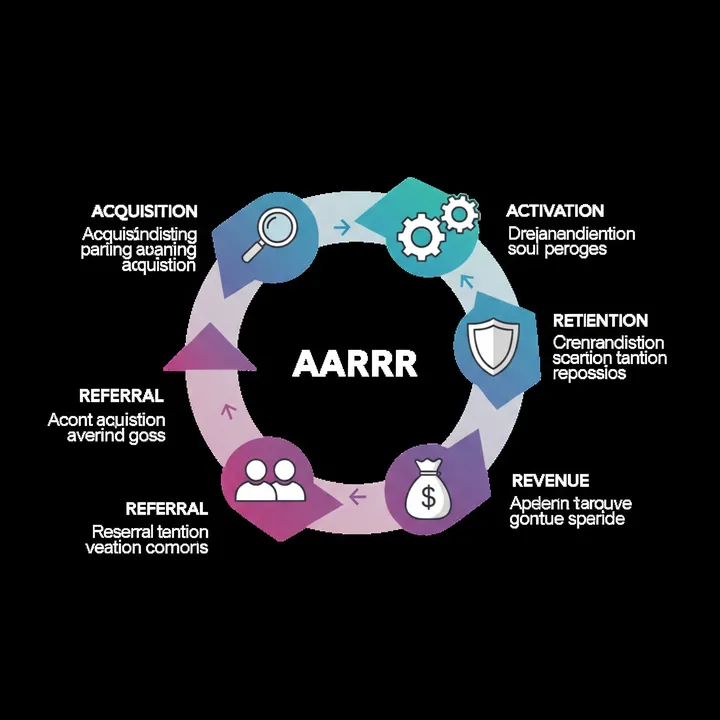
Gemini drew five stages horizontally on the whiteboard. Acquisition, Activation, Retention, Revenue, Referral—the AARRR model.
"The AARRR model," I began, "originally emerged as a growth metrics framework for startups. Acquire users, activate them, retain them, generate revenue, and drive referrals—growth is measured across these five stages. But its essence is a way of thinking that visualizes the funnel from entry to exit and identifies where drop-offs occur."
"Why use a marketing framework for order processing?" the logistics director asked.
"Because," Claude answered, "order forms are 'input data' arriving from clients. The flow of getting that data accurately and swiftly into the sales management system is structurally identical to the flow of a user engaging with a service. You can visualize, stage by stage, where data 'drops off'—that is, where delays and errors occur."
[Acquisition: Organizing the Data Entry Point]
"Stage one—Acquisition. Data intake," I said, pointing to the first section.
"Currently, order forms arrive in three mixed formats: fax, email PDF, and handwritten scans," Gemini confirmed. "This chaos at the entry point cascades through every downstream stage."
"The key here," I emphasized, "isn't forcing every client to adopt a single format. That's not realistic. What matters is designing an entry point that can convert any format into the same data structure."
"Specifically," Claude proposed, "pursue three measures in parallel. First, offer a web order form to the top twenty clients by order volume. This alone should capture approximately 45% of all orders as direct digital data. Second, apply AI-OCR to the remaining faxes and email PDFs. Third, combine high-accuracy OCR with operator visual verification for handwritten slips."
"Will the top twenty clients actually use a form?" the logistics director worried.
"It benefits them too," Gemini answered. "Orders placed via the form receive an instant automated confirmation. With fax, there's always the client's anxiety of 'Did it even arrive?' Eliminating that anxiety becomes the incentive for form adoption."
[Activation: Making Data Move]
"Stage two—Activation. The stage where captured data is correctly reflected in the sales management system," I continued.
"This is where AI-OCR and RPA come in," Claude explained. "Data read by OCR is automatically transcribed by RPA into the sales management system's input screens. However, any items with a confidence score below a certain threshold—meaning data the OCR isn't confident about—are routed to an operator confirmation queue instead of being auto-entered."
"The design of this confirmation queue is the key," I pointed out. "If you visually verify every record, automation is pointless. But if you pass everything through without verification, errors increase. Set the confidence score threshold appropriately, aiming to keep the items requiring confirmation to 15–20% of the total."
[Retention: Sustaining Accuracy]
"Stage three—Retention," Gemini said, pointing to the third section.
"Automation doesn't peak at the moment of implementation," I cautioned. "OCR recognition accuracy fluctuates when clients change their formats or new clients are added. You need an operational rule: measure recognition accuracy monthly, and retrain the model whenever it declines."
"Furthermore," Claude added, "data corrected by operators in the confirmation queue can be used directly as training data for the OCR model. The longer you use it, the more accurate it becomes—by building this positive feedback loop into the design, the system grows smarter over time."
[Revenue: From Cost Cutting to Value Creation]
"Stage four—Revenue," I continued.
"Freeing three staff members from transcription work saves approximately 12 million yen annually in labor cost equivalence," Gemini calculated. "Add the loss avoidance from reduced input errors at roughly 24 million yen per year. That's a combined annual impact of approximately 36 million yen."
"But," I emphasized, "the real Revenue comes not from cost savings but from shifting those three staff members to higher-value work. For example, analyzing order data to identify demand trends, visualizing ordering patterns by client, proactively detecting delivery delay risks—work that there was never time for before. Now their years of experience and judgment can be channeled into these tasks."
The logistics director's expression shifted. "Can staff who've only done transcription really handle analytical work?"
"They weren't only doing transcription," Claude pointed out. "Because they've been reading ten thousand order forms, they've developed an intuition for changes in client ordering patterns and spotting anomalies. Combine that intuition with analytical tools, and it can generate enormous value."
[Referral: Scaling Success Horizontally]
"Finally, stage five—Referral," Gemini concluded.
"The insights gained from automating order forms can be applied to other paper-based operations," I explained. "Delivery receipts, invoices, inspection certificates—if similar paper transcription work exists elsewhere in the company, the system built for order forms can be replicated. Taking one success story and connecting it to organization-wide process improvement—that's the true meaning of Referral."
Chapter 3: The Funnel Blueprint
The logistics director studied the five stages drawn on the whiteboard.
"I was only thinking about implementing AI-OCR. But OCR is just one of five stages. Organizing the input formats, designing the confirmation queue, maintaining accuracy, redeploying staff, scaling to other operations—unless the whole system is designed, we'll end up with partial automation."
"The essence of the AARRR model," I responded, "is visualizing the funnel from entry to exit and measuring the conversion rate at each stage. From the moment an order form arrives to the completion of the shipping instruction—how many are auto-processed, how many are routed to manual confirmation, how many result in errors. Tracking these numbers reveals improvement priorities."
"For the pilot," Gemini suggested, "start with the five highest-volume clients among the top twenty. Launch the web order form and AI-OCR processing in parallel, and measure conversion rates at each stage over two months. Use those results to decide on expanding to the remaining fifteen."
"And," I reminded, "review KPIs for each of the five stages monthly without fail. Form adoption rate for Acquisition, auto-processing rate for Activation, recognition accuracy for Retention, labor hours saved for Revenue, and number of horizontal expansions for Referral. These five numbers become the dashboard indicating the health of automation."
The logistics director stood and bowed deeply. "Thank you. Next week, we'll start by listing the top twenty clients and defining the requirements for the web order form."
Chapter 4: The Day Slips Begin to Speak
After he left, Gemini murmured, "I always associated the AARRR model with SaaS growth metrics, but it works for process automation too."
"Indeed," I answered. "The power of AARRR lies in breaking a process into stages and making the conversion rate at each stage trackable by numbers. Whether it's user acquisition rate or order form auto-processing rate, only the subject of measurement changes—the framework's structure stays the same. From entry to exit, identify where 'drop-offs' occur with hard numbers. Repeating that identification, the right improvement actions naturally emerge. That's reproducibility."
Outside the window, forklifts at the distribution center were moving back and forth in the evening light.
Four months later, a report arrived from DataStream Solutions.
After offering the web order form to the five pilot clients, 92% of their orders migrated to the form. AI-OCR was applied to the remaining faxes and email PDFs, achieving a 78% auto-processing rate. Items routed to the confirmation queue settled at approximately 18% of the total, in line with initial projections, and monthly input errors dropped from thirty-eight to seven.
Two of the three staff members transferred to an order data analysis team. They built a dashboard visualizing ordering patterns by client and launched a system for proactively detecting demand spikes. One staff member succeeded in backing up an intuition cultivated through years of transcription—"This client tends to place large orders at month-end"—with data. By proactively notifying the sales department, they prevented two major orders from being missed.
At the end of the report, the logistics director wrote: "We track KPIs for each of the five AARRR stages on a monthly dashboard. Last month, when recognition accuracy dropped by two points, we were able to immediately identify the cause as a new client's format—thanks to this dashboard. As a next step, we're preparing to apply the same framework to delivery receipt and invoice automation. One success story is becoming a template for improvement across the entire organization."
The ten thousand slips had left the three people's hands. But the wisdom those three had read from the slips was breathing new life within the organization—in the new form of data analysis.
"When you approach process automation as a technology implementation, you fall into local optimization. What the AARRR model provides is the perspective of breaking the data flow into five stages from entry to exit and measuring the conversion rate at each. Where does data stall, where do errors arise, where is human judgment truly needed? Each time you repeat these five measurements, automation accuracy improves and people can focus on work only humans can do. Draw the funnel, track the numbers, and keep improving—that repetition is the true nature of reproducibility in process automation."
Related Files