ROI Case File No.439 'Four Seconds Through the Gate'

Four Seconds Through the Gate
Chapter 1: The Ninety-Day Countdown
"Ninety days until the law takes effect. If we're not compliant, penalties apply."
The head of logistics at TechnoVision pointed to a calendar on the wall. April 1st was circled in red, with the remaining days hand-counted back to today's date.
"We're an automotive parts manufacturer specializing in body frame development and production. Our three main customers are Japan's major automakers. Annual revenue is approximately 21 billion yen. An average of about 120 large trucks enter and exit our headquarters factory grounds daily."
The logistics director handed over a document outlining the "Logistics Efficiency Act."
"Under this law taking effect in April 2026, logistics hubs must accurately record and report to authorities the arrival time, waiting time, loading and unloading time, and departure time of every truck. Records must be precise to the minute. Non-compliance triggers warnings, public disclosure, and penalties."
"How is truck management currently handled?" I asked.
"At the guard station, drivers manually write their names and times in a paper log. They read the time off a wall clock at the guard station. Some drivers round the time—writing '14:00' instead of '14:03,' for example."
"Minute-level precision isn't being maintained," Claude confirmed.
"Not at all. And the log stays on paper—filed for one month and stored on a shelf. There's no mechanism for digital aggregation."
"The executive meeting decided to implement image recognition technology," Gemini confirmed.
"Yes. Initially, we considered a stopgap—having drivers enter arrival and departure times on a tablet. But the executive meeting said, 'No half measures. If we're going to do this, automate it completely with license plate recognition.' The direction is set, but—"
The logistics director's voice caught.
"We have no in-house expertise in image recognition. Camera selection, recognition software selection, integration with our existing logistics management system, recognition accuracy at night and in rain—there's a mountain of items to evaluate, and only ninety days. If we follow a standard project plan, requirements definition alone would consume all ninety days."
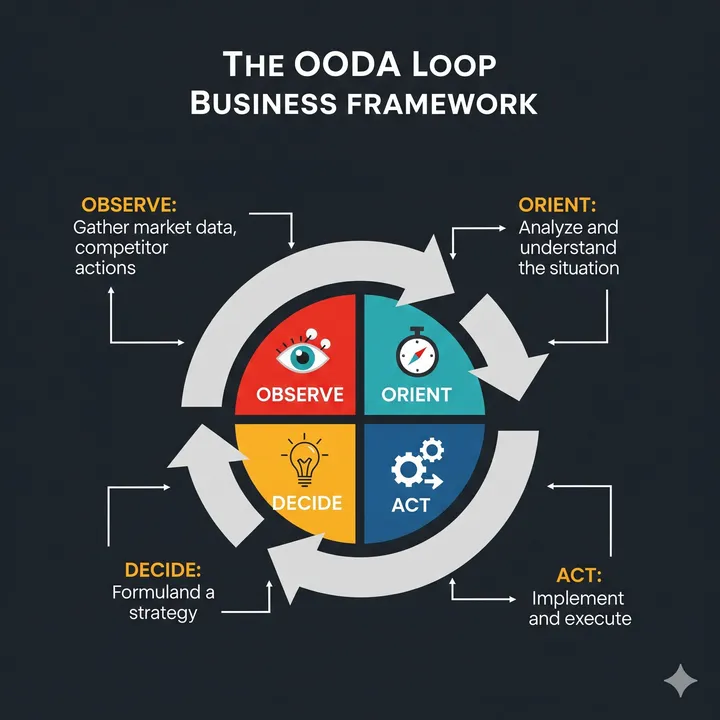
This was a case that demanded repeated decision-making under incomplete information with no time to spare. There was no luxury of perfecting a plan before moving. Observe, orient, decide, act—this cycle had to spin at high speed within a constrained timeframe.
Chapter 2: Four Rotations
"Within a ninety-day constraint, crafting a perfect plan is impossible. But moving without perfection is entirely possible."
Gemini drew four elements in a loop on the whiteboard. Observe, Orient, Decide, Act—the OODA Loop.
"The OODA Loop," I began, "is a decision-making model proposed by U.S. Air Force fighter pilot John Boyd. In a dogfight between fighter jets, the one who reads the situation and acts faster survives. Observe—watch. Orient—assess the situation. Decide—make a choice. Act—execute. Spin these four faster than your opponent. Boyd positioned this as a fundamentally different way of thinking from PDCA."
"How does it differ from PDCA?" the logistics director asked.
"PDCA," Claude answered, "starts with Plan—you plan before you move. It places high value on planning precision and assumes you'll take time to build an accurate plan. But in situations like this one—where time is short, information is incomplete, and uncertainty is high—the time spent planning becomes fatal. OODA rapidly cycles observation and judgment even with incomplete information, correcting course while moving forward."
[Loop One: The First Seven Days]
"Let's spin the first OODA Loop," I proposed. "Duration: seven days."
"Observe," Gemini began. "First, observe the site. Spend one full day at the headquarters factory gate watching trucks actually enter and exit. What to watch for: the physical structure of the gate, truck approach speed and angle, license plate position and dirt conditions, lighting conditions, and weather-related visibility changes."
"Orient," Claude continued. "Based on observations, assess the technical constraints of image recognition. The gate width determines camera placement. Truck speed determines shutter speed requirements. Nighttime lighting conditions determine whether infrared cameras are needed. You don't need to cover every requirement. The goal at this stage is identifying the most challenging recognition conditions—most likely nighttime, rain, and mud on plates."
"Decide," I added. "Based on observation and assessment, narrow the camera and software candidates to three. The goal isn't perfect selection—it's shortlisting."
"Act," Gemini concluded. "Contact the three candidates, and request site visits and demos. Reach this point within seven days."
[Loop Two: The Next Twenty-One Days]
"Loop two is three weeks," I continued.
"Observe—run demos from all three vendors on-site," Claude explained. "Test all three systems in parallel at the same gate, same time of day, same conditions. Limit evaluation criteria to three. First, recognition accuracy—the correct read rate for license plates. Second, recognition speed—seconds from a truck passing the gate to the result appearing. Third, error handling—the fallback mechanism when recognition fails."
"Orient—compare test results by the numbers," Gemini continued. "What matters here is not average accuracy but accuracy under worst-case conditions. A system that boasts 99% recognition in fair weather but drops to 80% in nighttime rain has a reliability of 80%."
"Decide—select one vendor and finalize the contract," I defined the decision point. "On a ninety-day schedule, there's no room to exhaustively compare three vendors for the perfect one. Choose the most stable performer under worst-case conditions, and plan to cover remaining risks operationally."
"Act—confirm the installation schedule with the selected vendor," Claude summarized.
[Loop Three: The Remaining Sixty Days]
"Loop three covers the sixty days through installation, testing, and go-live," I explained.
"However," Gemini emphasized, "don't plan sixty days as a single block. Divide sixty days into four small OODA Loops of two weeks each."
"Cycle one: camera installation and initial testing. Cycle two: data integration with the logistics management system. Cycle three: edge case identification and countermeasure implementation. Cycle four: production launch and verification of regulatory compliance report output," Claude organized.
"At the end of each cycle," I emphasized, "always return to Observe. After cameras are installed, unforeseen problems will inevitably surface. For instance, when a double-linked trailer enters the gate at an angle, the license plate might fall into a blind spot. Such problems can only be observed after installation. That's precisely why OODA doesn't end in one pass—it keeps spinning as a loop."
Chapter 3: The Courage to Accept Imperfection
The logistics director studied the three OODA Loops drawn on the whiteboard.
"Split ninety days into seven plus twenty-one plus sixty. Then split sixty into two-week increments. Decomposing large uncertainty into small verification cycles."
"The essence of OODA," I responded, "is not waiting for perfect information. PDCA prioritizes planning precision. OODA prioritizes speed of action. In a ninety-day situation, spending three months producing a flawless requirements document is pointless. Make judgments on incomplete information gathered in seven days of observation. Act. Observe the results of your actions. Correct course. This high-speed rotation is the only way to approach an optimal solution within limited time."
"However," Claude added an important caveat, "OODA's emphasis on speed doesn't mean sacrificing quality. Within each loop, Observe—observation—functions as a built-in quality check. You always observe the results of your actions, and if problems arise, you correct them in the next loop. The mechanism for balancing speed and quality is embedded in the loop structure itself."
"Start the pilot with the single main gate at headquarters," Gemini added. "Of the 120 daily trucks, about eighty enter through the main gate. Establish recognition accuracy and operational workflow there, then expand to the remaining two gates."
"And," I reminded, "keep records of each OODA Loop. What you observed, how you assessed it, what you decided, what you did. And what was corrected in the next loop. These records become a decision-making template the next time you face a different system implementation project."
The logistics director stood and bowed deeply. "Thank you. Tomorrow, I'll start with on-site observation of the gate. In seven days, I'll have three camera candidates selected."
Chapter 4: The Day the Gate Gains Memory
After he left, Claude said, "The OODA Loop is known as a military decision-making model, but it's highly effective for time-constrained project management too."
"Indeed," I answered. "OODA truly shines when uncertainty is high, time is limited, and information is incomplete. In business, there are countless moments—regulatory compliance deadlines, competitor moves, technology trend shifts—where waiting for perfect information means moving too late. OODA is the very attitude of accepting that imperfection, moving small and fast, observing results, and correcting. And if you keep records of the judgments in each loop, the next time you face a similar situation, you don't have to start from scratch. A record of decision-making under uncertainty—that's the most practical form of reproducibility."
Outside the window, trucks moved quietly along the factory's internal roads.
Three months later, a report arrived from TechnoVision.
In the first seven days, on-site gate observation was conducted. Insufficient nighttime lighting and blind spots when large vehicles entered at an angle were identified as the most challenging recognition conditions. Based on these observations, three vendors capable of infrared cameras combined with wide-angle lenses were shortlisted.
During loop two's three weeks, demos were run with all three vendors. Recognition accuracy under worst-case conditions—nighttime and rain—was 94% for Vendor A, 88% for Vendor B, and 91% for Vendor C. Recognition speed was fastest for Vendor A at an average of 3.2 seconds. Vendor A was selected and the contract signed.
Over loop three's sixty days, camera installation, system integration, edge case response, and production launch were executed in two-week cycles. In the second cycle, a drop in recognition rate was discovered for vehicles with mud-caked license plates. In the third cycle, a character-completion algorithm for partial obscuration was added, bringing overall recognition accuracy to 97.3%.
By the April 1st enforcement date, all gates had the system fully operational. Handwritten logs were completely abolished, and truck arrival and departure times were automatically recorded to the second.
But what the logistics director valued most wasn't the regulatory compliance itself. Analysis of the automatically recorded data revealed that truck waiting times were concentrated in specific time windows. After switching to a thirty-minute-slot reservation system for gate entry, average waiting time dropped from forty-seven minutes to eighteen. Driver satisfaction improved, and relationships with carrier companies strengthened.
At the end of the report, the logistics director wrote: "We've kept records of every OODA loop. What we observed in the first seven days, how we assessed it, what we chose. What problems emerged in each two-week cycle and how we corrected them. These records will be used directly as a decision-making template for the overseas factory system rollout starting next month. What we learned in ninety days will accelerate the next ninety. That's the power of OODA—I feel it firsthand."
Four seconds through the gate—in that time, the camera captures, the system records, and data accumulates. The memory once entrusted to a handwritten log now belongs to the gate itself.
"Time is short. Information is insufficient. Uncertainty is high. In such situations, waiting for a perfect plan is the greatest risk. What the OODA Loop provides is a decision-making pattern: move on incomplete information, observe the results, and course-correct at high speed. Observe, Orient, Decide, Act—keep spinning these four, small and fast. With each loop's completion, the next loop's precision improves. And by recording the judgments made in each loop, the next time a similar situation arises, you don't start from zero. Recording, accumulating, and reusing decision-making under uncertainty—that is the essence of reproducibility in the OODA Loop."
Related Files