ROI Case File No.440 'The Queue Born from Two Days of Silence'

The Queue Born from Two Days of Silence
Chapter 1: By the Time One Is Finished, the Next Has Arrived
"To manufacture a single product, we first have to create the documentation. And that documentation takes an average of two days."
The manufacturing director at TechNova placed three thick binders on the table. The first was a "Work Standard," the second a "Procedure Manual," and the third a "Quality Checklist." Each contained content unique to a specific product.
"We're a precision metal fabrication specialist. Annual revenue is approximately 3.2 billion yen. Our defining characteristic is high-mix, low-volume production—roughly 800 product types per year. Of those, only about 15% are manufactured consecutively more than once."
The manufacturing director opened one of the binders. A twelve-page work standard. Machining procedures, tools used, quality criteria, safety precautions—all documented in meticulous detail.
"Each of our 800 product types requires its own work standard and procedure manual. Page counts range from five to thirty depending on product complexity. New products are written from scratch; repeat products still require revisions to reflect changes since the last run."
"What's the annual documentation volume?" I asked.
"Approximately 320 new documents and 480 revisions. About 800 in total per year. Average creation time per document is roughly sixteen hours—two business days. That's approximately 12,800 hours annually, shared among seven staff in the manufacturing engineering department."
"That's about 1,830 hours per person per year," Claude calculated. "With annual working hours at roughly 2,000, that means 91% of their work time is consumed by documentation."
"Exactly. The manufacturing engineering department's real job should be optimizing machining conditions, improving processes, and planning quality initiatives. But in reality, they're buried in documentation with almost no time for improvement work."
"And," the manufacturing director's voice grew heavy, "when documentation can't be completed in time, the production line goes into standby. Without a work standard, operators can't begin machining. On average four times per month, the line sits idle for half a day waiting for documentation. Each stoppage costs approximately 1.2 million yen in lost opportunity. That's roughly 4.8 million yen per month, or about 58 million yen annually."
"And you're exploring generative AI to streamline documentation," Gemini confirmed.
"Yes. But the documentation for 800 product types varies in content. Even if we prepared templates, the sheer variety makes standardization seem impossible. What to input into the AI to get an accurate work standard as output—we can't see how to design that."
This was neither an AI problem nor a documentation problem. In a high-mix, low-volume environment, the challenge was discovering the "common structure" hidden across 800 product types and finding a foothold for standardization.
Chapter 2: Record, Check, Do
"Before designing what to input into the AI, let's dissect the current documentation process."
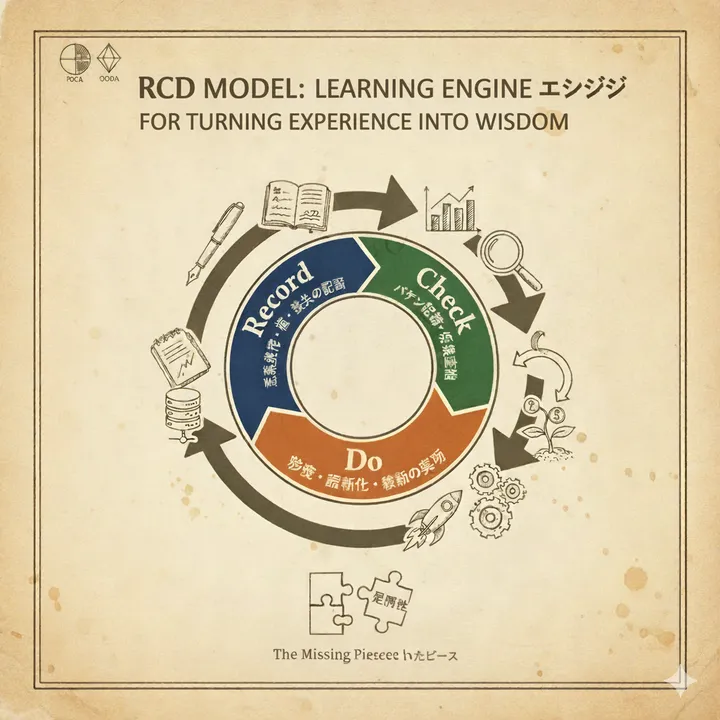
Gemini wrote three large letters on the whiteboard: R, C, D. Record, Check, Do—the RCD model.
"The RCD model," I began, "is a framework for driving process improvement in three stages. Record—thoroughly document the current state. Check—analyze the recorded data to identify issues and patterns. Do—execute concrete measures based on the analysis. It looks similar to PDCA, but RCD eliminates Plan. Instead of starting with a plan, you start with records. Record first, plan later. This is the cardinal rule for accurately grasping what's actually happening on the ground."
"Why start documentation improvement with recording?" the manufacturing director asked.
"Because," Claude answered, "the notion that documentation for 800 product types is 'each completely different' is a shop-floor intuition. But is it really 800 entirely distinct documents? If you record and analyze, you might discover common structures and patterns. Starting from data rather than intuition—that's the departure point for improvement."
[Record: Document the Current State]
"Stage one—Record. First, document the reality of the documentation process," I explained.
"What exactly should we record?" the manufacturing director asked.
"Collect three types of data over two weeks," Gemini proposed. "First, a breakdown of creation time. Of the sixteen hours, how many go to information gathering, how many to building the document skeleton, how many to detailed writing, how many to inserting drawings and photos, and how many to review and approval? Have staff keep time logs in thirty-minute increments."
"Second," Claude continued, "randomly sample fifty documents from the 800 created over the past year and compare their structures. Table of contents, chapter organization, listed items, page counts—examine how much these have in common within each product category."
"Third," I added, "a list of information sources that writers reference during creation. Previous documents for similar products, engineering drawings, machining condition databases, quality standards—what they look at, what they transcribe, and what they write fresh. Record this information flow."
"If we spend two weeks just recording, won't improvement stall?" the manufacturing director showed his impatience.
"Recording is the first improvement," I answered. "Many organizations leap to solutions without accurately understanding their current state. Even when AI tools are introduced, they don't know what to delegate to the AI, so results never materialize. Two weeks of recording will accelerate the months that follow."
[Check: Identify Patterns]
"Stage two—Check. Analyze the collected data to identify patterns," Claude explained.
"Start with the time log analysis," Gemini proceeded. "Once you know the sixteen-hour breakdown, you can pinpoint the highest-impact improvement target."
The manufacturing director shared rough estimates from a past informal measurement. "Ballpark figures: information gathering about four hours, skeleton creation about two hours, detailed writing about six hours, drawings and photos about two hours, review and approval about two hours."
"The six hours of detailed writing is the largest block," I pointed out. "We'll need to further decompose what's inside those six hours, but let's start with a hypothesis. High-mix or not, precision metal fabrication has common processes—cutting, grinding, drilling, surface treatment. The descriptions for each of these processes shouldn't change much from product to product."
The manufacturing director's eyes widened. "That's true—about 70% of the basic process descriptions are the same regardless of product. What changes are the parameters: dimensional tolerances, tool model numbers, feed rate settings."
"That's the discovery," Claude emphasized. "The documentation for 800 products isn't '800 completely different documents.' It's a common skeletal structure with product-specific parameters layered on top. Record and check, and this structure should be confirmed with hard numbers."
"The fifty-document structural comparison will likely confirm," Gemini predicted, "that approximately 60–70% of document components are shared within each product category. This shared portion becomes the skeleton of the AI template."
[Do: Execute Based on Records and Findings]
"Stage three—Do. Execute concrete measures based on analytical results," I explained.
"If the Check stage confirms that 70% of documentation shares a common structure," Claude began designing, "the AI application becomes clear. Train AI on the common-structure template for each product category. The writer inputs only the product-specific parameters—dimensions, tool model numbers, machining conditions. The AI embeds the parameters into the common structure and auto-generates a work standard draft."
"In terms of the sixteen-hour breakdown," Gemini calculated, "information gathering drops from four hours to two through automatic integration with the machining conditions database. Skeleton creation drops from two hours to half an hour via template auto-generation. Detailed writing drops from six hours to two through auto-generation of common sections plus parameter insertion. Total: sixteen hours down to roughly 6.5—an approximately 60% reduction."
"However," I cautioned, "this is a hypothesis. Verify it with data from the Record stage before proceeding to implementation. Execution without recording means falling back on intuition."
Chapter 3: When Records Become Blueprints
The manufacturing director studied the three RCD stages drawn on the whiteboard.
"I assumed all 800 product types were completely different. But if you record and check, common structures emerge. Those common structures become the AI templates—and this sequence is what matters."
"The essence of the RCD model," I responded, "is using recorded facts as the starting point. Many improvement projects begin with shop-floor intuition or management hypotheses and jump straight to Plan. But intuition is often biased. The intuition that '800 products are all different' may be overturned by records showing '70% share a common structure.' Conversely, the optimism that 'AI can easily automate this' may be overturned by records showing 'parameter exception patterns far exceed expectations.' In either case, records guide the right judgment."
"For implementation," Claude proposed, "start with two weeks of Record. Then one week of Check—data analysis and hypothesis validation. Based on the results, build an AI template prototype targeting the single highest-frequency product category. Test it on three documents, measuring both quality difference and time difference against the traditional manual approach."
"Once the three-document pilot confirms the effect," Gemini added, "expand to all products within that category and accumulate three months of performance data. Then use that data to design templates for the next category. The Record from one category accelerates the Check for the next—this chain reaction is the power of RCD."
"And," I emphasized, "always record which sections the writer modified and how when reviewing the AI-generated draft. These edit records are the best training data for improving AI template accuracy. Record in RCD doesn't end after the first two weeks. Embed a recording mechanism into the workflow and keep the improvement cycle spinning perpetually."
The manufacturing director stood and bowed deeply. "Thank you. Starting tomorrow, I'll have all seven team members begin keeping time logs."
Chapter 4: The Production Line Where the Queue Disappeared
After he left, Claude said, "The RCD model is essentially PDCA with Plan removed, but the significance of that is profound."
"Indeed," I answered. "Plan wasn't removed to diminish planning. It was removed to place recording before planning, thereby increasing planning precision. Many improvement projects fail because they plan solutions without accurately understanding the current state. A plan to 'introduce AI' without current-state records leaves you unable to determine where to apply it or what effect to expect. Record—recording is the starting point for everything, and it determines the quality of every improvement."
Gemini added, "And the three RCD stages don't end after one cycle. The results of Do become new Records, leading to new Checks and the next Do. This spiral structure transforms improvement from a one-time event into an embedded organizational habit. The act of continuous recording itself is the foundation of reproducibility."
Outside the window, forklifts were quietly lining up at the factory's loading dock.
Five months later, a report arrived from TechNova.
The two-week Record stage yielded remarkable data. A structural comparison of fifty documents revealed that within the same product category, the average commonality rate of documented items was 73%. The manufacturing director's intuition that "about 70% is the same" was confirmed by the numbers. Furthermore, time log analysis revealed that of the six hours spent on detailed writing, 4.1 hours were devoted to common-structure content—in other words, essentially rewriting the same material every time.
Based on these records, an AI template was built for the highest-frequency category, "precision-cut components." Inputting product-specific parameters—dimensions, material, machining conditions—automatically generated a work standard draft.
Results from the three-document pilot: average documentation time dropped from sixteen hours to 5.8 hours. Writer modifications amounted to only about 12% of the total, and quality met the same standards as before.
Over five months, rollout was completed to three product categories, covering approximately 45% of all 800 product types. Line stoppages due to documentation delays dropped from a monthly average of four to zero—not a single occurrence in five months.
The seven manufacturing engineering staff began redirecting their freed-up time to their original work—optimizing machining conditions and improving processes. One engineer tackled a surface treatment cycle time reduction he had wanted to address for years, achieving an 8% improvement in process time.
At the end of the report, the manufacturing director wrote: "The biggest change was embedding the 'R' of RCD into our workflow. We record every edit made to AI-generated drafts and Check them monthly. Last month's Check uncovered an improvement opportunity in the description pattern for a specific tool model number, and we updated the template. As long as this Record-Check-Do cycle keeps spinning, template accuracy keeps rising. All seven team members say the same thing: 'Once recording became a habit, we never ran out of things to improve.'"
The two days of silence—the production line's stillness while waiting for documentation—had vanished. In its place, the quiet habit of recording was generating an unending chain of improvements.
"The starting point for improvement is not planning—it's recording. What the RCD model shows is a fact-based improvement cycle: Record—first document the current state, Check—analyze records to find patterns, Do—execute based on those patterns. When intuition says 'everything is different,' records may reveal that '70% is shared.' That discovery can fundamentally redirect the course of improvement. And the true power of RCD emerges when you Record the results of Do. Record, check, execute, and record again. By continuously spinning this spiral, a one-time improvement becomes an organizational habit, and habit becomes reproducibility."
Related Files