
ROI Case File No.448 'The Lonely Islands of Six Accountants'

The Lonely Islands of Six Accountants
Chapter 1: The Invoice Mountain and Six Isolated Islands
"Who is doing what — honestly, I can't keep full track of it myself."
Atsuko Kimura, Head of Accounting at TechNova, said this with a tired smile. A six-person accounting department. Accounts receivable, accounts payable, payroll, expense reimbursement, monthly close, tax compliance — each assigned to specific individuals, operating without visibility into each other's work.
"I was approached by an executive who wants to use AI to improve accounting efficiency. I've looked at some examples from other companies and I can see the potential. But —" Kimura continued. "I don't know where to start. I'm worried the goal will become 'we implemented AI' rather than actually solving anything."
"You mentioned a lot of paper-based processing?" Gemini confirmed.
"Invoices. Vendor invoices arrive by fax and postal mail, and staff manually retype them into the accounting system. We get over a hundred in a busy month. Input error checking is also manual, so every month before close there's overtime."
"When you say 'work is fragmented,'" Claude asked, "what does that look like?"
"For example, there's no mechanism to confirm whether the amounts processed by the expense reimbursement person match the amounts the accounts payable person is handling. We operate on the assumption that each person is doing it correctly, and the only time the full picture gets reconciled is at monthly close. Sometimes discrepancies surface for the first time then."
"What takes the most time?" I asked.
"Invoice re-entry and investigating the cause when discrepancies appear. Investigations can take up to three days."
The full picture of the problem came into view. All six accountants were doing their jobs accurately. But there was no structure connecting those jobs. What needed to be solved with AI wasn't efficiency — it was fragmentation.
Chapter 2: Build Small, Learn What's Real
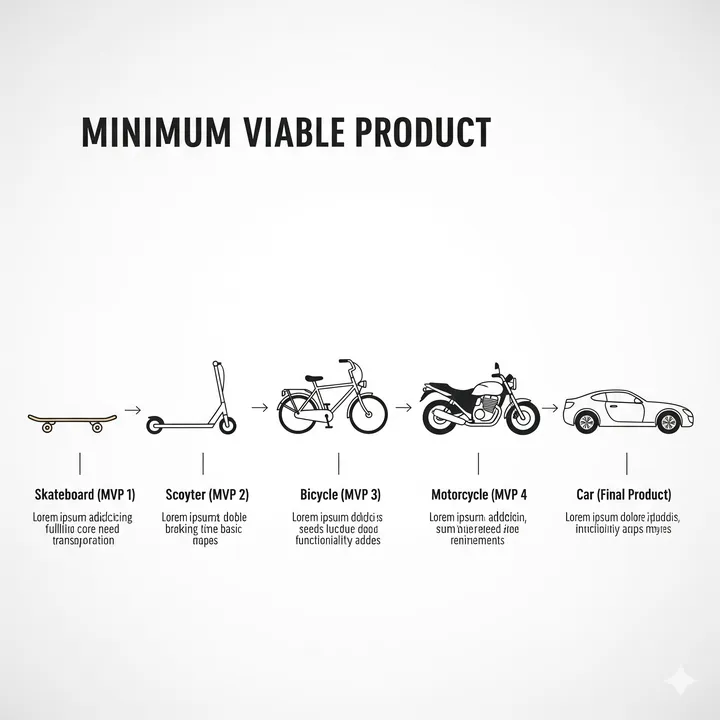
"This case calls for the MVP approach."
Claude drew a long arrow on the whiteboard — minimum viable prototype → test → learn → improve — repeating.
"MVP, Minimum Viable Product," I began explaining, "is a methodology in which rather than trying to build a perfect system all at once, you build something that works with the minimum necessary features, use it, and discover the real problems through actual use. It's especially important for AI tool adoption. Because the workflow you design on paper and the workflow that emerges after people actually start using it are always different."
"When you try to automate all business functions at once," Gemini added, "what gets built six months later is often misaligned with what was actually needed. MVP is a design philosophy for discovering that misalignment small and early."
"So where do we start?" Kimura asked.
[MVP Round 1: Single-function invoice AI reader prototype]
"The first MVP covers only invoice auto-reading," Claude proposed. "Faxed and mailed invoices are scanned, AI-OCR reads the amount, date, and vendor name, and automatically generates a candidate entry for the accounting system. The operator just confirms the generated candidate and presses a button."
"How long would it take to build?" Kimura asked.
"Two weeks for the initial prototype," Gemini answered. "Using the invoice processing AI tools available on 321 Platform, the core functionality can be up and running immediately, with minimal upfront cost — the focus is on getting something moving first."
"Round 1 measures three things only," I continued. "Change in time spent on invoice re-entry. OCR accuracy rate — the percentage of documents read correctly. And the number of manual corrections staff need to make. Those three numbers determine the direction of the next improvement."
[MVP Round 2: Automated reconciliation]
"Once Round 1 invoice processing is stable, we move to Round 2," Gemini explained. "Automatically cross-reference expense reimbursement data against accounts payable data, and trigger an alert when discrepancies appear. This enables detection of month-end discrepancies by the following day."
"The three-day root cause investigations Kimura-san mentioned," Claude continued, "would be able to start the day after the discrepancy occurs. Catching problems while they're small — that's the essential design for solving fragmentation."
[MVP Round 3: Full department dashboard]
"Round 3 is a dashboard where the work status of all six members is visible on one screen," I proposed. "Who is processing what and where things are stuck becomes visible at a glance. Kimura-san's 'I can't keep track of who is doing what' problem gets resolved."
"Drawing on the data visualization logic from GA4 Quick," Gemini added, "you can design a real-time progress monitoring setup for accounting workflow — essentially an analytics dashboard for the accounting department."
Chapter 3: What to Sort Out Before You Ask AI
Kimura took notes and said quietly:
"I'd braced myself when I heard 'AI implementation.' But today's conversation was really about starting small and verifying as you go."
"The MVP philosophy," I replied, "is the opposite of perfectionism. The biggest reason accounting AI implementations fail is trying to change everything at once. An AI tool that floor staff won't use generates no efficiency. Placing what you can only learn from trying at the center of the design — that's the methodology."
"There's one more important point," Claude continued. "Being explicit about what AI is good at and what humans are good at. Invoice reading and re-entry: AI. Verifying the format of a first invoice from a new vendor, or judging an exceptional payment condition: humans. If this division of labor isn't built into the design, instead of AI taking human jobs, humans end up being run ragged by AI."
Kimura nodded. "I'll start with Round 1. In two weeks, I'll sit down with the staff and we'll start using it — and we'll see what actually happens."
Chapter 4: The Day Six Islands Connect
After she left, Gemini murmured: "When you say 'AI for accounting,' you picture a large-scale system overhaul, but in reality it's the accumulation of six people's daily work."
"That's right," I answered. "What MVP teaches is that even big problems can start with a small first step. Begin with the single point of invoice re-entry, then connect to reconciliation and the dashboard. Through that iteration, six lonely islands gradually become linked."
Outside, the city lights were scattered across the night sky.
Five months later, a report arrived from Kimura.
Three weeks after Round 1 launched, OCR accuracy reached ninety-four percent. Average monthly invoice re-entry time per person dropped from three hours to forty minutes. Monthly overtime fell from a thirty-two-hour average to seven hours.
Round 2's automated reconciliation moved discrepancy detection from monthly close to the following day. Root cause investigations that previously took up to three days were now completed in three hours at most.
Kimura's report read: "Staff were on guard from the start when they heard 'AI.' But after the two-week Round 1 trial — where they experienced confirming and pressing OK themselves — their attitude changed. AI doesn't decide; we confirm. That design was what mattered."
Bridges were slowly being built between the six lonely islands.
"When trying to change accounting with AI, the greatest barrier is not technology — it's the anxiety of the people on the floor. What MVP provides is the methodology for dissolving that anxiety. Build small, use it, learn, improve. Within this cycle, the floor shifts from 'AI is taking over' to 'we are using AI.' The time lost waiting for a perfect system is always the greatest cost. The smaller the first step, the faster it can be taken."
Related Files
Tools Used
- 321 Platform — Initial prototype build for invoice processing AI
- GA4 Quick — Visualization design for accounting workflow progress dashboard


