
ROI Case File No.449 'The Figure That Begins to Speak in July'

The Figure That Begins to Speak in July
Chapter 1: Why the Figure Is Silent
"Every time we meet with the development company, the list of reasons it can't be done gets longer."
Naoki Endo, Product Director at TechnoFig, said this while sharing his project management screen. Most of the tickets were stuck on "hold" or "pending review." Some hadn't moved in six months.
"Our company is a figure brand operating domestically and internationally. For this project, we planned a service where customers can have AI chat conversations with the characters on the figures they purchase. You hold up your smartphone, and the figure's character speaks in that character's own voice and style. We planned a July launch — but —"
Endo scrolled the screen. "We terminated our first development firm after three months. Communication never worked. We'd send a spec document and get no reply, or a reply that didn't connect to what we'd said. This service requires understanding the character universe as a premise, but they could only talk about technical specifications."
"Four months until July," I confirmed.
"Yes. We need to find a new development partner urgently. But after the first failure, I'm not even sure how to select one. It's less about wanting selection criteria — first I want to understand why the first company didn't work."
That single sentence pointed straight to the heart of this case.
Chapter 2: Put Realization First
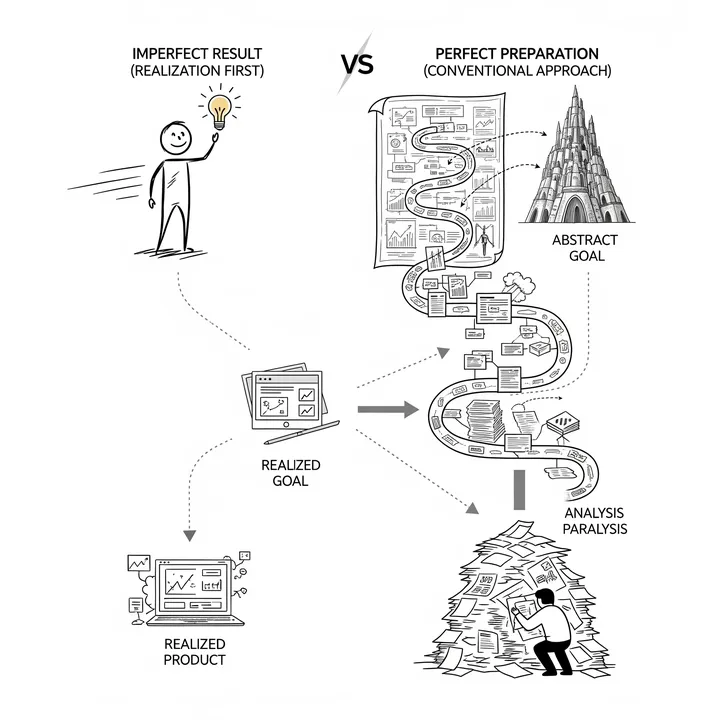
"This case calls for the Realization-First Principle."
Claude wrote a single question on the whiteboard: "Can you show us something that works today?"
"The Realization-First Principle," I began, "is a way of thinking that puts realization before planning. The greatest cause of project stagnation is waiting for perfect design. Meetings stack up, specs get refined, consensus gets built — and through that process, the project loses energy, and eventually a pile of holds is all that's left with no one taking responsibility."
"The reason the first development firm didn't function," Gemini continued, "was likely not a technical capability problem. The essence of Endo-san's words — 'communication never connected' — is that a cycle of showing working things never existed in the conversation."
"What do you mean?" Endo leaned forward.
"A service where a figure's character speaks with AI is hard to convey through writing," Claude explained. "The tone of voice, the pacing of conversation, the fine calibration of what counts as 'in character' — these can only generate 'that's not quite right' when you see them working. Specification documents can't produce that 'not quite right.' That's why three months passed with nothing connecting."
"Going Realization-First," Gemini made it concrete, "the first request to a new development partner is not creating a spec document. It's building a working demo — one character, one conversation scenario — in two weeks."
[Three tests for partner selection]
"For selecting the development partner," I continued, "set three tests."
"Test one: understanding of the characters," Claude explained. "Give candidates TechnoFig's figure catalogue and ask them, one week later, to write down: 'If this character were to speak, what would their voice and manner be like?' This measures their capacity to empathize with the universe, not their technical specs."
"Test two: the two-week demo," Gemini continued. "Companies that pass test one are asked to show a working version of the simplest possible scenario — a single exchange where a character responds to 'hello.' Technical polish doesn't matter. We're looking at their orientation toward realization."
"Test three: revision speed," I added. "After seeing the demo, give one modification instruction. For example: 'Make the speech a bit more childlike.' Whether that revision is reflected the next day — that is the most honest indicator of whether a company can run alongside you through the four months to July."
Endo took notes with a serious expression. "I understand why three months passed without anything moving. We were also spending too much time writing spec documents."
[Reverse-engineering July]
"Let's plan the four remaining months," Gemini proposed. "Two weeks for partner selection, three weeks for the initial demo sprint after selection, six weeks for expanding to all character types, three weeks for test-user trial launch, two weeks for final adjustments and launch preparation. It's tight, but running a weekly demo cycle under Realization-First principles makes July reachable."
"Let's use ROI Proposal Generator to organize the schedule and investment plan," I suggested. "Presenting a document to partner candidates that clearly states milestones and cost ceilings per development phase prevents scope creep."
Chapter 3: What a Working Thing Says Beyond Words
Endo closed his notebook and said quietly:
"I spent three months trying to understand why things weren't moving forward. Today, for the first time, I feel like I can see the answer: it was because there was nothing working to look at."
"The essence of the Realization-First Principle," I replied, "is not waiting for completion. When building a service with no precedent — figures speaking with AI — the right answer doesn't exist from the start. Work it, look at it, revise it, work it again — the right answer can only emerge from that repetition."
"The criteria for selecting a development partner," Claude added, "are not track record or spec document completeness. It's whether you can keep working together — understanding the universe, responding quickly to revisions, and always showing you something new a week later. The company with that orientation is the one closest to July."
Endo stood up. "This week I'll contact three companies and send them test one."
Chapter 4: The Day It Has a Voice
After he left, Gemini murmured: "A figure speaking — it's not technology, is it. It's an experience. That's why spec documents couldn't convey it."
"That's right," I answered. "An experience can't be understood until you've experienced it. What Realization-First asks is how quickly can you create an experience — not a perfect one, but an imperfect one that works. That single step moves every conversation forward."
Outside, white clouds moved through the spring sky. July was nearly here.
Four months later, a short message arrived from Endo.
Attached was a video file. When a smartphone camera is pointed at a figure, the character starts speaking — in that character's own manner. The tone of voice, the pauses, the quirks at the end of sentences — none of these had been written into the spec document three months ago, and yet there they were.
"July 3, launched" — a single short line.
"The development partner I chose was the company with the deepest character understanding in test one. When I saw the test two demo, what came out exceeded what I had imagined. In the moment I saw something working, I finally felt like I understood what we were building."
In July, the figure found its voice.
"When building a new service, the spec document is never finished first. Because the right answer doesn't exist until you've built it. What the Realization-First Principle asks is: can you show us something that works today? A partner who keeps answering that question is the partner who can turn four months into July. Time spent waiting for completion should always be pushed as close to zero as possible."
Related Files
Tools Used
- ROI Proposal Generator — Organizes development phase milestones and investment plans


